Leasehold
Jul 16, 2026
How to Prepare Your Home for a Property Survey
Clear access, organised documents and minor repairs to speed a property survey, avoid delays and ensure an accurate inspecti

Preparing for a property survey is straightforward but requires some planning. A surveyor needs clear access to all areas of your home, both inside and out, to inspect its condition thoroughly. This includes the loft, boiler, fuse box, and exterior walls. You’ll also need to gather key documents like planning permissions, safety certificates, and maintenance records. Fixing small issues, such as leaks or blocked gutters, can leave a positive impression and avoid delays. By decluttering and addressing minor repairs, you help ensure the survey runs smoothly and accurately reflects your property’s condition.
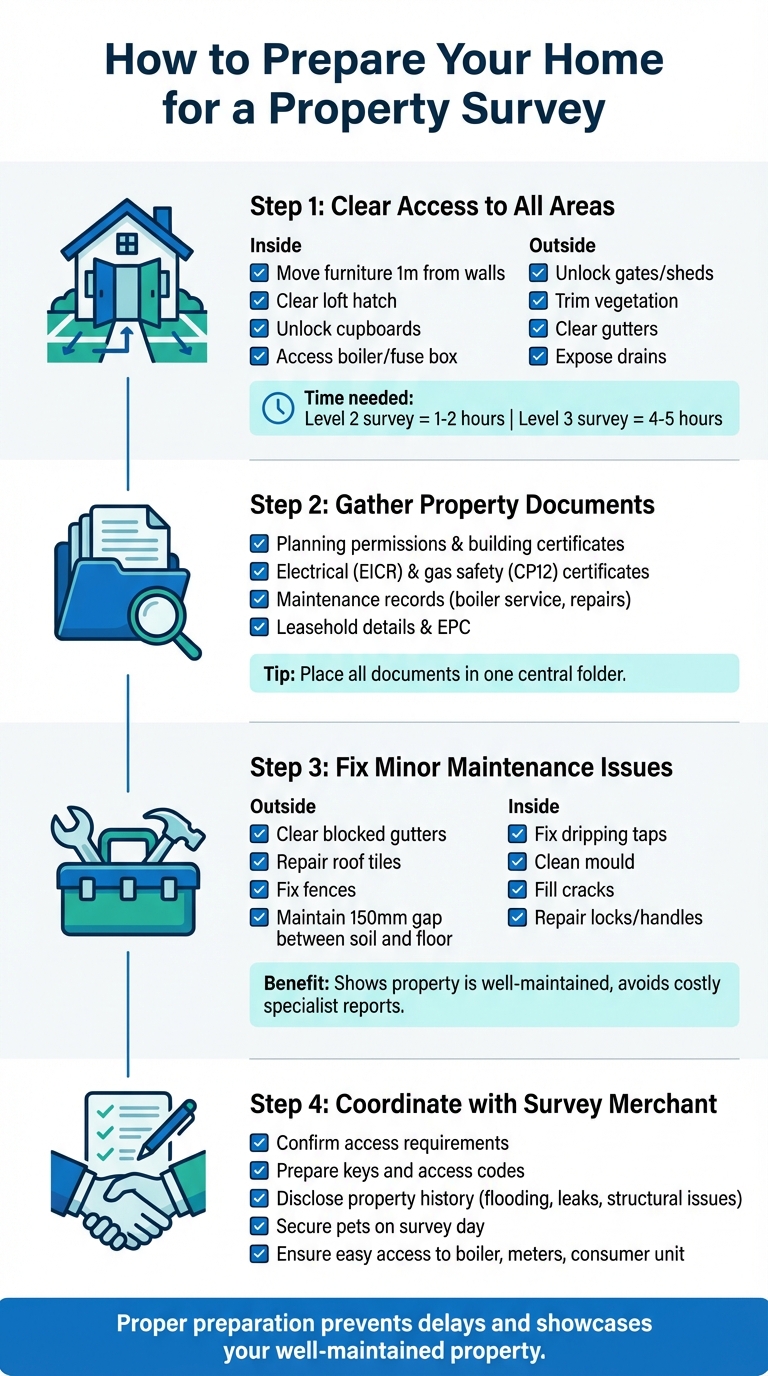
4-Step Property Survey Preparation Checklist
Surveyors need unrestricted access to every part of your property to deliver a thorough and accurate report. When key areas are blocked - by heavy furniture, storage boxes, or other obstructions - it can result in incomplete findings or even a cancelled inspection. For example, a cluttered loft or furniture covering exterior walls can prevent surveyors from completing their work.
A standard HomeLevel Report (Level 2) usually takes about one to two hours, while a more detailed Building Survey (Level 3) can take four to five hours [1]. By ensuring clear pathways and accessible spaces, you not only help surveyors work more efficiently but also speed up the process, ensuring you receive your report without unnecessary delays. Jason Weale, Head of Customer Relations at Find My Surveyor, puts it this way:
"A professional RICS surveyor is like a medical doctor for your property. They need: Unrestricted access, clear views of structural elements, honest information about the property's history, [and the] ability to conduct a comprehensive examination" [5].
Making sure both indoor and outdoor areas are accessible is essential for an effective survey.
Start by moving furniture away from exterior walls, leaving at least a metre of space, and clearing windowsills for easy access. Surveyors often use damp metres to check for moisture, so they need direct contact with walls and windows. Also, make sure any keys for locked windows are readily available.
For harder-to-reach areas, preparation is key. Ensure your loft hatch opens easily and provide a ladder if necessary. Clear out under-sink cupboards, built-in wardrobes, and under-stairs storage to allow inspection of pipework and internal structures. Additionally, ensure surveyors can easily access your boiler, heating systems, radiators, electrical consumer units (fuse boxes), and metres. If you have a basement or cellar, remove any items blocking the entrance.
Outdoor preparation is just as important. Unlock all garden gates, garages, sheds, and outbuildings before the surveyor arrives, and leave labelled keys in an accessible spot. Surveyors will need to inspect boundaries and check for issues like invasive plants, such as Japanese knotweed.
Trim back any overgrown vegetation that might block views of exterior walls or drainage points. Move garden furniture, firewood, or other equipment away from the house, and ensure external drains and manhole covers are not hidden under pots or garden debris. Clear pathways around the entire perimeter of your property so the surveyor can easily move around. Lastly, remove leaves and debris from gutters to allow for a proper inspection of potential leaks or blockages.
Getting all your paperwork in order before the survey can save time and ensure the inspection goes smoothly. Missing documents might lead to additional checks or even a second visit, which can be avoided with proper preparation [4]. Having everything ready also helps provide the surveyor with a clear understanding of your property's history and upkeep. Here's what you'll need to have on hand.
Start by gathering planning permission notices and building regulation completion certificates for any extensions, renovations, or outbuildings [5]. These documents confirm that any major work complies with legal standards. Make sure you also have electrical safety certificates (EICR) and gas safety certificates (CP12), as these demonstrate that your property meets current safety regulations [5].
Next, compile maintenance records - this includes the boiler service history, receipts for roof repairs, and any guarantees for specialised work like damp-proofing, timber treatment, or double-glazing [5]. If you’ve had surveys done in the past, these can provide valuable insights into the property's condition and how it has changed over time [5]. For leasehold properties, ensure you have leasehold details, along with title deeds or boundary maps, if applicable [4].
To make things easier for the surveyor, place all the documents in a single folder and leave it in a central, easily accessible location [9]. If you can’t be there during the inspection, leave a note indicating where the folder is kept. Lastly, check your Energy Performance Certificate (EPC) in advance. Surveyors often find discrepancies in these reports, and they’ll likely compare it with their findings during the visit [8].
Taking care of small maintenance issues before a survey can make a big difference in how your property is perceived. It’s not just about fixing things - it’s about showing that the property has been looked after. As Allcott Associates highlights:
"Repair minor defects that you are aware of to show that your property is well maintained and limit the number of defects your survey uncovers" [3].
Addressing these issues early can also save you from costly delays. Small problems left unattended might lead to recommendations for expensive specialist reports, which could hold up the sale or impact the valuation [7][4]. Building Surveyors Ltd adds:
"The surveyor will be looking for evidence of steady ongoing maintenance and upkeep. A tidy, well presented home is likely to be valued higher than a cluttered, messy home even if they have the same features" [2].
Start with the exterior - surveyors often notice issues outside before stepping indoors. Clear out blocked gutters and downpipes, as debris like leaves and weeds can lead to water damage. From ground level, inspect the roof for cracked, slipped, or missing tiles, and arrange repairs if necessary. Trim back overgrown plants near exterior walls to prevent blocked gutters or damp problems. Make sure external paths and soil are at least 150 mm below internal floor levels to avoid penetrating dampness [10].
Don’t forget fences, gates, and boundary walls - repair any loose sections or broken mortar joints. Check for timber rot in window and door frames, and ensure air bricks and gulleys are clear to maintain proper ventilation [10].
Once the outside is sorted, it’s time to turn your attention indoors.
Inside the home, focus on fixing those small but noticeable issues. Repair dripping taps, leaking toilets, and faulty seals around baths and showers. If you spot mould on bathroom tiles or walls, clean it thoroughly - surveyors often flag visible mould as a potential damp concern. Fill any hairline cracks in walls or ceilings and touch up scuffed or peeling paintwork.
Make sure all doors and windows open and close smoothly, and repair any broken locks or handles. Leave keys in an accessible place for the surveyor to test them. As Novello Surveyors explains:
"The surveyor will look for signs that the house has been well maintained and general upkeep has been carried out as you've lived there; such small jobs like this can make a big difference" [1].

Once you've taken the initial steps to prepare, the next stage is to collaborate with Survey Merchant to customise the survey to suit your property's specific needs. Survey Merchant provides access to a nationwide network of qualified RICS surveyors who can carry out Level 2 HomeBuyer Reports, Level 3 Building Surveys, and Red Book valuations - each designed for different property types and conditions [1][5]. Choosing the right survey type is crucial to ensure everything goes smoothly on the day of the inspection.
Preparation is essential, but final coordination with Survey Merchant is just as important. Confirm exactly what the surveyor will need in terms of access and documentation. This step builds on the earlier tasks of clearing access points and organising relevant paperwork.
Surveyors will inspect all visible and accessible features, including roofs, walls, floors, windows, and permanent outbuildings, while also performing basic visual checks on systems like gas, electrical, and drainage. Make sure all required documents are ready and that access to key areas has been arranged. Don’t forget to prepare keys and any access codes they might need.
If your property has a history of issues such as flooding, structural movement, or leaks, be upfront about these details. This information helps the surveyor provide a more accurate assessment. On the day of the survey, secure any pets and limit the number of people at home to avoid disruptions. Also, ensure the boiler, hot water system, electrical consumer unit, and metres are easily accessible. These small but important steps will help Survey Merchant's surveyors deliver a detailed and timely report without unnecessary delays.
Getting your home ready for a property survey doesn’t have to be overwhelming. With a bit of planning and attention, you can ensure everything runs smoothly. Start by clearing access to all areas, fixing minor maintenance issues, and organising relevant documents. These simple steps allow the surveyor to carry out their inspection without unnecessary delays. As WR Surveying explains:
"A well-prepared home not only saves time for the surveyor but also ensures that any potential issues are highlighted and can be addressed in advance" [7].
Beyond making the process more efficient, a tidy and well-maintained home reflects positively on its care. It can leave a strong impression on the surveyor, showcasing a property that has been consistently looked after [1].
Preparing thoroughly also protects your investment. If surveyors can’t access critical areas, they might halt the inspection, leading to wasted time and extra costs [6][3]. By ensuring your home is ready, you reduce the risk of delays and demonstrate the property’s upkeep.
Survey Merchant connects you with RICS-accredited surveyors who provide detailed and impartial evaluations. Take these preparation steps now to ensure your survey is efficient and accurate. Reach out to Survey Merchant today to arrange your property survey and move forward with peace of mind.
To make your property survey run smoothly, it’s a good idea to organise all the necessary documents ahead of time. These might include past survey reports, building or renovation plans, warranties or guarantees, planning permission and building regulation approvals, the Energy Performance Certificate (EPC), and any insurance or maintenance records. Having these on hand allows the surveyor to evaluate your property more efficiently and with greater accuracy.
To help the surveyor complete their inspection smoothly and thoroughly, it's important to make your property easily accessible. Begin by clearing pathways to essential areas such as the loft, basement, boiler, fuse board, and radiators. Move furniture away from external walls and windowsills to allow checks for damp, cracks, or other potential issues.
If you have outbuildings, garages, or garden sheds, ensure they are organised and easy to access, leaving any necessary keys or codes in a convenient spot. Remove tripping hazards, secure loose rugs, and check that ladders or steps are stable if they might be needed. Taking a few minutes to walk through your home in advance can help you identify and address any obstacles, saving time and ensuring the inspection stays on track.
Taking care of small issues before a property survey can make the whole process smoother and minimise potential delays. It ensures your home is presented in its best light, which may result in a more accurate and positive evaluation.
Quick fixes like repairing a dripping tap, replacing cracked tiles, or decluttering messy spaces can have a noticeable impact. A tidy, well-maintained property leaves a good impression and lets the surveyor concentrate on the important parts of the inspection without unnecessary distractions.
Survey Merchant provides vetted RICS surveyors across 100+ UK locations at fixed fees:
→ Level 2 Home Survey (HomeBuyer Report)
→ Level 3 Building Survey (full structural survey)
→ RICS Red Book property valuations
→ Party wall surveyors — notices, awards & schedules of condition
→ Expert witness surveyors — CPR Part 35 reports for property disputes