Leasehold
Jul 16, 2026
Top Surveyor Tips for Damp Cost Estimates
Correct damp diagnosis saves thousands—RICS surveyors, moisture testing and itemised quotes stop unnecessary repairs and pro

Damp can reduce property value by over 10%, and repair costs vary widely. Here's what you need to know to budget effectively:
Accurate diagnosis by qualified surveyors ensures cost-effective solutions, prevents unnecessary expenses, and protects property value.
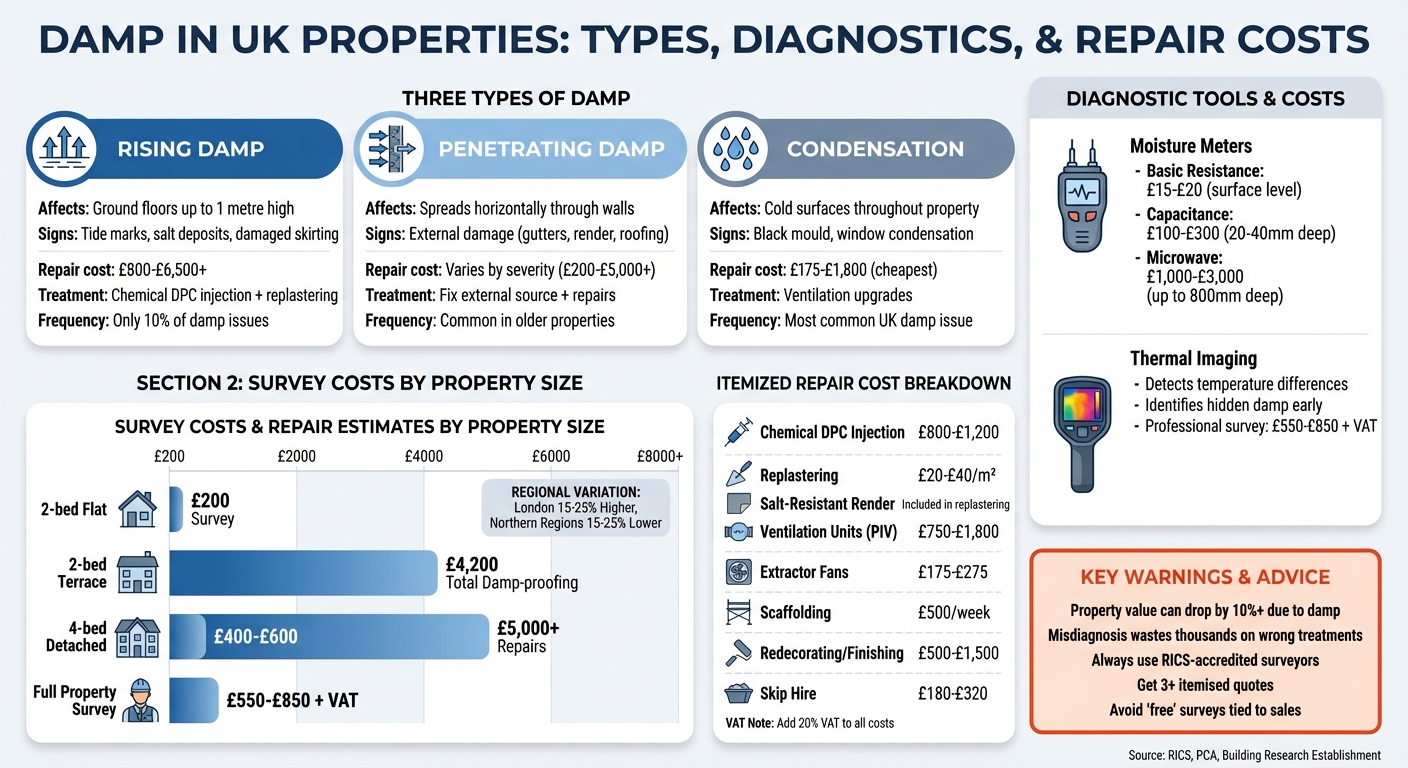
Damp Types, Costs and Repair Methods Comparison Guide
Pinpointing the type of damp is crucial for estimating costs accurately. Rising damp, penetrating damp, and condensation each require different treatments, and misdiagnosing the issue can lead to wasted money on the wrong solutions.
Rising damp happens when groundwater travels up through walls via capillary action. It typically affects ground floors up to about 1 metre high and can be recognised by tide marks, salt deposits, or damage to skirting boards [7] [10]. Fixing rising damp is often the most expensive, as it involves installing a new damp-proof course (DPC) and carrying out specialist replastering [7] [11].
Penetrating damp spreads horizontally through walls and is usually caused by external problems like leaking gutters, cracked render, or damaged roofing [5] [10]. The cost of repairs varies significantly, depending on the severity - clearing a gutter, for instance, is far cheaper than fixing a damaged roof.
Condensation is the most common damp issue in UK homes. It occurs when warm, moist air meets cold surfaces, leading to black mould and condensation on windows [7] [10]. This is generally the least expensive to address, often requiring better ventilation or small lifestyle changes [5]. Correctly identifying the type of damp is key to managing costs effectively.
"Rising damp is not a conclusion, as it does not identify the source of the excess moisture. Failure of an original damp-proof course is extremely rare."
– Professor Michael Parrett FRICS, Consultant Building Pathologist [5]
Getting the diagnosis right avoids unnecessary expenses. Check external factors like gutters, downpipes, and ground levels to pinpoint the real cause of dampness [8]. Independent surveyors who are RICS-qualified specialise in identifying the root cause rather than pushing unnecessary treatments [7] [8].
Modern technology has transformed how damp is detected and assessed for repairs. Thermal imaging cameras help identify temperature differences on surfaces like walls, floors, and ceilings. Since water retains heat longer and can cause evaporative cooling, damp areas often appear cooler in these images [13]. To confirm the presence and level of moisture, moisture meters are used, providing a detailed picture of the affected areas [14]. Together, these tools create a comprehensive moisture profile.
Thermal imaging is especially useful for spotting hidden damp without the need for invasive methods [13][14]. It can detect moisture issues early - long before visible signs like tide marks or mould appear. This early detection allows for smaller, less costly repairs that can prevent major structural damage [13]. Additionally, the precision of these tools reduces the risk of misdiagnosis and helps refine repair cost estimates. For a full property survey using both technologies, expect to pay between £550 and £850 + VAT [8].
"Thermal imaging technology detects dampness by revealing temperature differences. Areas with moisture appear cooler on a thermal image."
– Damp2Dry Solutions [13]
Moisture meters come in various types, each with different capabilities. Basic resistance meters, costing around £15–£20, provide surface-level readings. Capacitance meters, priced between £100 and £300, can measure moisture up to 20–40 mm deep. For deeper readings - up to 800 mm - microwave meters are used, though these are more expensive, ranging from £1,000 to £3,000 [15]. Professional surveyors often use a combination of these tools to distinguish between issues like rising damp, penetrating damp, and condensation [8].
It’s important to note that thermal imaging identifies temperature anomalies, not moisture itself. A cold spot might indicate something like cold bridging, rather than dampness. That’s why surveyors must confirm findings with moisture meters. To ensure an accurate diagnosis and cost-effective solutions, make sure your surveyor is RICS-qualified and uses both tools [8][16].
When it comes to damp-proofing, the size and type of a property significantly influence repair costs. Larger properties naturally require more labour, which makes up over 95% of the total expense. The complexity of a property’s layout can also drive costs up. For instance, a damp survey for a 2-bed flat might cost around £200, while a 4-bed detached house could range between £400 and £600 [9][17].
Construction methods play a key role too. Older properties, particularly those built before 1875 without a damp-proof course, are more susceptible to rising damp. These homes often need retrofitting solutions like chemical damp-proof course (DPC) injections, which typically cost between £800 and £2,500 [2][7][18][19]. However, not all experts agree on the necessity of such treatments for older buildings. Allan Williams-Jones, RICS Chartered Surveyor at HFWJ Surveyors, cautions:
"Chemical DPC injection is often unnecessary and is rarely appropriate for older, breathable, solid-walled buildings." [8]
Accessibility is another factor that can add to the cost. Features like cellars, attics, or fitted kitchens can obstruct access to affected walls, requiring additional labour for a thorough inspection [19]. For properties with extensive damp issues, a whole-property survey priced at £850 plus VAT may be more economical [8]. Before committing to internal treatments, it’s also essential to inspect external factors. For example, soil or paving within 15cm of the damp-proof course can bridge it, leading to damp problems. In such cases, excavation work might be required [20].
The cost of damp-proofing varies widely depending on the property. For a standard 2-bed terraced home, comprehensive damp-proofing typically costs around £4,200 [17]. Larger detached houses with significant damp issues can easily surpass £5,000 [19]. Regional differences also play a role; surveys in London and the South East tend to be 15%–25% higher than the UK average, while those in Northern regions are often 15%–25% lower [17].
When it comes to damp issues, expertise plays a critical role in connecting technical findings with practical, cost-conscious solutions. A skilled surveyor ensures damp cost estimates are accurate and prevents costly misdiagnoses by correctly identifying the type of damp - whether it's rising, penetrating, or condensation. As Michael Parrett, FRICS and Building Pathologist, cautions:
"Getting this wrong could mean that unnecessary and expensive remedial actions are taken." [4]
This level of expertise is essential for choosing effective and economical solutions.
In addition to technical know-how, a surveyor’s accreditation sharpens their ability to diagnose problems. Look for professionals with PCA qualifications. For instance, the Certified Surveyor in Remedial Treatments (CSRT) certification guarantees a precise diagnosis and proportionate solutions [21]. If your property has a basement or faces below-ground moisture issues, the Certified Surveyor in Structural Waterproofing (CSSW) qualification is particularly relevant [21].
RICS membership - whether MRICS, AssocRICS, or FRICS - offers an extra layer of reliability. RICS-accredited surveyors provide independent assessments backed by insurance, ensuring unbiased advice. Be wary of "free" surveys offered by treatment contractors, as these are often driven by sales agendas. RICS surveyors, on the other hand, can identify straightforward fixes, like clearing blocked gutters, rather than pushing unnecessary, expensive treatments [8].
For added assurance, verify that your surveyor is a PCA member. This ensures adherence to industry standards and the ability to provide insurance-backed guarantees for any recommended work [21]. Platforms like Survey Merchant can help you find accredited professionals who are indispensable for accurate damp assessments.
Providing a clear cost breakdown can turn a potentially confusing estimate into a practical tool for decision-making. When surveyors detail treatment options - such as chemical DPC injections, replastering, timber treatment, or ventilation upgrades - clients can better understand where their money is going and why some methods come with higher price tags.
The core treatment is just one part of the overall expense. For example, chemical DPC injections for a terraced house generally cost between £800 and £1,200[19]. However, quotes should also cover follow-up work like removing salt-contaminated plaster, which typically costs around £20–£40 per m²[23], and applying a salt-retardant render. As Hallmoore Developments explains:
"The initial treatment is only part of the story. Hacking off old, salt-contaminated plaster and applying a specialised salt-retardant render is a vital part of a professional job." [19]
Skipping these steps can lead to recurring damp problems and higher costs down the line.
Different repair methods also come with their own price ranges. Chemical injections are often the most budget-friendly approach for rising damp, costing anywhere from £500 to £5,000[19]. On the other hand, physical membranes, often used in basements, are more durable but require more labour, with costs ranging from £2,000 to over £5,000[19]. For condensation problems, solutions like Positive Input Ventilation units (priced around £750–£1,800) or extractor fans (£175–£275) are usually sufficient[19]. Separating "moisture source repairs" - such as fixing gutters or repointing brickwork - from internal treatments can help clients focus their budget on preventing damp from returning.
A thorough quote should also account for "making good" tasks, such as redecorating, replacing skirting boards, and waste disposal. These finishing touches can add an extra £500 to £1,500 to the cost of a mid-sized room project, but they are often left out of initial estimates[24]. As Property Workshop recommends:
"Ask for a breakdown of the costs involved, especially for any additional/remedial work such as re-plastering or paving." [22]
Testing for salt contamination can mean the difference between a £2,000 repair and a £15,000 strip-and-rebuild project [26]. Hygroscopic salts like nitrates and chlorides absorb moisture from the air, making walls seem damp even after the original water source has been resolved [26]. This can lead to moisture meters giving inflated readings, resulting in unnecessary chemical treatments.
Laboratory salt analysis goes beyond what moisture meters can detect, offering a clearer picture of the damp issue. According to the Building Research Establishment, only 10% of dampness problems are truly caused by rising damp [25]. Gravimetric testing, done to BRE Digest 245 standards, distinguishes "free" capillary water from hygroscopic moisture. This method identifies whether the issue is active dampness or historic salt contamination in the plaster [27]. As Complete Preservation notes:
"The only way to carry out a quantitative test is to take samples and carry out a gravimetric test to BRE Digest 245 with salt analysis. This will then show the exact free moisture dampness in the wall." [27]
When salts are found, standard replastering won’t solve the problem. Instead, it’s essential to include salt-resistant plasters or lime renders in your repair plans [26]. Chimney breasts are especially prone to issues because combustion gases often leave nitrates and chlorides behind, mimicking damp patches [34,36].
For mould contamination, professional testing is critical. It identifies spores that can cause asthma, allergic reactions, and respiratory infections, helping to prioritise remediation and establish proper safety measures [40,7]. Tools like thermal imaging, combined with moisture meters, can spot hidden moisture behind plaster or under floors. This approach minimises the risk of recurring mould and prevents underestimating repair costs [2,8]. Addressing mould is particularly crucial in cases involving Category 1 hazards under the Housing Health and Safety Rating System, as these pose serious public health risks.
Getting quotes from at least three contractors is a smart way to understand the realistic cost range for damp treatments and avoid overpaying. A single quote might seem appealing but could hide extra costs like scaffolding, salt neutralisation, or warranty extensions that aren't included in the initial price [28]. When quotes differ significantly - sometimes by as much as 40% - it could mean one contractor is either overestimating the work required or planning to cut corners [30]. Comparing multiple quotes gives you a solid foundation to evaluate the details of each proposal.
By gathering several quotes, you can also spot unnecessary recommendations. For instance, expensive solutions like tanking systems might be suggested when simpler fixes, such as improving ventilation, could solve the problem [28]. In older buildings with solid walls, chemical damp-proof courses are often unsuitable and may not address the root issue [8][3]. To ensure you're only paying for essential treatments, independent RICS surveyors can confirm whether the proposed work is genuinely needed, helping you avoid sales-driven suggestions [29][8].
Always insist on itemised, written quotes that clearly outline costs for labour, materials, VAT, and any preparatory work [20]. Check that the contractors you consider are accredited by organisations like the Property Care Association, TrustMark, or compliant with PAS2035 standards [9]. Poorly executed or non-compliant work can lead to failed property surveys during resale, which could end up costing you three times as much as the original fix [28]. As Insitu Building Preservation puts it:
"A 'cheap' damp proof often costs 3x as much at resale or audit. Get it covered first." [28]
Be cautious of free surveys offered by treatment companies, as these often prioritise sales over providing an unbiased assessment [30]. Instead, consider independent damp surveys, which typically cost between £200 and £600 - a small price compared to the potential cost of unnecessary or ineffective treatments [9][3]. For property buyers, obtaining multiple detailed quotes not only helps establish a realistic cost range but can also be a powerful tool during negotiations [3]. This approach protects your investment and ensures you're following tried-and-tested survey practices.
Damp repair costs for heritage properties can climb by 10% to 25%, largely due to tricky access and the need for materials that match the period of the building [32]. If the damp area is tucked behind fitted kitchen units, crammed into a small cellar, or located over three metres above ground, contractors may tack on extra labour hours and bring in specialised equipment to get the job done [33][20]. These hurdles often mean higher bills.
Hiring scaffolding adds about £500 per week to your costs, and if on-site waste disposal is limited, you'll likely face extra charges for skip hire (£180–£320) and roadside permits (£25–£35 per week) [35]. Labour itself can make up 50% to 60% of the total cost for treatments like tanking or membrane installations [33]. Hallmoore sums it up well:
"If the area is difficult to reach, surrounded by vital structures, the operation becomes complex and takes longer. The same logic applies to damp proofing." [33]
On top of this, logistical challenges can stack up quickly. Multi-unit properties, shared access points, and active tenancies often complicate the process [32]. While standard damp proofing jobs typically take two to seven days, access difficulties can stretch this timeline [34].
To save money and avoid delays, you can prep the work area yourself: move furniture, lift carpets, and remove skirting boards before contractors arrive [33]. It's also smart to check if quotes include scaffolding and waste removal, as these extras are frequently billed separately [31][33].
When obtaining a damp repair estimate, ensure it includes all costs - labour, materials, preliminary work, overheads, profit, and VAT [20]. Without this clarity, you could end up with an unexpected 20% increase if VAT is added later. Always confirm if the quote is "plus VAT" or "VAT inclusive" before agreeing to any work. Keeping a detailed record of all costs can protect you from surprise charges.
Pay close attention to warranties. Some "free" surveys might come with restrictive guarantees that make claims difficult. As Dampserve UK points out:
"The company will always get out of the guarantee somehow, stating that you didn't do something they recommended or something like that." [36]
It's also wise to include any additional costs - like salt neutralisation, scaffolding, or waste removal - in your estimate to avoid hidden expenses. If the survey fee (ranging from £90 to £400) is supposed to be deducted from the final invoice upon proceeding with repairs, ensure this is clearly documented [6].
For those looking to sell their property, transferable warranties are crucial. Mortgage lenders and buyers often require these during conveyancing, and a non-transferable guarantee could negatively impact your property's value [28]. As Insitu Building Preservation highlights:
"The only thing less valuable than no guarantee is a guarantee that's voided by cutting corners." [28]
Lastly, verify the accreditations of the professionals providing the quotes. Look for qualifications like CRDS, CSRT, or PCA to ensure the work is supported by proper professional indemnity [9]. Independent RICS surveyors typically offer quotes backed by indemnity insurance, while "free" contractor surveys may sometimes promote unnecessary chemical treatments to boost sales [7].
A thorough survey report is essential for producing accurate cost estimates. Proper documentation ensures that any treatments address the underlying causes of damp rather than just covering up symptoms. Ignoring this can lead to expensive structural repairs down the line. Allan Williams-Jones, RICS Chartered Surveyor at HFWJ Surveyors, emphasises:
"A damp survey is a structured diagnostic inspection carried out by a qualified surveyor to establish whether damp is present, where the moisture is originating from, why it is occurring, and how to put it right - properly and cost-effectively." [8]
To achieve this, your report should include moisture profiling, thermal imaging, and annotated diagrams. These tools help differentiate between rising damp, penetrating damp, and condensation - each with its own cost implications [12][8]. By combining these advanced techniques with clear documentation, the survey can effectively guide repair decisions. The inclusion of visual aids bridges technical findings with actionable recommendations.
Additionally, prioritising issues within the report improves cost planning. Using a RAG (Red, Amber, Green) rating system, for instance, can categorise issues based on urgency. This allows you to budget for immediate fixes, such as clearing blocked gutters, separately from more extensive structural repairs like re-rendering [37][3]. Typically, a physical damp inspection takes 1–2 hours, with the full report delivered within 3–5 working days [7][8].
The report should also highlight areas that do not require treatment, acting as a safeguard against unnecessary work that contractors might suggest. Michael Parrett, FRICS, Building Pathologist, cautions:
"Getting this wrong could mean that unnecessary and expensive remedial actions are taken." [4]
Finally, ensure your surveyor holds recognised accreditations, such as CSRT or RICS. This guarantees the report meets technical standards and is acceptable to mortgage lenders [8][9][12]. A detailed and well-prepared survey report not only supports immediate repairs but also helps protect your property investment in the long run.

Survey Merchant connects property owners and buyers across the UK with RICS-accredited Chartered Surveyors who specialise in independent damp assessments. These assessments form the foundation for the detailed cost analyses discussed in this article. Unlike the so-called "free" surveys often provided by contractors - who may prioritise selling costly treatments like chemical DPC injections - Survey Merchant’s panel focuses on practical, evidence-based solutions. This independence ensures you receive straightforward advice, whether the issue can be resolved with something as simple as clearing blocked gutters or requires more substantial structural repairs.
The platform matches you with surveyors qualified to conduct Level 2 (HomeBuyer) Reports and Level 3 (Building) Surveys, offering a thorough property evaluation. These surveys go beyond basic damp inspections by identifying the root causes of damp, such as damaged roofing, faulty gutters, or inadequate subfloor ventilation - issues that might otherwise be missed. For older or more unusual properties, a Level 3 Survey delivers an in-depth analysis from roof to foundations, making it ideal for uncovering hidden structural problems that could lead to moisture ingress. This tailored approach ensures that even complex cases receive the detailed attention they require.
Survey Merchant surveyors use advanced diagnostic tools to differentiate between rising damp, penetrating damp, and condensation. This precision ensures that cost estimates are accurate and based on the actual issue at hand. As Peter Hughes, RICS Associate at Cadastral, points out:
"A RICS survey is independent, backed by insurance and delivered by a qualified surveyor instead of a contractor."
All surveyors on the platform hold recognised accreditations such as MRICS, CSRT, or CSTDB, ensuring their reports meet the standards required by mortgage lenders and comply with the Homes (Fitness for Human Habitation) Act 2018. By combining cutting-edge diagnostics with strict accreditation, Survey Merchant highlights the importance of accurate cost estimates in damp treatment. With access to qualified experts, you can avoid unnecessary treatments and confidently plan necessary repairs.
Getting an accurate estimate for damp-related costs starts with identifying the correct issue. Without distinguishing between rising damp, penetrating damp, and condensation, you could end up paying for solutions that don't address the real problem. As Allan Williams-Jones, MA, MBA, MSc, MRICS from HFWJ Surveyors explains:
"Accurate diagnosis avoids the cost and disruption of ineffective treatments" [8]
The ten tips in this article - such as using thermal imaging, moisture meters, and obtaining multiple quotes - serve as a guide for ensuring realistic and well-supported cost estimates. However, the key to success lies in expert evaluation to achieve cost-effective results.
It's crucial to rely on independent, qualified professionals. Surveyors with RICS, CSRT, or CSSW credentials use advanced tools and offer impartial advice, as they have no financial interest in promoting specific damp-proofing solutions. With between 962,000 and 6.5 million UK homes affected by damp [1], a misdiagnosis could lead to unnecessary expenses when the root cause might be something as simple as blocked gutters or cracked render. Qualified surveyors ensure you're getting evidence-based recommendations rather than sales-driven advice.
A detailed report is the foundation of any accurate assessment. Such reports provide clear remediation steps, highlight cost priorities, and support effective budgeting, property negotiations, and compliance with the Homes (Fitness for Human Habitation) Act 2018. As Ideal Response notes:
"The cost of a damp survey is very small when compared to the cost of fixing all the problems that are caused by damp" [1]
Investing in a professional survey can save you from much higher expenses that arise from ineffective treatments.
Damp and mould hazards categorised as serious (Category 1) cost the NHS an estimated £1.4bn annually in first-year treatment costs [4]. Beyond financial implications, damp presents significant health risks. By following these strategies, you can safeguard your home's value and protect your financial well-being. Always choose surveyors with verified credentials and a commitment to evidence-based methods before starting any work.
The three main types of damp that can affect properties are rising damp, penetrating damp, and condensation.
If you're unsure which type of damp is affecting your property, consulting a professional surveyor can help pinpoint the problem and suggest the right course of action.
Tools like thermal imaging cameras and moisture meters are essential for accurately identifying damp problems in properties. Thermal imaging works by detecting temperature differences on surfaces, revealing cooler spots that could signal hidden damp or cold bridging. This method is non-invasive, making it particularly handy for identifying damp in tricky areas like behind walls or under floors. By catching these issues early, surveyors can address them promptly, helping to prevent further damage.
Meanwhile, moisture meters measure the moisture levels in materials such as plaster, wood, or masonry. These devices deliver precise data, allowing surveyors to locate damp areas and evaluate the severity of the problem. When combined, these tools provide a detailed, efficient, and non-destructive way to diagnose damp, ensuring repairs are both targeted and effective.
Choosing an RICS-accredited surveyor for a damp assessment means getting advice from a highly qualified professional. These experts are specifically trained to pinpoint the exact causes of damp and suggest practical solutions to address the problem, safeguarding your property’s condition and value over time.
Their neutral and detailed evaluations ensure that any recommended repairs or treatments are genuinely needed and reasonably priced. This expertise can help you avoid unnecessary expenses, wasted time, and the hassle of dealing with damp-related issues.
Survey Merchant provides vetted RICS surveyors across 100+ UK locations at fixed fees:
→ Level 2 Home Survey (HomeBuyer Report)
→ Level 3 Building Survey (full structural survey)
→ RICS Red Book property valuations
→ Party wall surveyors — notices, awards & schedules of condition
→ Expert witness surveyors — CPR Part 35 reports for property disputes