Leasehold
Jul 16, 2026
Health & Safety in Building Surveys
UK guide to building survey risks, legal duties (Building Safety Act, Awaab's Law), common hazards and prioritised actions.

Building surveys are essential for identifying structural issues, safety risks, and compliance with UK regulations. Despite their importance, only 1 in 3 homebuyers in England and Wales opt for a survey before purchase, often leading to unexpected repair bills averaging £6,000, with some exceeding £12,000.
Surveyors assess properties using a traffic light system (Red: urgent risks, Amber: issues needing attention, Green: satisfactory), ensuring safety concerns like fire hazards, asbestos, electrical faults, and structural defects are flagged. Updated regulations, including the Building Safety Act 2022 and Awaab’s Law 2026, now enforce stricter timelines and responsibilities for addressing hazards, especially in higher-risk buildings.
Key takeaways:
Skipping a survey may save money initially but can lead to costly repairs and legal risks. Hiring an RICS-regulated surveyor ensures compliance with the latest standards and provides peace of mind for property owners and buyers.
In the UK, several laws guide how building surveys are conducted. These regulations not only define a surveyor's legal obligations but also influence how their reports are structured and presented.
The Health and Safety at Work etc. Act 1974 (HASWA) is a cornerstone of workplace safety. It imposes a general duty on employers and self-employed individuals to ensure their work does not endanger others. As the Act states:
"It shall be the duty of every employer to conduct his undertaking in such a way as to ensure, so far as is reasonably practicable, that persons not in his employment who may be affected thereby are not thereby exposed to risks to their health or safety." [4]
Surveyors must also adhere to the Construction (Design and Management) Regulations 2015 (CDM 2015) when they take on roles such as a designer or principal designer. This includes identifying foreseeable risks, such as structural weaknesses or hazardous materials, and documenting them in a health and safety file [2][3]. Additionally, the Management of Health and Safety at Work Regulations 1999 requires surveyors to perform "suitable and sufficient" risk assessments before starting any inspection [6].
For older buildings, the Control of Asbestos Regulations 2012 is crucial. It mandates identifying asbestos before any work that might disturb it. This involves either a Management Survey for occupied buildings or a more intrusive Refurbishment/Demolition Survey for structural work [7][8]. The Health and Safety Executive (HSE) strongly advises using surveyors accredited by the United Kingdom Accreditation Service (UKAS) for these inspections [7].
| Regulation | Key Requirement for Surveyors |
|---|---|
| HASWA 1974 | General duty to avoid exposing others to risks [4] |
| CDM 2015 | Identify risks and prepare a health and safety file [2] |
| Management of H&S at Work Regs 1999 | Conduct pre-survey risk assessments [6] |
| Control of Asbestos Regs 2012 | Identify asbestos before disruptive work [7] |
| Building Safety Act 2022 | Additional duties for higher-risk buildings [5] |
These regulations form the backbone of compliance and best practices in building surveys.
It’s important to distinguish between legal obligations and recommended best practices. Legal compliance requires actions like asbestos removal under Regulation 7 of CAR 2012 or conducting pre-survey risk assessments as per CDM 2015. Non-compliance can lead to severe penalties, including unlimited fines, enforcement orders, or even criminal prosecution [9].
Best practice, on the other hand, goes beyond the minimum legal requirements. For instance, the increasing reliance on accredited surveyors highlights the importance of UKAS-qualified professionals. Falling short of these standards may not result in legal action but could lead to claims of professional negligence [9].
The line between compliance and best practice is becoming less distinct. For example, Phase 2 of Awaab's Law, effective in 2026, has turned fire and electrical hazard response timelines into enforceable legal obligations. Emergency hazards now require investigation and remediation to begin within 24 hours [9]. What was once recommended is now mandatory.
Survey reports are deeply influenced by the legal and best practice standards discussed above. For instance, reports must highlight urgent risks in line with the Building Act 1984 and the Regulatory Reform (Fire Safety) Order 2005 [4][5]. In higher-risk buildings, as defined by the Building Safety Act 2022, surveyors must also address oversight requirements from the Building Safety Regulator and ensure that all relevant safety information is clearly documented [5].
Ultimately, a well-prepared survey report is not just a technical document; it’s a reflection of legal knowledge and professional diligence. It identifies issues that carry regulatory significance and flags those requiring immediate attention from specialists.
A surveyor's work starts well before setting foot on-site, beginning with careful preparation and planning.
Before visiting a property, surveyors are required to carry out a comprehensive risk assessment. This involves gathering all available information about the site in advance of the inspection.
For properties constructed before 2000, RICS provides clear guidance:
"Reasonable enquiries of the person in control of the property should be made as to whether the building is known to contain or suspected to contain asbestos. If so, details of significant risks, and of any procedures in place to control these, should be requested." - RICS [10]
All findings must be documented in a formal Risk Assessment and Method Statement (RAMS) prior to the inspection [10]. If critical hazard information is unavailable, surveyors must rely on their asbestos awareness training and professional judgement.
If certain areas of the property cannot be accessed safely, this must be communicated upfront. RICS emphasises this point:
"The engagement letter and report to the client should clearly record any limits to the inspection, including any areas of the property that will not be inspected and any issues that will not be dealt with in the report." - RICS [11]
Survey records and risk assessments should be retained for at least 15 years to address potential negligence claims in the future [11]. Once risks are identified, surveyors must ensure they are equipped with the correct protective gear.
After identifying risks, it’s essential to select the appropriate PPE to ensure safety during the inspection. The type of equipment required depends on the property's characteristics, its age, and the level of inspection. For example, a Level 3 Building Survey involves more detailed physical investigation than a Level 1 condition report, and the PPE used should reflect this.
RICS provides members with a Health and Safety checklist and an Equipment checklist to consult before any site visit [1]. Standard PPE includes items such as hard hats, safety boots, gloves, high-visibility clothing, and dust masks. If airborne hazards like asbestos are suspected, certified Respiratory Protective Equipment (RPE) must be used [10].
Surveyors are not only responsible for their own safety but also for safeguarding others, including occupants, neighbours, and passers-by.
Under section 3 of the Health and Safety at Work etc. Act 1974, surveyors must act immediately if they encounter a serious and immediate risk during an inspection. For instance, if exposed asbestos is found in a hazardous condition, work must stop, and the person responsible for the premises must be informed without delay [10].
Lone working can pose additional challenges. The Health and Safety Executive (HSE) recognises that surveyors working alone may face risks such as aggression or unpredictable behaviour from occupants. This is particularly relevant in settings like Houses in Multiple Occupation (HMOs). As guidance from Surveyors UK advises:
"Stay calm, don't escalate, and trust your instincts. If something feels off, it probably is. You are always entitled to remove yourself from a situation." - Surveyors UK [12]
These precautions not only help ensure personal safety but also maintain the reliability of the survey report.
Lastly, surveyors should remember that their inspection records may be reviewed years after the visit. As Nigel Davies, Managing Director of Davies & Davies Associates Ltd, highlights:
"Surveyors involved in inspections, defect investigations and remedial works should assume that their records may be scrutinised long after the event." - Nigel Davies, Davies & Davies Associates Ltd [13]
Accurate and thorough documentation is more than just a best practice - it is a professional responsibility.
Once on-site, building surveyors focus on identifying hazards that could pose risks to occupants. These surveys often reveal a recurring set of issues, and understanding these can help property owners and buyers appreciate the importance of detailed documentation. Following the preparation and safety protocols outlined earlier, surveyors systematically examine hazards, ensuring that safety measures are noted for further action.
Structural problems are some of the most serious issues uncovered during surveys, as they directly impact health and safety standards. Surveyors examine signs of subsidence, wall cracks or bulges, roof rafter deflection, lintel damage, and unstable chimney stacks [14][15]. External dangers like loose render, detached cladding, and unsecured parapet walls are also assessed, as they can pose significant falling risks. These external and internal issues are reviewed together for a comprehensive assessment [15].
When cracks are detected, surveyors measure their width using graduated scales and may recommend installing "tell-tales" - small devices used to monitor movement. This helps determine whether the issue is ongoing or historical. For example, a minor hairline crack in plaster differs significantly from active subsidence. The report must pinpoint the root cause, not just describe the visible signs [14][15]. Under updated 2026 protocols, surveyors evaluate hazards based on their presence, severity, required remedial actions, and urgency. Risks deemed as emergencies - those posing immediate danger to life - must be addressed within 24 hours [9][15].
Damp is a frequent issue flagged in UK building surveys, with implications for both occupant health and structural durability. Surveyors look for signs like staining, blistering paint, salt deposits, and mould. These symptoms are often traced to external factors such as blocked air bricks, high ground levels, or leaking gutters [17]. Kitchens and bathrooms, being high-moisture areas, are given extra attention, with checks for failed sealants, floor movement, and ineffective extractor fans [17].
Handling asbestos requires a different approach. Surveyors visually inspect accessible areas like lofts, service ducts, and soffits for suspect materials. However, as the Health and Safety Executive (HSE) explains:
"The only way to confirm if a suspect material contains asbestos fibres is to obtain and analyse a sample of it." - Health and Safety Executive (HSE) [7]
If an area cannot be accessed, it is assumed to contain asbestos until a proper inspection is conducted [7]. Standard Level 2 surveys are non-destructive, meaning surveyors do not move heavy furniture or lift carpets. This limitation can make it harder to detect hidden damp or hazardous materials [17].
Fire, electrical, and gas hazards are common across all types of properties and represent significant safety concerns. For fire safety, surveyors check for missing or inadequate smoke and carbon monoxide alarms, blocked escape routes, combustible materials in roof spaces, and defective fire doors. For instance, a gap exceeding 4mm between a fire door and its frame is considered a failure, and the absence of intumescent strips further compromises safety [15]. In converted properties, surveyors also ensure original fire barriers weren’t removed during renovations and that fire stopping around service penetrations remains intact [18].
Electrical hazards include outdated consumer units, amateur wiring, overloaded circuits, and the absence of a current Electrical Installation Condition Report (EICR) [14][18]. Burn marks on consumer units or non-compliant wiring are immediate warning signs [9]. Gas safety checks focus on aging boilers, faulty flues, poor ventilation, and improperly installed appliances [18][17].
Since building surveys are non-destructive, findings are based on visual indicators rather than definitive conclusions. These observations often lead to urgent follow-up inspections by specialists, such as Gas Safe engineers or electricians conducting full EICR tests, to confirm the extent of risks [16][17]. Below is a summary of common hazards and typical recommendations:
| Hazard Category | Typical Issues Flagged | Common Recommendations |
|---|---|---|
| Fire Safety | Missing alarms, blocked escape routes, combustible materials, defective fire doors | Install interlinked alarms, replace fire doors, improve compartmentation |
| Electrical | Old consumer units, DIY wiring, overloaded sockets, lack of earthing | Full EICR testing, consumer unit upgrade, partial or full rewiring |
| Gas Safety | Gas leaks, poor ventilation, aging boilers, defective flues | Gas Safe engineer inspection, boiler service or replacement, flue repair |
With over 50,000 electrical fires occurring annually in UK homes [9], even suspected issues should be investigated thoroughly to prevent potential disasters.
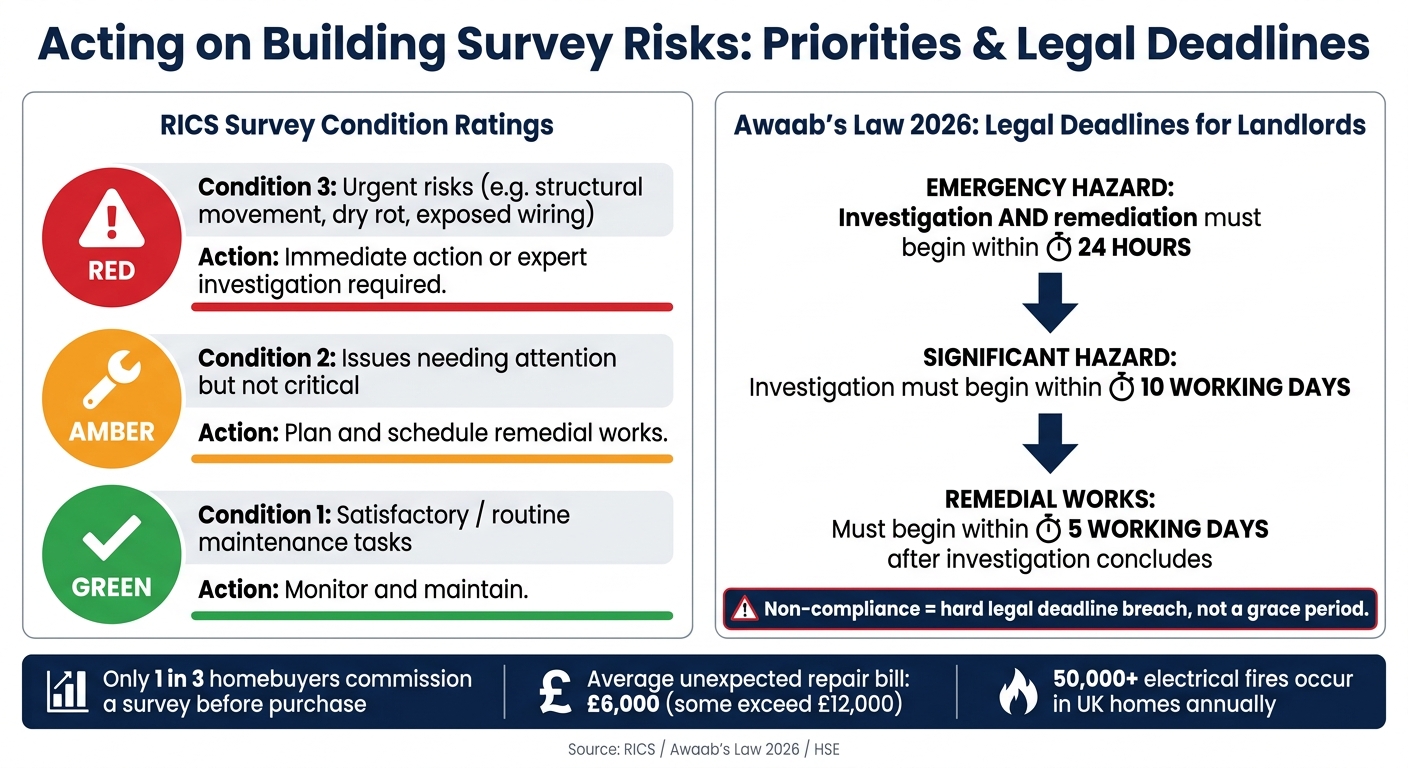
Awaab's Law 2026: Landlord Hazard Response Deadlines & Survey Traffic Light System
Survey reports often highlight several issues, and it’s crucial to address them promptly and methodically.
RICS survey reports use a traffic light system to indicate the urgency of issues. Here's how it works:
To manage these findings effectively, organise them into three groups: getting quotes, raising legal queries, and consulting specialists [19].
For landlords, Awaab's Law 2026 sets strict deadlines for addressing hazards in rental properties. Emergency risks must be investigated and resolved within 24 hours. Significant hazards need investigation within 10 working days, and remedial works must begin within 5 working days after the investigation concludes [20][9].
"The 10-working-day investigation window is not a grace period - it is a hard legal deadline from the moment a landlord is made aware of a hazard." - Surventrix [9]
Once priorities are clear, the next step is to hire accredited professionals to tackle critical problems.
Survey reports often recommend specific specialists and outline the scope of their assessments [19]. For example:
Always confirm that specialists have the right qualifications. For instance:
For large-scale projects, hiring a professional project manager can streamline the process. They can manage tenders, select contractors, and oversee staged payments [9][19][22]. Survey Merchant, for example, offers access to project managers and surveyors who can handle everything from planning to completion.
Once the specialists are on board, formalise your approach by creating a detailed risk register.
After addressing immediate concerns, it’s essential to maintain proper documentation for compliance and ongoing risk management. A health and safety risk register transforms your survey findings into a dynamic record. This document tracks each hazard, its location, current condition, and the actions taken or planned.
Each entry should include four key details: the hazard, its severity, the required action, and a clear timeline for resolution [14]. Use the following priority levels:
Review the register annually or whenever there’s a change in building use or maintenance plans [24]. For landlords, this isn’t optional. Under the Renters' Rights Act 2026, failing to meet the Decent Homes Standard could result in fines of up to £7,000 for an initial breach and £40,000 for ignoring enforcement notices [21].
"From 2026, private landlords will be judged not on intent, but on evidence - how quickly issues were investigated, how thoroughly causes were identified, and how effectively risks were removed." - Canterbury Surveyors [14]
Keep all supporting documents - such as reports, photos, quotes, and certificates - to build a solid compliance record [20].
Building surveys play a crucial role in identifying hazards like structural instability, asbestos, and fire or electrical risks - issues that carry serious legal responsibilities. A detailed survey provides a prioritised roadmap of what needs addressing and why, all within the framework of UK health and safety regulations.
"Health and safety compliance is not just about avoiding penalties. It is about demonstrating professionalism and care." - Harrison Clarke Chartered Building Surveyors [25]
Skipping a survey might save money upfront, but it can lead to unexpected and costly repairs down the line. For properties, especially those constructed before 1930 or significantly altered, a Level 3 Building Survey offers the in-depth evaluation needed to uncover hidden risks and confirm that proper measures have been taken to manage them responsibly.
Given the financial and legal risks, choosing the right surveyor is critical. Make sure your surveyor adheres to RICS standards, ensuring inspections you can rely on. Platforms like Survey Merchant connect property owners and buyers with a trusted network of RICS-qualified surveyors. Their services range from Level 2 HomeBuyer Reports and Level 3 Building Surveys to specialised support like party wall agreements, dilapidations, and project management.
"A building survey is one of the best ways to make sure those issues are found and dealt with before they cause harm." - Tim Clarke, Managing Director, Harrison Clarke Chartered Surveyors [25]
Whether you're buying, managing rental properties, or overseeing commercial buildings, commissioning a professional survey is a key step in meeting UK health and safety standards. Take these insights seriously to protect your investment and ensure compliance.
When deciding on the appropriate survey level, you’ll need to consider the age, construction, and overall condition of your property. The RICS Home Surveys are divided into three levels:
A standard building survey does not provide a thorough asbestos inspection. Surveyors might visually note materials associated with asbestos, such as textured coatings, but they don’t carry out testing. Confirming the presence of asbestos requires a specialised survey.
When it comes to damp, surveyors can identify visible signs like staining. More advanced surveys may involve tools like moisture meters, but diagnosing underlying problems may call for more invasive methods. Survey Merchant can connect you with professionals to address your specific requirements.
If your building survey flags a Red condition rating, don’t panic - this doesn’t automatically mean the property is a no-go. Begin by carefully reviewing the summary section of the report, which often provides guidance on what to prioritise. Next, get written quotes from qualified contractors to get a clear picture of potential costs. It’s also wise to arrange any specialist investigations that might be needed before making a final decision on the purchase. Survey Merchant can connect you with experienced surveyors to guide you through these essential steps.
Survey Merchant provides vetted RICS surveyors across 100+ UK locations at fixed fees:
→ Level 2 Home Survey (HomeBuyer Report)
→ Level 3 Building Survey (full structural survey)
→ RICS Red Book property valuations
→ Party wall surveyors — notices, awards & schedules of condition
→ Expert witness surveyors — CPR Part 35 reports for property disputes