Valuation
Sep 4, 2026
How to prepare for a valuation: UK buyer's guide
Learn essential steps to effectively prepare for a property valuation in the UK. Ensure access and gather crucial documents to enhance accuracy.

Organise your documents and confirm unrestricted access before anything else. That single action does more to protect the quality of a formal RICS valuation than any amount of tidying or decorating. A surveyor who cannot reach the loft, find the building regulations certificate, or confirm when the extension was built will record those gaps as limitations, and limitations weaken a report’s usefulness to lenders.
Start here before the inspection date:
Pro Tip: Use Surveymerchant’s valuation survey checklist to gather title deeds, warranties, planning permissions, and service records before the surveyor arrives — it is the fastest way to cover every document category in one pass.
Preparing documentation and unrestricted access before a RICS inspection is the single most effective step to produce a complete, lender-ready valuation report with minimal limitations.
| Point | Details |
|---|---|
| Documents first | Gather title deeds, planning permissions, building regs certificates, warranties, and the EPC before the inspection date. |
| Physical access | Clear lofts, cellars, boiler cupboards, and external areas so the surveyor can inspect without recording avoidable limitations. |
| Vendor questionnaire | Obtain written answers on dates of works, known defects, and guarantees — RICS recommends this before every inspection. |
| Honest disclosure | Concealing defects adds limitations clauses and increases post-report costs; disclosure with remediation records improves valuation confidence. |
| Surveymerchant | Book a verified RICS surveyor through Surveymerchant for confirmed MRICS credentials, PI insurance, and nationwide coverage. |
Getting the right report matters before you prepare a single document. The four main options for mortgage and formal valuation purposes are:
For Level 2 vs Level 3 guidance, the decision usually turns on property age and construction type.
Pro Tip: If the property was built before 1930, has been significantly extended, or uses non-standard construction (timber frame, thatched roof, concrete panels), choose Level 3. The access and documentation requirements are higher, but the protection is greater as well.
The most important documents are title deeds, planning permissions, building regulations completion certificates, warranties, the EPC, and any tenancy or lease details. Organised paperwork lets the surveyor assess alterations confidently rather than flagging them as unverified.
Ownership and legal
Alterations and planning
Services and maintenance
Warranties and guarantees
Environmental and planning context
| Document category | Why the surveyor needs it |
|---|---|
| Title deeds and lease | Confirms ownership, boundaries, and any covenants affecting the property |
| Planning and building regs | Verifies alterations are lawful and structurally signed off |
| Service certificates | Allows condition assessment without intrusive testing |
| Warranties and guarantees | Confirms remedial works are covered and transferable |
| Environmental searches | Flags flood, contamination, or planning constraints affecting value |
Pro Tip: Scan everything into a single shared folder (Google Drive or Dropbox works well) and name files clearly: “2019_loft_conversion_building_regs.pdf”. A surveyor who can open one folder on a tablet during the visit will move faster and note fewer limitations.
Clear access and visibility are not optional extras. A surveyor who cannot reach a critical area must record it as a limitation, which can prompt a lender to request further investigation before releasing funds.
Pro Tip: Follow Surveymerchant’s room-by-room guide on how to prepare for a building survey for a complete safety and access checklist, including advice on loft lighting and party wall access.
Obtain a completed vendor questionnaire before the inspection date. The RICS vendor liaison checklist recommends that surveyors gather as much information from the vendor or occupier as possible in advance, since a questionnaire completed beforehand saves time and improves inspection completeness.
Ask specifically about:
Record answers with timestamps. A short written timeline of works, supported by contractors’ invoices and photographs, gives the surveyor verifiable context rather than verbal assurances. Store everything in the same document folder used for the formal paperwork.
HomeBuyer (Level 2) reports typically take a few hours on site, while Level 3 building surveys can take several hours — plan access and your own schedule accordingly. The surveyor will take dated photographs as evidence; this is standard practice, not a cause for concern. They will not carry out intrusive tests (drilling, lifting floorboards) unless this has been agreed and specified in the instruction letter.
The most common limitations surveyors record are restricted access, concealed defects, and missing service evidence. Each one can reduce a lender’s confidence in the report.
Pro Tip: Small, honest repairs and making service records available help the surveyor form confident judgements about ongoing maintenance. That confidence feeds directly into valuation accuracy.
Report turnaround depends on property complexity and surveyor workload. A straightforward mortgage valuation can be reported within 24–48 hours; a detailed Level 3 survey on a large Victorian property may take five to seven working days.
Additional fees may apply for specialist tests (damp meter readings, thermal imaging), scaffold hire for high elevations, or drainage CCTV. Agree these in writing before the inspection date.
The single best credential is MRICS membership combined with confirmed professional indemnity (PI) insurance. MRICS means the surveyor has met RICS’s competency standards; PI insurance means you have recourse if the report contains a negligent error.
Credentials to verify:
Questions to ask when booking:
Surveymerchant’s RICS valuation services panel is matched to property type and location, with RICS credentials and PI insurance verified before any surveyor is listed.
Read the headline valuation figure first, then go straight to the limitations section before anything else. Limitations tell you what the surveyor could not assess, which is often as important as what they did assess.
After reading, share the report with your solicitor and mortgage lender promptly. Store the original PDF securely; you will need it for any renegotiation, insurance claim, or future sale. For a plain-language explanation of what each section means, Surveymerchant’s building surveys guide walks through typical report structures.
Pro Tip: Use condition rating 3 items as a negotiation checklist. Get contractor quotes before going back to the vendor — a vague “there’s damp” carries less weight than a £4,500 remediation quote.
Commission a specialist when the surveyor flags a potential issue outside standard scope, or when safety or legislation is involved. The rule is simple: if the report says “we recommend further investigation by a specialist,” act on it before exchange.
For structural follow-ups, Surveymerchant’s structural engineering service connects you with qualified engineers who can provide reports, calculations, and design advice.
Surveyors assess value against comparable evidence, but financial documents you provide can confirm the property’s running costs, compliance status, and income potential — all of which affect valuation confidence.
Gather and share:
The most damaging mistakes are not cosmetic — they are informational. A surveyor working with incomplete data produces a report with more limitations, and more limitations mean less lender confidence.
Avoid these specific errors:
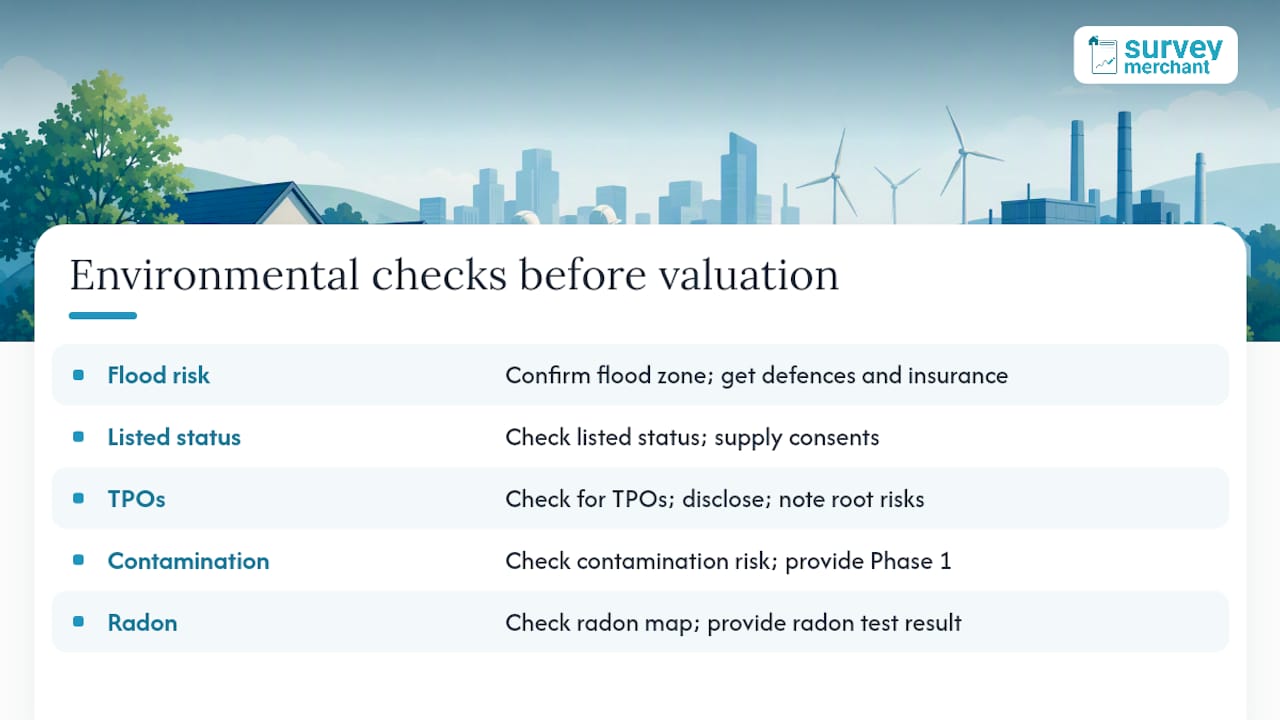
Environmental and planning constraints can affect value directly, and surveyors are required to note them. Prepare by checking these before the inspection.
Flood risk: Use the Environment Agency’s Flood Map for Planning to confirm the flood zone. If the property is in Flood Zone 2 or 3, obtain details of any flood defences, previous flood events, and current buildings insurance terms. Lenders treat uninsurable flood risk as a significant valuation risk.
Conservation area and listed building status: Check with the local planning authority. Works carried out without listed building consent are a legal liability and will be flagged in the report. Have any consent documentation ready.
Tree Preservation Orders (TPOs): If trees on or adjacent to the site are subject to a TPO, confirm this with the local authority and disclose it. Root spread from protected trees can affect foundations and drainage.
Ground contamination: For properties on or near former industrial land, a Phase 1 desktop environmental study may already exist. If not, the surveyor may recommend one. Have any existing environmental reports available.
Radon: Properties in high-radon areas (parts of Devon, Cornwall, Northamptonshire, and Derbyshire) may require a radon test. The UK Health Security Agency publishes radon potential maps; if the property is in an affected area, a test result strengthens the report.
Most buyers treat survey preparation as a formality. That is the wrong frame entirely. A surveyor who arrives at a well-documented, fully accessible property produces a report with fewer limitations, a more confident valuation, and less risk of a lender requesting further work before releasing funds. The preparation is not about impressing the surveyor — it is about removing every reason they have to hedge.
The conventional advice focuses on tidying and decorating. That misses the point. Presentation has almost no bearing on a RICS valuation; evidence does. A boiler service record from last month is worth more than a freshly painted hallway. A building regulations completion certificate for a 2018 extension removes a limitation that would otherwise sit in the report for the lender to query.
The other underrated step is honest disclosure. Buyers and vendors sometimes assume that hiding a known defect protects the transaction. It does the opposite. A surveyor who finds evidence of a concealed issue will record it as a concern, often with stronger language than if it had been disclosed upfront with a remediation record attached.
Finding a qualified surveyor who is available, RICS-accredited, and matched to your property type is where most buyers lose time. Surveymerchant removes that friction by matching you directly to a panel of verified RICS surveyors across the UK, with MRICS credentials and professional indemnity insurance confirmed before any surveyor is listed.

Every booking through Surveymerchant comes with access to sample reports, clear methodology statements, site-visit confirmation, and dated photographic evidence as standard. Whether you need a formal RICS valuation for a mortgage application or a full Level 3 building survey for a complex property, the platform gives you the trust signals and turnaround commitments you need before you commit. Book your surveyor through Surveymerchant today and get your inspection confirmed within 24 hours.
For complex legal or planning questions arising from a report, consult your solicitor and refer to the relevant RICS guidance directly. Surveymerchant’s building surveying services page lists the full range of available reports and booking options.
This article is general information, not a substitute for advice from a qualified financial advisor. Consult a qualified financial professional about your own circumstances before acting on anything here.
Survey Merchant provides vetted RICS surveyors across 100+ UK locations at fixed fees:
→ Level 2 Home Survey (HomeBuyer Report)
→ Level 3 Building Survey (full structural survey)
→ RICS Red Book property valuations
→ Party wall surveyors — notices, awards & schedules of condition
→ Expert witness surveyors — CPR Part 35 reports for property disputes