Valuation
Sep 4, 2026
Property reinstatement cost assessment: guide for UK owners
Discover how a property reinstatement cost assessment ensures accurate insurance coverage, protecting your investment from future losses.

A reinstatement cost assessment (RCA) is a professional estimate of what it would cost to rebuild your property from scratch, used to set the correct insurance sum insured, known as the declared value. If your current policy is more than three years old, or you have made significant changes to the building, arrange a RICS-qualified RCA now. Surveymerchant connects you with RICS-qualified surveyors across the UK to do exactly that. The BCIS (Building Cost Information Service) underpins the cost data most surveyors use, and the RICS professional standard (3rd edition) governs how every compliant RCA must be prepared.
A reinstatement cost assessment sets the declared value your insurer uses to settle a claim, and getting it wrong exposes you to proportionate reductions under the average clause.
| Point | Details |
|---|---|
| RCA sets the declared value | The declared value is the day-one reinstatement figure your insurer uses; it has no direct relationship to market value. |
| Average clause risk | If your sum insured is too low, your insurer pays only a proportionate share of any claim, not the full loss. |
| Review every three years | RICS recommends a full professional reassessment every three years and an annual desktop review in between. |
| Elemental analysis for complex buildings | Listed, historic, or unusual properties need an elemental cost breakdown, not a simple area rate. |
| Surveymerchant connects you to RICS surveyors | Surveymerchant matches you with RICS-qualified surveyors for desktop reviews and full on-site RCAs across the UK. |
An RCA calculates the cost of demolishing what remains after a total loss and rebuilding the property to its current specification, including all associated professional fees and statutory costs. It covers the physical structure and everything needed to reconstruct it. It does not include the land value.
The declared value is the figure the RCA produces. Your insurer uses it on a day-one reinstatement basis, meaning the sum insured is set at the declared value on the policy start date, and the insurer then applies an inflation provision (sometimes called an index-linking uplift) throughout the policy year to account for rising construction costs.
Key terms you will see in reports and policies:
Market value is what a buyer would pay for the property and its land in the open market. Reinstatement cost covers only the physical structure and the cost of rebuilding it. The two figures can diverge dramatically, and confusing them is one of the most common causes of underinsurance in the UK.
In a high-demand urban location, the market value of a flat may be £600,000 while the rebuild cost is £280,000. The land, the postcode premium, and the demand from buyers are irrelevant to what a contractor charges to lay bricks and fit a roof. Conversely, a Grade II listed farmhouse in a rural area might sell for £450,000 yet carry a reinstatement cost of £700,000 or more, because specialist lime mortar, traditional timber framing, and heritage consent add enormous expense that the market price does not reflect.
Underinsurance is widespread across UK commercial and residential property. Insurers and industry bodies consistently report that a significant proportion of UK buildings are insured for less than their true reinstatement cost, leaving owners exposed to proportionate reductions in claim payouts under the average clause. Zurich’s insurer guidance and MarshCommercial’s rebuild cost guidance both identify incorrect sums insured as the primary driver of disputed claims.
The RCA process follows a logical sequence from instruction to a signed-off declared value. Here is how it typically unfolds:
MarshCommercial confirms that desktop valuations are acceptable for many properties but not for Grade I or II* listed buildings or unusual cases. For anything outside the ordinary, a site visit is not optional.
Pro Tip: Ask your surveyor whether they will use an elemental breakdown or a simple area rate. For a standard modern house, a BCIS rate-based approach may be adequate. For a Victorian terrace, a barn conversion, or any listed building, insist on a full elemental analysis. The RICS journal guidance is explicit: average m² rates are often inadequate for non-standard buildings because they cannot account for access, specialist materials, or regulatory compliance costs.
A report that omits standard allowances will produce a declared value that is too low. The following items should appear in every compliant RCA:
On VAT: residential rebuilds are generally zero-rated for VAT purposes, but commercial properties and certain conversions may attract VAT at the standard rate. Where VAT applies, it must be included in the declared value. If there is any doubt about the VAT position for your property, take advice from a tax professional before finalising the sum insured.
Pro Tip: Do not assume your surveyor has included external works automatically. Boundary walls, gates, and drainage connections are frequently omitted from basic assessments. Check the report’s scope statement before signing off the declared value.
The declared value is the foundation of your insurance contract. Get it wrong and the consequences at claim time can be severe.
Insurers settle building claims on a new-for-old basis using the declared value as the reference point. If the declared value is correct and the insurer’s inflation provision has kept pace with construction cost movements, you receive a full settlement. If the declared value is too low, most commercial property policies apply the average clause, which reduces your payout proportionately.
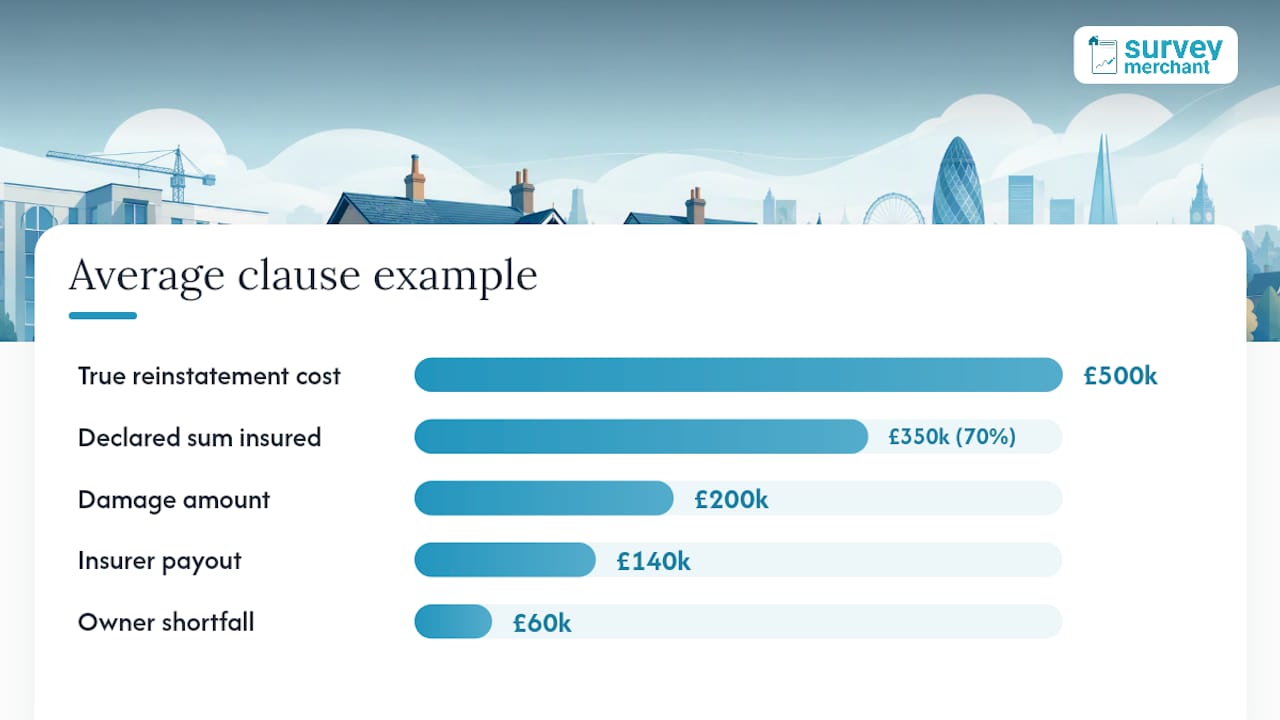
A worked example of the average clause: Your property has a true reinstatement cost of £500,000 but you have insured it for £350,000 (70% of the correct figure). A fire causes £200,000 of damage. Under the average clause, your insurer pays only 70% of the claim: £140,000. You bear the remaining £60,000 yourself, even though you have been paying premiums for years.
The Zurich guidance on reinstatement cost assessments confirms that professional RCAs should include demolition, professional fees, and appropriate allowances, and that a credible report prepared by a RICS-qualified surveyor can lead insurers to remove or limit the application of the average clause.
Properties most at risk of underinsurance include:
RICS recommends a full professional reassessment every three years, with annual desktop reviews in between to adjust for construction cost inflation. Construction costs in the UK have been volatile, and an RCA that was accurate three years ago may now be materially out of date.
Annual desktop reviews matter. RICS recommends them specifically because construction inflation can move a declared value out of alignment within a single policy year, not just over a three-year cycle.
Certain events should trigger an immediate reassessment regardless of when the last one was done:
For portfolio owners and strata (leasehold) buildings, formal review cycles may be required by statute, by the terms of the head lease, or by the insurer as a condition of cover. Check your policy wording and lease carefully.
Not every surveyor who offers an RCA will produce a report your insurer will accept. Before you book, work through this checklist:
For standard residential properties, a desktop review from a RICS-qualified surveyor is usually sufficient. For listed buildings, properties with access difficulties, or any building with unusual construction, an on-site inspection by a surveyor with relevant specialist experience is the only reliable route to an accurate declared value. The RICS journal on reinstatement cost assessment factors notes that for listed or conservation properties, surveyors often need budget figures from specialist contractors for stonework or historic carpentry, and may need to allow for extended approval times with heritage bodies.
A compliant report prepared under the RICS professional standard (3rd edition) should include the following sections:
The RICS standard is clear that the report must state the declared value has no direct relationship to market value and is prepared for insurance purposes only. When you submit the report to your insurer or broker, draw their attention to the limitations section. If the insurer requests further detail or a site inspection at claim stage, the report’s stated assumptions and caveats are your first line of defence.
Turnaround and fees vary with property type and complexity. Desktop reviews for straightforward residential properties can be completed within a few working days. Full on-site assessments typically take 7–21 working days from instruction to delivery, depending on the surveyor’s workload, the complexity of the building, and how quickly the owner provides supporting documents.
Factors that affect the fee include:
You may also pay more when the assessment requires input from additional specialists. An asbestos survey, a structural engineer’s report, or specialist contractor quotes for historic materials are separate commissions that sit alongside the RCA fee. For a detailed breakdown of cost drivers and regional variations, the Surveymerchant cost of reinstatement guide covers the main factors in depth.
Getting an RCA through Surveymerchant is straightforward. Here is what the process looks like:
Before you contact Surveymerchant, have the following ready: the property title or address, any existing floor plans, details of recent alterations or extensions, and your current policy schedule showing the existing sum insured.
Once you have the report:
The Surveymerchant panel holds professional indemnity insurance, works to RICS standards, and can provide sample reports on request. For properties that also need a full structural assessment, the Level 3 building survey service can be combined with an RCA to give a complete picture of the building’s condition and rebuild cost.
The single most common error is using the market value as the sum insured. It happens because the mortgage valuation or estate agent’s figure is the most visible number in a property transaction, and it feels authoritative. It is not the right number for insurance. Market value and rebuild cost are calculated for entirely different purposes, and in most cases they are not even close to each other.
The second error is leaving an RCA untouched for five or more years. Construction costs move. A declared value that was accurate in 2020 may be materially wrong today, and the insurer’s inflation provision will not fully compensate for a figure that started too low.
The third is commissioning a report that relies entirely on a simple floor-area rate without any elemental analysis or site-specific adjustment. For a standard modern house, that may be adequate. For anything older, unusual, or listed, it is a shortcut that tends to produce an underestimate.
A RICS-compliant report avoids all three traps. If you are unsure whether your current sum insured is correct, contact Surveymerchant for an initial check or ask to compare a sample report against your insurer’s requirements before you commit.
Getting the declared value right is the single most effective thing you can do to protect yourself at claim time. Surveymerchant gives you direct access to a panel of RICS-qualified surveyors across the UK, matched to your property type and location, with clear terms of engagement and professional indemnity cover as standard.

Whether you own a standard residential property that needs a straightforward desktop review or a listed building that requires a full elemental assessment by a heritage specialist, Surveymerchant matches you to the right surveyor without the guesswork of searching independently. Every report produced through the platform follows the RICS professional standard, includes a clearly stated declared value, and comes with the assumptions and caveats your insurer needs to see.
Book your reinstatement cost assessment through Surveymerchant today, or browse the building surveying services page to see the full range of assessments available for residential and commercial properties across the UK.
The following UK sources are the primary references for RCA practice and insurer requirements:
This list is selective. A full bibliography is available in the appendices of a compliant RCA report, and your surveyor should be able to direct you to any additional technical references relevant to your property type.
This article is general information, not a substitute for advice from a qualified financial advisor. Consult a qualified financial professional about your own circumstances before acting on anything here.
Survey Merchant provides vetted RICS surveyors across 100+ UK locations at fixed fees:
→ Level 2 Home Survey (HomeBuyer Report)
→ Level 3 Building Survey (full structural survey)
→ RICS Red Book property valuations
→ Party wall surveyors — notices, awards & schedules of condition
→ Expert witness surveyors — CPR Part 35 reports for property disputes