We use cookies to improve your experience on our site, analyze site traffic, and assist in our marketing efforts. By clicking "Accept all," you agree to the storing of cookies on your device. You can choose to "Reject all" non-essential cookies. For more information, please read our Cookie Policy.
Awaab's Law 2026: Phase 2 Deadlines & Landlord Guide
A complete 2026 guide to Awaab's Law: what it is, who it covers, Phase 1 and Phase 2 timescales, the hazards added from 30 November 2026, the private landlord consultation and how accredited surveyors help you comply.
Awaab’s Law is the name given to the legal duties that force landlords to investigate and fix dangerous hazards in rented homes within fixed timescales. It is named after Awaab Ishak, the two-year-old who died in December 2020 after prolonged exposure to mould in his family’s social housing flat in Rochdale. Phase 1 has applied to social landlords in England since 27 October 2025, Phase 2 arrives on 30 November 2026, and a live Government consultation (opened 9 October 2026) is asking how the same rules should reach private renters. This guide explains exactly what Awaab’s Law requires, the deadlines landlords must hit, what changes this November, and how a suitably qualified, accredited surveyor helps you comply.
Key takeaways
Phase 1 (live since 27 October 2025): social landlords must deal with significant damp and mould hazards and all emergency hazards within strict timescales set by the Hazards in Social Housing (Prescribed Requirements) (England) Regulations 2025.
Phase 2 (from 30 November 2026): the duties extend to excess cold, excess heat, falls, structural collapse, fire and explosions, electrical hazards and domestic hygiene.
The core clock: investigate a significant hazard within 10 working days, give the tenant a written summary within 3 working days of the investigation ending, make the hazard safe within 5 working days, and fix emergency hazards within 24 hours.
Private rented sector: a Government consultation opened on 9 October 2026 and closes on 18 December 2026. The earliest feasible start date for private landlords is 2027.
Investigations must be competent: the law requires a person the landlord reasonably believes is competent to assess the risk. For damp, structural and electrical hazards that usually means an accredited surveyor or qualified specialist.
Get ahead now: landlords who commission independent damp, condition and hazard surveys before November avoid missed deadlines, alternative-accommodation costs and disrepair claims.
What is Awaab’s Law?
Awaab’s Law is a set of legal duties, implied into every social housing tenancy in England, that require landlords to investigate reported hazards and carry out safety work within fixed timescales. Created by section 42 of the Social Housing (Regulation) Act 2023, it took effect on 27 October 2025 and is being extended in phases through 2027.
Before Awaab’s Law, a tenant complaining about mould relied on general repairing obligations and the slow machinery of disrepair claims. The coroner’s inquest into Awaab Ishak’s death found that his family had repeatedly reported the mould and that no effective action was taken. The new law replaces vague “reasonable time” obligations with hard, enforceable deadlines, and because the duties are implied terms of the tenancy, tenants can take landlords to court for breach of contract and seek specific performance.
Under Awaab’s Law, a reported damp and mould hazard must be investigated by a competent person within 10 working days.
Who does Awaab’s Law apply to in 2026?
Right now the duties apply to registered providers of social housing in England – local authority landlords and housing associations – under “relevant social housing leases”. Private landlords are not yet covered, but that is changing. The Renters’ Rights Act 2025 contains the power (sections 60 and 61) to extend Awaab’s Law to private tenancies and to accommodation occupied under licence, and the Ministry of Housing, Communities and Local Government opened a formal consultation on 9 October 2026 setting out how that would work. We cover the detail below.
The law applies to the landlord, not the managing agent. Even where an agent handles repairs, the landlord remains liable for every missed deadline, which is why the consultation flags that landlords may need to renegotiate agency contracts before the rules arrive.
Does Awaab’s Law apply in Scotland, Wales or Northern Ireland?
No. Awaab’s Law is England-only legislation: the 2025 Regulations are made under the Landlord and Tenant Act 1985 as it applies to England, and the private rented sector consultation is likewise limited to England. Housing standards are devolved, so tenants in Scotland rely on the Repairing Standard and the tolerable standard, tenants in Wales on the fitness-for-human-habitation requirements of the Renting Homes (Wales) Act 2016, and Northern Ireland on its own fitness standard. None of those regimes currently sets Awaab’s Law-style fixed investigation and repair deadlines, although the Rochdale case has prompted calls for equivalent rules across the UK.
Awaab’s Law timescales: the deadlines landlords must meet
Begin, or take steps to begin, within 5 working days; start within 12 weeks at the latest
Investigation identifies the work
Completion of preventative work
Within a reasonable time
Work begins
Alternative accommodation
Immediately, at the landlord’s expense, if safety work cannot be completed in time
Deadline missed or cannot be met
Significant hazard vs emergency hazard
The regulations draw a line between two categories. A significant hazard is one that poses a significant risk of harm to the health or safety of the tenant or household – in practice, a risk a reasonable landlord would make safe within 15 working days. An emergency hazard poses an imminent and significant risk that a reasonable landlord would make safe within 24 hours; the GOV.UK guidance gives examples such as gas or carbon monoxide leaks, total loss of water and exposed wiring. The test is objective but takes account of the individual household, so a mould patch that is a nuisance in one home may be a significant hazard where a baby or a person with a respiratory condition lives.
The written summary
Within 3 working days of concluding an investigation the landlord must give the tenant a written summary stating whether a significant or emergency hazard was found and what it is; what action will be taken, with target dates for starting and finishing; or, if no action is needed, why not; and the landlord’s contact details. If all required work is finished within those 3 working days, the summary is not needed, but the tenant must still be told the work is complete. A professional survey report is the natural evidence base for this summary, which is why many landlords instruct an independent surveyor rather than relying on an operative’s job notes.
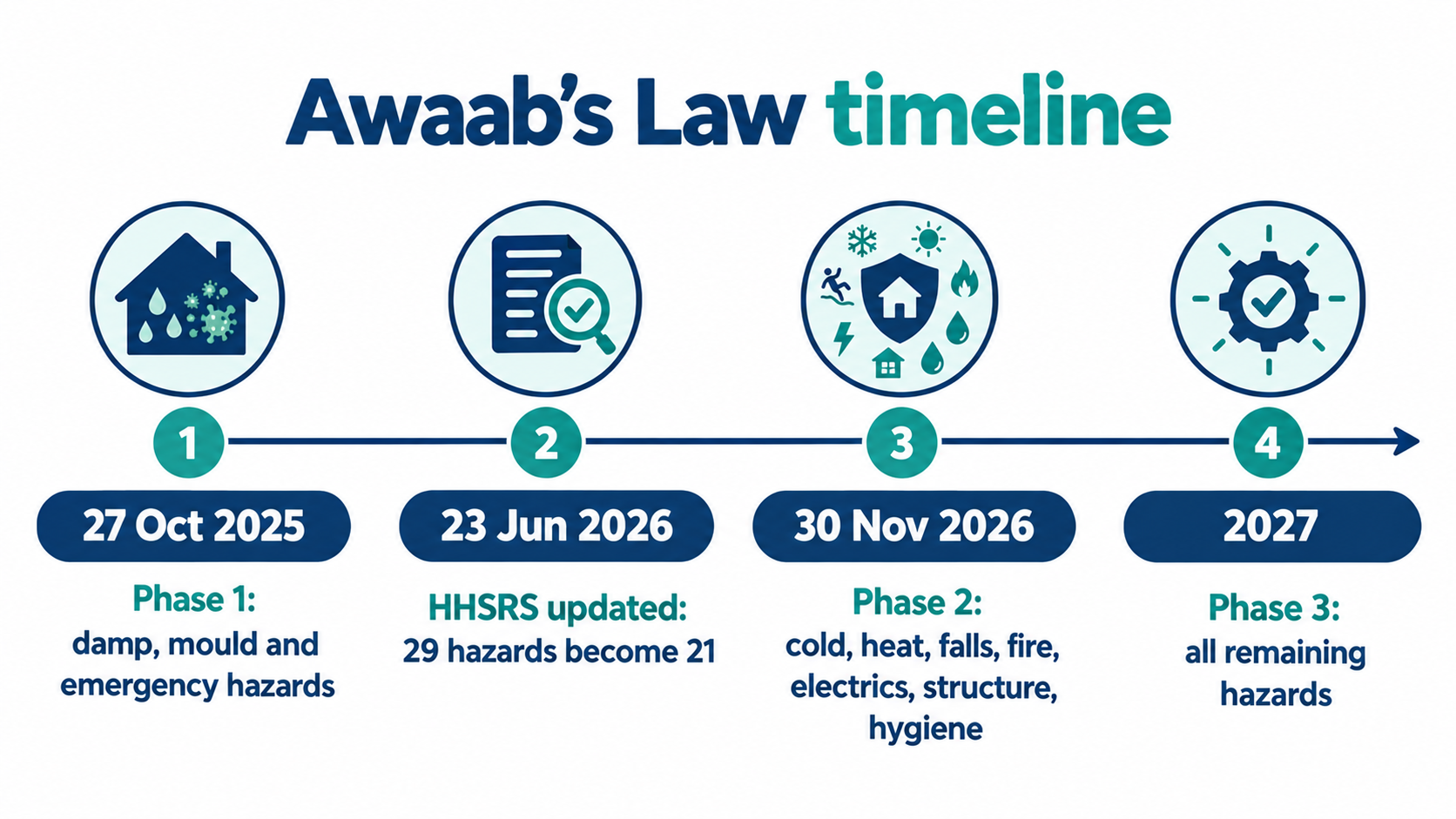
Awaab’s Law is being rolled out in phases, with the HHSRS hazard framework updated in June 2026 between Phase 1 and Phase 2.
Phase 2 of Awaab’s Law: what changes on 30 November 2026?
Phase 1 covered damp and mould that poses a significant risk, plus every emergency hazard. From 30 November 2026 the Hazards in Social Housing (Prescribed Requirements) (England) (Amendment) Regulations 2026 extend the significant-hazard duties to seven further HHSRS hazard groups:
Falls – on the level, on stairs and between levels, and falls associated with baths.
Structural collapse and falling elements – failing ceilings, balconies, parapets and render.
Fire and explosions – defective fire doors, missing detection, compromised compartmentation.
Electrical hazards – dangerous wiring, consumer units and fittings.
Domestic hygiene, pests and refuse – including personal hygiene, sanitation, drainage and food safety.
The Government published its updated Phase 2 guidance for social landlords on 13 July 2026 (last updated 31 July 2026), together with a separate hazards annex to help landlords triage reports. The Phase 1 guidance remains in force until 11:59pm on 29 November 2026. Phase 3, planned for 2027, will bring in every remaining HHSRS hazard except overcrowding.
The HHSRS was updated in June 2026
Awaab’s Law borrows its hazard categories from the Housing Health and Safety Rating System (HHSRS). On 23 June 2026 the HHSRS was reformed: the 29 hazards were consolidated into 21 by merging related categories (for example, fire and explosions, and the various hygiene and sanitation hazards), scoring was simplified into High, Medium and Low bands, and new operating and enforcement guidance replaced the 2006 editions. Surveyors assessing Phase 2 hazards therefore need to work to the 2026 hazard profiles and baseline indicators, not the old guidance.
Who is allowed to investigate under Awaab’s Law?
The regulations do not insist on an HHSRS-qualified inspector. They require the landlord to ensure the investigation is carried out by someone who, in the landlord’s reasonable opinion, is competent to assess the risk the hazard poses to the occupier. The GOV.UK guidance is explicit that electrical hazards should be investigated and remediated by a qualified electrician, and the same logic applies elsewhere: diagnosing whether mould is caused by condensation, penetrating damp or rising damp, or whether cracking signals structural movement, calls for a suitably qualified, accredited surveyor.
Competence matters for a second reason. If a tenant later brings a claim, the landlord must show it acted reasonably. An independent report from a surveyor accredited by a recognised body such as RICS, CIOB or RPSA, with moisture readings, thermal imaging and photographs, is far stronger evidence than an internal job sheet. Our guide to housing disrepair expert witness reports explains how that evidence is used in court.
Will Awaab’s Law apply to private landlords?
Yes, in time. On 9 October 2026 MHCLG published Extending Awaab’s Law to private rented tenancies and to licences, a 64-question consultation that closes at 11:59pm on 18 December 2026. It would cover England’s private rented sector – around 11 million renters in 4.7 million households, let by at least 2.3 million landlords, 82% of whom own fewer than five properties – as well as supported housing, temporary accommodation and care-leaver accommodation occupied under licence.
The headline proposals, using the social housing rules as the starting point, are:
Scope: all HHSRS hazards except overcrowding, at the same significant and emergency thresholds used in social housing.
Timescales: options of 5, 10 or 15 working days to investigate; 1, 3 or 5 working days for the written summary; 3, 5 or 10 working days to make safe; and 12, 24 or 48 hours for emergencies.
Who investigates: three options – any competent person (the social model), a two-stage process where the landlord or agent triages and a specialist follows up, or a requirement for specific qualifications such as an HHSRS practitioner or building surveyor.
Timing: the earliest feasible implementation date is 2027, with 2028 and 2029 also offered. The consultation asks whether the Private Rented Sector Landlord Ombudsman, expected in 2028, should be in place first.
Enforcement: as an implied term of the tenancy, enforced by tenants through the courts or Ombudsman. Councils keep their HHSRS powers, including civil penalties of up to £7,000 for Category 1 hazards under the Renters’ Rights Act 2025.
Nothing changes for private landlords yet, but the direction of travel is clear. Combined with the Private Rented Sector Database opening on 15 December 2026 and the wider reforms we cover in our Renters’ Rights Act rollout guide, private landlords should treat 2027 as the realistic deadline to get their stock condition evidence in order.
A clear written summary, backed by an independent survey, is required within 3 working days of an investigation concluding.
How does Awaab’s Law affect tenants?
Tenants gain three practical rights. First, certainty: once a hazard is reported, the landlord is on a statutory clock. Second, information: the written summary tells the household what was found and when it will be fixed. Third, remedies: because the duties are implied terms, a tenant can bring a breach-of-contract claim, seek an order for specific performance and claim compensation, in addition to complaining to the Housing Ombudsman. Landlords cannot contract out of the duties, and the regulations imply a covenant allowing the landlord entry to carry out investigations and work.
If you are a tenant living with damp or mould, report it in writing, photograph it, and keep every message. Our guide to what causes damp in a house helps you describe the problem accurately, and an independent damp survey can give you objective evidence if your landlord disputes the cause.
Awaab’s Law compliance checklist for landlords
Whether you are a housing association preparing for Phase 2 or a private landlord planning ahead, the same steps apply:
Map your reporting routes. Tenants must be able to report every in-scope hazard easily, and you need a timestamp for when you became aware.
Triage every report into emergency, significant or routine within hours, using the Phase 2 hazards annex.
Line up competent investigators. Damp, structural, fire and electrical hazards need accredited surveyors and qualified trades with capacity to attend inside 10 working days.
Commission stock condition and damp surveys now, so known defects are fixed before they become reported hazards on a statutory clock. Our landlord property inspection checklist is a good starting point.
Check electrical and fire safety records, including a valid EICR – see our EICR certificate guide.
Template the written summary so it can be issued within 3 working days every time.
Keep an audit trail of reports, access attempts, investigations, summaries and completion dates. Records of failed access attempts are your evidence of “reasonable endeavours”.
Plan for alternative accommodation and budget for it, because the duty applies as soon as a deadline cannot be met.
Common hazards surveyors find in rented homes
Across the damp and condition surveys our panel carries out on rented stock, the same issues recur. Condensation and mould caused by inadequate ventilation and under-heating remain the most common, which is why diagnosing the cause correctly matters: a dehumidifier will not fix a bridged damp-proof course. Our guides to tackling condensation and mould and thermal imaging surveys explain the diagnostic tools involved. From 30 November 2026, failed boilers (excess cold), loose stair balustrades (falls), spalling concrete balconies (structural collapse), defective fire doors and ageing consumer units will all carry the same statutory deadlines, so a single multi-hazard inspection is the most efficient way to prepare.
Why choose Survey Merchant for your Awaab’s Law surveys?
Survey Merchant connects landlords, housing providers and tenants with independent surveyors across the UK, and Awaab’s Law is exactly the kind of work where independence and competence count. Here is why clients use us:
An accredited panel matched to the hazard. Our panel includes suitably qualified surveyors accredited or regulated by bodies such as RICS, CIOB and RPSA, so a damp and mould investigation, a structural inspection or a full HHSRS-style hazard assessment goes to the right specialist.
Nationwide coverage with local knowledge. Surveyors who know the housing stock in your area, from pre-war terraces to 1960s system-built flats.
Fast turnaround. With a 10-working-day investigation deadline, we prioritise prompt appointments and reports written for the statutory written summary.
Transparent, competitive fixed fees agreed before the inspection, with no surprises for landlords managing large portfolios.
Impartial advice. Our surveyors do not sell damp-proofing or remedial works, so their diagnosis of cause and remedy is independent.
End-to-end support, from initial triage advice through to expert witness reports if a dispute reaches court.
Awaab's Law is a set of legal duties, implied into social housing tenancies in England, that require landlords to investigate reported hazards and carry out safety work within fixed timescales. It is named after Awaab Ishak, who died in 2020 from prolonged exposure to mould in his Rochdale home.
When does Awaab's Law Phase 2 come into force?
Phase 2 comes into force on 30 November 2026. It extends the significant-hazard duties to excess cold, excess heat, falls, structural collapse, fire and explosions, electrical hazards and domestic hygiene. Phase 1, covering damp, mould and emergency hazards, has applied since 27 October 2025.
What are the Awaab's Law timescales for repairs?
Landlords must investigate a significant hazard within 10 working days of becoming aware of it, give the tenant a written summary within 3 working days of the investigation concluding, and make the hazard safe within 5 working days. Emergency hazards must be investigated and made safe within 24 hours. Preventative works must start within 5 working days, or within 12 weeks at the latest.
Does Awaab's Law apply to private landlords?
Not yet. The Renters' Rights Act 2025 gives the Government the power to extend it to private tenancies, and a consultation on how to do so opened on 9 October 2026 and closes on 18 December 2026. The consultation says the earliest feasible implementation date for the private rented sector is 2027.
Who can carry out an Awaab's Law investigation?
The landlord must use someone it reasonably believes is competent to assess the risk the hazard poses to the occupier. An HHSRS qualification is not mandatory, but electrical hazards should be investigated by a qualified electrician, and damp, mould and structural hazards are best assessed by a suitably qualified surveyor accredited by a body such as RICS, CIOB or RPSA.
What happens if a landlord misses an Awaab's Law deadline?
If safety work cannot be completed in time, the landlord must provide suitable alternative accommodation at its own expense. Because the duties are implied terms of the tenancy, tenants can bring a breach-of-contract claim, seek specific performance and claim compensation, as well as complaining to the Housing Ombudsman.