Leasehold
Sep 24, 2026
Guide to Understanding Easements in Property Surveys
Clear guide to identifying easements on surveys, their legal types, effects on use and value, and how surveyors report them.

Easements are legal rights allowing someone to use another's land for specific purposes, like access or utilities, without owning it. They stay tied to the land, affecting future owners. Here's what you need to know:
Understanding easements early is key to avoiding costly disputes and ensuring smooth property transactions.
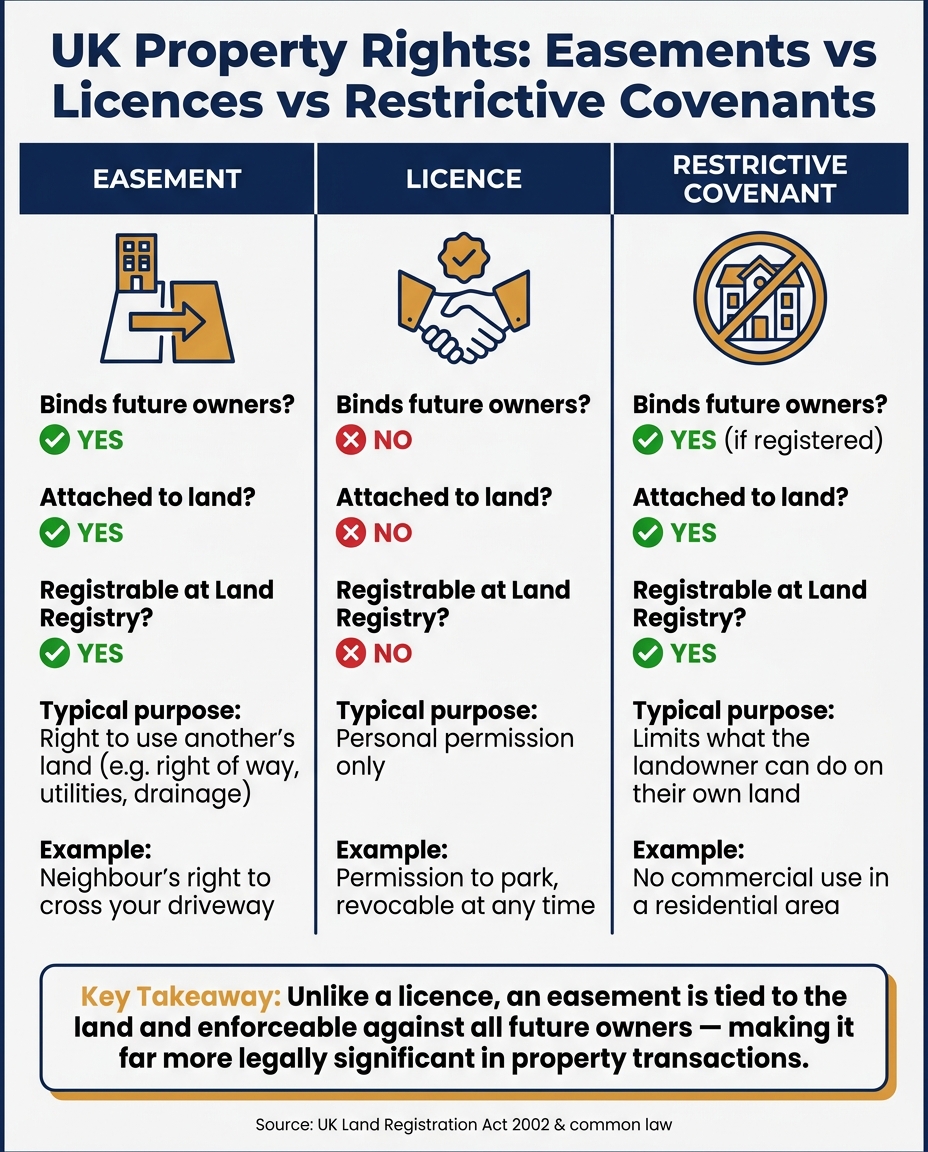
Easements vs Licences vs Restrictive Covenants: UK Property Rights Compared
Understanding the legal framework behind easements helps surveyors correctly identify and interpret these rights.
For a right to qualify as a legal easement under UK property law, it must meet four key criteria:
The ouster principle plays a crucial role here. This principle ensures that an easement does not give the beneficiary complete control over the servient land. Higgs LLP explains:
"The ouster principle asserts that a right cannot exist as an easement if the effect of that right is tantamount to granting possession of the land to the party claiming the benefit of the right." [4]
A good example is the case of Viscido and others v Raimondo, where homeowners in New Southgate, London, attempted to claim a prescriptive right to permanently park vehicles in a shared passageway. The court ruled against this, stating that such a right would render the landowner's control meaningless [4].
In legal terms, easements are classified as incorporeal hereditaments, meaning they are intangible rights that still bind future owners of the land burdened by the easement.
Easements can be established in several ways, each with distinct legal processes and implications.
| Creation Method | How It Arises | Registration Required? |
|---|---|---|
| Express Grant | Created through a formal deed (e.g., within a Transfer deed) | Yes, at HM Land Registry |
| Implied Grant | Arises by necessity, such as avoiding landlocking | No, arises by law |
| Prescription | Established through continuous use over 20+ years without force, secrecy, or permission | No, but registration advised |
| Statutory | Granted under legislation, e.g., the Electricity Act 1989 | Yes, typically via a Deed of Grant |
Prescriptive easements deserve special attention. To establish one, the use must meet the Latin principle "nec vi, nec clam, nec precario" – without force, without secrecy, and without permission – and it must continue for at least 20 years [1]. However, this timeframe can be interrupted. For example, in Nicholson v Hale, a landowner successfully blocked a prescriptive claim by erecting a "private property" sign, proving the use was not "as of right" [9].
Under the Land Registration Act 2002, express easements must be registered against the servient land's title to be legally enforceable. Without registration, they may only exist as equitable interests [6].
Recognising these methods of creation helps differentiate easements from other property-related rights.
Easements are often confused with other property rights, but the differences are important.
A licence is a personal permission that does not transfer with the land and cannot bind future owners. By contrast, an easement is tied to the land itself and remains enforceable even if ownership changes [2].
On the other hand, a restrictive covenant works differently. While an easement allows someone to do something on another's land (e.g., cross it), a restrictive covenant limits what the landowner can do on their own property – for instance, prohibiting commercial use in a residential area.
| Feature | Easement | Licence | Restrictive Covenant |
|---|---|---|---|
| Binds future owners? | Yes | No | Yes (if registered) |
| Attached to land? | Yes | No | Yes |
| Registration possibility | Can be registered at the Land Registry | Not registrable | Can be registered |
| Typical purpose | Right to use another's land | Personal permission | Restriction on land use |
Knowing the distinctions between these rights is critical when dealing with property transactions. For instance, a licence that seems similar to a right of way offers far less security than a properly registered easement. This difference can significantly impact the usability and value of a property.
Surveyors use a mix of desk research and on-site inspections to identify and verify easements. These practical methods ensure that easements are accurately represented on survey plans and align with the legal framework.
HM Land Registry Title Plans use a consistent colour-coding system to highlight easements. According to HM Land Registry:
"Easements granted are usually defined by reference to a plan, so it is important that they are clearly shown on that plan using a line, edging or tinting as appropriate." [7]
Here’s a breakdown of common markings you’ll find on these plans:
| Marking | What It Typically Means |
|---|---|
| Red Edging | Outlines the general boundary of the registered land |
| Blue Tinting/Edging | Indicates land burdened by an easement, such as a neighbour's right of way |
| Brown Tinting | Highlights a right of way benefiting your property on a neighbour's land |
| Green Edging | Marks land affected by a specific register entry or covenant |
| Lettered Points (A, B, C) | Refers to specific locations detailed in the Title Register text |
It’s important to note that Title Plans originate from Ordnance Survey maps, typically at scales of 1:1,250 for urban areas and 1:2,500 for rural areas. These maps show general boundaries rather than precise ones, so they should always be read alongside the Title Register for full clarity.
After reviewing survey plans, surveyors turn to legal documents for confirmation. Section A (the Property Register) records easements benefiting the property, while Section C (the Charges Register) lists those that burden it [10][11]. Both sections need to be checked to avoid missing crucial details.
When the register references a specific deed, the surveyor will retrieve the original Deed of Grant or Conveyance through an Associated Documents search. These older documents often contain detailed Deed Plans with measurements that aren’t included in standard Title Plans [10][11]. For public rights of way, such as footpaths or bridleways, surveyors rely on Local Authority searches and Definitive Maps maintained by local highway authorities, as these rights are rarely recorded in Land Registry title documents [10].
A survey report goes beyond listing easements - it explains their practical implications. Surveyors document physical evidence found on-site, such as shared gates, worn access paths, manhole covers, overhead cables, or areas suggesting underground pipework. As Wedlake Bell points out:
"Site inspections are the only way to find out certain types of information about a property... [they] reveal information that should be discoverable through other means, but... does not come to light until much later." [3]
The report also clarifies whether the property is the dominant or servient tenement. It highlights any inconsistencies between legal documents and on-site findings, such as misplaced fences or unregistered access routes. This thorough process ensures that all easements affecting the property are clearly identified and understood.
This section examines the typical easements that can impact residential properties in the UK and their practical effects, expanding on the legal and survey concepts already introduced.
Access easements are some of the most frequently encountered on residential properties. They grant one property owner the legal right to pass across another’s land, often via shared driveways, private lanes, or footpaths [2][5]. In these arrangements, the property benefiting from the easement is referred to as the dominant tenement, while the land burdened by it is the servient tenement.
Understanding the specifics of such easements is crucial for buyers. For instance, parking on a right of way is only permissible if explicitly allowed in the deed [13]. Similarly, obstructing a neighbour’s access - by installing gates or fences, for example - is a violation of their legal rights [8]. When planning extensions or outbuildings, homeowners must also consider access routes, as vehicular paths require a minimum width of 3.7 metres, and pedestrian paths need about 1 metre. These easements can reduce the usable area of your property and influence development plans [12]. Survey reports often highlight these constraints and their potential impact.
In addition to access rights, easements governing utilities and essential services are also common.
Utility easements allow infrastructure such as electricity cables, gas pipes, water mains, or telecoms equipment to be installed on or through private land [2][1]. These rights are typically permanent and remain binding on future property owners, distinguishing them from wayleaves, which are temporary agreements that can be renegotiated when ownership changes [2][5].
If utility equipment is present on your property, the service provider usually has the right to access it for maintenance and inspections. Furthermore, building over buried pipes or cables is prohibited if it would hinder future repairs [14][16]. Before purchasing a property, it’s essential to confirm whether such infrastructure is covered by a permanent easement or a wayleave, as this can significantly affect land use. Surveyors will identify visible utility installations and flag any restrictions they impose.
Drainage easements are another critical factor to consider, particularly for properties requiring connection to public sewer systems.
Drainage easements allow sewer pipes or drains to pass through a neighbouring property to connect to public mains [1][5]. These are especially relevant for homes without direct street frontage or where natural drainage routes cross third-party land.
As highlighted by Laceys Solicitors:
"If your neighbour has a right of drainage through pipes on your land, you must not build over them in a way that makes repair and maintenance difficult." [14]
This restriction can influence landscaping and development plans. For example, diverting a foul water drain can cost anywhere from £5,000 to £20,000, depending on the depth and length of the work required [12]. Additionally, if a previous owner built over a drain without proper consent, the new owner might inherit liability for the breach [14]. Surveyors will carefully document any visible drainage infrastructure and cross-check it with legal records to help buyers understand their obligations before completing a purchase.
Easements, while often essential, can bring some practical challenges for property owners. From restrictions on land use to maintenance duties and even potential impacts on property value, understanding these effects is crucial for anyone dealing with easements.
Easements can limit what you can do with your land. A common restriction involves prohibiting construction over areas where utility services like gas mains or water pipes are located. Even if you own the land outright, obstructing access to these services is not allowed, as it would hinder maintenance work [17][15].
Rights of way introduce their own set of limitations. For instance, as Nyree Applegarth, Partner and Head of Property Litigation at Higgs LLP, explains:
"It may be an actionable interference if you were to put a gate across your land that makes it much more difficult for the neighbour to exercise that right of way." [8]
Another example is the right to light, which can significantly influence development plans. If your construction - such as an extension or additional storey - blocks a neighbour's longstanding natural light, courts may step in to halt the project or require design changes [15].
Easements also come with responsibilities, particularly around maintenance and liability. Typically, the party benefiting from the easement is responsible for its upkeep. Linda Chew, Senior Associate at Pinney Talfourd Solicitors, summarises this principle:
"The general rule is that if you have the benefit of an easement, you also have the burden." [1]
When easements are shared - like a communal driveway - maintenance costs are usually divided proportionately among the benefiting properties. Meanwhile, the owner of the burdened land (the servient owner) must avoid interfering with the easement and ensure the surrounding area is kept in reasonable condition [17]. Failing to meet these obligations can lead to legal action, including court orders and financial penalties.
Easements don’t inherently decrease property value, but their impact depends on the specific circumstances. For example, a prominent right of way cutting through a garden might deter potential buyers or lead to lower offers. On the flip side, easements that provide access to essential services, such as drainage or shared driveways, may support or even enhance a property’s appeal [17].
However, undocumented or disputed easements can complicate property transactions. These issues may delay sales, increase legal costs, and even cause mortgage lenders to decline financing if access rights are unclear or contested [5][10].
To avoid such complications, sellers with unregistered prescriptive easements should secure statutory declarations from former owners to prove at least 20 years of continuous use [9]. If disputes arise, early mediation is often a better option than costly litigation [17]. Survey reports can also help clarify the situation, enabling better decision-making for all parties involved.
Once easements have been identified and their potential effects are understood, collaborating with a skilled surveyor becomes essential. Surveyors don't just confirm the existence of easements - they provide detailed reports that assess their impact on property value and usage.
Surveyors do much more than evaluate a building's physical state. During property inspections, they often uncover clues like worn paths or shared access points that may indicate unrecorded easements [3]. As noted by Wedlake Bell:
"Site inspections are the only way to find out certain types of information about a property... [they] reveal information that should be discoverable through other means, but, for one reason or another, does not come to light until much later." [3]
In a Level 2 HomeBuyer Report or Level 3 Building Survey, surveyors highlight easements that could impact how the property is used or the feasibility of future developments. For formal Red Book valuations, surveyors go a step further by estimating the financial impact. This involves calculating the difference in property value with and without a specific easement. A case from 2015, handled by CLS Property Insight, illustrates this well. A surveyor assessed the loss of an undocumented access route in the Midlands - used since the late 1970s - and determined a valuation difference of £7,500. Including solicitor and expert fees, the total claim reached £16,500 [18].
Specialised services are available to ensure thorough and accurate evaluations.

Survey Merchant offers a network of qualified surveyors across the UK who specialise in identifying and reporting on easements. Whether you need a basic residential survey, a detailed analysis for party wall agreements, or expert witness reports for easement disputes, their service is tailored to your requirements. They cover Level 2 HomeBuyer Reports, Level 3 Building Surveys, and Red Book valuations. Every surveyor in their network is professionally insured, providing advice that is both impartial and accountable.
Having the right documents ready can make the easement review process smoother and more accurate. Below is a list of key paperwork to gather:
| Document | Purpose |
|---|---|
| Title Register & Title Plan | Identifies express grants or reservations and the title numbers of affected land [18][5] |
| Transfer Deeds (e.g., TP1) | Reveals easements created when land was originally divided or sold [18] |
| Deeds of Grant | Records the formal creation of a right [18] |
| Statutory Declarations | Demonstrates continuous use over the required 20-year period for prescriptive easement claims [18][9] |
| Ordnance Survey Maps | Verifies historic routes and physical features over time [9] |
| Local Authority Search Results | Highlights public rights of way distinct from private easements [5] |
For a seamless process, always refer to the specific HM Land Registry title number when discussing affected land. Vague descriptions can lead to delays during registration [7]. Additionally, ensure that any plans provided are in full colour and properly signed. HM Land Registry may issue formal requisitions if plans are unclear or lack signatures [7][6].
Easements have a lasting impact on land use, shaping how properties can be developed and affecting their value over time. They also bind future owners, making it crucial to understand their implications.
While some easements are clearly documented, others arise from long-term, unregistered use. This disconnect between legal records and on-the-ground realities can often cause delays during property transactions. Under the principle of caveat emptor (buyer beware), it's vital to identify these easements early on. A Level 2 HomeBuyer Report or a Level 3 Building Survey is among the best ways to uncover easements that might otherwise remain hidden until they escalate into costly disputes.
A professional survey not only highlights existing easements but also offers guidance on managing potential risks. In cases where documentation is lacking, an Absence of Easement indemnity policy can act as a practical safeguard. For a cost often under £100, it can cover substantial losses and legal expenses, which could otherwise reach tens of thousands [18].
Grasping the nuances of easements is key to making informed and confident property decisions.
Easements are generally long-lasting rights connected to the land itself, which makes them challenging to revoke. You can't simply alter or end an easement because it becomes inconvenient.
However, an easement might end under specific circumstances, such as:
For a clear understanding of your situation, it’s wise to review your title deeds and HM Land Registry records with the help of a professional.
To identify unregistered easements, begin by making formal enquiries with the seller and carrying out local authority searches. A physical inspection is equally important, as it can reveal signs such as tracks or access points that may indicate easements. Talking to neighbours can also provide insight into any usage rights that might not be immediately obvious. If there are still uncertainties, indemnity insurance might be worth considering. Survey Merchant links property owners with experienced surveyors who can provide specialist reports to aid in your due diligence efforts.
Easements can influence both your mortgage prospects and your ability to sell a property. Since easements are tied to the land itself, not the owner, they stay in place even after the property changes hands. Easements that limit access, cause disagreements, or restrict development can reduce a property's value or make it less appealing to potential buyers. Lenders might also see such properties as a greater risk, which could make securing a mortgage more challenging. To avoid any setbacks or issues, it's important to identify and disclose all easements during the conveyancing process.
Survey Merchant provides vetted RICS surveyors across 100+ UK locations at fixed fees:
→ Level 2 Home Survey (HomeBuyer Report)
→ Level 3 Building Survey (full structural survey)
→ RICS Red Book property valuations
→ Party wall surveyors — notices, awards & schedules of condition
→ Expert witness surveyors — CPR Part 35 reports for property disputes