We use cookies to improve your experience on our site, analyze site traffic, and assist in our marketing efforts. By clicking "Accept all," you agree to the storing of cookies on your device. You can choose to "Reject all" non-essential cookies. For more information, please read our Cookie Policy.
Adverse Possession UK 2026: Rules, Time Limits & Claims
Everything you need to know about adverse possession in 2026: registered vs unregistered land, the three legal tests, ADV1 and FR1 applications, fees, Brown v Ridley and Crofts v Welsh, and how to claim or defend land.
Adverse possession is one of the most misunderstood areas of UK property law. Often called “squatters’ rights”, it allows someone who has occupied land they do not own, without permission and for long enough, to apply to become its legal owner. In practice, most adverse possession cases in England and Wales are not about squatters at all. They are about garden boundaries, strips of land behind fences, shared driveways and field edges where the physical boundary has quietly drifted away from the line on the Land Registry title plan. This 2026 guide explains how adverse possession works, the 10-year and 12-year rules, what HM Land Registry expects, what the latest court decisions mean, and why a measured boundary survey from a suitably qualified, accredited surveyor is often the evidence that decides a claim.
Key takeaways
Registered land: after 10 years of adverse possession you can apply to HM Land Registry under Schedule 6 of the Land Registration Act 2002, but the registered owner is notified and can usually block the first application.
Unregistered land: the older 12-year rule under the Limitation Act 1980 still applies, and the paper owner’s title is extinguished once time has run.
You must prove three things: factual possession, an intention to possess, and possession without the owner’s consent, for the whole period.
Boundary cases have a special route: the “reasonable belief” condition, clarified by the Supreme Court in Brown v Ridley [2025] UKSC 7, lets neighbours regularise long-standing fence lines.
Evidence wins or loses claims: dated photographs, invoices, witness statements and an accurate measured survey plan matter far more than legal argument.
Act early if you are the owner: a counter-notice on form NAP within 65 business days is usually enough to defeat a first application on registered land.
What is adverse possession?
Adverse possession is the legal process by which a person who has occupied land without the owner’s permission, exclusively and continuously for a set period, can apply to be recognised as its owner. In England and Wales the period is 10 years for registered land (Land Registration Act 2002) and 12 years for unregistered land (Limitation Act 1980). The occupier must show factual possession and an intention to possess throughout.
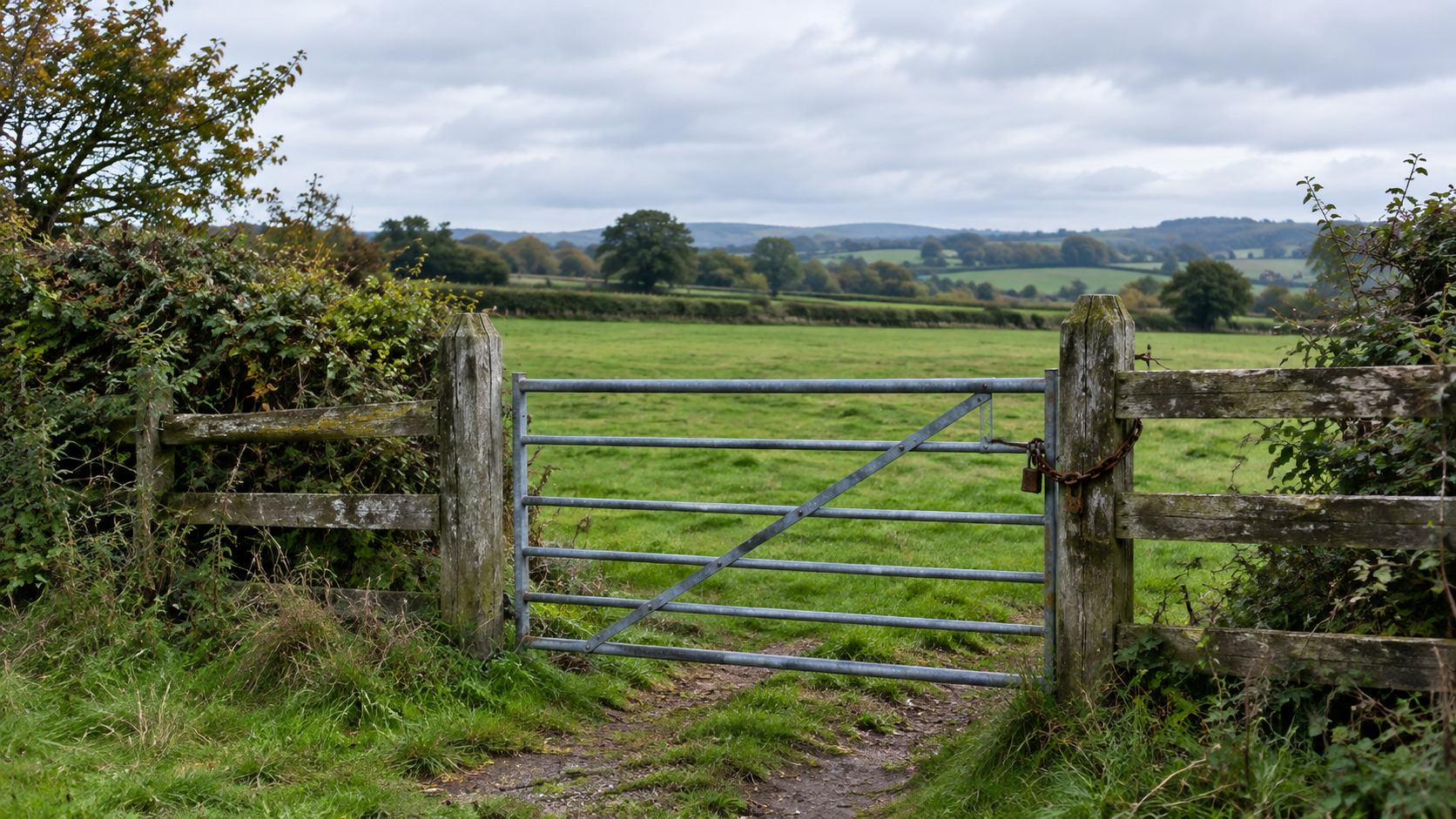
Enclosing land with a locked gate and maintained fences is some of the strongest evidence of factual possession in an adverse possession claim.
The underlying principle is that land should not lie in limbo. If the true owner takes no steps to recover land for many years while someone else treats it as their own, the law eventually recognises the reality on the ground. Since 13 October 2003, however, the Land Registration Act 2002 has made that much harder for registered land. Registered owners now get formal notice of any application and a straightforward way to object, which is why adverse possession today is less a “land grab” and far more a tool for tidying up genuine boundary anomalies.
The three legal tests every claim must pass
Whether the land is registered or not, the applicant has to prove the same three ingredients for the full qualifying period. These tests were confirmed by the House of Lords in JA Pye (Oxford) Ltd v Graham [2002] UKHL 30 and are set out in HM Land Registry’s guidance.
1. Factual possession
You must have had a sufficient degree of exclusive physical control over the land, judged by what an owner would do with land of that type. Fencing it off, fitting a locked gate, laying a drive, cultivating a garden, grazing animals and maintaining hedges all count. Occasional use, such as walking a dog across a field or parking now and then, usually does not.
2. Intention to possess
You must have intended to possess the land to the exclusion of everyone else, including the true owner, so far as reasonably practicable. You do not need to have believed you owned it, and you do not need an intention to own it, only to possess it. Acts that are visible to the world, like erecting a fence, are the best evidence of intention.
3. Possession without consent
Possession must be “adverse”, meaning without the owner’s permission. A tenancy, licence or informal “you can use it for now” agreement stops time running. A written, signed acknowledgement of the owner’s title also resets the clock. As the Upper Tribunal reminded everyone in February 2026 (see below), permission only counts if it comes from the owner or the owner’s agent, not from a third party.
Registered land: the 10-year rule under the Land Registration Act 2002
Once you can show at least 10 years of adverse possession ending on the date of the application, you apply on form ADV1 with a statement of truth (form ST1 is the recommended template) made no more than one month before you apply. If you are claiming only part of a title, you must include a signed plan showing exactly which land you claim. This is where many DIY applications fail: a sketch is not enough, and an inaccurate plan can see the whole application rejected or the wrong area registered.
Step 2 – The Land Registry notifies the owner
HM Land Registry serves notice on the registered proprietor, any registered chargee (usually the mortgage lender) and anyone else with a relevant interest. They have 65 business days to respond. The owner can consent, object, or serve a counter-notice on form NAP requiring the application to be dealt with under paragraph 5 of Schedule 6.
Step 3 – If a counter-notice is served, you need one of three conditions
If the owner serves a counter-notice, the applicant will only be registered if one of three conditions applies:
Estoppel: it would be unconscionable for the owner to dispossess the applicant because of an assurance the applicant relied on, for example being told they could build on the land.
Some other entitlement: the applicant is entitled to the land for another reason, such as under a will or a contract where the price has been paid.
Reasonable belief in a boundary case: the land is adjacent to land the applicant owns, the exact boundary has not been determined under section 60, and for at least 10 years the applicant (or a predecessor) reasonably believed the land belonged to them. The land must also have been registered for more than a year before the application.
Step 4 – The two-year “second chance”
If none of the conditions is met, the application is rejected. Crucially, the owner then has two years to take action, by starting possession proceedings or otherwise regaining control. If the squatter is still in adverse possession two years after the rejection, they can re-apply and, this time, will be registered without the owner being able to object. Owners who ignore a rejected application do so at their peril.
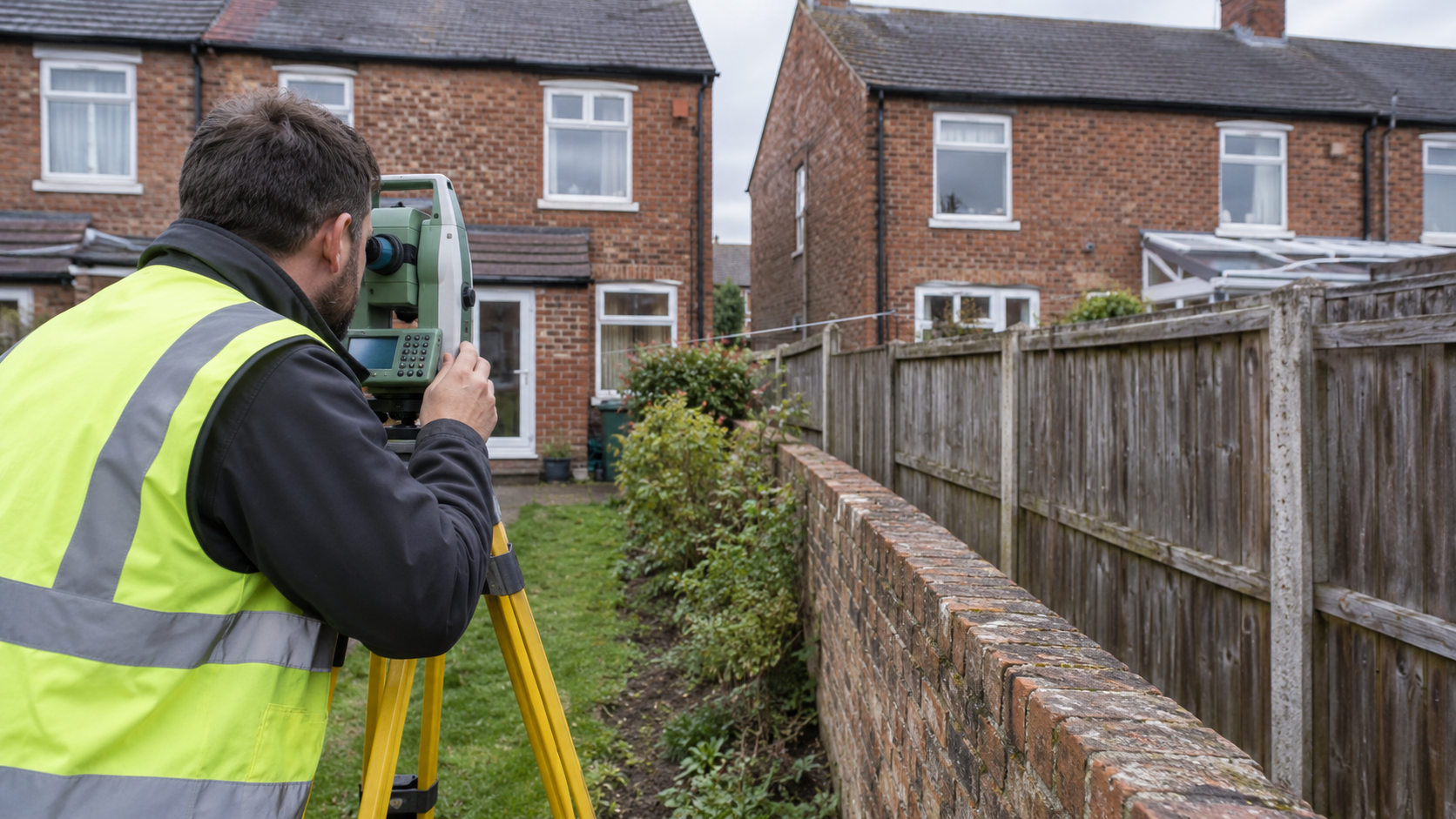
A measured boundary survey shows precisely how far the physical boundary departs from the registered title plan, which is essential evidence for both applicants and objecting owners.
Unregistered land: the 12-year rule under the Limitation Act 1980
Roughly one in eight land titles in England and Wales is still unregistered, typically older farmland, verges, church land and property that has not changed hands for decades. For this land the traditional limitation rules apply. Under section 15 of the Limitation Act 1980 the owner has 12 years to bring an action to recover land, and under section 17 their title is extinguished once that period expires. The squatter does not need the owner’s cooperation and the owner is not notified while time is running.
Longer periods apply to some owners: 30 years for Crown land and 60 years for Crown foreshore. The same is true for registered land held by the Crown as foreshore. Once 12 years have run, the squatter applies for first registration on form FR1, supported by a statement of truth and plan. HM Land Registry will normally grant possessory title rather than absolute title, which can later be upgraded. The detail is in HM Land Registry Practice Guide 5, updated on 1 June 2026. The same transitional rules apply to registered land where the 12 years had already run before 13 October 2003.
Registered vs unregistered land: adverse possession compared
Feature
Registered land (LRA 2002, Sch 6)
Unregistered land (Limitation Act 1980)
Minimum period
10 years (60 years Crown foreshore)
12 years (30 years Crown; 60 years foreshore)
Is the owner told?
Yes – formal notice with 65 business days to respond
No – owner’s title is simply barred after 12 years
Can the owner block it?
Yes, by counter-notice (form NAP), unless one of three conditions applies
No, once the period has expired
Application form
ADV1 plus statement of truth (ST1)
FR1 (first registration) plus statement of truth (ST1)
HM Land Registry fee
£130 per title, including site inspection (fee scale in force since 9 December 2024)
Treated as a voluntary first registration: £30 to £830 depending on land value
Class of title granted
Usually the same class as the existing title
Usually possessory title
Second application
Possible after a further 2 years if still in possession
Not needed
Fees are taken from the HM Land Registry fee guidance, which confirms the December 2024 scale still applies in 2026. Legal and surveying costs are additional.
What has changed: the latest adverse possession case law (2025–2026)
Brown v Ridley [2025] UKSC 7 – the Supreme Court fixes the “reasonable belief” trap
For more than a decade, the Court of Appeal’s decision in Zarb v Parry was read as requiring the 10 years of reasonable belief in a boundary case to run right up to the date of the application. That meant a neighbour who discovered the mistake and then took a few months to apply would fail. In February 2025 the Supreme Court unanimously rejected that reading. Mr and Mrs Ridley had built a house on land they reasonably believed was theirs between 2004 and February 2018, when planning enquiries revealed the error; they applied in December 2019. The court held that any period of at least 10 years of reasonable belief within the period of adverse possession is enough, restoring the First-tier Tribunal’s decision in the Ridleys’ favour. The court also dismissed a “de minimis” grace-period argument and a human-rights challenge to the 2002 Act regime (source: Osborne Clarke analysis, March 2025).
Crofts v Welsh [2026] UKUT 35 (LC) – permission must come from the owner
On 2 February 2026 the Upper Tribunal (Lands Chamber), Judge Elizabeth Cooke, dismissed an appeal against a decision registering Mrs Welsh as owner of part of a field at Bank Hall Farm that she had fenced, gated with the only key and used for horses since the 1980s. The appellant argued she had used the land with a neighbouring family’s permission. The tribunal held that the First-tier Tribunal’s finding of no permission was not clearly wrong and, in any event, consent from someone who did not own the land could not make her possession non-adverse. The case is a useful reminder that enclosure plus exclusive control over decades is very hard to defeat (source: Charles Russell Speechlys, 2026).
Criminal squatting and residential buildings
Since 1 September 2012, squatting in a residential building has been a criminal offence under section 144 of the Legal Aid, Sentencing and Punishment of Offenders Act 2012. The Court of Appeal in Best v Chief Land Registrar [2015] EWCA Civ 17 nevertheless held that this does not by itself prevent an adverse possession application. In reality, however, residential squatting claims are rare; the vast majority of successful applications concern gardens, driveways, verges and agricultural land.
How a surveyor helps with adverse possession claims
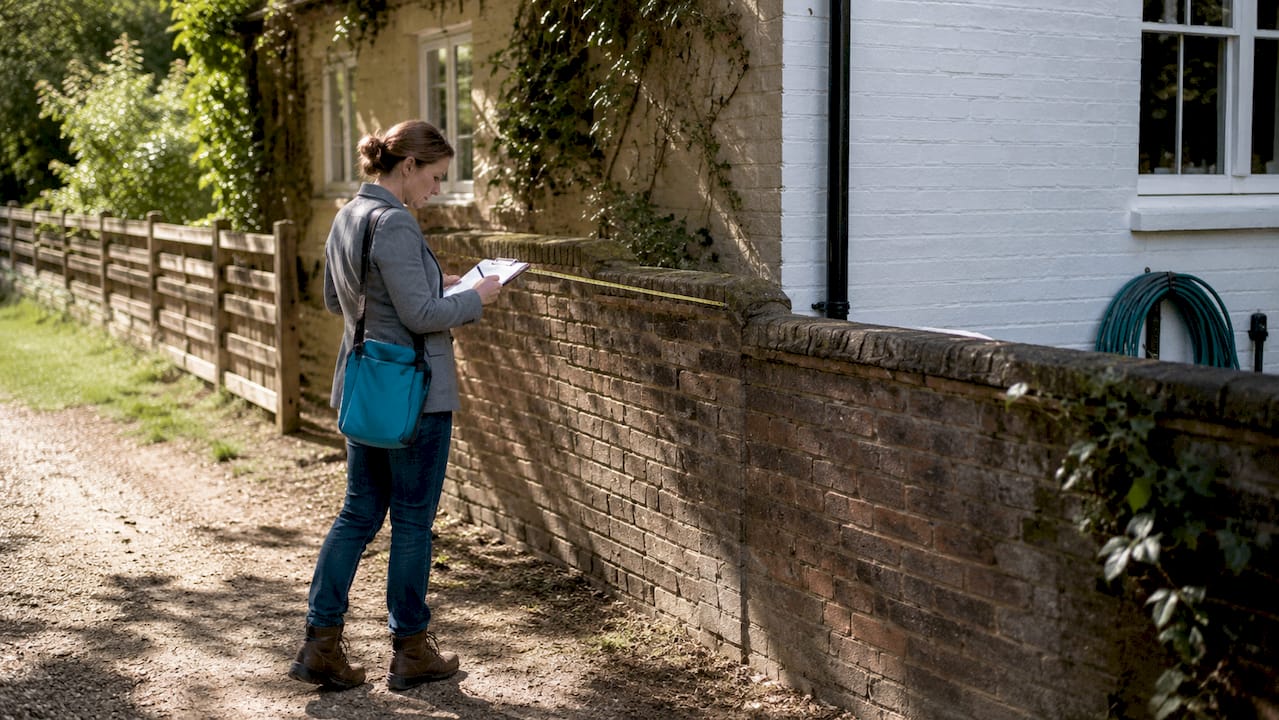
Adverse possession is decided on facts, and the most contested fact is usually where the boundary actually is compared with where the title plan suggests it should be. Land Registry title plans are drawn on Ordnance Survey mapping at 1:1250 or 1:2500 and show only general boundaries; they are not intended to fix the precise line. That is why both applicants and objecting owners rely on a measured survey or topographical survey of the disputed strip prepared by a suitably qualified, accredited surveyor.
A good boundary surveyor will:
Carry out an accurate measured survey of fences, walls, hedges, kerbs, buildings and other physical features, tied into the Ordnance Survey grid.
Overlay the registered title plan, pre-registration deeds and historic OS mapping to show how the occupied area differs from the paper boundary.
Examine aerial photography, historic imagery and physical evidence (weathering, fence-post age, tree growth) to help date when enclosure took place.
Prepare a scaled plan suitable for lodging with form ADV1 or FR1, which HM Land Registry requires when only part of a title is claimed.
Surveyors cannot give legal advice and this article is not a substitute for it; a solicitor should handle the application or objection. But the surveyor’s plan and report are frequently the single most persuasive document in the file. If you are already in a dispute, our guides to boundary dispute costs and outcomes and boundary dispute surveyor costs explain what to budget for.
Land Registry title plans show general boundaries only; a measured survey is needed to prove exactly how much land has been possessed.
How to make an adverse possession claim: step-by-step
Check the title. Download the register and title plan (£7 each) from HM Land Registry to confirm whether the land is registered and who owns it. An index map search (form SIM) will confirm whether unregistered land is affected.
Gather evidence. Dated photographs, receipts for fencing and landscaping, council tax or utility records, planning documents, statutory declarations from previous owners and neighbours, and aerial imagery.
Commission a measured survey. Instruct a suitably qualified, accredited surveyor to produce a scaled plan of the land possessed, overlaid on the title plan.
Prepare the statement of truth. Use form ST1 as a checklist: when possession began, what acts of possession were carried out, whether consent was ever given, and whether any of the statutory restrictions apply.
Submit the application. ADV1 for registered land (£130 per title) or FR1 for unregistered land, with the plan and supporting documents. Applications on registered land must be made within the correct window if you have recently been evicted (within six months, and not under a court order).
Respond to the outcome. If the owner consents or does not respond, you are registered. If a counter-notice is served and you cannot satisfy one of the three conditions, diarise the two-year re-application date and keep possessing the land. Disputes go to the First-tier Tribunal (Property Chamber).
How to protect your land from an adverse possession claim
If you are a landowner, especially of a vacant plot, a strip behind a garage, an access way or agricultural land, the recent cases underline a simple message: inspect regularly and act promptly.
Walk the boundaries at least once a year and compare them with your title plan; a neighbour building on land you own needs to be challenged in writing immediately.
If someone is using your land, put the arrangement in writing as a licence or tenancy. Permission defeats adverse possession.
Consider voluntary first registration of unregistered land. Once registered, you will receive notice of any application and can object.
Register for alerts: HM Land Registry’s free Property Alert service flags activity on up to ten titles, and form ADV2 lets you be notified of future adverse possession applications against a title.
If you receive a notice, serve a counter-notice on form NAP within 65 business days, and take legal advice at once.
After a rejected application, recover possession or regularise the position within two years, or the applicant can re-apply and succeed automatically.
Where the land is a wall, fence or hedge shared with a neighbour, it is also worth understanding the difference between a party fence wall and a boundary wall, because party structures are governed by a different statutory framework entirely.
Adverse possession and buying or selling property
Adverse possession frequently surfaces during conveyancing, when the measured extent of a garden does not match the title plan or when a seller cannot prove title to a strip they have used for decades. Options include a statutory declaration with title indemnity insurance, a boundary agreement with the neighbour, an application for a determined boundary under section 60, or an adverse possession application before exchange. Buyers should ask their surveyor to flag discrepancies between the physical boundaries and the title plan during a building survey; we cover this and other title defects that create investment risk in a separate guide. A pre-purchase building survey that notes fence lines, encroachments and shared accesses gives your solicitor the prompt to investigate before you are committed.
Why choose Survey Merchant for your adverse possession and boundary survey?
Adverse possession claims are won on precise, well-presented evidence, and that is where Survey Merchant adds value. Here is why homeowners, landowners and solicitors across the UK use us:
An accredited panel matched to the job. We connect you with suitably qualified surveyors accredited by bodies such as RICS, CIOB and RPSA, including specialists in boundary identification, measured surveys and expert witness work.
Nationwide coverage. From rural field boundaries to London garden strips, we have local surveyors who understand regional mapping, construction and land use.
Fast turnaround. Adverse possession has hard deadlines: 65 business days to respond to a notice and two years after a rejection. We prioritise time-critical instructions.
Transparent, competitive fixed fees. You will know the cost of your measured survey or expert report before you instruct, with no hidden extras.
Impartial, tribunal-ready evidence. Our surveyors prepare plans and reports to the RICS boundaries professional standard and understand their duty to the tribunal when acting as experts.
End-to-end support. We work alongside your solicitor, from initial site survey to a Land Registry-compliant plan and, if needed, expert evidence at the First-tier Tribunal.
This article provides general information about adverse possession in England and Wales as at October 2026 and is not legal advice. Scotland and Northern Ireland have different rules. Always take advice from a solicitor and a suitably qualified, accredited surveyor about your own circumstances.
Related guides
No items found.
Book a RICS surveyor
Survey Merchant provides vetted RICS surveyors across 100+ UK locations at fixed fees:
Adverse possession is the process by which someone who has occupied land without the owner's permission, exclusively and continuously for a set period, can apply to HM Land Registry to be registered as the owner. In England and Wales the period is 10 years for registered land under the Land Registration Act 2002 and 12 years for unregistered land under the Limitation Act 1980. The applicant must prove factual possession, an intention to possess and possession without consent for the whole period.
How many years do you need for adverse possession?
At least 10 years for registered land, ending on the date of your application, and at least 12 years for unregistered land. Longer periods apply where the Crown owns the land (30 years) or it is Crown foreshore (60 years). Possession must be continuous; a gap, a licence from the owner or a written acknowledgement of the owner's title will restart the clock.
Can a registered owner stop an adverse possession claim?
Usually, yes. HM Land Registry notifies the registered proprietor and lender, who have 65 business days to object or serve a counter-notice on form NAP. If a counter-notice is served, the applicant is only registered if one of three conditions applies: estoppel, another entitlement to the land, or 10 years' reasonable belief in a boundary case. If the application is rejected, the owner must then recover the land within two years or the applicant can reapply and succeed.
What did the Supreme Court decide in Brown v Ridley?
In Brown v Ridley [2025] UKSC 7 the Supreme Court held that, for the boundary condition in Schedule 6 of the Land Registration Act 2002, the applicant needs any period of at least 10 years of reasonable belief that the land was theirs during their adverse possession. The belief does not have to continue right up to the date of the application, overturning the stricter reading of Zarb v Parry. This makes it easier for neighbours to regularise long-standing fence lines.
How much does an adverse possession application cost?
HM Land Registry charges £130 per title for an application to register an adverse possessor of registered land (form ADV1), which includes the site inspection fee. First registration of unregistered land based on adverse possession is treated as a voluntary first registration, costing between £30 and £830 depending on the land's value. Solicitor's fees, a measured boundary survey and any tribunal costs are additional.
Do I need a surveyor for an adverse possession claim?
A surveyor is not legally required, but when you are claiming part of a title HM Land Registry needs an accurate signed plan, and disputes are decided on evidence of where the physical boundary sits compared with the title plan. A suitably qualified, accredited surveyor can produce a measured survey, overlay the title plan and historic mapping, and act as an expert witness at the First-tier Tribunal. Survey Merchant can match you with a boundary specialist anywhere in the UK.