Leasehold
Aug 2, 2026
Understanding Red Flags in Survey Reports
How to spot serious survey red flags, estimate repair costs, and get specialist reports to renegotiate or walk away.

A bad survey result does not always mean you should pull out - but a Condition Rating 3 means I’d stop and check the risk before exchange.
If I were buying a home in the UK, I’d treat survey red flags in three groups:
The big point is simple: some defects are just repair jobs, while others can affect mortgage approval, insurance, or resale. Costs can climb fast too. A rewire may be around £4,000 to £8,000, a new roof can run from £5,000 to £15,000+, and underpinning can hit £10,000 to £30,000+.
Before I’d commit, I’d do four things:
| Red flag type | What it can mean | What I’d do next |
|---|---|---|
| Cracks or movement | Possible subsidence or structural trouble | Get a structural engineer |
| Roof or damp issues | Water damage, timber decay, leak spread | Get a roofer or damp surveyor |
| Old wiring / asbestos | Safety risk or work before moving in | Get an EICR or asbestos check |
| Knotweed / legal gaps | Lender refusal, resale trouble, delays | Speak to a specialist and solicitor |
In short, I’d use the survey to sort budgetable repairs from deal-breaking risk. That puts you in a better position to decide whether the home is still worth buying.
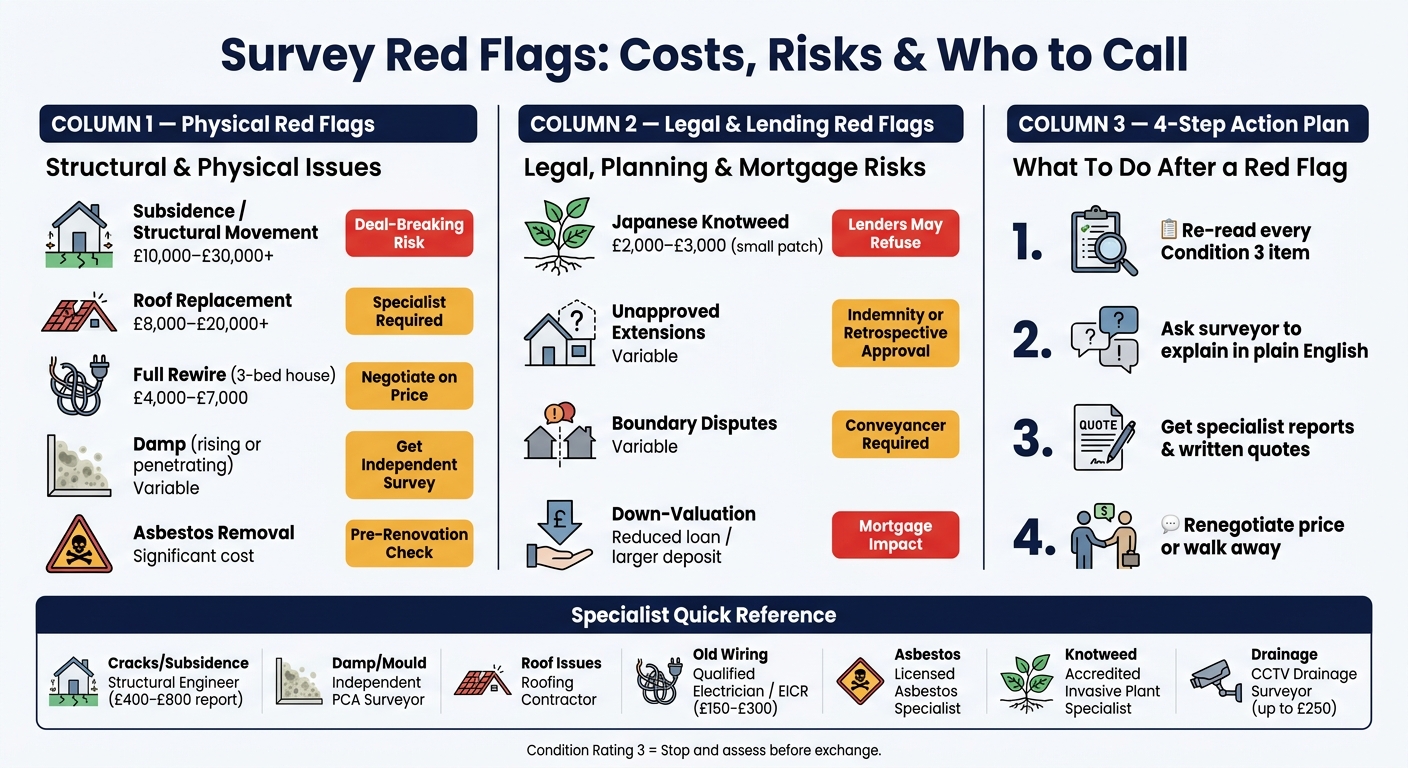
Survey Red Flags: Costs, Risks & Who to Call
Once a survey moves past the general condition of a property, the main issue is simple: does the defect affect the structure, keep water out, or create a safety problem?
Small hairline cracks in plaster are often just old settlement. But stepped diagonal cracks, especially around doors and windows, combined with sticking doors or sloping floors, can point to structural movement [5][2]. Those are the signs buyers tend to take most seriously, because they can change the whole deal, whether that means going ahead, asking for a price cut, or pulling out.
If movement is suspected, you’ll usually need a structural engineer’s report. That typically costs £400 to £800 [3]. And if drainage might be part of the problem, a CCTV drainage survey can cost up to £250 [6].
If movement is ruled out, the next big concerns are usually water getting in and roof failure.
A slipped tile here and a blocked gutter there are pretty standard. A sagging roofline, rotten timbers, or large areas of roof covering failure are a different story. These problems matter because what you can see is often only part of it. The main thing is to pin down the cause, the spread, and the likely repair bill [3][5].
| Issue Type | Typical Signs | Common Remedial Action |
|---|---|---|
| Roof defects | Sagging ridge, rotten trusses, widespread leaks, chimney debris | Specialist roofer; possible full re-covering |
| Penetrating damp (water getting in from outside) | Damp patches after rain, staining on walls, failed render | Fix external leaks, repoint, repair gutters |
| Rising damp (moisture rising from the ground) | Tide marks on ground-floor walls, peeling wallpaper | Install or repair damp-proof course (DPC) |
| Condensation | Black spot mould, misted windows, musty smell | Improve ventilation (extractor fans, air bricks) |
A full roof replacement usually costs between £8,000 and £20,000+ [3]. For damp issues, it’s best to use an independent PCA-qualified surveyor who does not sell treatment. That way, you’re paying for a diagnosis, not a sales pitch [1][3].
Some red flags aren’t structural at all, but they can still stop a purchase in its tracks or create an immediate safety issue.
Some defects won’t make a building fall down, but they can still hit safety, mortgage approval, and resale.
Electrical systems usually last around 25 years [2]. An old fuse board without RCD protection, or wiring described as beyond safe working life, points to a fire risk. In that case, you’d need an Electrical Installation Condition Report (EICR) from a qualified electrician, which usually costs about £150–£300 [3]. A full rewire for a three-bedroom house tends to cost £4,000–£7,000 [3].
Asbestos is common in properties built before 2000. You might find it in Artex ceilings, floor tiles, insulation, or garage roofs [6][2]. The main risk comes when it’s disturbed during building work, which is why a specialist survey should be done before any renovation starts.
Japanese knotweed is another issue that tends to worry lenders. It often needs an accredited management plan [4][1]. Even removing a small patch usually costs £2,000–£3,000 [6].
The wording in the survey matters a lot here. It helps you tell the difference between something cosmetic, something that needs more checks, and something that could affect the sale itself.
| Issue | Typical Survey Wording | Specialist to Consult | Impact on Value/Lending |
|---|---|---|---|
| Electrics | "System beyond safe working life", "Needs an EICR" | Qualified electrician (EICR) | Negotiable repair cost; rarely affects lending unless dangerous |
| Asbestos | "Suspected asbestos-containing material (ACM)" | Licensed asbestos specialist | Can involve significant removal cost; may affect resale if widespread |
| Japanese knotweed | "Presence of invasive species within 7 m of the boundary" | Accredited knotweed specialist | High; many lenders refuse mortgages without a management plan |
| Structural movement | "Evidence of progressive movement", "Subsidence suspected" | RICS-accredited structural engineer | Very high; can make the property unmortgageable until stabilised |
Physical defects are only part of the picture; survey reports also flag legal and valuation risks.
Surveys don't just point out cracked render or a tired roof. They can also bring up issues that hit the property's title, consent status, and mortgage prospects. In plain terms, some problems aren't about fixing the building at all. They're about whether the home can be sold, financed, or insured without hassle.
Boundary mismatches need a conveyancer to compare the title plan with what the survey shows. If the lines on paper don't match the site, that can turn into a legal problem rather than a building one.
Unapproved alterations need checks on both planning and building control. When approval paperwork is missing, a solicitor may need to look at retrospective building control approval or indemnity cover to deal with the risk of enforcement. If no one deals with it, the issue can stall resale, slow down exchange, or leave the buyer exposed to enforcement action.
If paperwork is missing, the next job is to check whether that gap also affects mortgage approval.
If the valuer puts the property below the agreed price, the lender may offer less than expected. That usually means one of two things: a bigger deposit from the buyer or a smaller loan. In more serious cases, the lender may retain part of the loan until repairs are done. Active subsidence and Japanese knotweed can lead to that outcome. Knotweed can also mean a lender will not proceed unless there's a management plan in place from an accredited specialist [1][4].
The impact often comes down to the type of problem involved:
| Issue | Main impact | Who handles it |
|---|---|---|
| Technical defect (e.g. damp, roof failure) | Direct repair costs; health and safety risks | Specialist contractors (roofers, damp experts) |
| Legal/planning issue (e.g. unapproved extension, boundary dispute) | Enforcement risk; difficulty reselling | Conveyancing solicitor, building control |
| Lending risk (e.g. subsidence, Japanese knotweed) | Lower loan, held-back funds, or mortgage refusal | RICS valuer, structural engineer, accredited invasive plant specialist |
The right professional can tell you whether the issue can be fixed, funded, or whether it's a sign to walk away.
When a survey throws up a red flag, don't panic. The next job is to check the defect is real and work out what it could cost you. Read the report twice, then speak to the surveyor and ask for a plain-English run-through. Be blunt if you need to: ask whether they would buy the property if that issue was still unresolved.
Start by confirming the problem. Then get a specialist report and a firm quote. If the survey marks something as Condition 3, take that as a sign to bring in a specialist.
| Red Flag | Recommended Specialist |
|---|---|
| Structural cracking / subsidence | Structural engineer |
| Damp or mould | Independent damp surveyor |
| Roof sagging or leaks | Roofing contractor |
| Old wiring or fuse board | Qualified electrician (EICR) |
| Suspected asbestos | Licensed asbestos specialist |
| Japanese knotweed | Accredited invasive plant specialist |
| Drainage concerns | CCTV drainage surveyor |
Before exchange, get at least two or three written quotes from independent specialists. That matters. A written quote carries more weight than a rough estimate when you negotiate [8][7].
Once you have written costs, you can make a clear decision. If repairs are needed, ask for a price reduction that matches the cost of putting the problem right. In most cases, that's better than asking the seller to arrange the work themselves. Use written quotes to support that request [7].
Some problems are too big to shrug off. Active subsidence, Japanese knotweed, suspected asbestos, or major structural failure can turn a purchase into a money pit. If the seller won't shift on price and the defects are serious, walking away is a valid choice. Do not exchange until the defect is fully priced and understood. After exchange, you are legally committed [6][9].
For older or more complex homes, step up to a Level 3 survey before exchange [3][6].
If specialist checks still leave too much doubt, stop there and get fuller advice before you go any further.
Once you have the survey findings, the next step is sorting fixable issues from deal-breaking risk. A survey matters when you can see which points affect the purchase and which ones don't. Some defects need action straight away. Others can sit on your budget list for later. That's where professional survey advice comes in.
Use the survey, any specialist reports, and written quotes to weigh up repair costs, legal risk, and lender impact. That gives you a firmer footing to renegotiate, go ahead, or walk away. Survey Merchant connects buyers with impartial surveyors for Level 2 and Level 3 reports, valuations, and related property advice.
In RICS survey reports, Condition 3 means there’s a serious defect that needs urgent attention, repair, replacement, or further professional investigation. It can signal major safety risks or large costs.
That said, it doesn’t always mean there’s an obvious fault you can see straight away. Surveyors may give this rating to services like electrics or plumbing when their testing is limited. So it’s worth reading the surveyor’s comments closely and thinking about getting independent specialist reports before you move ahead.
Not always. A survey report with red flags doesn't automatically mean you should walk away from the purchase. In many cases, especially with older homes, some issues are common. They may point to routine upkeep rather than a reason to scrap the deal.
What matters is the scale of the problem, the likely repair bill, and what it could mean over time. Get specialist reports and independent quotes so you have something solid to work from. Then you can use that evidence to renegotiate the price or ask the seller to fix the issues before exchange.
If the risks, costs, or uncertainty start to feel too high, stepping back may be the sensible move.
A Level 3 Building Survey is usually the right choice for older homes built before 1920, listed buildings, and properties with more involved features, such as extensions, flat roofs, or a past issue with flooding.
It also makes sense if you think there may be structural problems, plan to carry out renovation work, or are buying a larger or non-standard home. This type of survey gives you detailed repair advice, a schedule of defects, and estimated costs. That can make budgeting far easier and give you a stronger position when it comes to price negotiations.
Survey Merchant provides vetted RICS surveyors across 100+ UK locations at fixed fees:
→ Level 2 Home Survey (HomeBuyer Report)
→ Level 3 Building Survey (full structural survey)
→ RICS Red Book property valuations
→ Party wall surveyors — notices, awards & schedules of condition
→ Expert witness surveyors — CPR Part 35 reports for property disputes