Leasehold
Jul 16, 2026
Understanding HomeBuyer Report Ratings
Clear guide to RICS Level 2 HomeBuyer Report ratings — what Green, Amber, Red, NI and R mean, costs, and how to act on findi

The HomeBuyer Report (RICS Home Survey Level 2) is a property condition assessment commonly used by UK buyers. It uses a traffic light system to rate property elements - helping you identify issues, plan repairs, and negotiate a fair deal. Here's how the ratings work:
This system simplifies complex property details, making it easier to prioritise repairs and budget accordingly. Costs for a HomeBuyer Report range from £400 to £1,000. Use the findings to negotiate prices, request repairs, or reassess your purchase decision.
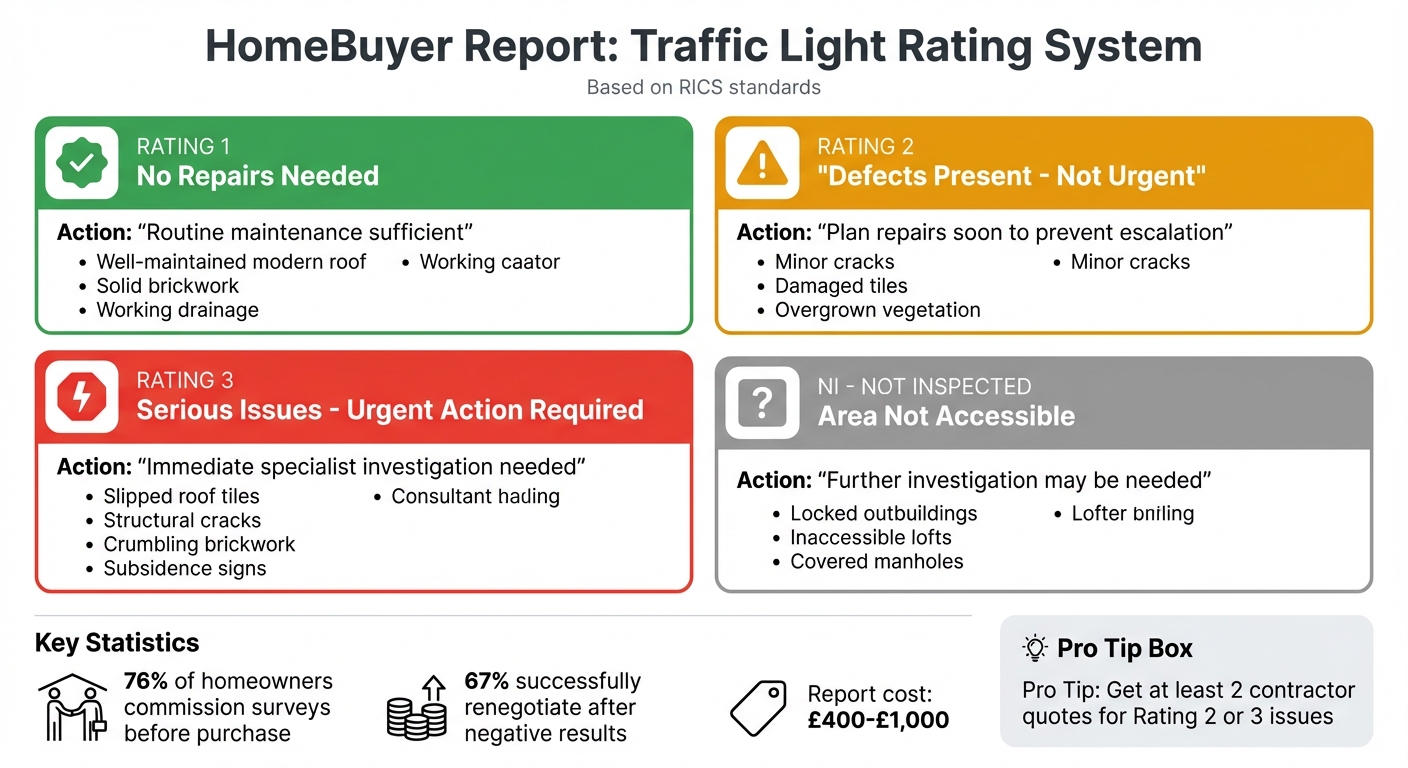
HomeBuyer Report Traffic Light Rating System Guide
The traffic light system, developed by RICS, simplifies property condition reports by using a visual approach. Rather than overwhelming buyers with technical jargon, it provides an easy-to-understand snapshot of any required repairs.
Surveyors assign a rating - 1, 2, or 3 - to various parts of the property, such as the roof, walls, ceilings, and services. These ratings are based solely on visual inspections, with the most pressing issues prioritised to give buyers a clear understanding of the property’s condition.
"The use of simple traffic light ratings gives readers an easy 'at a glance' way of seeing where the main problems lie."
- Ian, RightSurvey
With around 76% of homeowners commissioning surveys before purchasing a property [5], understanding these ratings can help buyers make informed decisions - whether that means proceeding with the purchase, renegotiating the price, or requesting repairs before finalising contracts. Let’s break down what each rating means.
Green indicates that the property element is in good shape and doesn’t need immediate repairs. Routine maintenance, such as cleaning, painting, or seasonal checks, is usually enough to keep it in excellent condition.
"A green rating indicates that the element assessed requires no immediate repairs and should be maintained in the usual manner."
Amber signals that some defects are present, which will need attention in the near future, though they aren’t urgent or hazardous. Examples might include minor cracks, slight tile damage, or overgrown plants near walls.
These defects should be addressed promptly to prevent them from worsening. Amber ratings also help buyers anticipate future maintenance costs.
Red highlights serious issues requiring immediate action. Examples include slipped roof tiles, damaged windows, spalling brickwork, or signs of structural movement like subsidence.
Surveyors often assign red ratings to services such as electrics or heating systems by default, as visual inspections don’t include technical testing. Additionally, elements like steep staircases might receive a red rating if they don’t meet current building regulations, even if they complied when built. For red-rated issues, it’s wise to get quotes from contractors to assess the financial implications.
Beyond the traffic light ratings, two additional labels provide extra context for areas that couldn’t be fully assessed or require further documentation.
Here's a straightforward guide to the traffic light system used in HomeBuyer Reports, summarising what each rating means and how to respond:
| Rating | Colour | Meaning | Action Required | Example Issues |
|---|---|---|---|---|
| 1 | Green | No repairs needed at the moment. | Routine maintenance will suffice. | Well-maintained modern roof, solid brickwork, working drainage. |
| 2 | Amber | Defects are present but not critical or urgent. | Plan for repair or replacement soon; schedule maintenance. | Minor cracks, damaged tiles, overgrown garden vegetation. |
| 3 | Red | Serious defects or urgent repairs required. | Immediate action or specialist investigation is necessary. | Slipped roof tiles, broken windows, crumbling brickwork, structural cracks. |
| NI | N/A | Not inspected. | Further investigation may be needed if the area is crucial. | Locked outbuildings, inaccessible lofts, covered manholes. |
Amber ratings signal issues that, while not urgent, need attention to prevent them from escalating. For any issues rated 2 or 3, it’s a good idea to obtain at least two contractor quotes. This helps you understand the costs involved and can strengthen your position if you need to renegotiate the purchase price [6][7].
Surveyors prioritise defects by severity, ensuring the most critical problems are highlighted first in the summary [4]. It’s worth noting that the condition of a property doesn’t strictly depend on its age. Older homes can score well, while new builds might still receive Amber or Red ratings based on their specific condition at the time of inspection.
Next, we’ll break down how to interpret and use the ratings summary in your report.
The Summary of Ratings page is often the first thing buyers focus on when they receive their HomeBuyer Report. It provides a quick snapshot of the property's condition using a traffic light system, making it easy to see which areas need attention and which are in good shape [3][1]. This summary ties directly to the more detailed ratings found earlier in the report.
Each major element of the property - like the roof, walls, windows, services, and drainage - is listed with its corresponding colour-coded rating. This system helps you assess the condition of the property at a glance.
It's not unusual to see multiple Red (Condition Rating 3) ratings, especially for services such as electrics or plumbing. As Garrington Property Finders points out:
"The traffic light rating system allows you to quickly identify significant issues. However, some items, especially services like electrics or plumbing, might automatically receive a Condition Rating 3 (Red) due to the surveyor's limited testing abilities" [3].
This means that a Red rating for these services doesn’t necessarily indicate a failure but often suggests that further specialist checks are needed to ensure safety.
Pay close attention to NI (Not Inspected) ratings. These are used for areas the surveyor couldn’t access, such as a locked outbuilding or a loft packed with stored items, which could potentially hide problems [7]. If these areas are important to you, it’s worth arranging access and requesting a follow-up inspection to rule out any hidden issues.
Lastly, the summary also includes the reinstatement cost - an estimate of how much it would cost to rebuild the property for insurance purposes. Keep in mind, this figure is purely for insurance and not related to the market value of the property [7].
Once you've reviewed the survey Summary, it’s time to take action. Pay special attention to Condition Rating 3 (Red) items, as these represent the most urgent issues. As noted, "Condition Rating 3 are the 'killer items' that need to be rectified immediately" [6]. These could include serious problems like subsidence, structural timber damage (e.g., dry rot), dangerous electrics, or invasive species such as Japanese Knotweed. These defects require immediate specialist attention, ideally before you exchange contracts.
It’s crucial to consult your surveyor to confirm the severity of each defect. Some items, such as electrics or plumbing, might automatically receive a CR3 rating because surveyors aren’t equipped to perform specialist tests - not necessarily because a fault has been confirmed [6][3]. Once you’ve identified which issues are genuine concerns, gather at least two independent written quotes from trusted contractors. These quotes are essential for negotiation. In fact, in 2025, 18% of failed property transactions occurred because buyers couldn’t renegotiate successfully after a survey [8]. Differentiating between immediate repairs and future maintenance is key to planning your next steps.
Condition Rating 2 (Amber) items, on the other hand, highlight defects that aren’t urgent but will need attention eventually. Examples include rotten window frames or minor damp patches [8]. These items give you time to plan repairs and budget accordingly. Use CR2 findings to create a realistic maintenance plan for the first few years of owning the property.
When it comes to negotiating based on survey findings, you have options. Present repair quotes and relevant survey extracts to the seller via your estate agent. Interestingly, 67% of buyers successfully renegotiate their offer or request repairs after receiving negative survey results [9]. Your choices typically include:
Before proceeding with any damp or timber repairs, check if the seller has valid guarantees in place [2]. This simple step could save you significant costs.
If the structural repairs exceed your budget or the report uncovers long-term stability concerns, you may need to reconsider your offer. Remember, a property’s value lies in what you’re willing - and able - to pay. Statistics show that 10% of homebuyers successfully renegotiate the price, while 9% convince sellers to address problems before completion [10]. Your HomeBuyer Report isn’t just a formality; it’s a powerful tool. By using it wisely, you can make an informed decision and secure a fair deal that aligns with your financial priorities.

A reliable HomeBuyer Report is essential for making informed property decisions. Survey Merchant connects buyers with a network of professional surveyors across the UK, offering independent assessments that prioritise your needs - not those of mortgage lenders or estate agents [11]. These reports provide detailed insights to help you make decisions with confidence.
Surveyors use advanced diagnostic tools, including damp meters, to identify hidden issues such as roof damage, wall defects, or ventilation concerns. Reports are typically delivered within days, allowing you to move forward quickly. Each report covers the property's construction details, including timber, insulation, drainage, and even local amenities.
One standout feature of Survey Merchant is its focus on highlighting urgent issues - like gas, electrical, and drainage problems - before contracts are exchanged. This ensures that critical aspects are addressed promptly. Additionally, the report includes a section specifically for your legal adviser, flagging areas that may require further investigation, such as structural repairs, property boundaries, or access rights. This level of detail allows you to approach negotiations with clarity and confidence. As Survey Merchant explains:
"A report in hand can serve as ammunition in renegotiating the purchase price or in persuading the owner to carry out the repairs themselves prior to exchange" [11].
If your report reveals Red or Amber ratings, it might be wise to commission a separate defect cost report to determine repair expenses, as standard reports don’t include cost estimates. The cost of a RICS Level 2 Home Survey ranges from £400 to £1,000, depending on the property's size and location [2][1] - a small price compared to the potential cost of missed issues.
By relying on expert surveyors and thorough reporting, you can avoid unexpected repair bills, negotiate effectively, or even decide to walk away if necessary. Survey Merchant emphasises:
"We recommend you do not skimp on the cost of a building survey to save a small amount, as it is crucial to ascertain as much information about the property condition as possible" [11].
HomeBuyer Report ratings offer valuable insights for making informed property decisions. The traffic light system simplifies this process by highlighting areas that need urgent attention (Red), those requiring repairs in the near future (Amber), and elements that only need routine maintenance (Green). As Countrywide emphasises, "Your survey is an important document, you should read it from cover to cover and highlight any sections which you don't understand" [7]. Taking the time to carefully review the full report is essential to fully grasp the significance of each rating. For any Red-rated issues, it's wise to seek professional quotes from contractors before committing to a purchase.
The cost of a RICS Level 2 HomeBuyer Report, ranging from £400 to £1,000 [2], is a small price to pay compared to the potential financial strain of unexpected structural problems, damp, or subsidence. These reports not only flag risks but also provide clarity on required actions and help you budget appropriately.
For expert support, Survey Merchant connects buyers with RICS-regulated surveyors who produce thorough, unbiased reports within days. These reports pinpoint critical issues, empowering you to make well-informed decisions. By understanding and addressing report findings, you can approach your property purchase with confidence.
A Red rating in a HomeBuyer Report signals a serious issue that demands immediate attention. This could involve major repairs or even potential safety hazards.
If you encounter a Red rating, it's crucial to arrange a professional inspection to assess the problem in detail. Gather repair or replacement quotes to estimate the costs involved. It's also wise to consult a qualified surveyor to understand the full extent of the issue. This process will help you decide whether to move forward with the purchase, renegotiate terms, or reconsider altogether.
The HomeBuyer Report is a handy resource when it comes to negotiating the price of a property. It breaks down the condition of the property using a traffic light system: green means everything is in good shape, amber points to minor concerns, and red signals serious issues that need attention. Common problems flagged in these reports include damp, roof damage, electrical issues, or structural faults.
If the report uncovers major defects, it can be a powerful tool for negotiation. You might use it to request a price reduction or ask the seller to fix the issues before the sale is finalised. For instance, if the report highlights expensive repairs, the estimated costs can back up your case for a lower price. By carefully reviewing and understanding the report's findings, you can make a well-informed decision and steer clear of overpaying for a property with hidden problems.
A Red rating in a HomeBuyer Report signals that the surveyor has found serious defects or problems needing immediate attention. For systems like electrics or plumbing, this might point to safety concerns, such as outdated wiring, faulty installations, or risks of major damage, like leaks or system breakdowns.
Taking swift action is essential to ensure the property remains safe and to prevent expensive repairs down the line. If you encounter a Red rating, it’s wise to consult a professional or arrange further inspections to assess the issue fully and determine the best course of action.
Survey Merchant provides vetted RICS surveyors across 100+ UK locations at fixed fees:
→ Level 2 Home Survey (HomeBuyer Report)
→ Level 3 Building Survey (full structural survey)
→ RICS Red Book property valuations
→ Party wall surveyors — notices, awards & schedules of condition
→ Expert witness surveyors — CPR Part 35 reports for property disputes