Building Surveying
Jul 16, 2026
Schedule of dilapidations: tenant and landlord guide
Understand the crucial schedule of dilapidations for tenants and landlords. Learn how to avoid costly repairs and navigate lease exits effectively.

A schedule of dilapidations is the landlord’s formal document listing every repair, reinstatement, or maintenance breach a tenant must address at lease end or compensate for financially. It is the single most consequential document in a commercial lease exit, and misunderstanding it costs tenants and landlords thousands of pounds every year. Whether you are approaching the end of a lease, mid-term on a long commercial agreement, or about to sign a new one, knowing how this document works is not optional. It is the foundation of every dilapidations assessment.
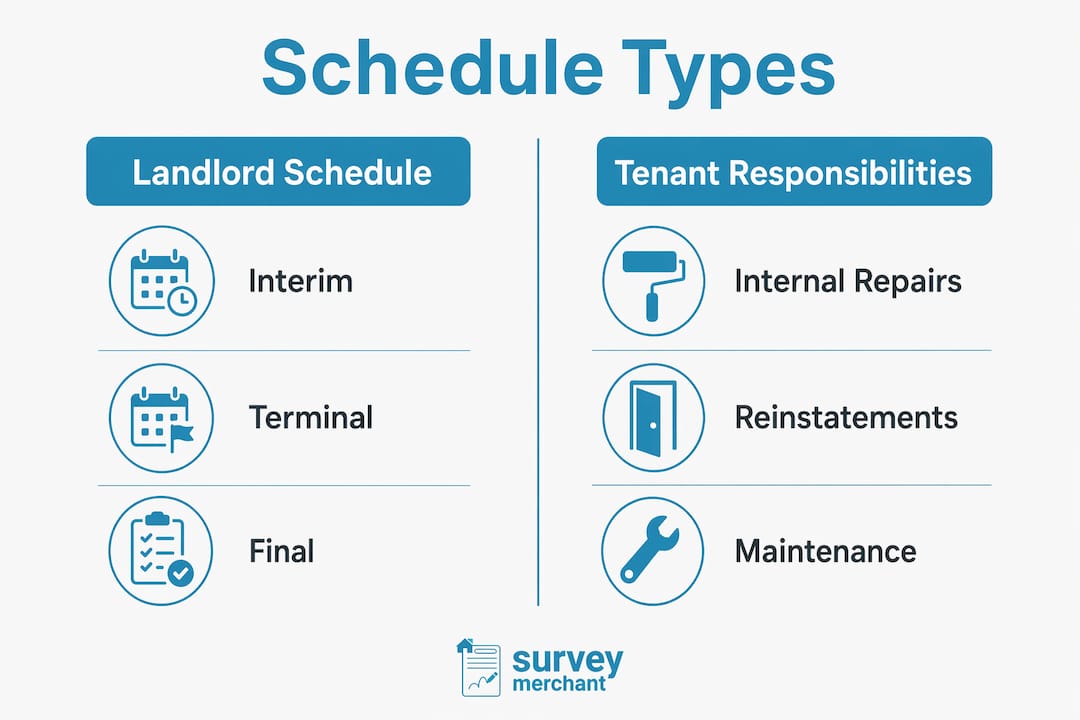
Schedules of dilapidations fall into three categories: Interim, Terminal, and Final. Each serves a distinct purpose and arrives at a different point in the lease lifecycle.
Interim schedules are served during the lease term, typically when a landlord identifies ongoing maintenance failures. They are not a claim for money but a formal notice requiring the tenant to carry out specific works while still in occupation. Ignoring an interim schedule is a serious mistake, as it can compound liability by the time the lease ends.

Terminal schedules are the most common type and the most financially significant. Served near or at lease expiry, they formalise the landlord’s full claim for repair, reinstatement, and any unauthorised alterations. This is the document most tenants encounter and the one that triggers the formal dilapidations process.
Final schedules follow after the lease has ended, once the landlord has assessed the actual cost of remedial works. They convert the terminal schedule into a financial demand, accounting for works already completed or costs actually incurred.
Key points about timing and protocol obligations:
Pro Tip: If you are a tenant within 12 months of lease expiry, commission a dilapidations risk assessment now. Knowing your likely exposure before the landlord serves their schedule gives you time to carry out works at your own pace and at lower cost.
A schedule of dilapidations details every breach of the tenant’s obligations under the lease, paired with a cost estimate for each item. Understanding its structure helps both parties assess whether a claim is fair or inflated.
A well-prepared schedule contains the following components:
| Component | Purpose |
|---|---|
| Lease clause references | Establishes legal basis for each breach claimed |
| Schedule of condition comparison | Limits or extends tenant liability based on original state |
| Itemised breach list | Defines the scope of remedial works required |
| Cost estimates | Converts physical breaches into a financial demand |
The cost estimates in particular deserve scrutiny. Initial dilapidations claims may overstate costs, and a chartered surveyor experienced in dilapidations can identify where figures have been inflated. This is not unusual. It is standard practice for landlords to open high, expecting negotiation.
The Dilapidations Protocol, which applies to commercial property in England and Wales, sets out a structured timetable that both parties must follow. Departing from it without good reason can affect costs awards if the matter proceeds to litigation.
The core timeline works as follows:
“Both landlords and tenants should prioritise alternative dispute resolution throughout the claim process, with litigation treated as a last resort.”
Alternative Dispute Resolution, including expert determination and mediation, is actively encouraged by the Protocol. It is faster, cheaper, and far less adversarial than court proceedings. In practice, the majority of dilapidations claims settle through negotiation between surveyors before either party instructs solicitors.
Tenant repair responsibilities typically cover non-structural internal works, while landlords handle structural repairs and common areas. However, the exact division depends entirely on the lease type and its specific wording.
In a full repairing and insuring (FRI) lease, the tenant bears responsibility for the entire property, including the structure, roof, and external fabric. This is the most common arrangement in UK commercial property and the one that generates the largest dilapidations claims. In a shorter licence or internal repairing lease, the tenant’s obligations are limited to the interior, and the landlord retains structural liability.
Common areas of dispute include:
Pro Tip: Always obtain written landlord consent for alterations, and ask explicitly whether reinstatement will be required at lease end. A licence for alterations that waives reinstatement is worth far more than a verbal agreement.
A schedule of condition prepared at lease commencement is the single most effective tool for limiting tenant liability. It records the property’s state on day one and prevents the landlord from claiming a higher standard of repair than the property was in when the tenant took it on.
Receiving a schedule of dilapidations is not the end of the negotiation. It is the beginning. Negotiations often lead to significantly reduced settlements, and tenants who engage promptly and professionally consistently achieve better outcomes than those who ignore or delay.
The practical steps for an effective response are:
Pro Tip: Do not wait for the terminal schedule to arrive before acting. Commission your own dilapidations survey 12 to 18 months before lease expiry. This gives you time to carry out works in a planned, cost-controlled way rather than reacting under pressure.
The Dilapidations Protocol actively encourages negotiation and settlement at every stage. Tenants who engage constructively, respond within the prescribed timelines, and instruct experienced surveyors routinely reduce their liability by a material amount.
A schedule of dilapidations is a legally structured document that defines the financial and physical obligations a tenant owes at lease end, and early professional advice is the most reliable way to reduce exposure for both parties.
| Point | Details |
|---|---|
| Three schedule types | Interim, Terminal, and Final schedules each serve a distinct purpose at different lease stages. |
| 56-day protocol deadline | Landlords must serve the Terminal Schedule and Quantified Demand within 56 days of lease expiry. |
| Schedule of condition value | A condition report prepared at lease start is the most effective tool for limiting tenant liability. |
| Claims are negotiable | Initial schedules often overstate costs; a chartered surveyor can challenge inflated figures through a Reasoned Response. |
| Litigation is a last resort | The Dilapidations Protocol prioritises alternative dispute resolution before any court proceedings. |
After years of working with commercial property clients, the pattern I see most consistently is this: tenants treat a schedule of dilapidations as a final bill rather than an opening position. They either panic and pay too much, or they ignore it entirely and face a far worse outcome later.
The reality is that negotiation is not just permitted under the Dilapidations Protocol. It is expected. Both surveyors know this. The landlord’s surveyor serves a schedule that opens high. The tenant’s surveyor responds with a Reasoned Response that challenges every inflated or unsupported item. The settlement lands somewhere in the middle, and both parties move on. That is how the process is designed to work.
What disrupts this is a lack of documentation. Tenants who cannot produce a schedule of condition, written consent for alterations, or records of maintenance works they carried out during the lease are negotiating blind. The landlord’s schedule becomes the only evidence in the room, and that is never a position you want to be in.
The other pitfall I see regularly is tenants appointing a generalist surveyor rather than one with specific dilapidations experience. The Reasoned Response is a technical document with legal weight. It needs to be prepared by someone who understands both the RICS guidance and the commercial realities of settlement. A generalist may produce a response that is technically correct but commercially weak. That difference can cost tens of thousands of pounds.
Start early, document everything, and appoint the right professional. Those three steps resolve the majority of dilapidations disputes before they become expensive.
— Surveymerchant
Surveymerchant connects commercial property owners and tenants with qualified building surveyors who specialise in dilapidations assessments and lease-end obligations. Whether you need a commercial property survey to establish baseline condition, a schedule of condition prepared at lease commencement, or an expert to review and challenge a terminal schedule, Surveymerchant’s panel of RICS-accredited professionals covers every stage of the process.

Acting early is the single most effective way to protect your position. Surveymerchant matches you with a surveyor who understands the Dilapidations Protocol, knows how to prepare a Reasoned Response, and has the commercial experience to negotiate a fair settlement. Explore Surveymerchant’s building surveying services to find the right professional for your lease situation.
A schedule of dilapidations is a formal document served by a landlord that lists every breach of the tenant’s repair and reinstatement obligations under the lease, along with cost estimates for remedying each item. It forms the basis of the landlord’s financial claim at or after lease expiry.
Under the Dilapidations Protocol, landlords must serve the Terminal Schedule and Quantified Demand within 56 days of lease expiry. Failure to meet this deadline does not extinguish the claim but weakens the landlord’s procedural position.
A schedule of condition prepared at lease start records the property’s existing defects and state of repair. At lease end, the landlord cannot claim a higher standard of repair than the property was in when the tenant took it on, which can significantly reduce the scope of a dilapidations claim.
Yes. Negotiation is standard practice and actively encouraged by the Dilapidations Protocol. Tenants have 56 days to serve a Reasoned Response challenging individual items, and most claims settle through surveyor-to-surveyor negotiation well before any litigation is considered.
A landlord can pursue a dilapidations claim for up to six years after lease expiry under the Limitation Act 1980. Receiving no schedule immediately after the lease ends does not mean the liability has gone away.
Survey Merchant provides vetted RICS surveyors across 100+ UK locations at fixed fees:
→ Level 2 Home Survey (HomeBuyer Report)
→ Level 3 Building Survey (full structural survey)
→ RICS Red Book property valuations
→ Party wall surveyors — notices, awards & schedules of condition
→ Expert witness surveyors — CPR Part 35 reports for property disputes