Building Surveying
Sep 4, 2026
Commercial Property Dilapidations: 2026 Expert Guide
Navigate commercial property dilapidations with confidence. Our 2026 guide covers lease obligations, claims, valuation, and negotiation for UK landlords and

Three months before lease expiry is when many occupiers first realise how exposed they are. The fit-out that suited the business, the scuffed decorations, the air of “we'll sort it at the end” can suddenly turn into a formal claim from the landlord's solicitor. For tenants, that often lands as a six-figure shock. For landlords, it's the point where protecting the value and lettability of the asset becomes urgent.
Commercial property dilapidations sit at the meeting point of lease wording, building condition, valuation and strategy. Get one part wrong and the whole process becomes more expensive than it needed to be. I've seen disputes harden because one side acted too late, relied on poor evidence, or treated a technical claim as a basic building snag list.
The sensible approach is practical rather than emotional. Read the lease closely. Inspect the premises properly. Separate valid items from inflated ones. Understand what the law allows a landlord to recover. Then negotiate from evidence, not assumption.
If you're holding a terminal schedule of dilapidations and wondering whether the figure is real, you're not alone. Most parties don't deal with commercial property dilapidations often enough to feel comfortable with the process. That uncertainty is where costs escalate.
Dilapidations aren't just about defects. They're about whether the tenant has complied with the lease covenants covering repair, redecoration, reinstatement, yielding up and, in some cases, statutory compliance. A landlord's claim may be justified in principle but overstated in scope. A tenant may have genuine defences but fail to present them properly.
Practical rule: The document that matters most is usually the lease. The building condition matters only in the context of the obligations the lease actually imposes.
The right response is disciplined. Landlords need a claim that is properly prepared, evidenced and commercially realistic. Tenants need to test every item, every rate and the legal basis of the demand. The strongest outcomes usually come from early surveyor involvement, accurate records and sensible negotiation before positions become entrenched.
Commercial property dilapidations are breaches of lease covenants relating to the physical state of a property. In plain terms, they cover the gap between the condition the lease requires and the condition in which the premises are returned.
A simple way to understand it is to compare the lease to a long-term vehicle hire. You're expected to return the vehicle in the condition the agreement requires, allowing for what the contract permits. If you've damaged it, failed to maintain it, or added items you were meant to remove, the owner has a claim. Commercial premises work in much the same way, except the sums and legal arguments are usually far more serious.
Most dilapidations claims turn on a handful of covenant types:
The categories are simple. The disputes rarely are. A cracked tile might be obvious disrepair. The argument starts when one side says the whole floor finish must be replaced and the other says a local repair is enough.
There are also different schedules in circulation at different points:
| Schedule type | Typical use |
|---|---|
| Interim schedule | Served during the lease term where the landlord wants breaches addressed before expiry |
| Terminal schedule | Prepared close to or at lease end to identify outstanding breaches |
| Final schedule | Used after further review or negotiation to refine the landlord's position |
A Schedule of Condition can be the difference between a manageable obligation and an expensive surprise. Where it is properly attached to the lease and clearly limits the repairing covenant, it can stop a tenant being forced to hand back the premises in better condition than they took them.
According to Mogers Drewett on schedules of condition and dilapidations risk, the average cost of drafting a Schedule of Condition is £1,500 to £3,000, compared with an average dilapidations claim of £15,000 to £50,000 when one is absent for a mid-sized office. The same source states that 65% of new commercial leases now include one, but 30% of tenants still face significant claims because the schedule wasn't properly evidenced with dated photographs and professional surveyor sign-off.
That last point matters. A weak schedule is often almost as unhelpful as no schedule at all.
For a plain-English overview alongside this guide, it helps to start with understanding property dilapidations.
A schedule of condition doesn't rescue a badly negotiated lease by itself. It only works when the lease wording clearly ties the tenant's obligation to that record.
The process has its own rhythm. When parties ignore it, unnecessary cost follows quickly.
Near lease expiry, the landlord usually instructs a building surveyor to inspect the property, review the lease and prepare a schedule of dilapidations. That schedule identifies alleged breaches and often includes remedial works and costings. After termination, the landlord may then pursue a quantified demand.
Early in the process, a visual roadmap helps: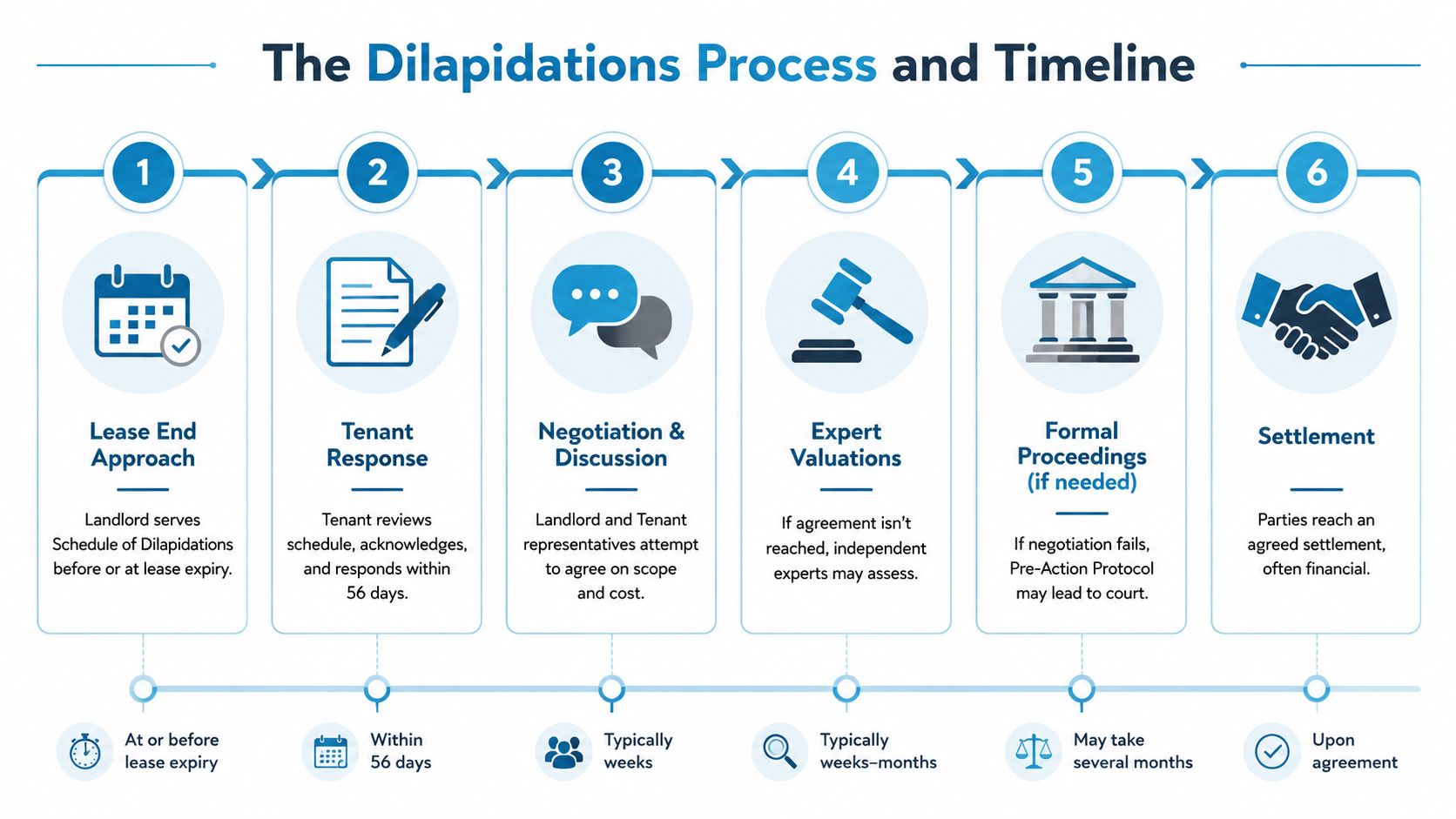
The Dilapidations Protocol recommends that landlords serve the schedule of dilapidations within 56 days after lease termination, and landlords legally have up to 6 years to file a claim, as explained by RIAA Barker Gillette on the protocol timetable and limitation period.
In practice, the sequence usually looks like this:
Inspection and document review
The landlord's surveyor reviews the lease, licences for alterations, side letters and any schedule of condition, then inspects the property.
Service of schedule and quantified demand
The landlord sets out alleged breaches, the works said to be required and the financial claim.
Tenant's reasoned response
The tenant should respond in detail, not with a general denial. Item-by-item comments are far more effective.
Negotiation between surveyors and solicitors
Many claims narrow quickly during this stage, provided both sides are working from evidence.
A short explainer can help if you want to see the process discussed visually and verbally:
The process works best when each side knows its own job.
Good dilapidations handling feels more like project management than litigation in the early stages. Deadlines, evidence, and decision-making discipline matter more than rhetoric.
Common mistakes are predictable. Landlords sometimes overreach by claiming every visible defect regardless of covenant wording. Tenants often underreact, assuming the claim is inflated and will disappear by itself. Neither approach works well.
The number on the front page of a schedule is only a starting point. It isn't automatically the amount that will be recovered.
A dilapidations claim usually begins with the cost of alleged remedial works. That may include repair items, reinstatement, redecoration and associated professional fees. But building cost is only one part of the picture. A landlord still has to connect that figure to recoverable loss.
This visual summary captures the main headings considered in valuation: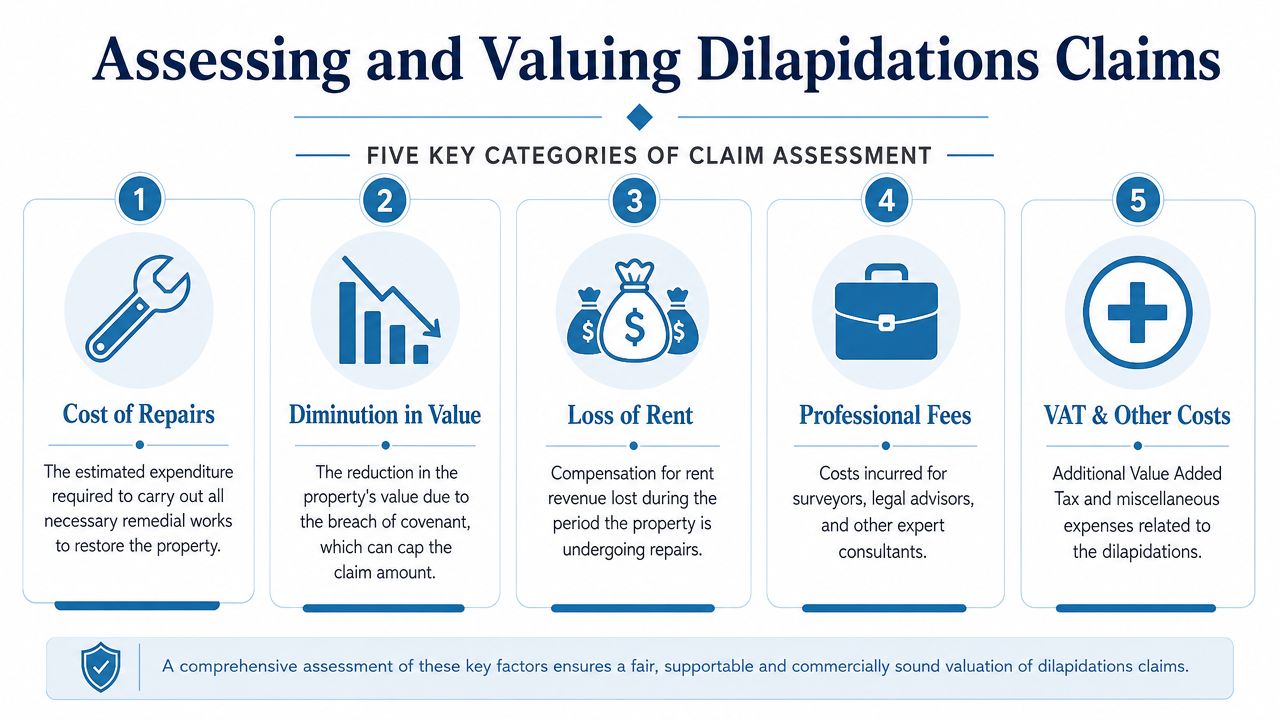
Commercial property dilapidations can produce large headline figures very quickly. According to Renovauk on UK dilapidations budgeting, commercial dilapidations costs in the UK average £7.27 per square foot across sectors. The same source states that modern office reinstatement and redecoration typically range between £15 and £25 per square foot. For a 10,000 sq ft office at £20 per sq ft, that creates a starting point of £200,000, and with 10 to 15% professional fees plus 10 to 20% contingency, the total can reach £250,000.
That explains why so many occupiers are alarmed by the first schedule they receive. The paper figure can be substantial even before the legal arguments begin.
The critical legal principle is the statutory cap under Section 18(1) of the Landlord and Tenant Act 1927. In broad terms, for disrepair claims the landlord cannot recover more than the amount by which the disrepair has reduced the value of the landlord's interest in the property.
That means there are often two separate exercises:
| Assessment route | What it asks |
|---|---|
| Cost of works | What would it cost to carry out the alleged remedial items? |
| Diminution in value | How much has the landlord's interest actually fallen in value because of those breaches? |
If the works bill is high but the effect on value is lower, the recoverable figure may be lower. In such cases, valuation evidence becomes decisive. A landlord may have a technically detailed schedule and still fail to recover the whole amount claimed if the loss in value doesn't support it.
The strongest tenant responses don't just argue that a rate is too high. They ask whether the item caused recoverable loss at all.
This is also where “betterment” arguments often arise. If the landlord's scope goes beyond like-for-like remedy and starts delivering an upgrade, that excess can become difficult to justify. Good surveyors strip that out early.
Most disputes don't turn on one dramatic defect. They turn on clusters of smaller arguments that affect scope, standard and value.

The recurring battlegrounds are familiar:
Supersession is often the strongest strategic defence where the facts support it. As set out by B P Collins on supersession and Section 18, if repair costs are £150,000 but the landlord's actual loss of value is zero because the property is intended for demolition or substantial alteration, the claim is legally limited to zero. The defence only works if the tenant can prove the landlord's intention is real, with evidence such as planning applications or board resolutions.
The most effective negotiations are evidence-led and selective. Tenants often weaken their position by disputing every item, including points they'll never win. Landlords weaken theirs by treating every schedule item as equally valuable.
What usually works:
What usually fails:
For building elements such as roofing, independent inspection evidence can help narrow whether an issue is maintenance-related, end-of-life, or tied to wider replacement plans. A practical reference point is the Four Seasons Roofing commercial roof inspection guide, which is useful when the dispute centres on whether roof-related defects justify targeted repair or more extensive works.
Settlement usually becomes realistic once both sides stop arguing about principle in the abstract and start discussing the actual future of the property.
A RICS chartered surveyor is not there to add ceremony to the process. The surveyor's value is in turning a general dispute into a technical, evidenced case that can be measured and negotiated properly.
For landlords, the surveyor's job starts with precision. That means reading the lease carefully, inspecting the property against the actual covenants, distinguishing breach from age, and pricing the remedial work on a rational basis. A thorough schedule should be clear enough that the tenant can see exactly what is alleged and why.
A capable surveyor will also flag where a claim may be weak before it is served. That can include doubtful reinstatement items, work that strays into betterment, or heads of loss that may be difficult to recover. Landlords are usually better served by a tighter, more defensible claim than by an ambitious one that collapses under challenge.
For tenants, the surveyor is part technical reviewer and part strategist. The work often includes:
Early involvement pays for itself because once a tenant has vacated and contractors have moved in, valuable evidence can disappear quickly.
If you want a broader view of why chartered advice matters in property risk and decision-making, this guide for UK property buyers gives a useful overview of the surveyor's role.
Where a client needs a surveyor to inspect, prepare or defend a commercial claim, one factual option is Survey Merchant, which matches instructions to a nationwide panel for comprehensive dilapidations services.
Good outcomes usually start long before lease expiry. The parties who manage commercial property dilapidations best are the ones who treat the lease as a live risk document from day one.
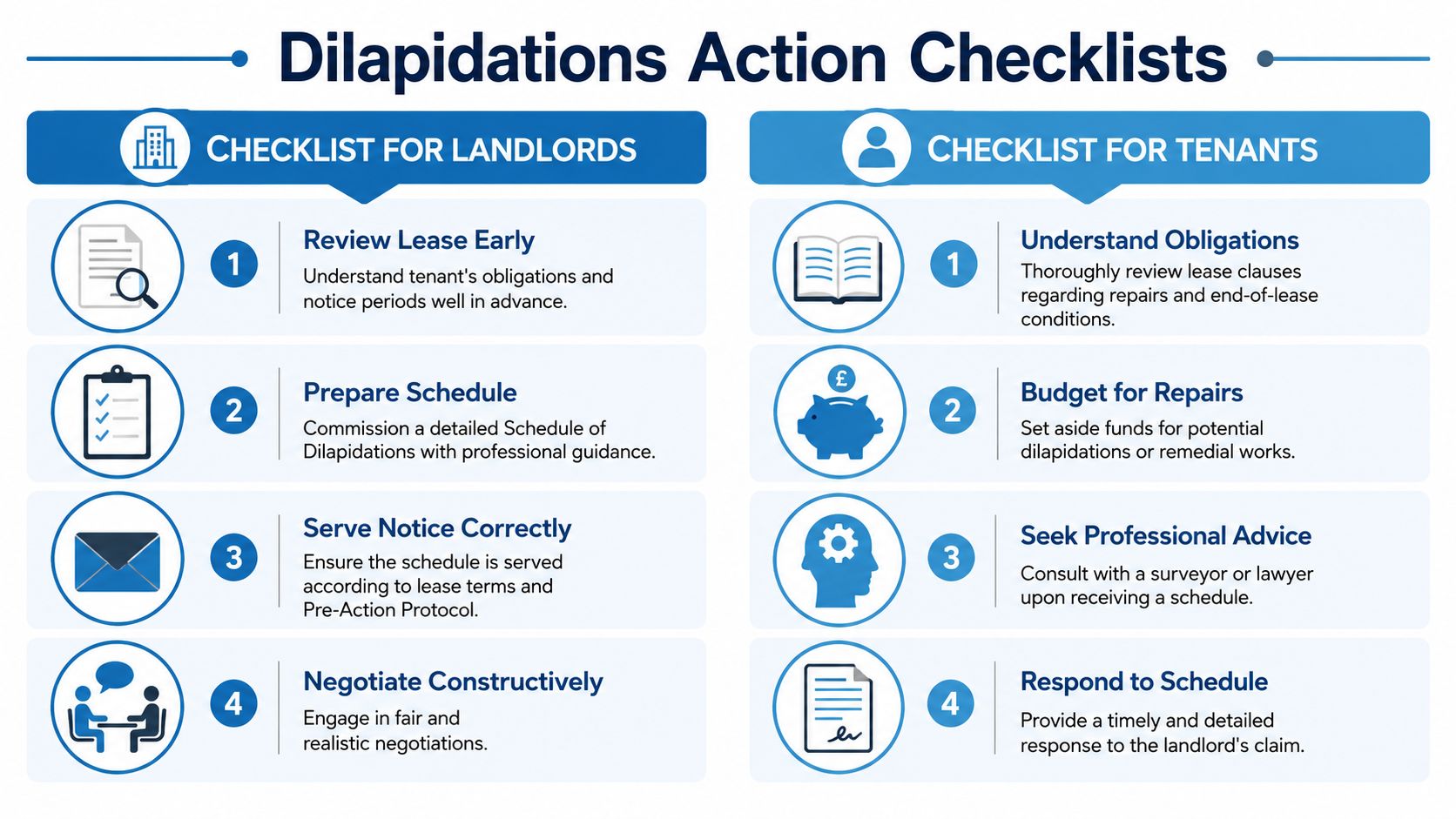
Before the lease starts:
During the term:
At lease end:
Before signing:
During the lease:
At lease end:
The tenant who prepares throughout the term usually has options. The tenant who starts preparing after receipt of the claim usually has arguments, but fewer options.
If you're facing a lease expiry, preparing a claim, or trying to reduce one, a measured surveyor-led review can prevent expensive mistakes on both sides. Survey Merchant connects commercial owners, occupiers and advisers with qualified surveyors who inspect the property, analyse the lease position and help turn a disputed schedule into a practical route forward.
Survey Merchant provides vetted RICS surveyors across 100+ UK locations at fixed fees:
→ Level 2 Home Survey (HomeBuyer Report)
→ Level 3 Building Survey (full structural survey)
→ RICS Red Book property valuations
→ Party wall surveyors — notices, awards & schedules of condition
→ Expert witness surveyors — CPR Part 35 reports for property disputes