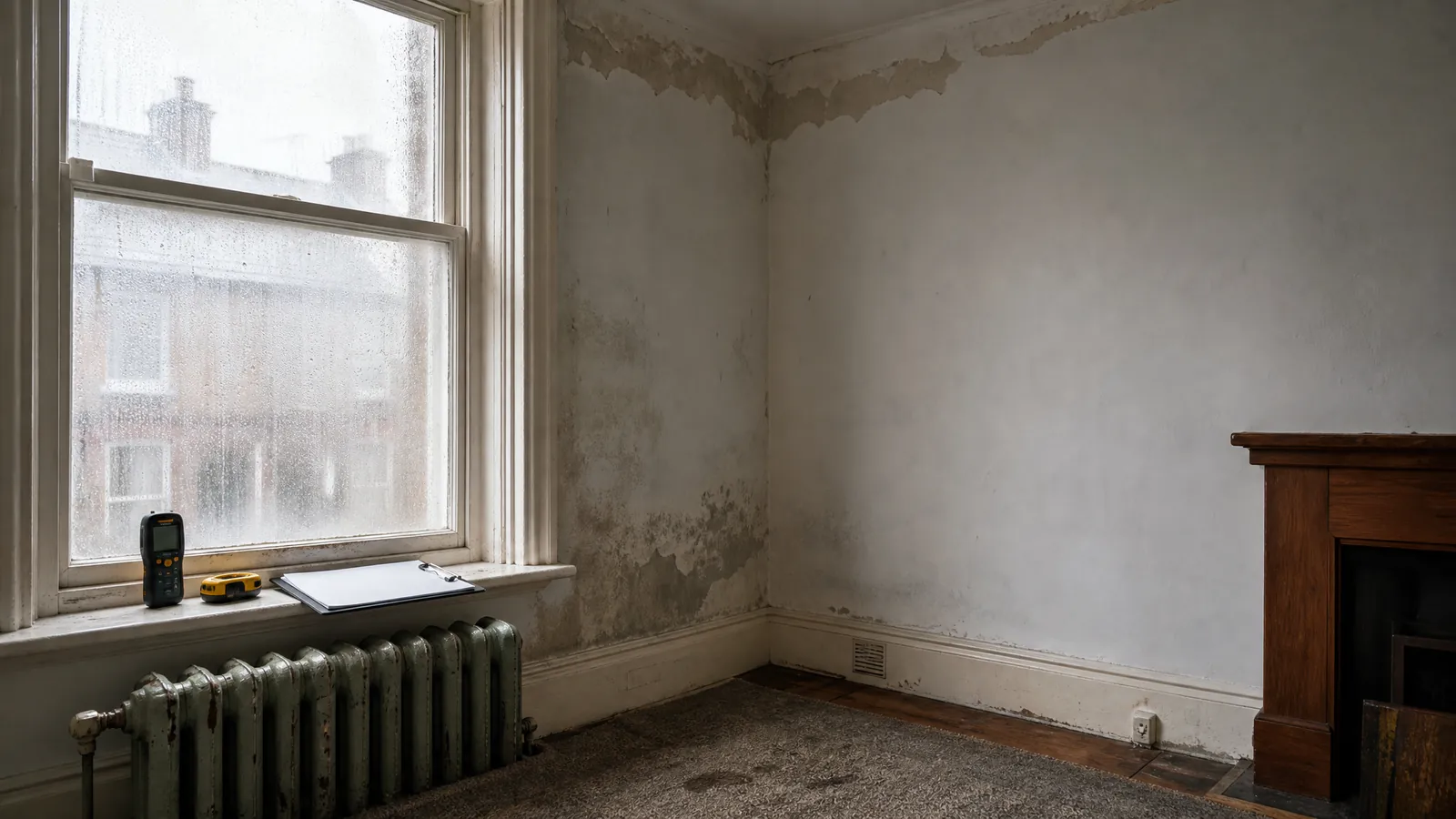
Building Surveying
Jul 16, 2026
Schedule of Dilapidations: A UK Tenant's 2026 Guide
Our 2026 guide explains the UK schedule of dilapidations process. Learn your legal duties, how to respond in 56 days, negotiate costs, and mitigate liability.

A Schedule of Dilapidations is a legal document a landlord serves at or near the end of a commercial lease, setting out alleged breaches and the cost of putting them right. If you receive one, you typically need to respond within 56 days.
If you're reading this after a lease-end notice has landed in your inbox, you're probably dealing with two things at once. The first is uncertainty about what the document means. The second is concern about the bill that may follow.
Most tenants see a schedule of dilapidations far too late in the process. By then, the claim feels like a legal ambush. In practice, it's usually more manageable than it first appears, provided you treat it as a process to be analysed, costed and answered properly.
The strongest tenants don't start at lease expiry. They start at lease commencement, with clear paperwork, realistic records of condition, and a plan for what happens when the term ends. That approach can turn dilapidations from a reactive dispute into a controlled business decision.
A Schedule of Dilapidations is the landlord's formal statement of what they say you've failed to do under the lease. It usually arrives at the end of the tenancy, or close to it, and it lists items the landlord says amount to breaches of covenant.
In simple terms, it's a claim document about the physical state of the premises. It links the condition of the property back to your lease obligations and turns those alleged failures into a list of remedial works and costs.
A proper schedule of dilapidations isn't just a complaint about wear and tear. It is meant to identify specific failures under the lease, such as repair issues, reinstatement of alterations, decoration obligations or compliance matters, and set out what the landlord says is needed to remedy them.
That matters because the lease is the starting point for the whole dispute. If the lease doesn't require a particular standard, the landlord can't invent one at the end. Equally, if the lease wording is broad, tenants can find themselves responsible for more than they expected.
Practical rule: Don't read a schedule of dilapidations as a final invoice. Read it as the landlord's opening position.
Some tenants ignore the document because they assume it is negotiable bluster. Others panic and assume every item must be accepted. Both responses are wrong.
A schedule of dilapidations is serious because it sits within a recognised legal process. But it is also challengeable. Every item still needs to be tested against the lease, the actual condition of the premises and the landlord's real loss.
A large part of that challenge depends on what was recorded at the start of the lease. If you had the foresight to document the original state of the property, that evidence can be central later on. If you want a practical overview of how baseline evidence works, it helps to start with understanding schedule of condition reports.
The document exists to frame a dispute in an orderly way. It tells you what the landlord alleges, what works they say are required, and what money they say flows from that.
Once you understand that, the schedule becomes less intimidating. It stops being a vague legal threat and becomes something your surveyor and solicitor can work through item by item.
A schedule of dilapidations has force because it is tied to the lease and to the formal pre-action process for terminal claims. The landlord is not merely saying the property looks untidy. They are alleging breaches of contractual obligations.
Most claims revolve around a familiar group of lease covenants:
This is why generic assumptions are risky. A tenant may think, “We only changed partitioning and carpets.” The lease may treat those changes as alterations that must be removed and made good at lease end. The same applies to decoration. If you want a plain-English view of how repair and decoration obligations can overlap in practice, this UK landlord painting legal guide is a useful comparison point.
The formal framework is the Pre-Action Protocol for Dilapidations Claims. Under that process, tenants are legally expected to respond within 56 days of receiving the landlord's schedule, as noted in this explanation of the UK dilapidations response window.
That deadline matters. Miss it, and you weaken your position immediately. You also make it harder to show that you engaged properly and constructively with the claim.
If you receive the schedule on a Friday afternoon, the clock still starts. Don't wait until internal teams “have had a look”.
A compliant claim should identify the lease clauses said to be breached, describe the alleged failures, and set out the remedial works and costing basis. That structure is important because it allows the tenant to give a reasoned response rather than a vague denial.
In practice, strong claims are organised and evidenced. Weak claims are often overbroad, poorly tied to the lease, or inflated in scope. That distinction is where surveyors earn their keep.
Dilapidations disputes often go wrong because tenants treat them as a maintenance issue when they are really a lease, valuation and evidence issue combined. The legal framework is designed to push both parties into early exchange of information and settlement discussions.
For tenants, the practical takeaway is simple. The moment the schedule arrives, your job is to preserve documents, inspect the property against the lease, and build a measured response within the protocol timetable.
Most schedules look dense because they compress legal obligations, building defects and cost estimates into one document. Once you break them apart, they become easier to assess.
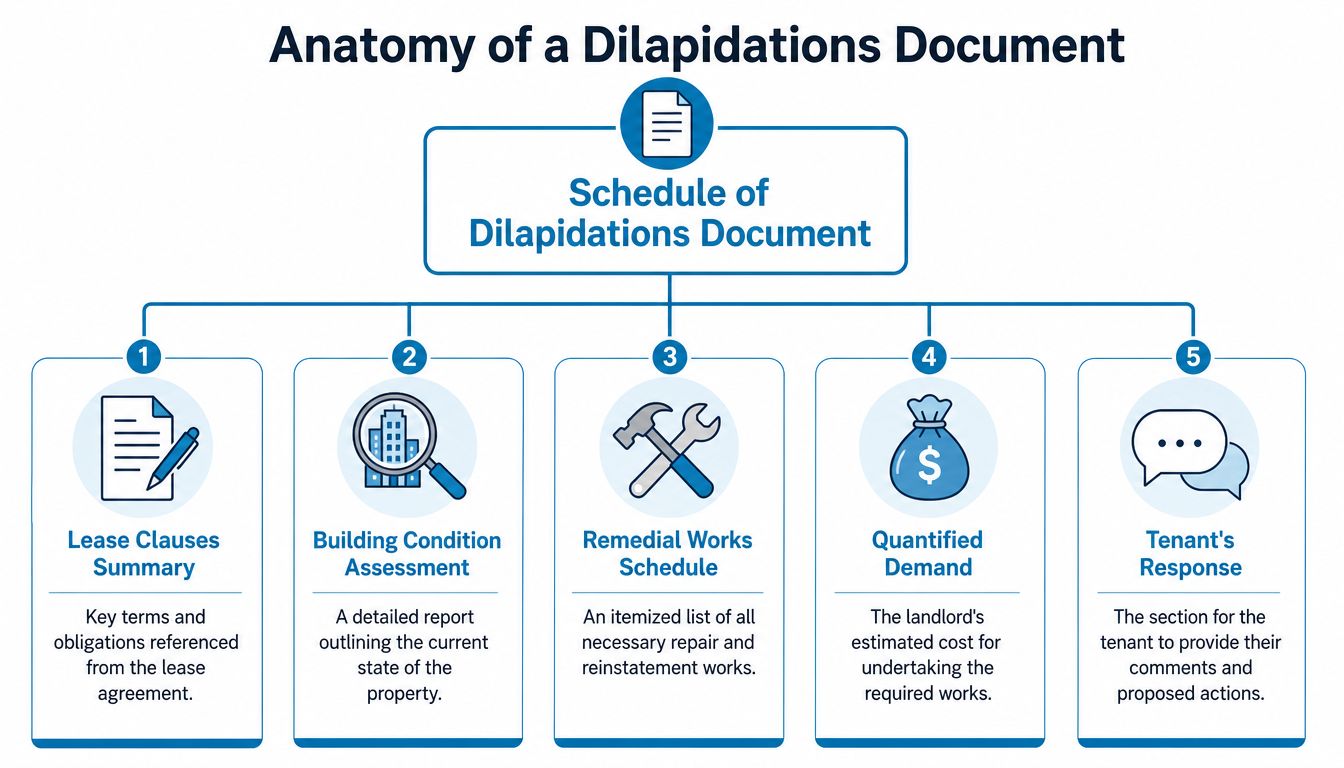
A compliant Schedule of Dilapidations in the UK must be structured so that alleged breaches are categorised into repair, reinstatement, redecoration and legal compliance items, and the landlord must provide a precise breakdown of remedial works together with a quantified financial demand supported by estimates or invoices, as outlined in this guide to schedule of dilapidation requirements.
That usually translates into a document with several recognisable parts:
| Part of document | What it does | Why it matters to the tenant |
|---|---|---|
| Lease clause reference | Identifies the covenant allegedly breached | Lets you test whether the obligation actually exists |
| Item description | Describes the alleged defect or non-compliance | Shows exactly what condition issue is being claimed |
| Proposed remedial work | States what the landlord says must be done | Helps you assess whether the remedy is excessive |
| Costing | Puts a figure against each item or section | Gives the basis for challenge and negotiation |
| Quantified Demand | Pulls the claim into a monetary summary | Shows the financial case the landlord intends to pursue |
Start with the lease clause, not the defect description. Tenants often do the reverse. They see “replace damaged ceiling tiles” or “remove partitioning and make good” and jump straight to the work item.
That's the wrong sequence. First ask, “What covenant is said to require this?” If the clause is weak, qualified, or limited by another document, the item may not stand as presented.
Then look at the proposed remedy. Landlords sometimes specify works that go beyond what is reasonably required to remedy the alleged breach. A tenant's surveyor will test whether the landlord has described a repair, or whether they have drifted into upgrade, renewal or improvement.
A schedule is only as strong as the link between the lease wording, the physical evidence and the costed remedy.
The Quantified Demand is where the claim becomes commercially real. This is the part that tells you what the landlord says the breaches are worth in money terms.
Don't assume the total is automatically recoverable. It is still a claim. It needs support, and it needs scrutiny. Cost assumptions, scope of work, duplication and landlord intentions after lease end can all affect how persuasive that demand really is.
A useful working method is to mark up the schedule in three colours:
That exercise won't replace professional advice, but it will help you and your surveyor focus on the parts of the document that move the settlement.
The first few days after receipt matter more than most tenants realise. Good responses are rarely improvised. They are organised quickly, then refined.
A sensible workflow looks like this:
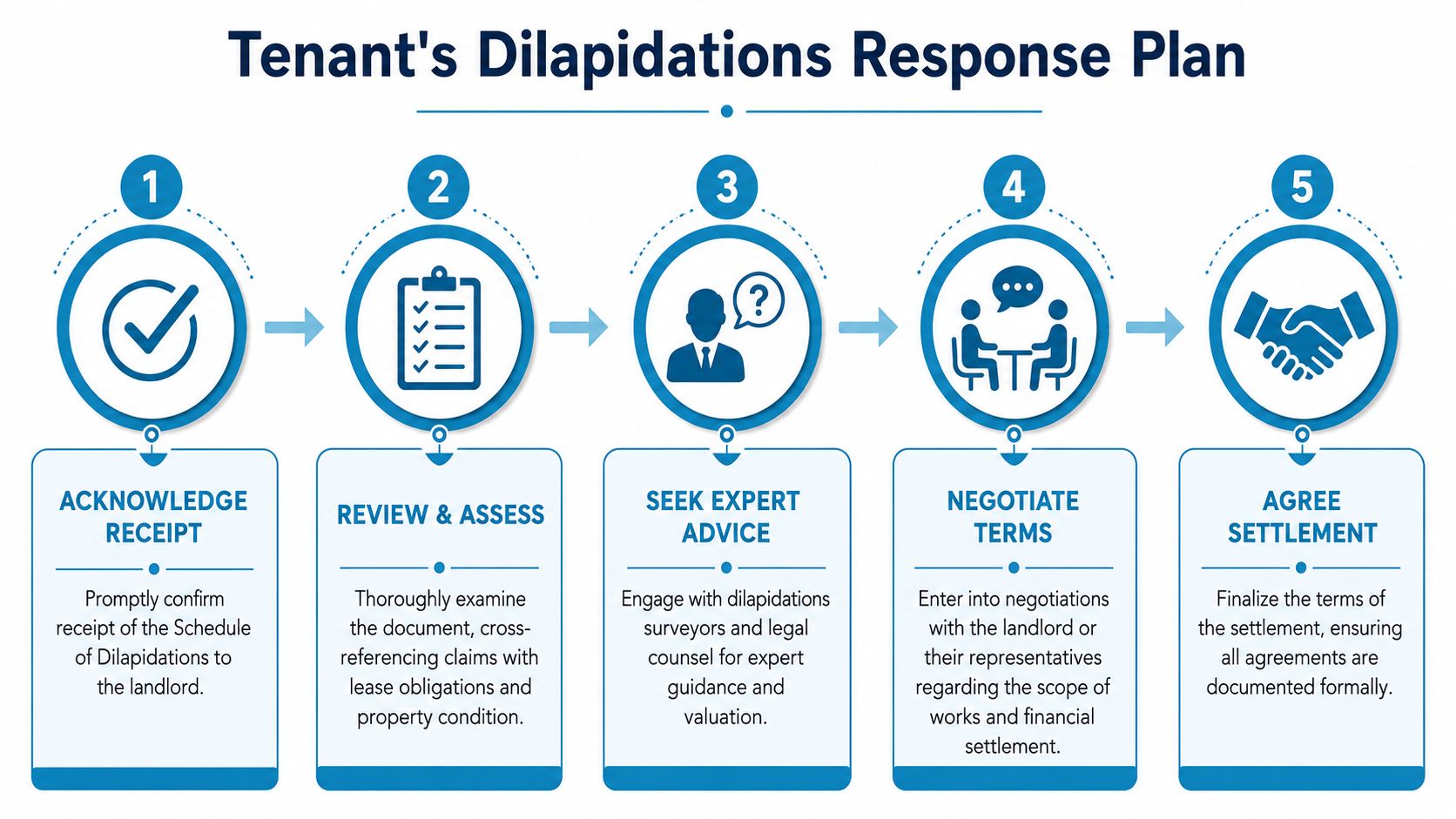
Record the date of receipt
The deadline runs from receipt, so diarise it immediately and circulate it internally. Don't leave this to an ad hoc email trail.
Secure the core documents
Pull together the lease, licences for alterations, side letters, any schedule of condition, repair history, fit-out records and photographs.
Arrange an early review of the premises
Your surveyor needs to see the property while evidence is still available and before memories become unreliable.
Separate legal points from building points
Some items are condition issues. Others are lease interpretation issues. They need different treatment.
A landlord's surveyor prepares the claim from the landlord's perspective. That's their role. Tenants need an independent surveyor who can inspect the property, test the scope of each alleged breach and prepare a proper response.
Specialist input changes the outcome. A good dilapidations surveyor won't only slash numbers. They will decide which items should be admitted, which should be disputed, and which can be narrowed by better evidence or different remedial assumptions. If you need a starting point for formal support, Survey Merchant can connect occupiers with surveyors offering dilapidation services.
Here's a useful explainer on the process before negotiations begin:
Your response should be calm, detailed and item-specific. It isn't a place for sweeping statements such as “all costs denied” unless you want to damage credibility.
A practical tenant response usually does three things:
Working approach: The best responses concede the right things early and fight the right things hard.
Tenants often make the same avoidable errors:
The discipline here is simple. Get the papers. Get the inspection done. Get the response drafted in time.
This is the part most tenants care about first. Understandably so. The financial exposure can be significant.
Industry analysis citing RICS data places the average cost of dilapidations across UK commercial property at approximately £7.27 per square foot, while modern office reinstatement and redecoration commonly range between £15 and £25 per square foot. On that basis, a 10,000 sq ft office at £20 per sq ft starts at £200,000, and with professional fees and contingency can approach £250,000, according to this dilapidations budgeting analysis.
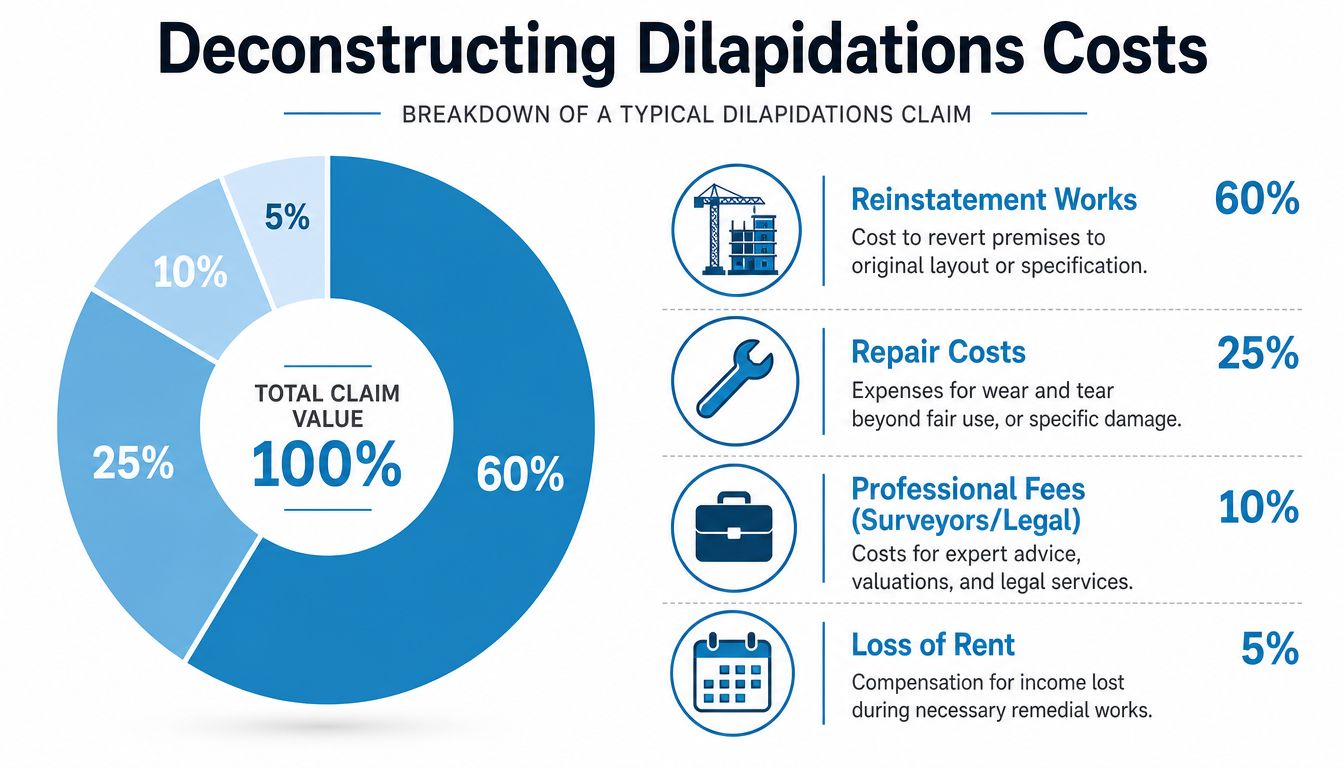
A landlord's quantified demand is an opening valuation of alleged loss. It is not automatically the settlement number.
Surveyors challenge cost claims in several ways. They may dispute the necessity of the works, the scope of the remedy, the pricing basis, or whether some items have any real value to the landlord after the lease ends. In many cases, the schedule contains a mix of valid points and overstated ones.
The money conversation usually turns on a small number of practical questions:
Is the item a breach at all
If not, the cost falls away.
Is the landlord's remedy too extensive
Repair and replacement are not the same thing.
Would the landlord do the work anyway
If future plans make the claimed item irrelevant, that affects value.
Has the claim drifted into improvement
A tenant isn't there to fund the landlord's upgrade programme.
A surveyor and solicitor may also consider legal limits on damages, including arguments around supersession and statutory caps on recoverable loss. Those are technical issues, but they matter because they move the discussion away from “cost to do the works” and towards “actual recoverable loss”.
Tenants often assume they must either fight everything or settle quickly. Neither extreme works well.
A stronger approach is to divide the claim into three baskets:
| Basket | Typical response |
|---|---|
| Clearly due | Price it realistically and move on |
| Technically arguable | Use evidence, photos and lease wording to narrow it |
| Commercially weak | Challenge firmly and ask the landlord to justify the loss |
That method helps avoid wasted fees on low-value arguments while keeping pressure on the expensive items that really matter.
The landlord's schedule should set the agenda, not control the outcome.
The cheapest dilapidations dispute is usually the one you've already prepared for. Tenants who wait until lease expiry are almost always negotiating from a weaker position.

A professionally prepared Schedule of Condition at lease commencement is the strongest practical protection a tenant can put in place. Industry data suggests it can reduce a final dilapidations settlement by 40 to 60 per cent, because it limits liability to deterioration beyond the agreed baseline condition, as set out in this summary of Schedule of Condition benefits.
That only works if it is properly prepared and properly tied into the lease. A bundle of casual move-in photos won't usually do the job. The record needs to be clear, dated, detailed and reflected in the lease wording.
Good mitigation doesn't stop after signing. It continues throughout occupation.
Tenants who manage liability well tend to do the following:
Some occupiers spend heavily on cosmetic tidying just before handing back the keys, yet leave the substantive lease issues untouched. Others do nothing and hope the landlord won't pursue them. Both approaches miss the point.
The right question is not “What can we patch quickly?” It is “What will reduce provable liability under this lease?”
That business mindset matters even more for growing firms already managing cashflow pressure. If broader risk planning is on your agenda, this piece on addressing financial challenges for new businesses gives a useful parallel on controlling liabilities before they become acute.
A Schedule of Condition doesn't remove lease obligations. It gives you a defensible starting line.
Landlord and tenant correspondence near lease expiry should be measured and recorded. Unclear emails, casual promises about works, or admissions made without advice can all cause problems later.
Open dialogue can still help. If the landlord has firm plans for refurbishment or reletting, that may affect which items matter. But those conversations should be informed, not speculative.
The best time to instruct a surveyor is before you think you need one. In practical terms, there are two key moments.
The first is at lease commencement, when a Schedule of Condition can still be negotiated into the lease documents. The second is immediately on receipt of a Schedule of Dilapidations, when the response timetable has already started.
If any of these apply, instruct a chartered surveyor without delay:
Tenants sometimes hesitate because they see surveyor fees as an extra cost. In reality, professional input is part of controlling a much larger exposure. That is especially true where the claim includes a dense schedule, disputed alterations or a high quantified demand.
You need someone who understands more than building defects. Dilapidations work sits across lease interpretation, condition evidence, remedial scope and negotiation.
That's also why career pathways in quantity surveying and building surveying matter to the market. If you want a broader view of the profession behind this work, Umbrella Company's London jobs guide gives useful context on the surveying skill base involved in cost and construction disputes.
A sensible next step is to shortlist surveyors with relevant commercial dilapidations experience, then compare approach as much as price. This guide to finding property surveyors is a practical place to begin if you need to identify appropriately qualified professionals.
A schedule of dilapidations should never be ignored, but it also shouldn't be accepted at face value. The tenant who does best is usually the one who documents the property properly at the start, reviews obligations before the end, and responds within the required timeframe with evidence rather than emotion.
That combination is what turns an intimidating claim into a manageable negotiation.
If you need help with a Schedule of Dilapidations, a lease-end review, or a Schedule of Condition at the start of a tenancy, Survey Merchant can help you find a suitable UK surveyor for the instruction. The platform connects clients with qualified surveying professionals for commercial property matters, including dilapidations analysis, condition reporting and related lease advice.
Survey Merchant provides vetted RICS surveyors across 100+ UK locations at fixed fees:
→ Level 2 Home Survey (HomeBuyer Report)
→ Level 3 Building Survey (full structural survey)
→ RICS Red Book property valuations
→ Party wall surveyors — notices, awards & schedules of condition
→ Expert witness surveyors — CPR Part 35 reports for property disputes