We use cookies to improve your experience on our site, analyze site traffic, and assist in our marketing efforts. By clicking "Accept all," you agree to the storing of cookies on your device. You can choose to "Reject all" non-essential cookies. For more information, please read our Cookie Policy.
Repointing Cost UK 2026: Prices, Signs & Surveyor Advice
A surveyor's guide to repointing cost in the UK for 2026: brick and stone prices per m², whole-house and chimney costs, what pushes quotes up, lime versus cement, and consent rules.
Repointing cost is one of the questions we get asked most often after a building survey, usually within a day of the report landing. The surveyor has flagged “eroded and recessed mortar joints” on the front elevation, the buyer wants to know what that means in pounds, and the seller wants to know whether it is a fair reason to knock money off. This guide sets out what repointing costs in the UK in 2026, per square metre and per house, what pushes the price up, why the mortar you choose matters more than the quote, and when the work needs consent.
Key takeaways
Repointing brickwork costs roughly £50 to £60 per m² with cement mortar and more with lime; stone walls run £60 to £100 per m² (Checkatrade, updated February 2026).
A whole semi-detached house typically costs £4,000 to £5,000; a Victorian terrace £3,000 to £4,400; a chimney stack £500 to £1,300 depending on access.
Labour is 90 to 95% of the bill, so scaffolding, raking out hard cement and awkward access move the price far more than the mortar itself.
Houses built before about 1919 should almost always be repointed in lime, not cement. Hard cement pointing traps moisture and makes the bricks erode instead of the joint.
Repointing an unlisted house needs no planning permission, but altering the pointing of a listed building usually needs listed building consent under section 7 of the Planning (Listed Buildings and Conservation Areas) Act 1990.
Materials prices rose 7.2% in the year to September 2026 (BCIS, November 2026), so quotes older than a few months are worth refreshing.
Fresh lime mortar going into raked-out joints on a Victorian terrace. The condition of the existing joints decides most of the cost.
How much does repointing cost in the UK in 2026?
Repointing brickwork costs around £50 to £60 per square metre in 2026, or £30 to £75 per m² where lime mortar is used. Repointing a whole semi-detached house costs about £4,000 to £5,000, a terrace £3,000 to £4,400, and a single chimney stack £500 to £1,300 including access.
Those are the figures that the main UK trade-pricing sites publish, and they match what our clients report back to us once the work is done. The table below pulls the figures together. Where two sources disagree we have shown both, because the spread tells you something useful: a London quote and a Yorkshire quote for the same wall can be 20% apart.
Job
Typical cost (2026)
Typical time
Source
Brick wall, cement mortar, per m²
£50 to £60 (Checkatrade); £20 to £50 (MyJobQuote)
n/a
Checkatrade Feb 2026; MyJobQuote Nov 2026
Brick wall, lime mortar, per m²
£30 to £75
Slower: lime needs curing time
MyJobQuote Nov 2026
Stone wall, per m²
£60 to £100
n/a
Checkatrade Feb 2026
Raking out old mortar, per m²
£20 to £50
Included in job
Checkatrade Feb 2026
Front elevation only (terrace or semi)
£650 to £2,200
3 to 5 days
Checkatrade; MyJobQuote
Victorian terrace, whole exterior
£3,000 to £4,400
3 to 6 days
Checkatrade; MyJobQuote
Semi-detached, whole exterior
£4,000 to £5,000
5 to 9 days
Checkatrade; MyJobQuote
Detached, whole exterior (about 145 m²)
£2,900 to £7,250
7 to 13 days
MyJobQuote Nov 2026
Chimney stack, including tower or scaffold
£500 to £1,300
1 to 2 days
Checkatrade; MyJobQuote
Scaffolding hire
£15 to £25 per m², or about £900 for an average house
Per week
Checkatrade; MyJobQuote
Bricklayer day rate
£250 to £350
Per day
MyJobQuote Nov 2026
Two points of caution. Some price guides quote the per-metre rate for the pointing alone and add raking out separately, so ask any tradesperson whether their figure includes removing the old mortar. And London and the South East sit 15 to 25% above the rest of England on these jobs (MyJobQuote, November 2026).
What pushes the repointing price up or down?
Because labour is nine-tenths of the cost, anything that slows the bricklayer down costs you money. In our experience these are the factors that explain most of the gap between a cheap quote and an expensive one.
Scaffolding. Anything above ladder height needs a scaffold or tower. A chimney-only scaffold is roughly £500; a full house wrap can reach £2,500 (Homebuilding, 2024). Combine repointing with roof or gutter work so you pay for the scaffold once.
How the old mortar comes out. Soft, weathered lime rakes out quickly by hand. Hard 1970s cement pointing has to be ground out, which takes longer and risks chipping the brick arrises. We see this on a lot of inter-war semis in the Midlands that were “tidied up” with cement in the 1980s.
Mortar choice. Hydraulic lime costs more per bag than cement and the finished work has to be kept damp and protected for longer, which adds labour days. MyJobQuote puts the lime upgrade at £150 to £600 on a typical house.
Brick repairs. Spalled or frost-damaged bricks have to be cut out and replaced before pointing. Budget £100 to £500 for a handful; more if a whole parapet has gone.
Render or paint removal, cleaning and access. Removing render or masonry paint first can add £300 to £1,500. Tight terraces with no side access also push the price up.
Region. Expect the top of each range in London and the home counties, and the bottom in the North East and parts of Wales.
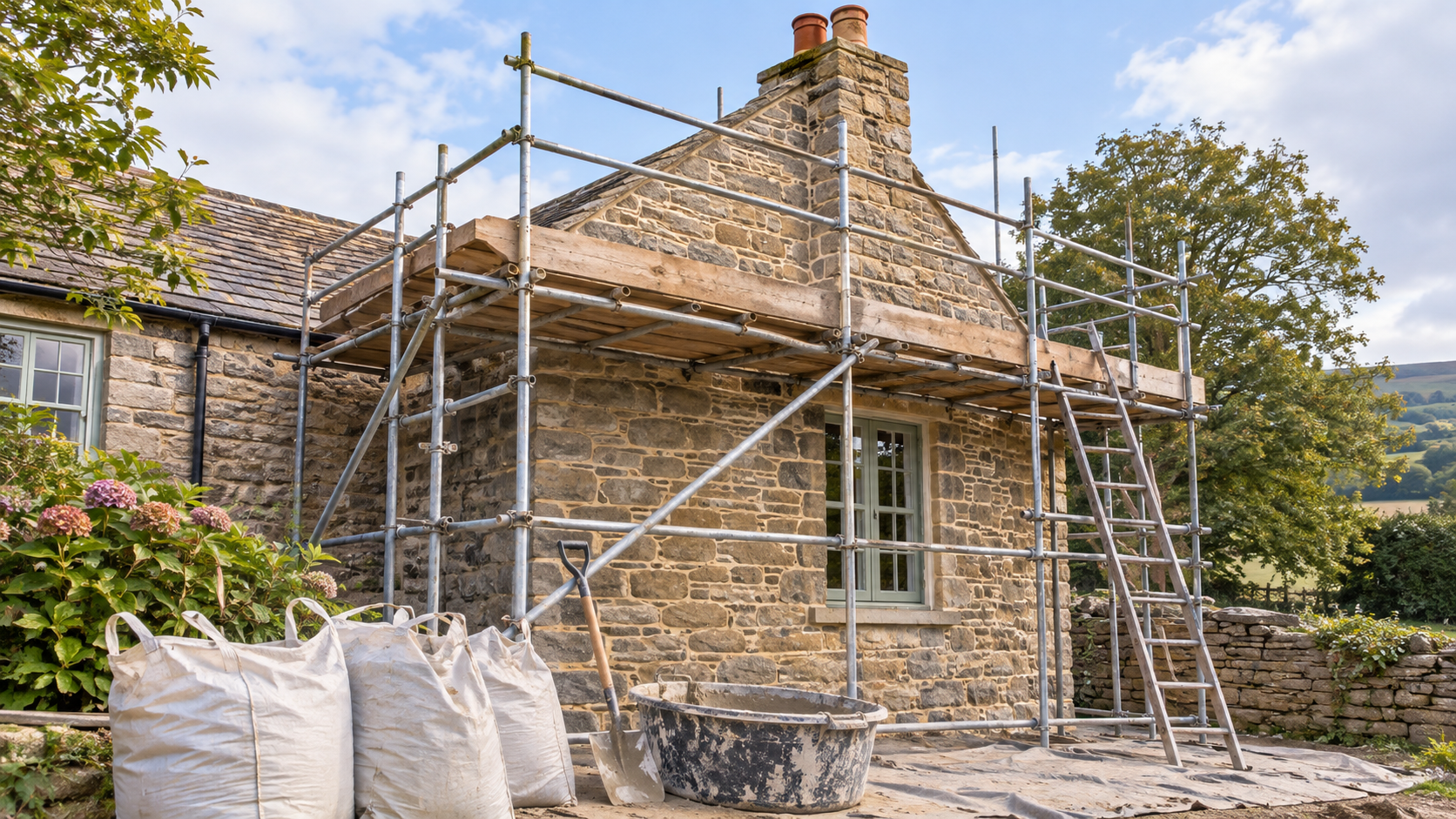
Scaffold hire and slow-curing lime are the two items that most often surprise clients on a stone cottage.
Lime or cement: the decision that matters more than the quote
This is where we'd urge you to slow down. A cheap repointing job in the wrong mortar can do more harm over twenty years than leaving the wall alone.
Most houses built before roughly 1919 have solid walls bedded in lime mortar. Lime is soft and breathable: moisture that gets into the wall evaporates back out through the joints. If you replace it with hard Portland cement, the joint becomes the least permeable part of the wall. Moisture then has to leave through the brick or stone face, which erodes, spalls and frost-damages while the cement joints stand proud. The Society for the Protection of Ancient Buildings describes exactly this failure mode and says cement pointing on pre-1919 walls “can disfigure and hasten their decay”. Hard cement also cracks with minor movement, whereas lime is autogenous and tends to heal hairline cracks itself.
The technical guidance is consistent. The Department for Communities (Northern Ireland) technical note on repointing stone and brick, updated May 2026, says modern cement mortar should not be used as a replacement for lime, that the new mortar should be weaker than the surrounding masonry, and that joints should be raked out to at least two and a half times their height (so a 10 mm joint goes back 25 mm) or until sound mortar is reached. For pointing it suggests an NHL 2 natural hydraulic lime, moving to NHL 5 only in severe exposure, mixed at about 1:2 to 1:2.5 with sharp sand. Historic England’s guidance note Repointing Brick and Stone Walls (HEAG144) adds that full repointing is rarely necessary and that sound historic mortar should be left undisturbed.
On site, the tell-tale sign of bad past work is “strap” or “ribbon” pointing: a hard cement bead smeared over the brick edges. It looks tidy for a decade, then falls off in sheets and takes the brick face with it. If a survey on a Victorian or Edwardian house mentions cement pointing on a lime-built wall, that is a bigger long-term issue than the odd recessed joint. We cover the construction in more detail in our guide to a survey on a Victorian house.
For a 1960s cavity-wall house built in cement mortar, the picture is reversed: a lime repoint would be unnecessarily expensive and a sand-cement mix matching the original is correct. Match what the wall was built with.
Signs your brickwork needs repointing
Pointing is a sacrificial layer. It is meant to wear before the brick does, and on an exposed elevation it does so over 30 to 60 years with lime, often 20 to 30 with cement. Our surveyors look for the following, usually from the pavement with binoculars before getting closer.
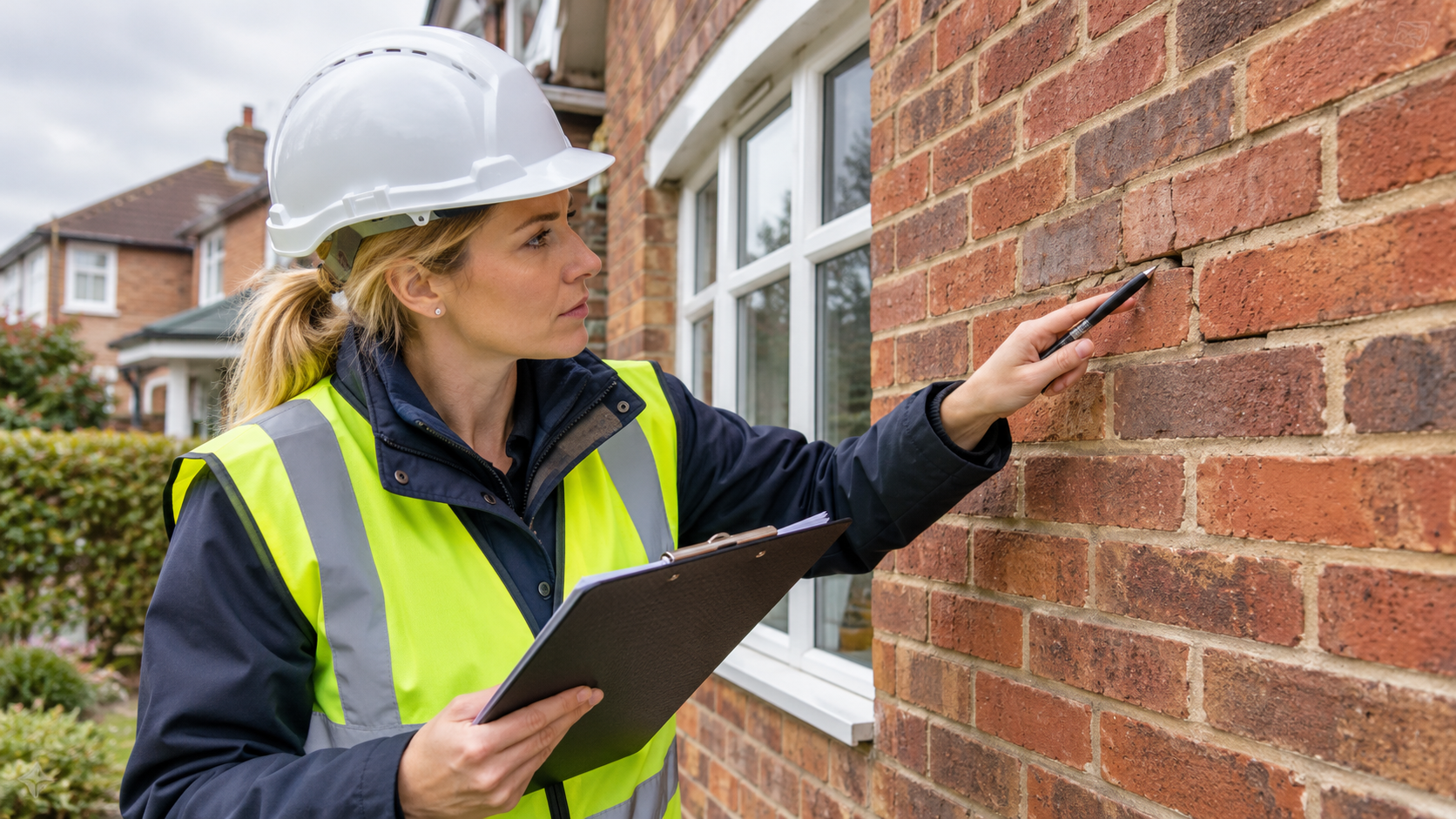
Joints recessed more than about 10 mm behind the brick face, or crumbling when pressed with a screwdriver.
Mortar washed out entirely below leaking gutters, under sills and around downpipes. These are the patches that cause penetrating damp on the inside face; see our guide to penetrating damp.
White salt deposits (efflorescence) tracking along joints, which usually mean water is moving through the wall. Our efflorescence guide explains when it matters.
Spalled brick faces next to hard, intact cement joints: the classic cement-on-lime failure described above.
Vegetation rooting in joints, particularly on chimney stacks and parapets. Chimneys fail first because they are wet on all four sides; our chimney stack repairs guide has the detail.
Stepped cracking through joints rather than through bricks. That is movement, not pointing, and needs a different conversation. Our article on why cracks appear in walls covers it.
One honest caveat. A few recessed joints on a sheltered elevation are cosmetic. Clients sometimes arrive expecting a four-figure repair because a report used the word “defective”; often a day of patch pointing at £250 to £350 is all that is needed.
Do you need planning permission or listed building consent to repoint?
For an ordinary, unlisted house, repointing is repair and maintenance and needs no planning permission, even in a conservation area, provided you are not changing the appearance of the wall (switching to a glaringly different mortar colour on a prominent elevation in a conservation area can attract an enforcement letter, so match the original). Our conservation area rules guide sets out what else is controlled.
Listed buildings are different. Section 7 of the Planning (Listed Buildings and Conservation Areas) Act 1990 makes it an offence to carry out works that affect the character of a listed building as a building of special architectural or historic interest without consent. Most conservation officers treat wholesale repointing, or any change of mortar type, as needing consent, while like-for-like patch repair in matching lime usually does not. Get it in writing before the scaffold goes up; the cost of a retrospective application and an enforced strip-out dwarfs the saving. We explain the process in our listed building consent guide. Councils will often ask for a sample panel of the proposed mortar first, and so would we.
What a building survey says about pointing, and how to use it
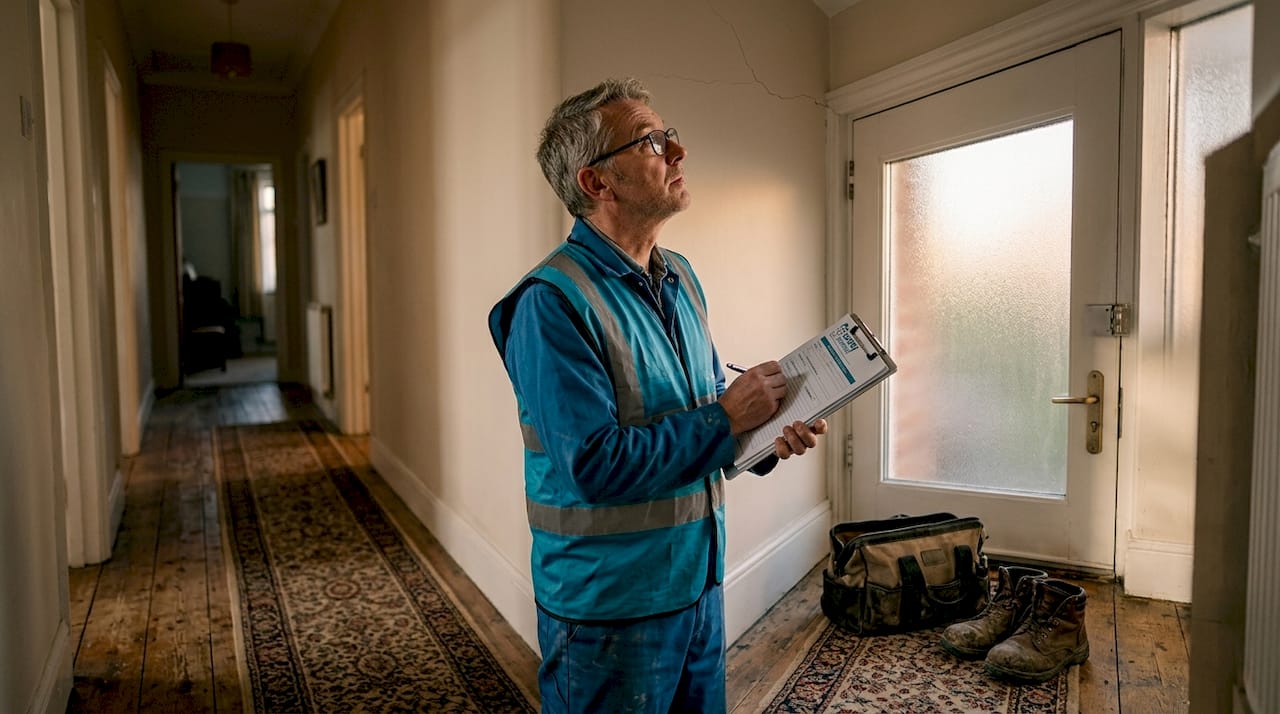
A Level 3 survey records the extent of defective pointing per elevation, which is what you need to price the work.
A RICS Home Survey Level 3 (the full building survey) will describe the condition of the pointing elevation by elevation, note the mortar type where it can be identified, and give a condition rating. A Level 2 report gives a shorter note and a rating. In both cases a Condition Rating 2 for pointing (“defects that need repairing or replacing but are not considered to be either serious or urgent”) is routine on anything pre-1950 and rarely a reason to walk away.
What the survey gives you is a bargaining position, if you use it properly. Get two itemised quotes from local bricklayers for the elevations the surveyor named, then go back to the seller with the figures rather than the adjective. We have seen buyers secure £3,000 to £5,000 off asking on terraced houses in Manchester and Leeds on the strength of a clearly described pointing defect and two quotes. Our guide on negotiating the price after a survey walks through the conversation.
If you are the seller, repointing the front elevation before marketing (£650 to £2,200) frequently pays for itself. A tidy front face is the first thing a valuer and a buyer’s surveyor see.
2026 cost pressures: why last year’s quote is out of date
BCIS reported on 6 November 2026 that construction materials prices rose 7.2% in the twelve months to September 2026, the fastest annual growth since March 2023, with repair and maintenance materials up 6.2%. Cement is one of the quieter lines; BCIS economist Sam Parkin noted that cement is “experiencing comparatively limited price pressure” because demand from the wider sector is weak. The pressure on repointing quotes is therefore mostly labour and scaffolding, not the bag of lime.
Looking further out, BCIS’s updated five-year forecast (8 October 2026) expects building costs to rise about 14% to the third quarter of 2031, with annual building cost growth running at 4.3% in the year to Q3 2026. If a wall needs doing, there is little financial case for waiting.
How long does repointing take?
A single wall section takes one or two days. A full elevation takes three to five. A whole house takes a week or more, and a lime job in autumn can take longer because the new mortar must be kept damp for at least seven days and protected from frost for up to three months (Department for Communities NI, 2026). We usually tell clients to book lime work for April to September. Cement pointing is less fussy, which is one reason it was overused in the first place.
Why choose Survey Merchant for your repointing and brickwork advice?
Before you spend £4,000 on repointing, it is worth being sure the pointing is the problem. Recessed joints can be a symptom of a failed gutter, a bridged cavity, or structural movement, and only an independent inspection will tell you which. Survey Merchant arranges that inspection through a panel of suitably qualified, accredited surveyors regulated by bodies including RICS, CIOB and RPSA, matched to the age and construction of your house rather than whoever is free.
Nationwide UK coverage with local surveyors who know their region’s brick and stone, from London stock brick to Pennine gritstone.
Level 2 and Level 3 surveys that describe pointing defects elevation by elevation, with photographs, so you can get like-for-like quotes.
Impartial advice on lime versus cement, and on whether listed building consent is needed, before any contractor is instructed.
Fast turnaround and transparent fixed fees agreed up front.
Support after the report, including help interpreting quotes and renegotiating the purchase price.
If a survey has flagged your pointing, or you'd like an inspection before instructing a bricklayer, our building surveying service is the place to start, or contact us for a fixed quote and some peace of mind.
How much does it cost to repoint a house in the UK in 2026?
Most UK homes cost between £3,000 and £5,000 to repoint fully: around £3,000 to £4,400 for a Victorian terrace and £4,000 to £5,000 for a semi, according to Checkatrade (February 2026). A detached house can reach £7,250. Front elevation only is usually £650 to £2,200.
What is the repointing cost per square metre?
Brickwork in cement mortar runs about £50 to £60 per m² on Checkatrade’s 2026 figures, while MyJobQuote (November 2026) quotes £20 to £50 for cement and £30 to £75 for lime. Stone walls cost £60 to £100 per m². Check whether raking out the old mortar (£20 to £50 per m²) is included.
How much does it cost to repoint a chimney?
Budget £500 to £1,300 for a single chimney stack. Checkatrade gives £500 to £1,000 before access costs; MyJobQuote gives £800 to £1,300 including the tower or scaffold. Chimneys are wet on four sides, so they tend to need repointing before the main walls do.
Should I use lime or cement mortar for repointing?
Match the original. Houses built before about 1919 were bedded in lime and should be repointed in lime, usually an NHL 2 natural hydraulic lime; hard cement pointing on these walls traps moisture and erodes the brick face (SPAB). Post-war cavity-wall houses built in cement mortar can be repointed in a matching sand-cement mix.
Do I need listed building consent to repoint?
If the house is listed, usually yes for full repointing or any change of mortar type, because section 7 of the Planning (Listed Buildings and Conservation Areas) Act 1990 controls works affecting the building’s character. Like-for-like patch repairs in matching lime are often accepted without a formal application, but confirm with the conservation officer in writing first. Unlisted houses need no permission.
Will a building survey tell me if repointing is needed?
Yes. A RICS Home Survey Level 2 or Level 3 records the condition of the pointing with a condition rating, and a Level 3 report describes it elevation by elevation with photographs. That detail lets you obtain two like-for-like quotes and, if the figure is significant, use it to renegotiate the purchase price before exchange.