We use cookies to improve your experience on our site, analyze site traffic, and assist in our marketing efforts. By clicking "Accept all," you agree to the storing of cookies on your device. You can choose to "Reject all" non-essential cookies. For more information, please read our Cookie Policy.
Black Mould in UK Homes: Causes, Removal & Rights (2026)
Black mould affects millions of UK homes. This guide covers causes, health risks, removal, prevention and the Awaab's Law duties on landlords from October 2025 and November 2026.
Black mould is the one defect almost every client recognises before we do. It is the speckled or furry dark growth that creeps across the top corner of a bedroom, around a window reveal or along the silicone at the edge of a bath. What people rarely know is why it is there, whether it will come back after a wipe-down, and who is responsible for fixing it. This guide answers those questions from a surveyor’s side of the fence, with the 2026 rules for landlords included.
Key takeaways
Black mould is a symptom, not the disease. In most UK homes the cause is condensation: warm, moist air meeting a cold surface. Treating the growth without fixing the moisture means it returns within weeks.
The English Housing Survey 2024-25 found 5% of dwellings (1.4 million) had a damp problem, with private rented homes worst affected at 10%. Serious condensation and mould was the most common form.
Government health guidance is blunt: damp and mould mainly affect the airways and lungs, children and people with asthma or COPD are at greatest risk, and landlords must act without waiting for medical evidence.
Since 27 October 2025, social landlords in England must investigate significant damp and mould within 10 working days and make emergency hazards safe within 24 hours. Phase 2 of Awaab’s Law starts on 30 November 2026, and a consultation on extending it to private tenancies closes on 18 December 2026.
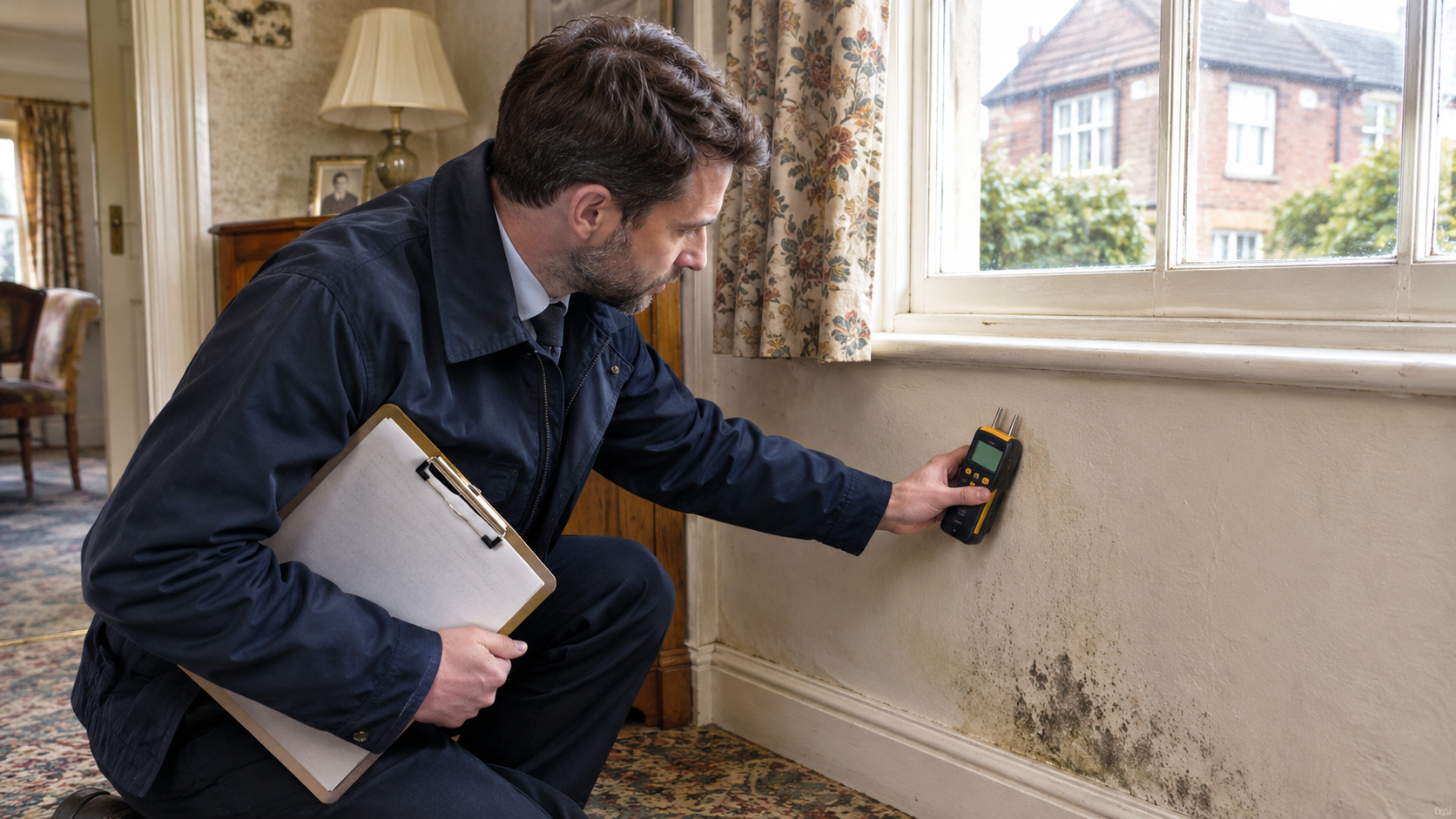
A moisture-meter survey by a suitably qualified, accredited surveyor tells you which of the four causes you are dealing with. That diagnosis decides whether the fix costs a few hundred pounds or several thousand.
What is black mould?
Black mould is the everyday name for dark-coloured fungal growth that colonises damp surfaces indoors. Several species look black, including Cladosporium, Aspergillus and the much-discussed Stachybotrys chartarum. All of them need the same two things to grow: a food source such as paint, plaster or wallpaper paste, and a surface that stays wet or very humid for days at a time.
Species matters less than people think. Our surveyors don’t send samples to a lab to decide whether a patch is dangerous. The practical question is how much moisture is reaching that surface and why, because that is what you can change.
A classic pattern: black mould concentrated where an external wall meets the ceiling, next to a window that streams with condensation on winter mornings.
How common is mould in UK homes in 2026?
More common than most buyers expect, and it is drifting upwards. The English Housing Survey 2024-25 headline report, published by the Ministry of Housing, Communities and Local Government on 29 January 2026, recorded a surveyor-identified damp problem in 5% of dwellings, or 1.4 million homes, in 2024. That is up from 4% in the modelled figures for 2021 and 2022.
The split by tenure is stark. Private rented homes had damp in 10% of cases, social rented in 7% and owner-occupied in 4%. Serious condensation and mould was recorded in 3% of all dwellings, ahead of penetrating damp at 2% and rising damp at 1%. When households were asked rather than inspected, 30% said they had a problem with condensation, damp or mould, rising to 46% of private renters.
Those numbers match what we see on site. Between November and March, most of the pre-1919 terraces and 1960s flats our surveyors inspect across London and the South East show at least some mould growth, usually in a bedroom corner or in a bathroom whose extractor fan has long since stopped working.
What causes black mould in a house?
Mould needs sustained moisture. In British homes that moisture arrives in one of four ways, and telling them apart is the whole job. Our guide to the three types of damp goes deeper on each.
Condensation
This is the cause in the clear majority of cases we inspect. A family of four produces several litres of water vapour a day from cooking, showering, drying washing and breathing. When that warm, humid air touches a cold surface, it condenses. Cold spots are predictable: the top corners of rooms on external walls, behind wardrobes pushed against outside walls, window reveals, and uninsulated concrete lintels in post-war flats. BS 5250, the British Standard on moisture in buildings, treats a surface humidity above about 80% as the point where mould becomes likely.
Penetrating damp
Water coming in from outside through a defect: a cracked render panel, a blocked gutter overflowing onto a wall, failed pointing on a chimney, or a bridged cavity. Mould from penetrating damp tends to appear as a defined patch that worsens after heavy rain, often at any height on the wall rather than low down.
Rising damp
Ground moisture drawn up through masonry where a damp-proof course has failed or been bridged by a raised path or render. True rising damp is rarer than the number of injected chemical courses in this country would suggest. It leaves a tide mark with salts up to roughly a metre, and the mould, if any, sits at skirting level.
Leaks and traumatic damp
A weeping pipe joint under a bath, a failed shower tray seal or a leaking flat roof. The mould is local, often on a ceiling below a bathroom, and the plaster may be soft or stained brown at the edges.
Cause
Where the mould appears
Tell-tale signs
Typical fix
Condensation
Upper corners, window reveals, behind furniture on external walls, bathrooms
Streaming windows in winter, speckled growth across a wide area, worse from November to March
Improve extraction and heating, insulate cold bridges, change moisture habits
Penetrating damp
Defined patch at any height, usually on an exposed elevation
Worsens after rain, external defect visible nearby (gutter, render, pointing)
Repair the external defect, allow the wall to dry, then redecorate
Rising damp
Skirting level, ground floor only
Tide mark up to about one metre, white salt deposits, blown plaster
Remove bridging, repair or replace the damp-proof course, replaster with a salt-resistant system
Leak
Local patch, often a ceiling below a bathroom or near a radiator pipe
Brown staining, soft plaster, growth that spreads outward from a single point
Find and fix the leak, dry out, replace damaged boards or plaster
Is black mould dangerous?
Yes, for some people more than others, and the government no longer treats it as a cosmetic issue. The joint guidance Understanding and addressing the health risks of damp and mould in the home, first published on 7 September 2023 and updated on 1 April 2026, states that damp and mould primarily affect the airways and lungs but can also affect the eyes and skin. It lists cough, wheeze, shortness of breath, airway infections including aspergillosis, and the worsening of asthma, rhinitis and COPD.
The same guidance cites estimates for 2019 linking damp and mould in English homes to around 5,000 cases of asthma and around 8,500 lower respiratory infections. The groups it names as most vulnerable are children and young people, older people, pregnant women, anyone with a weakened immune system, and people with existing lung or heart conditions. The NHS page on aspergillosis covers the rarer but serious infection that Aspergillus spores can cause in people with damaged lungs.
The case that changed the law was Awaab Ishak, a two-year-old who died in December 2020 from a severe respiratory infection caused by prolonged exposure to damp and mould in his family’s social rented flat in Rochdale. His name is now attached to the regulations described below.
How to get rid of black mould
There are two separate tasks here, and people usually only do the first one.
1. Remove the growth
Open a window and wear gloves and a mask. Keep children and anyone with asthma out of the room.
Wipe the area with a dedicated fungicidal mould cleaner or a mild detergent solution. Don’t brush dry mould, which throws spores into the air.
Bag and bin the cloths. Vacuum soft furnishings nearby if the patch was large.
Once dry, redecorate with an anti-mould paint if you want extra margin, but treat that as a buffer rather than a cure.
The government guidance puts it in one line: simply removing surface mould will not prevent the damp and mould from reappearing. We would add that a patch wider than about a square metre, or growth inside cupboards and under floor coverings, is a job for a specialist contractor rather than a sponge.
2. Fix the moisture
For condensation, which is most cases, the fix has three parts: extraction, heat and insulation.
Extraction first. Building Regulations Approved Document F sets the minimum intermittent extract rates for new work: 15 litres per second in a bathroom, 30 litres per second from a cooker hood (60 litres per second elsewhere in a kitchen), 30 in a utility room and 6 in a WC. Many of the fans we test in older homes move a fraction of that, or run for 15 seconds on a light switch and then stop. A humidistat-controlled fan with an overrun timer is a modest spend and the single most effective change in a bathroom. In flats with no scope for new ducting, a positive input ventilation unit in the loft or hallway is often the realistic answer.
Heat second. A bedroom kept at 12°C with the door shut will condense moisture from the rest of the flat. Low, steady background heating beats blasting the living room for two hours in the evening.
Insulation third. Where mould sits on a concrete lintel or an uninsulated corner, no amount of wiping helps until the surface is warmer. Internal wall insulation on the affected elevation, or insulating the reveal, removes the cold spot.
A pin moisture meter and a surface thermometer tell a surveyor in minutes whether a mouldy wall is cold and dry (condensation) or wet through (a leak or penetrating damp).
When should you get a damp survey?
Three situations justify paying for a professional opinion rather than guessing.
You are buying. Mould noted on a Level 2 or Level 3 report is a negotiating point, but only if you know the cause. A condensation issue in a flat with no extractor is a few-hundred-pound problem. The same black patch caused by a failed flat roof above can run to several thousand pounds once the roof, the ceiling and the redecoration are counted. Our guide to how surveyors assess damp explains what the inspection involves.
The mould keeps returning. If you have cleaned, painted and ventilated and it is back within a season, something structural is feeding it. A standalone damp and timber report with meter readings, thermal imaging and a sketch of the affected areas will pin it down.
You are in a dispute. Tenants who are being told the mould is their lifestyle, and landlords who want independent evidence that it isn’t, both need a written report from a surveyor with no stake in the outcome. The cost of a survey is small next to a disrepair claim.
Black mould and the law for landlords in 2026
This is the part that has changed most. Under the Housing Act 2004, every rented home must be free of Category 1 hazards assessed under the Housing Health and Safety Rating System, and the government guidance confirms this includes mould and all types of dampness. What was missing until recently was a clock.
Within 3 working days of the investigation concluding
Begin safety works
Within 5 working days of the investigation concluding
Complete further works
Within a 12-week backstop
Phase 2: excess cold and heat, falls, structural collapse, fire, electrical and hygiene hazards added
From 30 November 2026
Our Awaab’s Law Phase 2 guide covers what the 30 November 2026 extension means in practice for housing officers and the surveyors they instruct.
Private landlords: the consultation closing 18 December 2026
Private tenancies are not yet covered, but they will be. Using powers in the Renters’ Rights Act 2025, the government opened a consultation on extending Awaab’s Law to private rented tenancies on 9 October 2026. It runs until 18 December 2026 and asks whether the social sector timescales should apply, whether all HHSRS hazards except overcrowding should be in scope, and whether landlords should have a defence where a tenant has caused the hazard. We summarised the questions in our note on the private rentals consultation.
In our view, private landlords should behave as if the social timescales already apply. The health guidance already says landlords should not delay action to await medical evidence, and that tenant advice about ventilation must never substitute for fixing the underlying cause. A landlord who can show a dated inspection, a surveyor’s diagnosis and a works order will be in a far stronger position than one with a text message telling the tenant to open a window.
The guidance also recommends a follow-up inspection at least six weeks after remedial work. We’d build that into any works contract, because it is the only way to prove the fix held.
A working extractor fan and a trickle vent left open do more to stop bathroom mould than any cleaning product.
How to stop black mould coming back
Run the bathroom fan for 20 minutes after every shower, or fit one with a humidistat so it decides for itself.
Dry washing outside or in a vented tumble dryer. An airer in a closed bedroom puts every drop of water from that load into the room air.
Keep lids on pans and use the cooker hood, vented to outside rather than recirculating.
Pull wardrobes and beds a few centimetres off external walls so air can move behind them.
Leave trickle vents open all winter. They were fitted for this reason.
Heat bedrooms to a modest, steady temperature rather than leaving them cold with the door shut.
Clear gutters each autumn and check pointing and render after storms.
Why choose Survey Merchant for your black mould survey?
Diagnosis is where mould problems are won or lost, and it is the part most people skip. Survey Merchant matches your property to a suitably qualified, accredited surveyor from a panel regulated by bodies including RICS, CIOB and RPSA, so a Victorian terrace with a suspected bridged cavity is inspected by someone who deals with that construction every week, not a generalist with a checklist.
Nationwide UK coverage, with local surveyors who know the housing stock in your area.
Fast turnaround on damp and timber reports and Level 2 or Level 3 surveys, which matters when you are mid-purchase or mid-dispute.
Transparent fixed fees quoted up front, so there is no surprise invoice.
Impartial findings. We don’t sell damp-proofing, so you get the cause and the proportionate fix, nothing more.
End-to-end support from booking through to talking you through the report once it lands.
If you’ve found black mould in a home you own, rent out or are about to buy, book a building survey or damp inspection with Survey Merchant, or contact our team for a fixed-fee quote today. A clear diagnosis buys you something a bottle of mould spray never will: peace of mind that it won’t be back next winter.
Nearly always moisture that has nowhere to go. In the homes we inspect the usual culprit is condensation: steam from showers, cooking and drying washing settling on cold external walls, window reveals and ceiling corners. Less often it is water getting in from outside through a leaking gutter, failed render or a bridged damp-proof course, or a slow plumbing leak behind a bath panel. The pattern and position of the growth, plus a moisture meter reading, usually tells a surveyor which one you have.
Is black mould dangerous to health?
It can be, particularly for children, older people, pregnant women and anyone with asthma, COPD or a weakened immune system. Government guidance updated in April 2026 says damp and mould mainly affect the airways and lungs, causing cough, wheeze and worsening asthma, and can also irritate eyes and skin. A small patch in a bathroom is not an emergency, but persistent growth in a bedroom where someone vulnerable sleeps needs sorting quickly.
How do I get rid of black mould for good?
Clean it off with a fungicidal mould cleaner, wearing gloves and a mask, then fix whatever is keeping the surface wet. For condensation that means a working extractor fan (15 litres per second is the Building Regulations minimum for a bathroom), steadier background heating and insulating any cold corners or lintels. If the mould comes back within a season after that, book a damp survey, because something structural is feeding it.
Can I just paint over black mould?
You can, and it will come back. Government guidance puts it plainly: removing surface mould does not stop damp and mould from reappearing. Anti-mould paint buys you a bit of margin on a wall that is only marginally cold, but it does nothing on a wall that is wet from a leak or penetrating damp. We see a lot of freshly painted corners on viewings and they rarely fool a moisture meter.
Who is responsible for black mould, the landlord or the tenant?
The landlord is responsible for the building and must keep it free of Category 1 hazards under the Housing Act 2004, which includes damp and mould. Since 27 October 2025, social landlords in England must investigate significant damp and mould within 10 working days under Awaab's Law, with a consultation on extending the same rules to private tenancies closing on 18 December 2026. Tenants are expected to ventilate and heat the home reasonably, but official guidance says advice to tenants must never replace fixing the underlying cause.
Should I buy a house that has black mould?
Often yes, provided you know what is causing it before you exchange. Condensation mould in a flat with no extractor is cheap to put right and a fair reason to ask for a modest price reduction. Mould from a failed flat roof, a leaking parapet or a bridged cavity is a different conversation. A Level 3 building survey or a standalone damp and timber report from a suitably qualified, accredited surveyor gives you the diagnosis and a realistic cost before you commit.