We use cookies to improve your experience on our site, analyze site traffic, and assist in our marketing efforts. By clicking "Accept all," you agree to the storing of cookies on your device. You can choose to "Reject all" non-essential cookies. For more information, please read our Cookie Policy.
RAAC Concrete: 2026 Guide to Risks, Surveys & Costs
RAAC concrete was used in UK roofs, floors and walls from the 1950s to the 1990s and is now well past its 30-year design life. Learn how to identify it, what a RAAC survey costs and what to do if it is found.
RAAC concrete has gone from an obscure engineering term to a household worry. Since 2023, reinforced autoclaved aerated concrete has closed school buildings, delayed hospital rebuilds and, in Aberdeen, led to the planned demolition of hundreds of homes. If you own or are buying a property built between the mid-1950s and the mid-1990s – particularly one with a flat roof or a former council history – this 2026 guide explains what RAAC concrete is, how to spot it, what a RAAC survey involves and costs, and what the latest RICS, IStructE and government guidance means for you.
Key takeaways
RAAC concrete is a lightweight, bubbly, reinforced concrete used in UK buildings from the mid-1950s to the mid-1990s, with a design life of roughly 30 years – so most of it is now well past its intended lifespan.
It is most common in flat roofs of public buildings, offices and former social housing, not in standard brick-and-block homes, but ex-council properties sold under Right to Buy are a known risk group.
Tell-tale signs include 600mm-wide pale grey planks with V-shaped chamfered joints, a porous “Aero bar” texture, sagging, cracking, water staining and ponding on the roof above.
RICS issued a practice alert in February 2026 requiring surveyors to follow IStructE’s updated RAAC guidance, and its consumer guide was refreshed on 13 February 2026.
A RAAC survey runs in two stages: a non-intrusive detection inspection by a suitably qualified surveyor, then a structural condition survey if RAAC is confirmed.
RAAC is treated by lenders and conveyancers as a material structural defect, so finding it early protects your mortgage, insurance and negotiating position.
What is RAAC concrete?
RAAC concrete (reinforced autoclaved aerated concrete) is a lightweight, air-filled form of concrete reinforced with steel bars and cured in a high-pressure autoclave. Used in UK roofs, floors and walls from the mid-1950s to the mid-1990s, it has a design life of around 30 years, is highly porous, and can crack or collapse with little warning once moisture corrodes the reinforcement.
Unlike dense structural concrete, RAAC is made by adding aluminium powder to a slurry of sand, lime, cement and pulverised fuel ash. The reaction releases hydrogen, which leaves millions of tiny bubbles in the set material. That bubbly structure made it cheap, light and quick to install as precast planks – ideal for the post-war building boom – but it also makes the material weak, easily damaged and prone to soaking up water.
The Local Government Association notes that the Building Research Establishment flagged durability problems in the 1990s and again in 2002, and that most RAAC structures are now at least 38 years old. The Institution of Structural Engineers (IStructE) advises that any building constructed or altered between the mid-1950s and mid-1990s should be checked for its presence, although not every building of that era contains it.
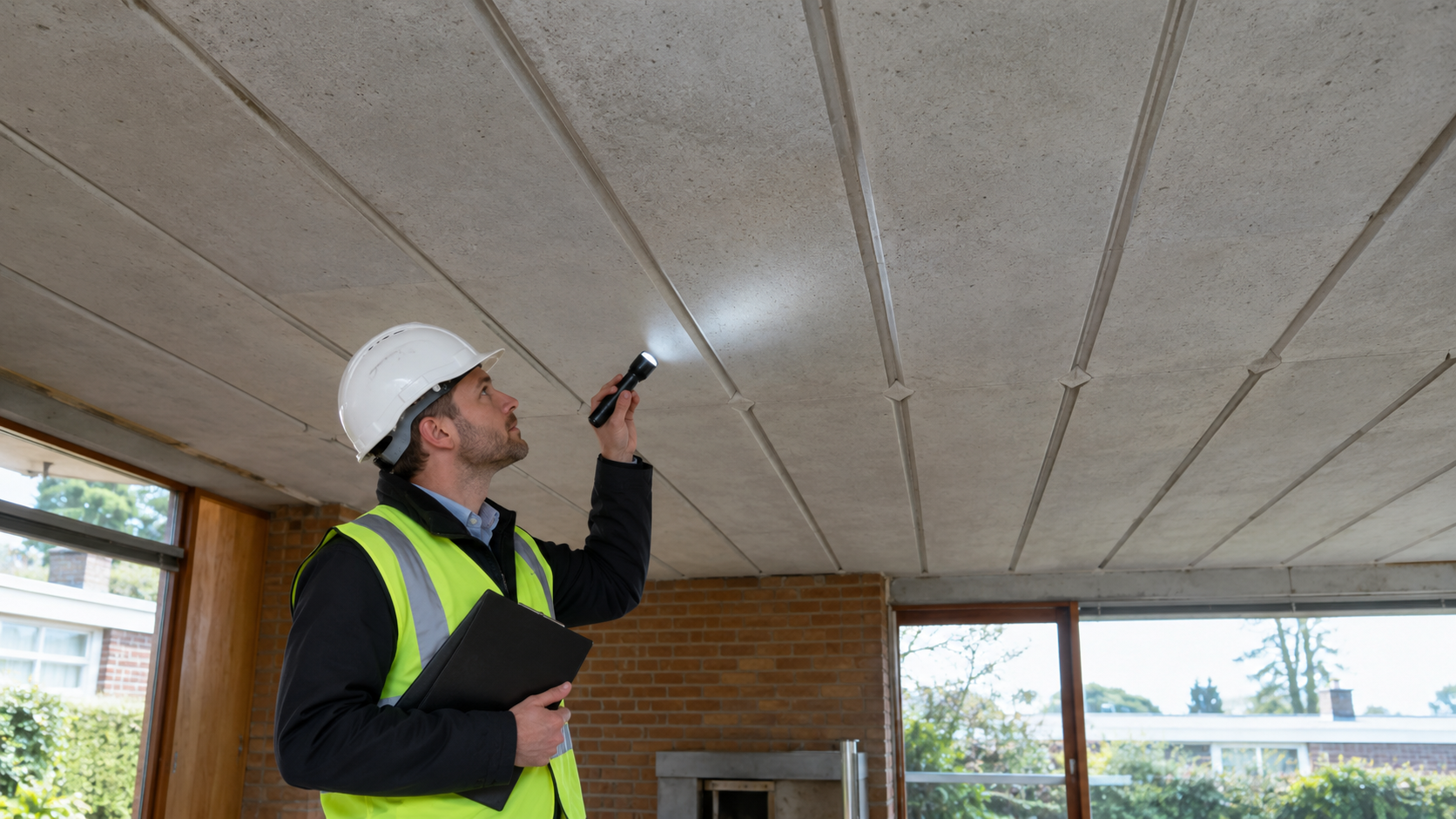
A RAAC survey starts with a careful visual inspection of exposed roof and ceiling planks for the characteristic chamfered joints.
Why is RAAC concrete a problem in 2026?
Three things combine to make RAAC concrete dangerous today. First, age: a material designed for 30 years is now commonly 40 to 70 years old. Second, water: flat roofs leak, and once moisture reaches the embedded steel it rusts, expands and splits the surrounding aerated concrete. Third, the failure mode: RAAC planks can deflect, crack at the bearings and drop suddenly, sometimes with no visible warning, as happened in a school in 2018 that triggered the UK-wide alerts.
The scale of the public-sector problem shows how seriously the material is now taken. In April 2026 the House of Commons Public Accounts Committee reported that dealing with RAAC in seven hospitals will cost taxpayers around £1 billion, with around £500 million already spent on mitigation and maintenance, and that full replacement has slipped from 2030 to 2033 (Construction Wave, 23 April 2026). The Department for Education’s identification guidance for schools was last updated on 20 July 2026, a sign that the programme is far from finished.
Is RAAC concrete found in houses?
Yes, though far less often than in schools, hospitals and offices. RAAC was used for the roofs of some local-authority housing, low-rise flats and system-built homes, and for the floors and walls of a smaller number of properties. Standard brick-built houses with pitched, tiled roofs almost never contain it. The highest-risk homes are:
Former council or housing-association properties built between the 1950s and 1990s, especially those with flat or very shallow roofs.
Homes bought under Right to Buy, where the owner inherited the structure but not the council’s maintenance records.
Office-to-residential conversions and flats above shops or community buildings of the same era.
Extensions, garages and single-storey additions built with precast roof planks.
The most prominent residential case is in Balnagask, Torry, Aberdeen, where RAAC was identified in 2022 in roughly 500 council and privately owned homes. On 2 October 2025 the Scottish Government announced a £10 million funding deal to support affected residents after owners complained that council buy-back offers were tens of thousands of pounds below pre-RAAC values (STV News, 2 October 2025). By 7 April 2026, 118 private households had agreed to sell to the council, with around 20 still in their homes (The Press and Journal, 7 April 2026). RICS’s February 2026 practice alert warns that similar former social housing exists elsewhere, outside the areas already identified by the Scottish Housing Regulator.
How to tell if your property has RAAC concrete
You can often make a first assessment yourself, but confirmation needs a suitably qualified, accredited surveyor or structural engineer. The IStructE RAAC guidance and the GOV.UK identification guidance list the features to look for.
What to look for
What it tells you
Pale grey or white planks about 600mm wide, often spanning between steel or masonry supports
Typical RAAC plank dimensions used in roofs and floors
V-shaped chamfered grooves along the joints between planks
The most distinctive visual sign of RAAC
Smooth, bubbly surface that can be scratched with a screwdriver or dented with a thumb
Aerated, low-density material – not dense concrete
Flat roof built or re-roofed between 1955 and 1995
Era and roof form most associated with RAAC
Sagging ceilings, cracks near plank ends, rust staining, damp patches
Possible deterioration needing urgent assessment
Ponding water, blocked outlets or failed membranes on the roof above
Moisture ingress accelerating corrosion of the reinforcement
Two cautions. Do not drill, cut or lift planks yourself: buildings of this era often contain asbestos in ceiling boards, coatings and roof felt, and disturbing it is a separate hazard. Our asbestos survey guide explains when a specialist survey is needed. And do not assume a ceiling finish rules RAAC out: planks are frequently hidden above plasterboard, suspended ceilings or insulation, which is why the roof void and roof edge are checked first.
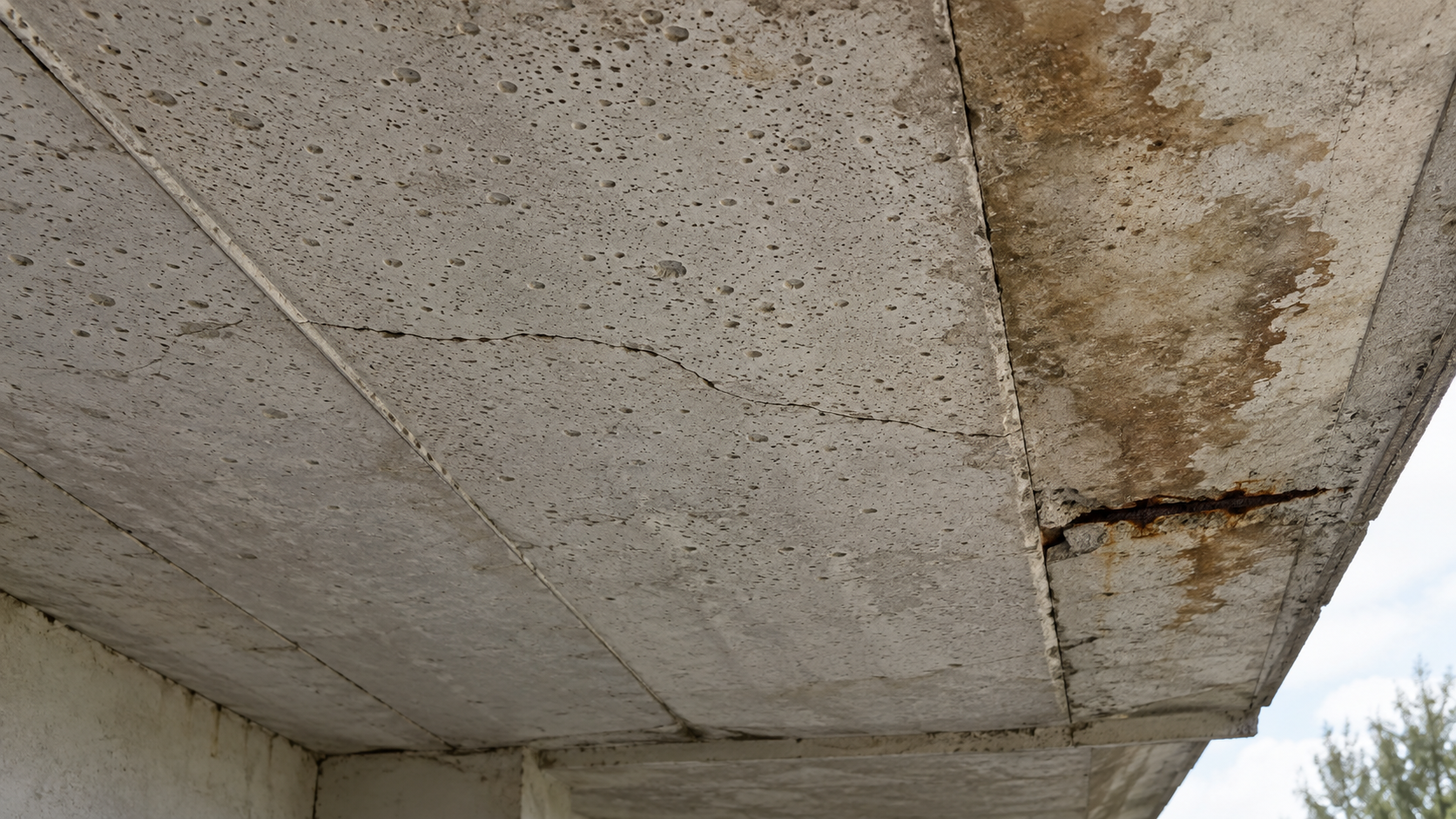
Cracking at the plank ends, water staining and exposed rusting reinforcement are the classic warning signs of failing RAAC.
What does a RAAC survey involve?
A RAAC survey is normally a two-stage process, mirroring the three steps IStructE sets out: identification, assessment and solutions.
Stage 1: RAAC detection survey
A suitably qualified building surveyor carries out a desk study (construction date, original drawings, council records) and a non-intrusive visual inspection of roofs, roof voids, ceilings and any exposed floor or wall panels. The output is a clear statement of whether RAAC is present, suspected or absent, with photographs and a recommendation on next steps. For most homes this can be combined with a Level 3 building survey, which is in any case the appropriate level of inspection for a property of this age and construction.
Stage 2: RAAC condition (structural) survey
If RAAC is confirmed, a structural engineer assesses its condition: bearing widths at supports, deflection, cracking, signs of corrosion, water ingress and the adequacy of the reinforcement. This may involve non-destructive testing with a cover meter, moisture readings and, where appropriate, taking core samples for laboratory analysis. The engineer then classifies the risk and recommends a management plan, which can range from monitoring and improved roof maintenance to propping, strengthening or replacement. Our article on structural engineer surveys explains how this stage is commissioned and reported.
The RICS consumer guide, updated on 13 February 2026, makes an important point: in some cases there may be no structural need to remove RAAC roofs or other elements. That can only be determined on a case-by-case basis, which is exactly why the condition survey matters so much.
How much does a RAAC survey cost in 2026?
Costs depend on property size, access and how much of the structure is exposed. The table below summarises typical starting points for 2026.
Survey type
Who carries it out
Typical 2026 cost
When to use it
RICS Level 2 Home Survey
Suitably qualified, accredited surveyor
From around £400
Conventional homes where RAAC is unlikely; flags concerns for further investigation
RICS Level 3 Building Survey with RAAC detection
Suitably qualified, accredited building surveyor
From around £650
Any 1950s–1990s property with a flat roof, former council history or non-traditional construction
Standalone RAAC detection survey
Building surveyor
Quoted individually, usually a fixed fee plus an element based on floor or roof area
Owners who already know the property’s general condition but need a definitive RAAC answer
RAAC condition survey with testing
Chartered structural engineer
Quoted individually; laboratory testing charged on top
Once RAAC is confirmed, to classify risk and plan remediation
The Level 2 and Level 3 starting prices above are drawn from 2026 market guidance published by Surveyor Local; always obtain a written quotation for your specific property.
What happens if a survey finds RAAC concrete?
Finding RAAC does not automatically mean the building is unsafe or that a sale must collapse, but it does change the transaction. Conveyancing solicitors treat RAAC as a material structural defect: they will raise enquiries with the seller, ask for structural assessments, check whether remedial works have been completed and warranted, and confirm the lender’s requirements. In Scotland, sellers must disclose known material defects, and RAAC clearly qualifies.
For buyers, the sensible sequence is:
Commission the Stage 2 structural condition survey before exchange, so you know whether the RAAC is sound, deteriorating or dangerous.
Obtain costed options for remediation (monitoring, strengthening, replacement) from the engineer and a contractor.
Check lender and insurer positions early. Many mainstream lenders may decline to lend on a property with unremediated RAAC, and some insurers restrict cover, which also affects the resale market.
For owners, the priorities are good roof maintenance (clear outlets, sound membranes, no ponding), regular engineer inspections of confirmed RAAC, and closing off any area showing deflection or cracking until it has been assessed. Our article on what happens when a survey finds problems covers the practical next steps for any serious defect.
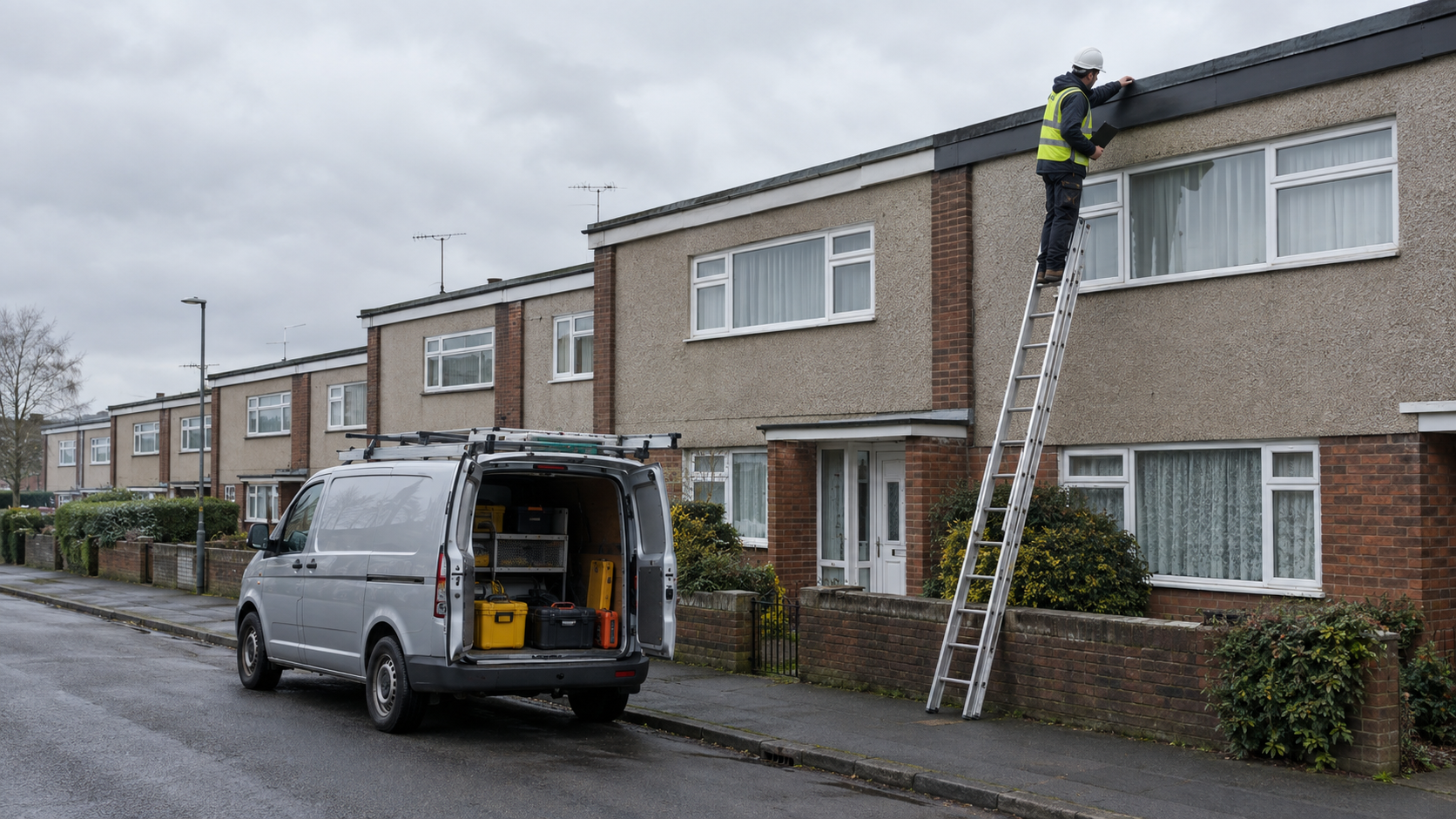
Flat-roofed former council houses from the 1950s to 1990s are the residential properties most likely to contain RAAC planks.
RAAC concrete, mortgages and valuations
Because RAAC is now firmly on lenders’ radar, a mortgage valuer who suspects it will usually report a retention or decline the property until a specialist report is produced. That is one reason the problem is often discovered late. A pre-purchase Level 3 survey with RAAC detection puts you ahead of the valuer, avoids a last-minute down valuation, and gives you the evidence to negotiate. Where RAAC has been remediated, keep the engineer’s report, the contractor’s warranty and any building-control sign-off together, as future buyers’ lenders will ask for them. An independent RICS Red Book valuation can also quantify the impact on market value where remediation costs need to be reflected.
Who should carry out a RAAC survey?
The RICS consumer guide recommends a chartered building surveyor competent in RAAC identification for the first stage and a structural engineer for the condition assessment. The February 2026 RICS practice alert goes further, requiring members inspecting Scottish residential property to follow IStructE’s updated guidance and to work only within their competence. In practice, the right professional may be regulated or accredited by RICS, CIOB, RPSA or another recognised body; what matters is demonstrable experience with RAAC and with the construction type in question. Always ask for evidence of that experience before instructing.
Why choose Survey Merchant for your RAAC survey?
Survey Merchant connects you with suitably qualified, accredited surveyors drawn from a nationwide panel regulated or accredited by bodies including RICS, CIOB and RPSA, matched to the specific job rather than assigned at random. For RAAC that means a surveyor who knows post-war and system-built housing, understands IStructE’s identification protocol, and can bring in a chartered structural engineer for the condition stage without you having to start again.
The right expert for the building: flat-roofed former council homes, non-traditional construction and converted commercial buildings each need different experience, and we match accordingly.
Nationwide coverage: local surveyors across England, Wales and Scotland, with knowledge of regional housing stock and local-authority records.
Fast turnaround: prompt inspection dates and clear, photographed reports so your purchase or remediation decision is not held up.
Transparent fixed fees: competitive quotations agreed in advance, with no surprises if RAAC is found and a second stage is needed.
Impartial advice: our surveyors have no stake in the sale or the repair, so you get an honest view of risk and options.
End-to-end support: from the initial building survey through structural assessment, costed remediation advice and valuation evidence for your lender.
RAAC (reinforced autoclaved aerated concrete) is a lightweight, bubbly form of reinforced concrete used in UK roofs, floors and walls from the mid-1950s to the mid-1990s. It has a design life of around 30 years, is porous and can crack or collapse suddenly once moisture corrodes its steel reinforcement.
How do I know if my house has RAAC?
Look for pale grey planks about 600mm wide with V-shaped chamfered joints, a soft bubbly surface, and a flat roof built between the 1950s and 1990s. Former council homes are the main residential risk group. Only a suitably qualified, accredited surveyor or structural engineer can confirm it, and you should never drill or cut panels yourself because of asbestos risk.
How much does a RAAC survey cost?
In 2026 a RICS Level 2 survey starts from around £400 and a Level 3 building survey with RAAC detection from around £650, depending on property size and location. A standalone RAAC detection survey is usually a fixed fee plus an area-based element, and a structural condition survey with laboratory testing is quoted individually.
Can you get a mortgage on a house with RAAC?
It is difficult. Lenders treat RAAC as a material structural defect, and many mainstream lenders may decline or apply a retention until a structural engineer confirms the RAAC is sound or has been remediated. Early detection through a pre-purchase Level 3 survey gives you time to obtain the reports lenders require.
Does RAAC always have to be removed?
No. The RICS consumer guide updated in February 2026 states that in some cases there may be no structural need to remove RAAC roofs or other elements, but this can only be decided case by case after a structural condition survey. Options range from monitoring and better roof maintenance to strengthening, propping or replacement.
What is the latest RAAC guidance in 2026?
IStructE updated its Scottish residential RAAC roof appraisal guidance on 20 January 2026, RICS issued a practice alert in February 2026 requiring surveyors to follow it, the RICS consumer guide was refreshed on 13 February 2026, and the Department for Education's identification guidance was updated on 20 July 2026. In April 2026 the Public Accounts Committee put the cost of RAAC in seven hospitals at around £1 billion.