Building Surveying
Sep 27, 2026
Full Structural Survey: A Buyer's Guide for 2026
Thinking of buying an older property? Our guide explains what a full structural survey (RICS Level 3) covers, when you need one, and how to use it to negotiate.

You've found the sort of house that gets under your skin. Original fireplaces. Uneven floors. A loft that looks full of potential. The estate agent calls it “full of character”, and that's often true. It can also mean patched movement, tired roof timbers, altered walls, old drainage, and repairs that were done cheaply rather than properly.
That's the point where first-time buyers usually feel two things at once. Excitement, because the property feels special. Anxiety, because you know a quick viewing won't tell you what's happening behind the wallpaper, under the roof covering, or around a chimney breast that may have been removed years ago.
A full structural survey is what turns that uncertainty into a decision you can live with. Not because it promises perfect certainty. It doesn't. But because it gives you enough evidence to judge risk properly, budget sensibly, and decide whether to proceed, renegotiate, or step back.
A buyer falls in love with a Victorian terrace. The bay window is beautiful, the ceiling roses are intact, and the garden is bigger than expected. On the second viewing, a few details start to bother them. One rear wall looks slightly out of true. A bedroom door catches on the frame. There's a crack above a window that the agent describes as “settlement”.
That word gets used far too casually.
Sometimes it is old, harmless movement. Sometimes it points to a defect that needs monitoring, structural advice, or repair. The problem isn't that older houses have flaws. Most do. The problem is buying one without understanding which flaws are routine and which ones can upset your budget, your mortgage process, or your renovation plans.
Older properties don't usually fail in neat, obvious ways. They present clues. A ripple in a roof slope. A chimney stack with weathered pointing. A line of cracking that may be cosmetic, or may relate to movement below. The house can still feel solid while carrying hidden risk.
That's why a full structural survey matters most when the purchase feels slightly uncertain rather than obviously disastrous. The aim is not to kill the deal. It is to test whether the story the house tells on a viewing matches the way it is performing as a building.
A good survey doesn't just list defects. It helps you separate “expected for age” from “financially dangerous”.
Buyers sometimes hesitate at the survey fee because it lands early, before exchange, and before the property is theirs. That reaction is understandable. But in practice, the survey is often the first point at which someone independent examines the building for your benefit rather than the lender's.
What works is treating the survey as a decision tool. What doesn't work is using it as a box-ticking exercise and then ignoring the report because the house is emotionally appealing.
If the property is older, unusual, run-down, or altered, the right survey can protect your deposit, your renovation budget, and your negotiating position in one step. For that sort of purchase, the answer is usually the same. You need the most thorough inspection available in the standard RICS framework.
A full structural survey is the term many buyers still use for the most detailed mainstream pre-purchase survey in the UK. In current RICS terms, that is the Home Survey Level 3, previously called a RICS Building Survey and still commonly described as a full structural survey by buyers and agents, as explained by HomeOwners Alliance's guide to survey types.
The terminology causes confusion because three different phrases are often used for roughly the same high-detail service. Buyers say full structural survey. Surveyors may say Level 3 or building survey. The key point is simple. It is the most thorough survey in the standard RICS framework, sitting above Level 1 and Level 2.
Consider the distinctions: A mortgage valuation is for the lender. A Level 2 is a solid general check for more routine homes. A Level 3 is the version you choose when the property needs careful diagnosis, not just a surface assessment.

A car analogy helps. A mortgage valuation is not even your mechanic. It's the bank checking whether the car broadly supports the loan. A Level 2 is closer to a sensible used-car inspection. A full structural survey is the deeper workshop check on an older classic where you want to know not just that something is wrong, but why it is wrong and what that means next.
Here's the simple comparison buyers usually need at the start.
| Feature | Level 1 (Condition Report) | Level 2 (HomeBuyer Report) | Level 3 (Building Survey) |
|---|---|---|---|
| Depth of inspection | Basic overview | Mid-level inspection | Most detailed inspection |
| Best suited to | Newer, straightforward homes | Conventional properties in reasonable condition | Older, altered, unusual, larger, or run-down properties |
| Focus on defects | Flags obvious issues | Identifies visible defects and risks | Analyses defects in detail and explains likely causes |
| Repair advice | Limited | General advice | More detailed repair and maintenance guidance |
| Use for renovation planning | Poor | Limited | Strongest option of the three |
| Useful for negotiation | Limited | Sometimes | Usually the most useful |
Practical rule: If the property has age, complexity, visible defects, or a history of alterations, don't choose the lighter report just to save money.
Not every home needs a Level 3. Many do.
The mistake buyers make is assuming the decision turns only on age. Age matters, but the key question is whether the building is simple and predictable, or whether its condition and history create enough uncertainty that you need deeper analysis before exchange.
In the UK, housing stock is old. A large share of homes in England were built before 1945, which increases the chance of age-related issues such as movement, damp, and outdated construction details, as discussed in this guide to full structural survey risks and limitations. That doesn't mean old homes are bad buys. It means they deserve proper scrutiny.
A Level 3 is usually the right call if any of these apply:
A lower-level report can be perfectly adequate for a conventional property in decent order. But with a risky building, saving money on the survey can cost far more later. The issue isn't only missed defects. It's missed context.
For example, a short report may note cracking. A stronger report is more likely to help you judge whether it appears historic, whether it relates to localised movement, whether a removed wall may have changed load transfer, and whether the next step is monitoring, intrusive opening-up, or a structural engineer.
If you're still weighing the options, this Level 2 vs Level 3 survey guide is useful for comparing the two approaches in practical terms.
A quick sense-check helps:
| Scenario | Likely better choice |
|---|---|
| Modern flat in good order | Level 2 may be enough |
| Standard suburban house with no obvious concerns | Level 2 may be enough |
| Older terrace with cracking and past alterations | Level 3 |
| Cottage, listed building, or unusual construction | Level 3 |
| House you plan to renovate heavily | Level 3 |
What works is matching the survey to the building's risk. What doesn't work is choosing the cheaper report and hoping the house turns out to be simple.
A full structural survey focuses on the load-bearing fabric of the building. The surveyor inspects accessible roofs, walls, floors, foundations, drainage, and signs of movement, then explains the defect and its likely cause-effect chain, with urgency and recommendations for further investigation where needed, as outlined in this guidance on structural inspection scope.

Expectations need to be realistic at this stage. A full structural survey is detailed, but it is usually non-intrusive unless something else has been agreed in advance. Surveyors don't normally open up walls, lift fitted floor finishes, or dismantle parts of the building during a standard pre-purchase inspection.
“Accessible” has a practical meaning. If the loft hatch can be opened safely, the roof void may be inspected. If floor voids are sealed off, the surveyor may comment only on indirect signs. If furniture, stored belongings, fitted panels, or locked areas block inspection, that limitation should appear in the report.
Full doesn't mean every hidden defect is found. It means the surveyor gives you a structured assessment of what can be reasonably inspected and tells you where uncertainty remains.
A capable surveyor reads the building from the top down and outside in. The order matters because defects are often linked.
Typical areas include:
If you want a buyer-friendly overview of the process, this Level 3 building survey guide is a useful companion to the formal report itself.
A short visual explainer can also help when you're trying to understand what surveyors are looking for on site.
The strongest reports do more than note defects room by room. They connect symptoms. A roof spread problem may relate to wall movement below. Damp may stem from failed rainwater goods rather than a single wall finish. A crack over an opening may matter less or more depending on the support above it.
Many first-time buyers open a Level 3 report and panic because the defect list looks long. That reaction is normal. Older buildings nearly always generate a long list. The important question is not how many comments the report contains. It is which comments affect safety, value, insurability, mortgageability, or your renovation budget.
A competent survey treats the building as a system. That matters in older UK housing, where chimney removals, wall knock-throughs, loft changes, and extensions can interrupt the original load path. This systems-based approach is described in structural BIM and load-path analysis guidance.
Cracks worry buyers most, but not all cracks mean structural failure.

A surveyor will look at pattern, location, direction, and associated symptoms. A hairline crack in plaster may be shrinkage or minor thermal movement. Stepped cracking through masonry, combined with sloping floors or sticking joinery, deserves much closer attention. The point is not to jump straight to subsidence. It is to judge whether the evidence suggests historic movement, current movement, or uncertain movement that needs follow-up.
Roof spread is another common example in period houses. The clue may be subtle. Slight outward bowing to upper walls, distortion at ceiling level, or historic tie arrangements altered during past works. A poor survey flags distortion. A good one asks why the roof is pushing outward and whether support has been reduced.
Don't read the word “cracking” in isolation. Read it alongside pattern, likely cause, urgency, and the recommended next step.
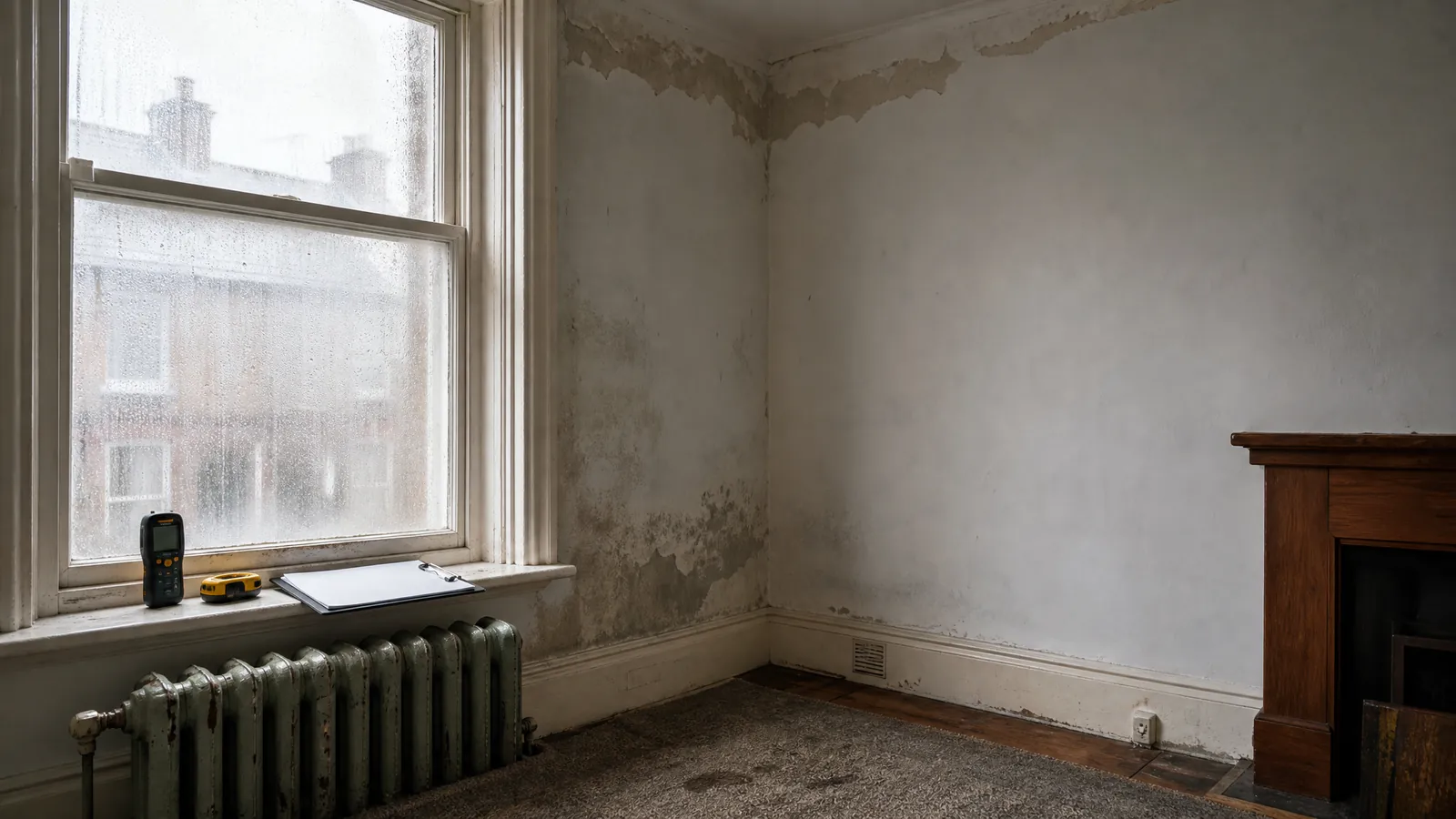
Damp also needs interpretation. Staining on a wall could be from condensation, penetrating damp, defective rainwater goods, bridging, or a long-resolved leak that left a visible mark behind. The surveyor's value lies in connecting visual evidence to building behaviour rather than defaulting to a generic damp label.
Timber decay follows the same principle. Rotten ends to joists, beetle damage, or localised wet rot are not all equal in seriousness. The report should help you understand extent, probable source of moisture, and whether repair means local replacement, wider opening-up, or basic maintenance and improved ventilation.
Alterations often produce the most expensive surprises. Common trouble spots include:
If you manage viewings, valuations, or renovation pipelines across several opportunities, it helps to document defect patterns and follow-up tasks consistently. In that context, tools that streamline your property listings can make it easier to track which homes need specialist review and which are still viable after survey findings come in.
The survey proves its value at this point.
A standard RICS Level 3 survey is often materially more expensive than Level 2. Compare My Move reports an average cost of about £629 for a Level 2 and around £1,000 for a structural survey, which is roughly £371 more, or about 59% higher than the Level 2 figure, according to its comparison of building survey and structural survey costs. Buyers sometimes focus on that premium and miss the point. The extra depth often gives you the evidence needed to renegotiate properly or walk away from a bad purchase.
Don't start with the whole report. Start with priority.

Use this order:
Urgent structural and water-entry issues first
Active movement, unsafe alterations, failing roof coverings, and defects causing ongoing water ingress go to the top.
Then items that affect mortgageability or insurance
Significant structural uncertainty, major damp-related timber decay, or missing support to altered elements may matter here.
Then medium-term repairs
Weathering, joinery repairs, repointing, local roof maintenance, drainage corrections.
Then cosmetic work
Decoration should sit at the bottom, not the top.
Ask trades to quote against the report wording, not your memory of it. If the surveyor says further structural engineer input is advisable, get that before you price the repair itself. Otherwise you risk obtaining meaningless estimates.
If you're trying to understand why one quote for a survey differs from another before you even get to this stage, this summary of factors affecting UK survey fees is worth reading.
The strongest negotiations are calm and evidence-led. Not emotional. Not vague.
A practical approach is to send the seller or agent a short schedule that separates:
That last category matters. If you treat every defect as a discount item, you weaken your position. Sellers know older homes are imperfect. You'll usually get further by focusing on defects that materially change the value proposition because they were not apparent at offer stage.
“The survey has identified issues that weren't visible during inspection. We still want to proceed, but only at a price that reflects the cost and risk now evidenced.”
Three outcomes are reasonable. You proceed unchanged because the defects are manageable. You renegotiate because the repair burden is now clearer. Or you withdraw because the risk profile no longer suits you. All three are successful uses of a full structural survey.
One practical route if you need help sourcing the right type of surveyor in the first place is Survey Merchant, which matches buyers and owners with a nationwide panel of survey professionals for services including Level 3 surveys, valuations, drone inspections, and defect reports.
The report is only as useful as the person writing it.
A strong surveyor doesn't just know defects. They know building age, construction type, alteration history, and how buyers need findings translated into action. That matters most with older houses, converted flats, and homes where the visible symptom may not be the actual problem.
Before you book, check the basics carefully:
If roofing defects are likely to be part of the story, it also helps to understand what competent follow-up looks like once the survey flags concerns. This guide from Four Seasons Roofing is a sensible checklist for choosing a roofing contractor after survey findings point you in that direction.
Buyers often think the key decision is whether to have a full structural survey at all. The better question is whether the surveyor is right for the property you're buying.
A listed cottage, a heavily altered terrace, and a converted upper flat may all need a Level 3, but they don't raise the same technical questions. The best outcome comes when the person inspecting understands that difference and writes a report you can use in the practical world, with your solicitor, your builder, and your budget.
If you need a practical starting point, Survey Merchant connects buyers and owners with qualified survey professionals across the UK for Level 3 building surveys and related inspections, helping you get a report that's suited to the property rather than a generic one-size-fits-all booking.
Survey Merchant provides vetted RICS surveyors across 100+ UK locations at fixed fees:
→ Level 2 Home Survey (HomeBuyer Report)
→ Level 3 Building Survey (full structural survey)
→ RICS Red Book property valuations
→ Party wall surveyors — notices, awards & schedules of condition
→ Expert witness surveyors — CPR Part 35 reports for property disputes