Building Surveying
Sep 9, 2026
EPC explained: what UK buyers, sellers and landlords must know
Discover what you need to know about Energy Performance Certificates (EPC) in the UK. Ensure compliance and maximize property efficiency today!

An EPC (energy performance certificate) is the legally required document that shows a property’s energy efficiency rating on an A–G scale, along with estimated running costs and recommended improvements. It is valid for a decade from the date of issue. If you are selling or letting, your first step is to check whether a valid certificate already exists on the Energy Performance of Buildings Register. If none exists or yours has expired, you need to commission an accredited domestic energy assessor before marketing begins.
An EPC is a legally required, 10-year-valid certificate that every seller and landlord must commission before marketing a property, and buyers are entitled to receive it free of charge.
| Point | Details |
|---|---|
| EPC validity and requirement | Valid for 10 years; must be commissioned before marketing begins, not after. |
| A–G rating scale | Scores run from G (1 to 20) to A (92 and above); the average UK home sits around band D. |
| Finding an existing EPC | Search free at the Energy Performance of Buildings Register using the property postcode. |
| Penalties for non-compliance | Failing to commission or display an EPC rating in adverts can result in a Trading Standards penalty charge notice. |
| Surveymerchant | When the EPC raises structural or condition concerns, Surveymerchant connects you with accredited surveyors for a full building survey. |
This article is general information, not a substitute for advice from a qualified lawyer. Consult a qualified legal professional about your own circumstances before acting on anything here.
The certificate gives a property an asset rating: a snapshot of how energy-efficient the building fabric and fixed services are, independent of how the occupants actually use it. The Energy Saving Trust describes it as measuring the building itself rather than behaviour, which means two identical houses with very different household habits will receive the same rating.
The rating is calculated using either SAP (Standard Assessment Procedure) or rdSAP (reduced data SAP). SAP is used for newly built dwellings where full design data is available and typically produces stronger banding. rdSAP is the method used for existing homes, where the assessor collects data on-site and the software fills in some values from standard tables. The official guidance sets out both methods and the accreditation requirements that underpin them.
The GOV.UK guidance maps each band to a specific score range:
| Band | SAP/rdSAP score | Description |
|---|---|---|
| A | 92 and above | Most efficient |
| B | 81 to 91 | Very efficient |
| C | 69 to 80 | Good |
| D | 55 to 68 | Average |
| E | 39 to 54 | Below average |
| F | 21 to 38 | Poor |
| G | 1 to 20 | Least efficient |
The average UK home sits around a mid-tier band. When you look at a certificate, you will see both the current band and a potential band showing where the property could reach if the recommended measures were implemented.
Three events trigger the legal requirement: selling a property, renting it out, or constructing a new building. The timing rule is strict. Under The Energy Performance of Buildings (England and Wales) Regulations 2012, an EPC must be commissioned before a property is put on the market. If marketing begins without a valid certificate, a 7-day window applies, with a possible additional 21-day extension only where the seller or landlord can demonstrate reasonable efforts to obtain one.
That 7-day allowance is narrower than many people assume. Solicitors and estate agents have a de facto duty under Regulation 6 to check that a valid EPC exists before marketing begins, so the responsibility does not rest solely with the owner.
According to GOV.UK selling guidance, you must also provide the certificate free of charge to the person who becomes the buyer or tenant. The energy rating must appear in any commercial media used to market the property, including online listings.
Non-compliance carries financial risk. Trading Standards can issue a penalty charge notice for failing to commission an EPC or to include the rating in marketing materials. The safest approach is to commission the certificate as soon as you decide to sell or let, not after you have already listed.
Only accredited domestic energy assessors may produce a valid EPC. You can find one through the government’s Get a new energy certificate service, which links to approved accreditation schemes including Elmhurst Energy, one of the largest accreditation bodies in the UK. Elmhurst maintains its own assessor directory and publishes guidance on what the assessment covers.
When comparing assessors, check their accreditation number against the relevant scheme’s register before booking. Price alone is a poor guide to quality.
The visit covers the main fabric and fixed services of the building: wall construction and insulation, loft insulation depth, window glazing type, the heating system (boiler type, age and controls), hot water system, and fixed lighting. The assessor will also note floor type and any secondary heating. A typical assessment takes from half an hour up to about an hour for a standard domestic property, though larger or more complex homes take longer.

Having the following ready saves time and can improve accuracy:
Pro Tip: If you have had cavity wall or loft insulation installed, dig out the guarantee certificate before the assessor arrives. Without documentary evidence, the assessor may default to a lower insulation assumption, which can drag the rating down by a band.
The front page of the certificate carries the two most important numbers: the current rating and the potential rating. The gap between them tells you how much room for improvement exists. A property sitting at D (62) with a potential of B (84) has significant scope; one at C (74) with a potential of C (79) is already close to its practical ceiling.
Below the headline ratings, the certificate lists estimated annual energy costs split across heating, hot water and lighting. These figures assume standard occupancy and are calculated from the asset rating, not from actual meter readings. They are useful for comparing properties, but your real bills will depend on how you use the home.
Pro Tip: The potential rating assumes every cost-effective measure on the list is installed. In practice, some measures may not be suitable for your property type, tenure, or planning constraints. Treat the potential band as a ceiling, not a guarantee.
The Energy Saving Trust guidance recommends using the recommendations report to prioritise low-cost, high-impact measures first rather than jumping straight to expensive retrofits.
The recommendations on your certificate are ordered by cost-effectiveness, so the list itself is a reasonable starting point. In practice, improvements fall into three broad tiers.
Draught-proofing doors and windows, switching to LED lighting throughout, and fitting a hot water cylinder jacket if you have a tank system. These rarely move a property by a full band on their own, but they contribute to the overall SAP score and cost very little.
Loft insulation (if absent or thin), cavity wall insulation, and upgrading heating controls (programmer, room thermostat, thermostatic radiator valves). Loft insulation in a property with none can shift a D-rated home noticeably toward C. Cavity wall insulation has a similar effect where the construction allows it.
Replacing an old gas boiler with a modern condensing boiler, installing solid wall insulation (internal or external), fitting solar photovoltaic panels, or replacing a gas heating system with a heat pump. These carry the largest potential band gains but also the longest payback periods and the most complex installation requirements.
Constraints matter. A listed building or one in a conservation area may face planning restrictions on external wall insulation, replacement windows, or solar panels. Solid wall insulation on a Victorian terrace is technically possible but expensive and disruptive. For a practical, step-by-step breakdown of what works for different property types, the EPC rating improvement guide on Surveymerchant covers the measures in detail.
Pro Tip: Before spending on any medium or high-cost measure, check suitability with a surveyor or your local conservation officer. Cavity wall insulation, for example, is not suitable for all cavity constructions and can cause damp problems if installed incorrectly.
Not every property needs one. The GOV.UK guidance sets out the main exemptions:
Exemptions are not self-certifying. If you believe your property qualifies, document the basis carefully. For listed buildings, a letter from the conservation officer confirming that required improvements would unacceptably alter the character is the clearest evidence. For holiday lets, keep records of actual letting periods.
Pro Tip: An exemption from the EPC requirement does not exempt a property from mortgage lender scrutiny. Some lenders now ask for energy efficiency information regardless of legal EPC obligations, so check with your broker before assuming the exemption removes all energy-related requirements.
The Energy Performance of Buildings Register is the authoritative source. You can search by postcode or by the certificate’s unique reference number. The search is free and open to anyone, including buyers and tenants.
If you find a certificate, check the issue date. A certificate issued more than 10 years ago has expired and a new one must be commissioned before marketing. If the certificate shows a different address configuration from the current property (for example, a house that has since been converted into flats), it may not be valid for the new units.
For buyers and tenants: ask the seller or landlord directly. If they cannot produce a valid certificate, they are in breach of the regulations and you are entitled to one before exchange or before signing a tenancy agreement.
For sellers and landlords: commission a new assessment immediately. Do not begin marketing or advertising until a valid certificate is in place. The EPC certificate requirements guide on Surveymerchant sets out the full legal obligations in plain terms.
Industry sources place many domestic EPC assessments in a low to mid-hundreds of pounds range, though prices vary by region, property size and assessor demand. Larger homes, properties with unusual construction, or those in remote areas tend to sit at the higher end. It is worth getting two or three quotes.
The typical timeline runs as follows:
Timeline summary: Book early. From first contact to a lodged certificate, allow at least a week in normal market conditions, and longer during busy periods. Commissioning the EPC the day before you want to list is a compliance risk.
An EPC is an asset rating, not a condition report. The assessor notes what is there; they do not assess whether it is in good repair, structurally sound, or free from defects. A property can hold a C rating and still have a failing roof, rising damp, or structural movement that the EPC will not mention.
A RICS building survey (Level 2 or Level 3) covers condition, defects, and remedial costs. The two documents answer entirely different questions. The EPC tells you how much it costs to run the building; the survey tells you whether the building is safe to buy and what it will cost to maintain.
Consider commissioning a full building survey when:
For buyers who want to understand energy deficiencies in the context of the wider fabric, a specialist survey can identify energy deficiencies that the EPC methodology does not capture, such as thermal bridging, air leakage paths, or poorly detailed extensions.
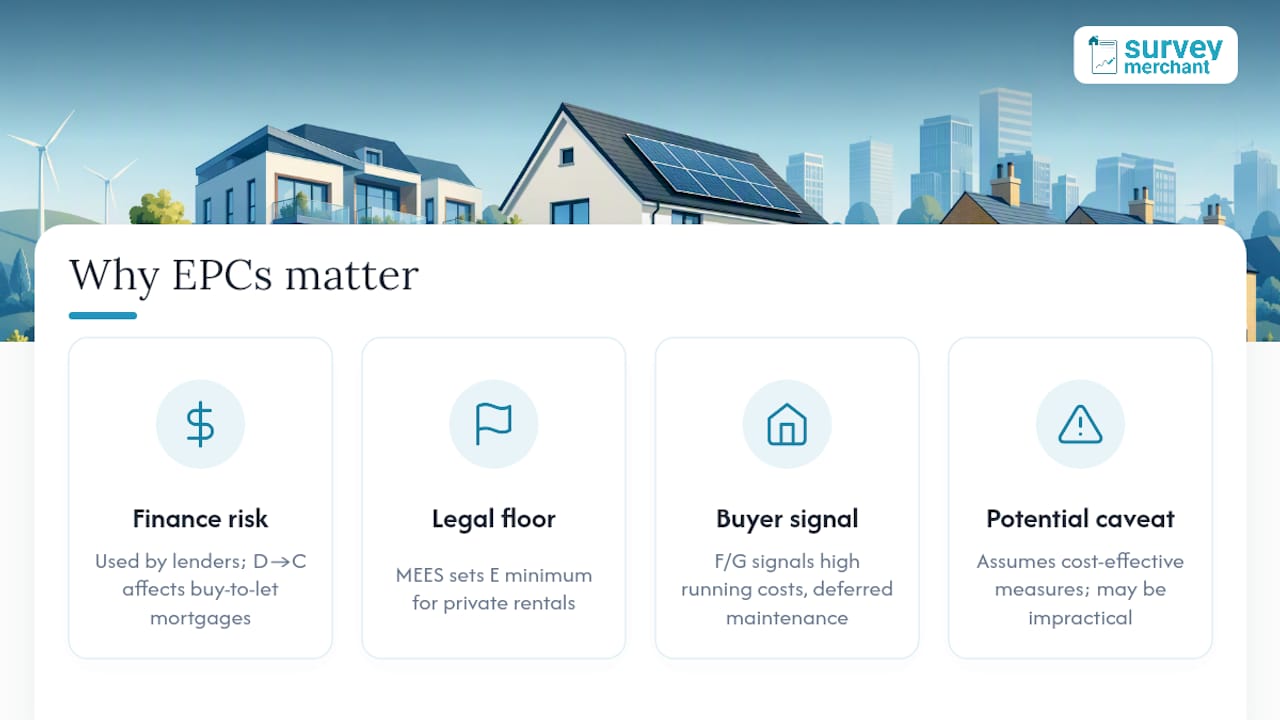
The EPC is treated as a compliance formality by a surprising number of sellers and landlords. That is a mistake. Lenders increasingly use EPC ratings in their risk assessments, and the gap between a D and a C rating can affect mortgage availability for buy-to-let properties. The Minimum Energy Efficiency Standards (MEES) already set E as the floor for most private rented properties in England and Wales, and the direction of travel in policy is toward tighter thresholds.
For buyers, the EPC is one of the few pieces of objective data available before exchange. A property at F or G is not just expensive to run; it signals a building that has had little investment in its fabric, which often correlates with deferred maintenance elsewhere. The recommendations section is worth reading carefully, not just for the energy measures, but for what it implies about the building’s construction and condition.
The potential rating is also frequently misread. Because it assumes all cost-effective measures are installed, it can look more achievable than it is. A Victorian solid-wall terrace with a potential of B has a long, expensive road to get there, and some of those measures may not be practical or permitted. Treat the potential band as a planning tool, not a promise.
When an EPC raises questions a certificate cannot answer, finding the right surveyor quickly matters.

Surveymerchant is an impartial marketplace connecting UK property buyers, sellers, landlords and developers with accredited surveyors across the country. Whether you need a Level 3 building survey to assess a property before purchase, a valuation, or specialist advice on structural or retrofit works, the platform matches you to qualified professionals without the guesswork of searching independently. Surveymerchant does not employ surveyors directly; it connects you to vetted, accredited professionals and lets you compare options. Get a quote through Surveymerchant today and have a qualified surveyor confirmed before your transaction moves forward.
Survey Merchant provides vetted RICS surveyors across 100+ UK locations at fixed fees:
→ Level 2 Home Survey (HomeBuyer Report)
→ Level 3 Building Survey (full structural survey)
→ RICS Red Book property valuations
→ Party wall surveyors — notices, awards & schedules of condition
→ Expert witness surveyors — CPR Part 35 reports for property disputes