Building Surveying
Jul 16, 2026
Drone Roof Inspection Report: A Complete UK Guide 2026
Understand your drone roof inspection report with our UK guide. Learn what's included, how to interpret findings, and the next steps for your property.

You're probably here because the roof is the part of the property you can't properly see, yet it may carry some of the biggest repair risk. Perhaps you're buying a house and the survey mentions the roof needs closer inspection. Perhaps you manage a block, own a rental, or need evidence for an insurer without putting someone straight onto a fragile covering.
A drone roof inspection report can be very useful in that situation. It can also be misunderstood. Clients often assume that better images mean complete certainty. They don't. A good report gives strong visual evidence of what is visible from above and, in some cases, useful thermal clues. It doesn't automatically prove what's happening beneath the covering, inside concealed voids, or at details that still need hands-on checking.
That distinction matters. If you know what a drone report can prove, what it can suggest, and what it cannot confirm, you can use it properly for purchase decisions, maintenance planning, and insurance conversations.
A drone roof inspection report is a structured roof assessment produced from aerial data captured by a drone. In practice, that usually means high-resolution images, sometimes video, and in some instructions thermal data where heat loss or moisture behaviour is relevant. The report should convert that captured material into findings, marked defect locations, and practical recommendations.
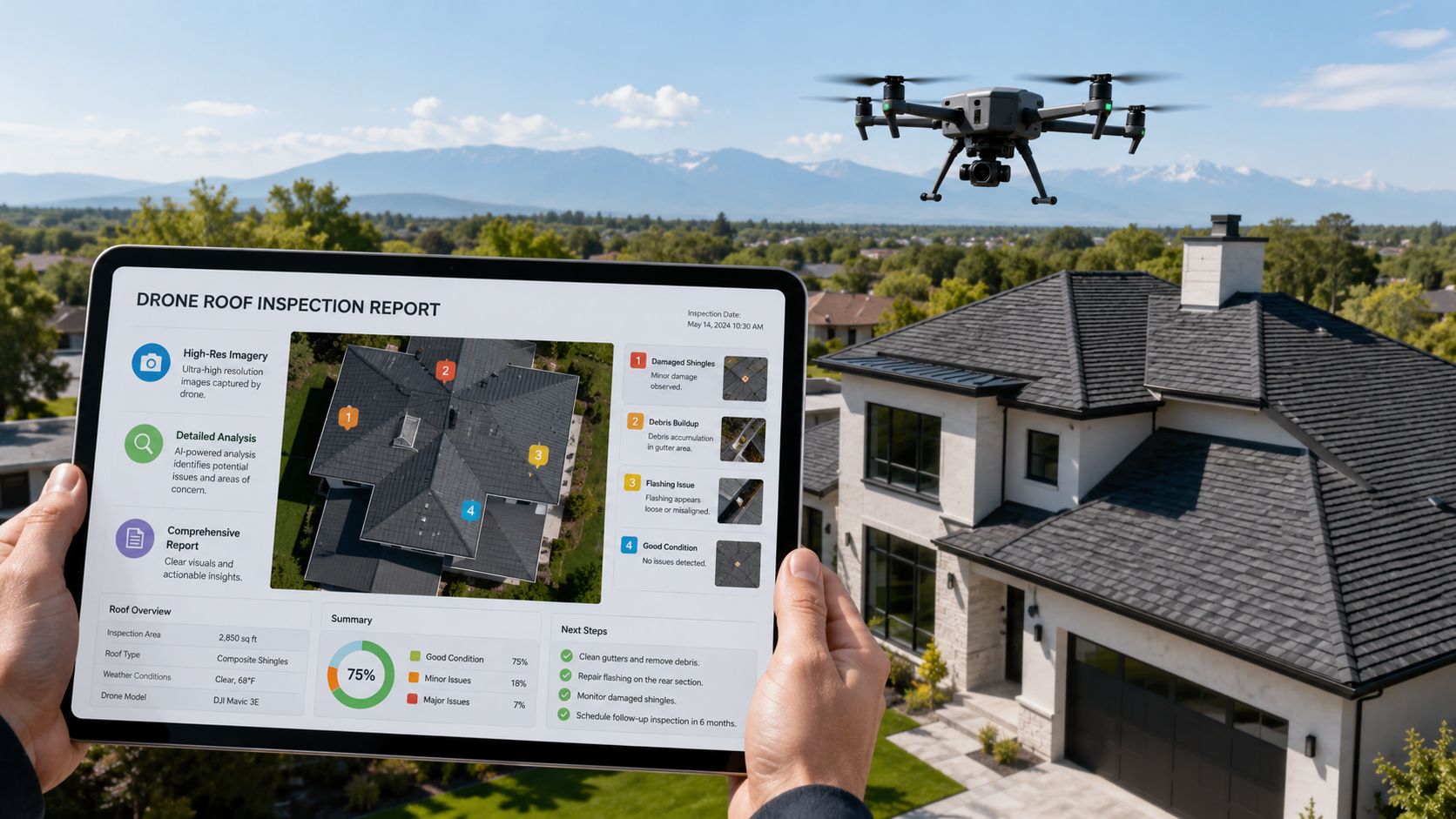
It isn't the same as a person flying a drone over a building and emailing over some pictures. It also isn't the same as a full intrusive roof investigation. The value lies in how the evidence is captured, reviewed, annotated, and explained.
A traditional ladder-based inspection may allow close viewing at selected points, but access can be restricted by height, fragility, layout, or safety concerns. A drone approach keeps the surveyor on the ground while obtaining views that are often difficult or unsafe to achieve manually.
A mortgage valuation is different again. That service is not designed to provide a detailed diagnosis of roof defects for the buyer. A drone report, by contrast, is focused on the roof itself and should show the condition evidence in a way a client can revisit later.
Practical rule: If the document only contains unlabelled photographs, it's not much of a report. You need commentary, defect locations, scope, and limitations.
Industry adoption has moved quickly. The commercial drone-services market for roof inspection reached approximately USD 0.3 billion globally in 2026 and is projected to reach USD 1.2 billion by 2036, at a 14.9% CAGR, according to Fact.MR's drone roof inspection market analysis. That matters because it shows drone-based reporting is no longer an experimental extra. It's becoming part of normal asset inspection practice.
A proper report depends on more than owning a drone. The operator must work within UK aviation rules and produce survey evidence that is useful to a property client, not just technically impressive. That means planning the flight, obtaining the right coverage, controlling image quality, and presenting the findings with enough restraint to avoid overclaiming.
If you want background on the broader service before focusing on the report itself, this guide to understanding drone roof surveys is a useful companion.
The strongest case for drone roof surveys rests on three things. Safety, access, and evidence quality. Those are practical benefits, not marketing phrases.
The safety point is obvious. Surveyors don't need to walk steep, slippery, or fragile coverings just to get an initial visual assessment. On older roofs, that matters for both the inspector and the building. Some coverings are easily damaged by foot traffic, and some roofs are unsafe to traverse without specialist access equipment.
A drone is particularly useful where the geometry is messy. Rear additions, valleys, dormers, parapets, chimney abutments, solar panels, glazed sections, and changes in level all create blind spots from the ground. Aerial capture lets the surveyor inspect those details far more clearly than binoculars from a driveway ever will.
It also helps where the roof is visible only from neighbouring land, over gardens, or above conservatories and extensions that make ladder positioning poor or impossible.
A typical residential drone roof inspection can take 20 to 45 minutes, and roof-report workflows can generate a report in just a few clicks after data capture for both residential and commercial buildings, as explained in DroneDeploy's roof report guide. That doesn't mean every job is simple. It means the capture stage is often far more efficient than arranging scaffold or repeated ladder access.
For a buyer or landlord, that speed usually means quicker clarity on whether the issue looks minor, moderate, or likely to require a contractor's quote.
A drone survey creates a durable record. The surveyor can enlarge images, compare elevations, mark exact defect points, and retain the material for later reference. That's useful when you're discussing repairs with contractors or trying to show why a recommendation was made.
A good drone survey is also less dependent on what one person happened to notice in a brief rooftop visit. The captured imagery can be reviewed afterwards in detail, which often improves consistency.
The real advantage isn't just getting into the air. It's being able to look again, zoom in, annotate, and explain the roof clearly after the visit.
Not all reports are equal. Some are robust survey documents. Others are little more than image dumps with a logo on the front.
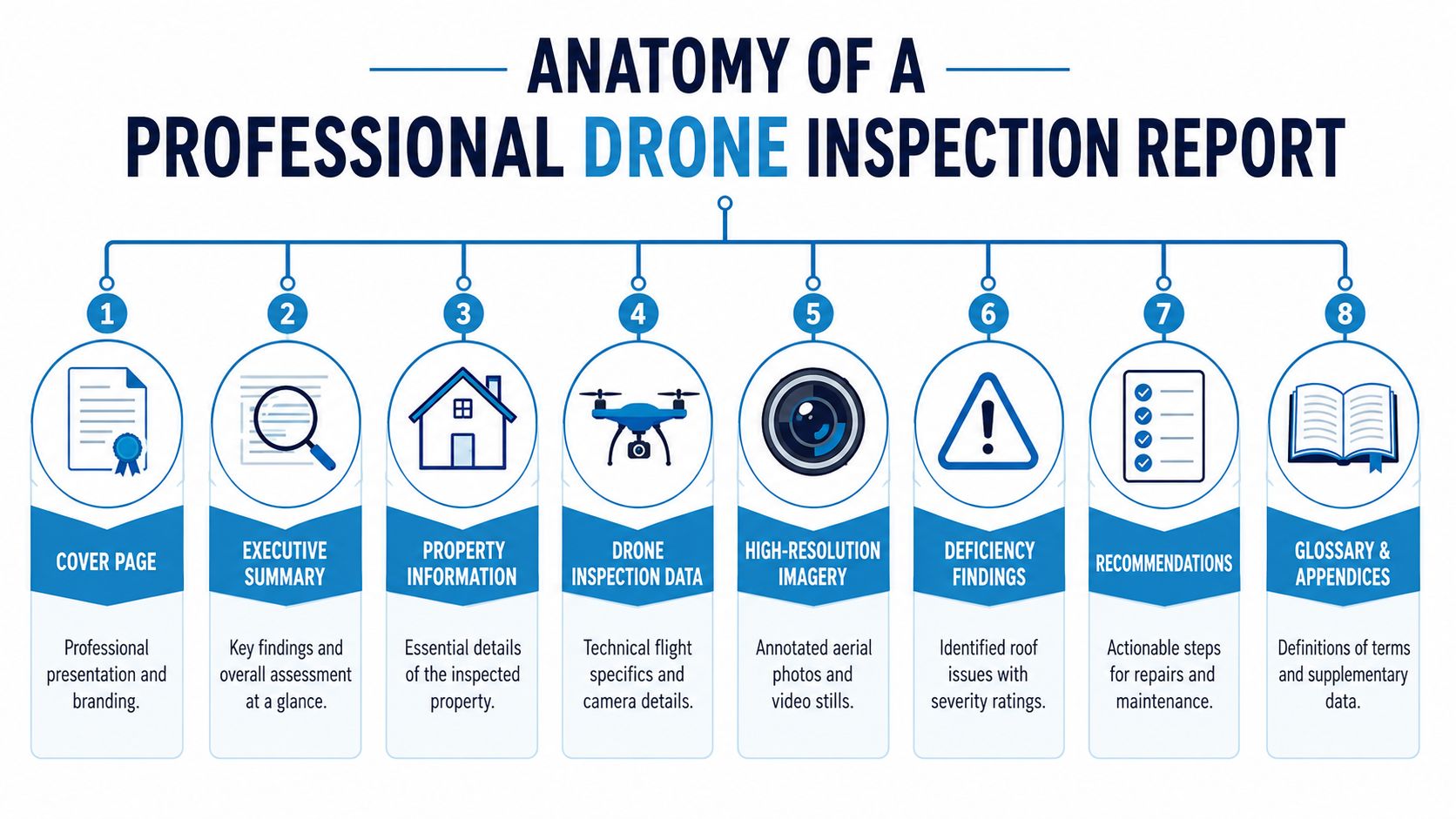
A professional report should begin with an executive summary. In it, the client should learn, quickly, whether the roof appears broadly serviceable, shows isolated repair items, or raises wider condition concerns. If that summary is missing, clients often struggle to judge urgency.
The next important element is the scope of inspection. This tells you what was inspected, what technology was used, and what was excluded. If the report doesn't explain whether the loft, underside, rainwater goods, or internal ceilings were inspected, you can't tell how much weight to place on the conclusions.
A strong report will also include:
Professional workflows often use automated flight paths, controlled image overlap, and 3D modelling to create measurable roof models that can be reviewed from different angles and exported into a report, as outlined in Anvil's guide to drone roof inspection software. On complex roofs, that's especially helpful because the surveyor can revisit the geometry during analysis rather than relying only on what was seen live on site.
The best reports don't merely say “damage noted”. They show the issue and explain its significance. For example, an annotated image might mark slipped slates at the left-hand rear pitch and then state the likely consequence, such as local water entry risk if not repaired.
A robust report should also include a defect map and high-resolution imagery, with thermal data where relevant to insulation performance or suspected moisture patterns. Those elements are described in Impact Aerial's outline of what a professional survey includes. Without that structure, the client is left guessing whether a mark in a photo is cosmetic wear or something more significant.
A useful way to assess report quality is to ask whether each finding answers four questions:
| Question | Why it matters |
|---|---|
| What can be seen? | Distinguishes observation from assumption |
| Where is it? | Helps contractors price and locate repairs |
| Why does it matter? | Translates an image into property risk |
| What should happen next? | Turns evidence into action |
A careful surveyor writes to the evidence first, then to the inference. That order matters when clients rely on the report for spending decisions.
Most clients look first at the pictures. That's natural. The mistake is treating the picture alone as the conclusion.
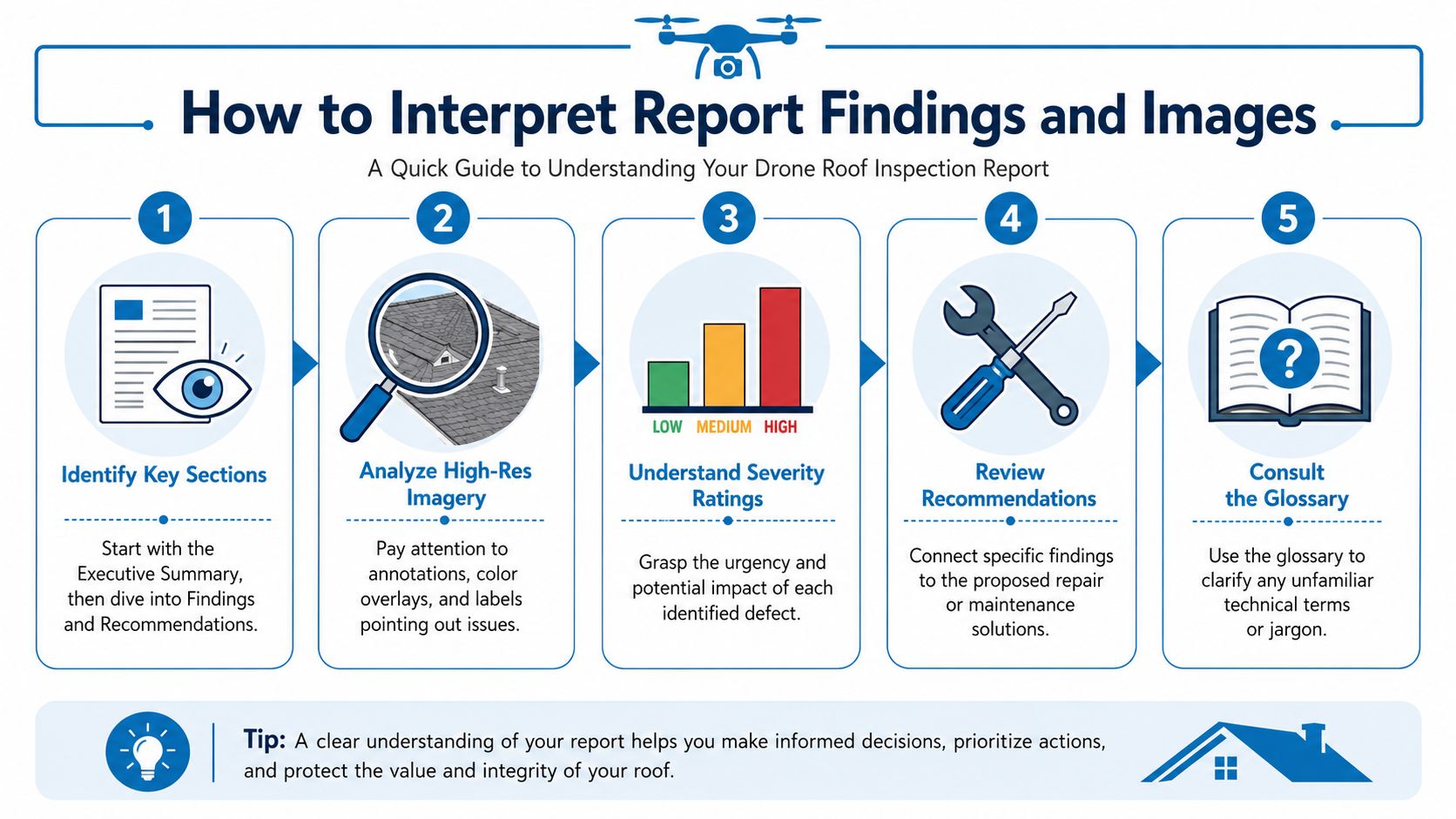
Suppose the report shows a slipped slate. The image is the evidence. The note is what gives it meaning. A good comment would identify the roof slope, the approximate location, the apparent defect, and the likely implication. In practical terms, that might mean increased risk of localised water penetration, especially in exposed weather.
The same applies to flashing. A photo may show lifting, splitting, or separation at a chimney abutment, but the surveyor's note tells you whether the issue appears isolated or part of broader deterioration. On flat roofs, a dark patch may indicate staining, standing water, or previous repair. The wording matters.
When reading findings, pay close attention to three things:
If the report includes thermal data, treat it as another layer of evidence, not a magic answer. In such cases, thermal surveys for property issues prove valuable. Thermal patterns can help distinguish simple surface wear from areas that may be associated with heat loss or moisture behaviour, but they still need interpretation in context.
This is the point many articles avoid. A drone report can be highly reliable for visible external defects. It is much less reliable for hidden defects.
A drone usually cannot confirm:
Guidance in this area is still thin for non-technical clients. Drone software can produce orthomosaics and 3D models, but published UK-facing material doesn't always explain how much evidential weight those outputs should carry for purchase or insurance decisions. That limitation is highlighted in this discussion of drone roof inspection evidential limits. A good report should caveat findings clearly where physical access wasn't possible.
Don't ask a drone report to prove what it cannot see. Ask it to show the visible condition well enough to decide whether more investigation is justified.
For a buyer, the report is often best used as a decision tool, not as a blanket warranty. It can support renegotiation, budgeting, or a request for further inspection. If major roof covering defects are visible, the report may carry real weight. If the concern is hidden decay, trapped moisture, or a long-running leak path, you may still need internal inspection or selective opening up.
For insurance, image-based evidence is often useful because it creates a dated visual record of condition. If you're preparing documentation after storm damage or trying to understand how evidence is usually assembled, these strategies for roof insurance claims give a helpful overview of how roof condition evidence tends to be organised. The key point is this. A drone report supports a claim best when it is clear, dated, and specific about what was observed.
The most useful reports don't just identify defects. They show patterns. Once you've reviewed a number of these inspections, recurring problem areas become obvious.
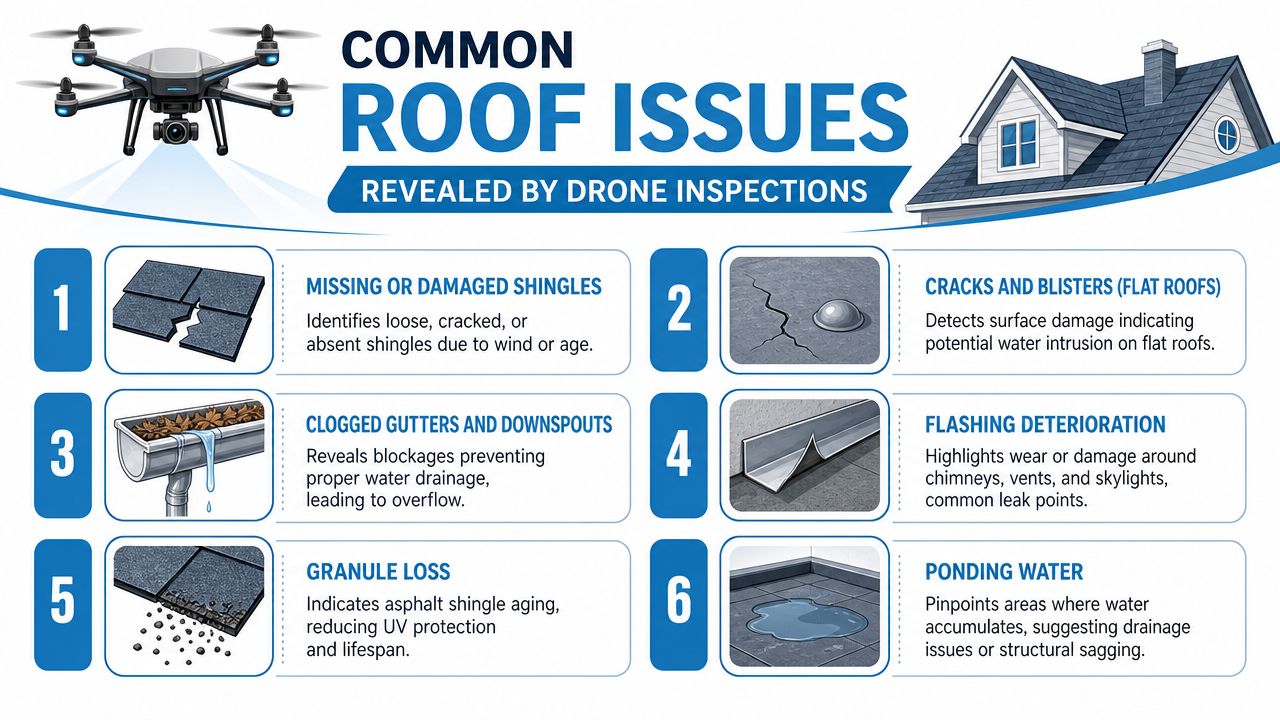
A detailed report should combine high-resolution imagery, a defect map, and, where relevant, thermal data so the surveyor can distinguish surface wear from more meaningful signs such as heat loss or water ingress patterns, as described in Impact Aerial's professional survey guidance.
On pitched roofs, the common findings are usually straightforward to recognise from good imagery.
Flat roofs usually require more interpretation because the issue is often about condition pattern rather than one obvious break.
Here are the problems I'd expect a drone report to flag clearly:
If roof ventilation appears to be part of the wider performance problem, especially in hot roof spaces or poorly ventilated roof assemblies, this overview of licensed roof ventilation installations is a helpful reference on the types of systems property owners may end up discussing with specialists after defects are identified.
Choosing the right professional matters more than choosing the drone. A poor operator with a good drone still produces a poor report.
Start with the surveyor's core competence. For property decisions, you want someone who understands building pathology, not just aerial image capture. Professional affiliations such as RICS, CIOB, CIAT, or CABE can help indicate a broader surveying or construction background, but the key indicator is whether the report translates roof evidence into property advice.
Then check the practical protections:
If budgeting is part of your decision, this guide to UK drone roof inspection costs helps frame what affects pricing and why the cheapest quote may not produce the most useful evidence.
The best client questions are simple and direct.
| Ask this | Why it matters |
|---|---|
| Will the report identify limitations clearly? | Prevents false confidence |
| Are findings linked to annotated images? | Makes the report usable by contractors and insurers |
| Can you advise when physical inspection is still needed? | Helps you plan next steps |
| Do you understand purchase and defect risk, not just flight operations? | Keeps the advice property-led |
If your concern follows severe weather, it can help to understand how restoration contractors frame storm response in practice. For context on that wider process, this article on understanding storm restoration in Tampa shows the kind of post-event workflow property owners often end up navigating, even though UK reporting and procurement arrangements differ.
The right instruction is not “fly a drone over my roof”. It's “inspect the roof and tell me what the evidence means, what it doesn't prove, and what I should do next”.
They can, especially in dense urban settings. A competent operator manages this through planning, controlled flight activity, and a narrow focus on the subject property rather than casual filming of surrounding homes. The aim is inspection, not general recording. If privacy is a concern, ask in advance how the operator handles briefing, flight paths, and image retention.
Sometimes yes, sometimes only as supporting evidence. Much depends on the question being asked. If the report clearly documents visible external defects, it can be useful evidence for maintenance, claims support, or a follow-up underwriting query. If the lender or insurer wants confirmation of hidden defects, causation, or long-term structural condition, a drone report alone may not be enough. In purchase work, it's often strongest when paired with an overall surveyor's opinion.
That happens. Weather, proximity constraints, site obstructions, and local flight limitations can prevent safe operation. A professional should say so early, not improvise poorly. The sensible alternatives are rescheduling, changing the inspection method, or combining limited drone use with binocular, ladder, or other access-based inspection where safe and appropriate.
A report produced under poor flying conditions is often less useful than a delayed report produced properly. Good evidence matters more than speed.
Sometimes. If the roof defect is visible and the implications are reasonably clear, the report may be enough to inform negotiation or budgeting. If the issue could involve concealed decay, widespread moisture entrapment, or defect causes that aren't externally visible, you should treat the report as one layer of evidence and consider further inspection.
It can identify defects associated with leak risk. It may also highlight thermal anomalies where that form of survey is included. But it usually cannot confirm every leak path or prove the exact internal route of water without more investigation.
Read the summary first, then review each finding with the annotated images. Separate items into three groups: urgent repairs, planned maintenance, and points needing further investigation. If the report is being used for a purchase, ask your surveyor which findings affect value, negotiation, or insurability.
If you need a clear, impartial drone roof inspection report from a qualified property professional, Survey Merchant can connect you with a suitable UK surveyor from its nationwide panel. That's often the simplest way to get a report that doesn't just show the roof, but explains what the findings mean for your purchase, ownership risk, or next repair decision.
Survey Merchant provides vetted RICS surveyors across 100+ UK locations at fixed fees:
→ Level 2 Home Survey (HomeBuyer Report)
→ Level 3 Building Survey (full structural survey)
→ RICS Red Book property valuations
→ Party wall surveyors — notices, awards & schedules of condition
→ Expert witness surveyors — CPR Part 35 reports for property disputes