Building Surveying
Sep 4, 2026
Contamination Survey: A UK Buyer's & Seller's Guide 2026
What is a contamination survey? Our guide explains the UK process, costs, legal context (Part IIA), and when you need one for a property transaction.

You're probably in one of three situations right now. You're buying a plot with an awkward industrial past, selling a property and worrying that an old use might spook buyers, or pushing a development through planning and you've been told you need a contamination survey before anyone signs off.
That can feel murky fast. The ground looks fine. The building may even look spotless. Yet your solicitor, lender, planning officer, or environmental consultant keeps talking about desk studies, intrusive investigations, pollutant linkages, and remediation strategies.
A contamination survey is how you turn that uncertainty into a practical decision. It tells you whether the land presents a real risk, what kind of risk it is, and what that means for price, planning, liability, and buildability.
A contamination survey is best thought of as a health check for the ground. It looks for harmful substances in, on, or under land that could affect people, buildings, groundwater, or nearby watercourses.
That matters because contamination is often invisible. A site can look tidy, level, and ready to use, while buried fill, fuel residues, metals, solvents, or asbestos-containing fragments sit below the surface. The survey's job is to find out whether there's a credible risk and whether that risk needs action.

A lot of buyers confuse this with a building survey. They aren't the same thing. A RICS building survey looks at the structure and condition of the property itself, things like movement, damp, roof defects, timber issues, and repair priorities. A contamination survey focuses on the land risk beneath and around the property.
In plain terms, the survey asks questions like these:
Practical rule: If the risk is underground, a standard building survey won't answer it.
The phrase “contamination survey” also covers more than one level of work. Sometimes the answer comes from records, maps, and a site walkover. Sometimes it needs boreholes, trial pits, and lab testing. The right scope depends on the site history and the likely exposure route.
If your concern is specifically hazardous material within the building fabric rather than the land, a separate resource like this homeowner's guide to asbestos inspection can help you understand where building-related asbestos checks fit alongside ground investigation.
The practical value is simple. A contamination survey helps you decide whether to proceed, renegotiate, seek planning support, request remediation, or walk away. It turns vague suspicion into evidence you can use in a transaction.
For a buyer, that can mean avoiding inherited liability. For a seller, it can mean reducing uncertainty before a deal stalls. For a developer, it can mean giving the planning authority the information it needs in the format it expects.
The reason contamination surveys matter so much in UK property work isn't only technical. It's legal. The current framework was created by the Environmental Protection Act 1990, with the contaminated land regime in Part IIA later implemented through the Contaminated Land (England) Regulations 2000. That framework introduced the formal test for whether land is contaminated by considering whether there's a significant possibility of significant harm or pollution of controlled waters, as noted in this reference to the Environmental Protection Act 1990 and Part IIA framework.
In practice, that means contamination isn't just “bad ground”. It becomes a legal risk when a source, a pathway, and a receptor line up. Surveyors and consultants often call this a pollutant linkage.
Here is the simple version:
If one of those elements is missing, the risk picture changes. That's why a useful contamination survey doesn't stop at “there may once have been industry here”. It asks whether that historic use still creates a real present-day risk.
Land history starts the conversation. Pollutant linkage is what decides whether the issue has teeth.
This is also where liability worries people. A current owner may face a problem even if they didn't cause the original contamination. That's one reason buyers, lenders, and developers want the ground risk assessed early, before contracts are exchanged or planning conditions tighten.
For readers who are comparing different kinds of property professionals, it's also helpful to understand what RICS accreditation means. It doesn't replace environmental expertise, but it helps you distinguish chartered surveying credentials from specialist contaminated land competence.
A good consultant won't improvise. They work to recognised methods and structured risk assessment. That affects how the desk study is prepared, how samples are taken, how laboratory suites are chosen, and how recommendations are justified.
This is one place people get mixed up with other environmental issues. Indoor air quality standards, for example, sit in a different technical lane from contaminated land, even though both involve exposure pathways. If you're comparing those disciplines, this overview of ASHRAE and EPA metrics shows how building-environment metrics differ from land contamination assessment.
A contamination survey isn't just a cautious extra. In many UK transactions, it's part of proper risk management because it supports decisions on liability, planning, insurance discussions, land value, and remediation scope.
Clients rarely order a contamination survey purely out of curiosity. They typically commission one because something in the transaction, planning process, or site history indicates a need for clearer answers.
The reason this comes up so often is straightforward. The Environment Agency has estimated that around 300,000 hectares of land in England and Wales are potentially affected by historical industrial contamination, with roughly 10,000 sites regarded as likely to pose a serious threat, according to this reference to the Environment Agency estimate on historically affected land. That's why land investigation sits at the centre of development risk management instead of the edge of it.
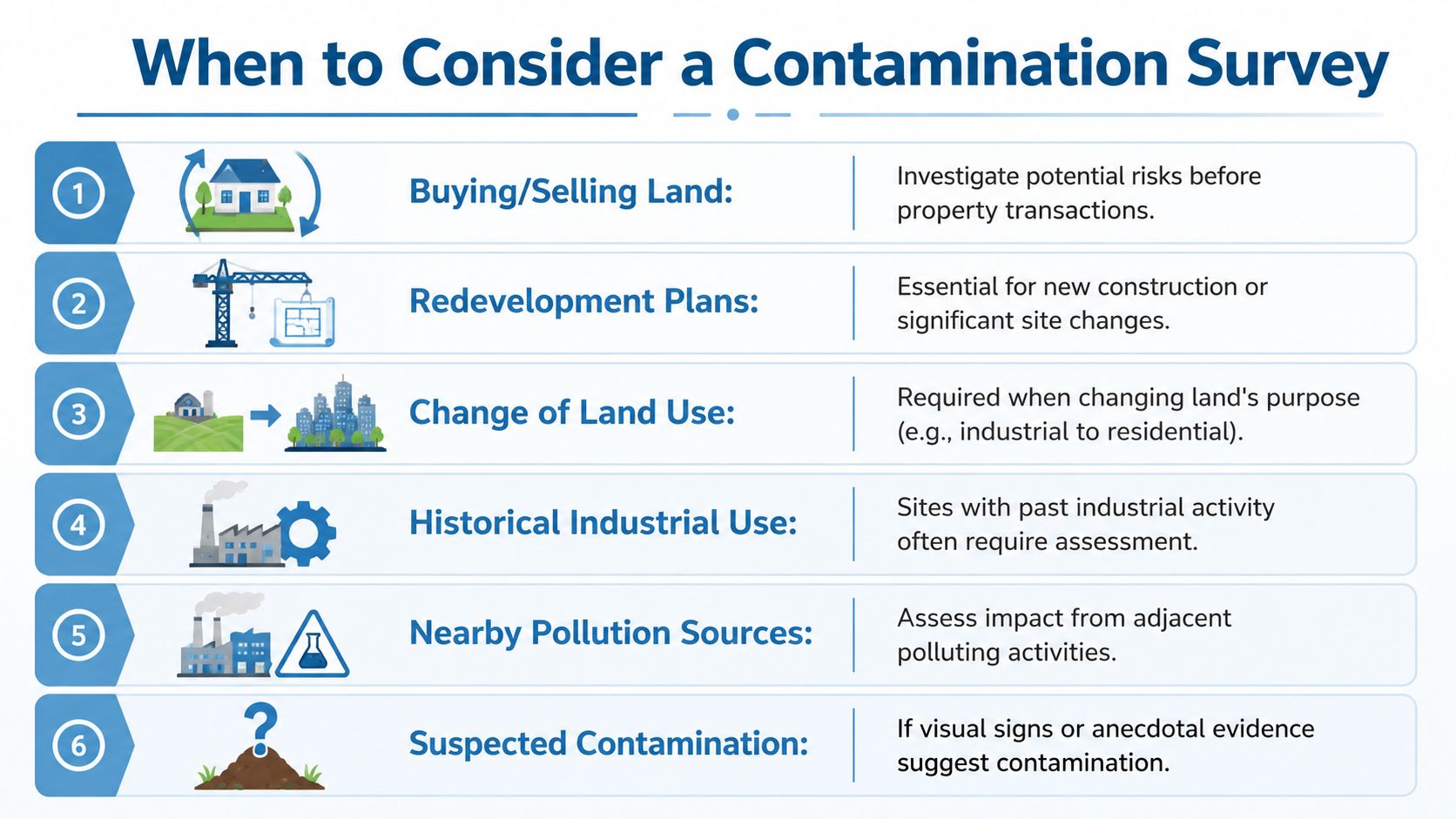
Some triggers are obvious. Others are easy to miss until a lender, planner, or consultant points them out.
If you're buying, treat these triggers as decision points, not background noise. The earlier you investigate, the more advantage you usually have.
Not every clue comes from paperwork. Some come from the site itself.
Watch for:
If a site history, a planning condition, and a lender's query all point in the same direction, delaying the survey usually just delays the problem.
A contamination survey is usually cheapest when it's used as an early filter. If the initial work clears the site, you move forward with confidence. If it raises issues, you still have time to renegotiate, redesign, add conditions to the contract, or sequence remediation sensibly.
A proper contamination survey usually follows a phased approach. That matters because the work should get more detailed only when the evidence justifies it. You don't want to pay for drilling if a thorough desk review already shows minimal risk. But you also don't want to rely on paperwork alone when the site history clearly points to buried hazards.
One of the biggest mistakes is ordering a generic investigation. The survey method needs to match the likely contaminant and exposure route. The approach for PFAS, asbestos in made ground, and fuel residues can differ significantly, as explained in this practical note on choosing the right land contamination survey approach.
Phase 1 is the research stage. No one starts digging yet. The consultant gathers the available evidence and builds an initial conceptual site model.
That normally includes:
The output isn't just a pile of records. It's a reasoned opinion on whether the site is low risk, needs targeted follow-up, or clearly requires intrusive investigation.
For a fuller breakdown of the sequence, this guide to soil contamination assessment is useful if you want to see how desk studies feed into later testing.
Phase 2 begins when records and site evidence suggest that you need actual samples. Such sampling may involve boreholes, window samples, trial pits, gas monitoring points, and groundwater checks.
The consultant designs the investigation around the suspected issue. For example:
Laboratory analysis then tests the samples against the contaminants of concern identified in the conceptual model. If the lab side interests you, this overview of outfitting environmental testing facilities gives a useful look at the kind of controlled environment that supports reliable environmental analysis.
| Aspect | Phase 1 (Desk Study) | Phase 2 (Intrusive Investigation) |
|---|---|---|
| Main purpose | Identify potential contamination risks from records and site appraisal | Confirm whether contamination is present and assess its extent |
| Typical activities | Historic maps, database review, walkover survey, preliminary risk assessment | Trial pits, boreholes, sampling, gas and groundwater monitoring, laboratory analysis |
| Ground is broken | No | Yes |
| Best used when | You need an initial view for purchase, sale, or planning | The desk study shows credible pollutant linkages or planning requires testing |
| Output | Conceptual site model and recommendation for no further action or more work | Factual data, quantified risk interpretation, and remediation recommendations |
If contamination is confirmed, the next step is deciding what to do about it. This isn't a failure. It's a management stage.
The remediation strategy sets out:
This is also where commercial decisions appear. A buyer may use the findings to renegotiate. A developer may revise the earthworks strategy, foundation design, or materials handling plan.
After remediation, someone has to show that the agreed works were completed and that the site now meets the required standard for its intended use. That's the purpose of verification.
Typical verification evidence can include photographs, waste transfer documentation, validation sampling, clean cover records, gas protection installation records, and an updated report for the planning authority or lender.
A contamination survey only becomes valuable in practice when the findings are turned into a decision, then into documented action.
The first time many clients open a contamination report, they go straight to the lab tables and panic. That's usually the least helpful place to start. What matters first is the consultant's interpretation of the risk in the context of the site's proposed use.
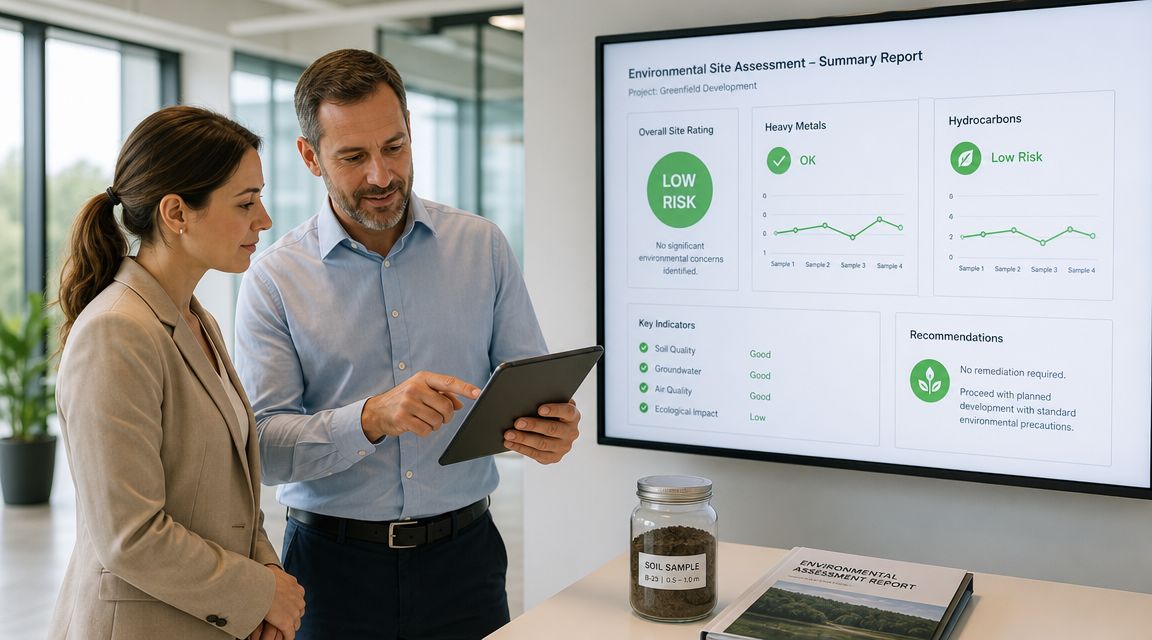
Most findings fall into a practical pattern. The report usually identifies a contaminant, explains who or what could be affected, and then says whether the risk is acceptable, needs refinement, or needs remediation.
Common issues in UK property work include:
A result doesn't mean the whole site is unusable. It means the land has to be assessed against the intended use. Land that may be manageable beneath hardstanding can become a bigger issue if the proposal includes gardens, soft landscaping, or sensitive end users.
Buyers often hear “contamination” and assume “deal over”. In reality, the real question is whether the risk is manageable for the intended use and at what cost or with what design change.
This video gives a useful general primer on environmental site assessment and how findings are interpreted in context:
The remedy depends on the problem. There's no single fix for every site.
The property implication is what most clients care about. If remediation is straightforward and documented properly, a site can still proceed through sale, funding, and development. The key is that the findings must translate into a plan that planners, lenders, buyers, and insurers can understand.
Not every surveyor is the right person for contaminated land work. You need someone who understands environmental risk assessment, site investigation design, regulatory expectations, and report writing for planning and transactional use.
Start with the basics. Look for a consultant or practice that regularly handles contaminated land assessments rather than treating them as an occasional add-on. Experience with similar sites matters more than polished marketing.
Useful signs include:
If you want a simple framework for checking professional standing before you appoint anyone, this guide on how to verify UK surveyor credentials is a good starting point.
A short conversation can reveal a lot. Ask direct questions and listen for practical answers.
A consultant who answers in plain language is usually easier to work with when the report lands on a buyer's desk or in front of a planning officer.
A contamination survey becomes most useful when you treat it as a decision tool, not just a report to file away. The checklist below is the practical version.
Selling a site with a known or suspected issue doesn't always mean trouble. Uncertainty is often the bigger obstacle.
Developers usually feel the impact most directly because contamination affects planning, programme, earthworks, foundation design, and verification.
The best time to manage contamination risk is before exchange, before planning conditions bite, and before the contractor prices the wrong job.
The strongest position, whether you're buying, selling, or developing, comes from asking one question early: what decision will this survey help me make? Once you know that, the scope, timing, and use of the report become much clearer.
If you need help finding the right professional, Survey Merchant connects property owners, buyers, and developers with qualified UK surveyors across multiple disciplines. That can be especially helpful when a transaction needs both general property advice and specialist input to manage risk clearly and quickly.
Survey Merchant provides vetted RICS surveyors across 100+ UK locations at fixed fees:
→ Level 2 Home Survey (HomeBuyer Report)
→ Level 3 Building Survey (full structural survey)
→ RICS Red Book property valuations
→ Party wall surveyors — notices, awards & schedules of condition
→ Expert witness surveyors — CPR Part 35 reports for property disputes