Building Surveying
Sep 29, 2026
Home Survey Level 2: A Buyer's Complete Guide for 2026
Our complete 2026 guide to the RICS Home Survey Level 2. Understand what it covers, UK costs, and how to use the report to negotiate your property purchase.

You've had the offer accepted. The estate agent is upbeat, your mortgage broker is asking for documents, and everyone seems to want the purchase to move quickly. This is usually the point where first-time buyers hear three similar-sounding terms, valuation, survey, and report, and assume they all mean roughly the same thing.
They don't.
A mortgage valuation is for the lender. It helps the bank decide whether the property is suitable security for the loan. A home survey level 2 is for you. It's a practical, independent look at the home's condition so you can spot defects, judge risk, and decide whether the agreed price still makes sense.
That distinction matters more than most buyers realise. A house can look tidy at a viewing and still hide signs of damp, roof wear, movement, poor maintenance, or alterations that deserve a closer look. Buying without a proper survey can leave you guessing. Buying with one gives you a basis for action.
If you like practical reading on uncovering a home's hidden secrets, that broader buyer mindset is helpful here too. The point of a survey isn't to make a property perfect. It's to make the risks visible before you're committed.
Most buyers don't regret getting a survey. They regret the problems they would never have known about without one.
A good Level 2 survey often changes the conversation around a purchase. Sometimes it confirms the home is broadly what you thought it was, with a few manageable maintenance items. Sometimes it shows that the neat paintwork and staged furniture were distracting you from more important issues, such as damp staining in a corner, slipped roof coverings, or older services that need attention.
Its value isn't just defect spotting. It's decision-making.
A survey helps you answer questions like these:
Practical rule: A survey is money spent before completion so you don't spend blindly after completion.
For first-time buyers, the emotional side matters too. Once you've mentally moved in, it's easy to downplay warning signs. An independent report helps bring the process back to evidence. That's why I often say the survey isn't there to kill the purchase. It's there to stop you walking into it without your eyes open.
For a standard flat, house, or bungalow that appears to be in reasonable condition, a Level 2 is usually the sensible middle ground. It gives more useful detail than a basic report without moving straight to the depth and cost of a full Building Survey.
That middle ground is why so many buyers end up here first. They want clear findings, practical priorities, and a report they can use when speaking to the seller, solicitor, lender, or trades.
A RICS Home Survey Level 2 is the standard choice for most mainstream residential properties, sitting between the simpler Level 1 and the more detailed Level 3. RICS offers it as survey only or survey and valuation, and the valuation option adds a market valuation and insurance reinstatement cost estimate, as explained in Cornerstone Surveyors' guide to choosing between a Level 2 and Level 3 building survey.
In older language, many buyers still call it a HomeBuyer Report. The name has changed in common use, but the practical idea is familiar. It is a mid-range survey for conventional properties that need proper checking, but not a highly intrusive or thoroughly diagnostic investigation.
One reason Level 2 works well for first-time buyers is the format. The report uses a traffic light rating system so you can quickly see what matters most.
You'll usually see:
That doesn't mean green equals perfect, or red equals don't buy. It means the surveyor is helping you prioritise.
A useful Level 2 report doesn't just list defects. It tells you which ones need action now, which ones need budgeting for, and which ones simply need routine maintenance.
A Level 2 is aimed at risk triage. It helps a buyer understand visible condition issues, likely maintenance liabilities, and areas where hidden problems could exist.
It is especially well suited to properties that are:
If that sounds like a broad chunk of the market, that's because it is. This is the mainstream survey for mainstream purchases.
The choice between the two Level 2 formats is straightforward:
| Option | What it includes | Best for |
|---|---|---|
| Survey only | Condition report and inspection findings | Buyers who mainly want condition advice |
| Survey and valuation | The survey plus market valuation and reinstatement cost | Buyers who want condition advice with added value context |
The important point is this. Both versions are still Level 2 surveys. The difference is whether you also want valuation-related information in the same instruction.
The right survey depends less on your budget than on the property's risk profile. Buyers often ask which level is “best”, but that's the wrong question. The better question is which level matches the building you're buying.
A modern flat in a straightforward block doesn't need the same level of investigation as an older house with alterations, mixed materials, and signs of movement. The survey should fit the property, not the other way round.
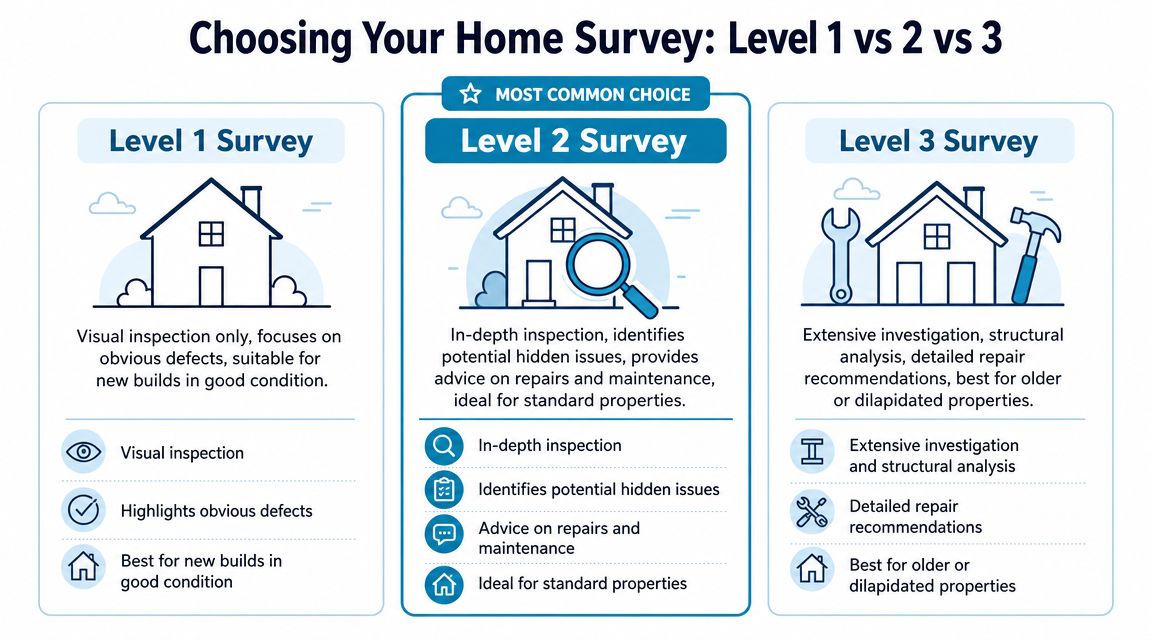
Level 1 is the lightest option. It suits homes where risk appears low and the construction is simple. If the property is very modern and presents well, that may be enough. For many buyers, though, it doesn't go far enough.
Level 2 is the common middle choice. It gives a fuller visual inspection and a clearer picture of condition and maintenance. That's why it's often the best fit for ordinary residential purchases.
Level 3 is the more detailed option. If the property is older, unusual, significantly altered, or plainly in poor condition, a Level 3 is usually the safer call. If you already know you plan major works, it often makes sense to start there rather than try to stretch a Level 2 beyond what it's meant to do.
Lender and insurer questions have also become more relevant. Buyers increasingly want to know whether a survey will help answer concerns around condition, construction type, and wider financial risk. HFWJ Surveyors' discussion of Level 2 versus Level 3 notes the growing focus on energy efficiency and the fact that many homes remain below EPC band C, which matters because a Level 2 can inform condition-related risk but isn't a full EPC or services audit.
If you want a deeper breakdown focused specifically on comparing Level 2 and Level 3 surveys, that comparison is worth reading before you instruct.
| Feature | Level 1 (Condition Report) | Level 2 (HomeBuyer Report) | Level 3 (Building Survey) |
|---|---|---|---|
| Best suited to | Very simple, lower-risk homes | Standard properties in reasonable condition | Older, altered, unusual, or higher-risk homes |
| Inspection depth | Basic visual overview | More detailed visual inspection | Much more detailed investigation and analysis |
| Report style | Simpler condition reporting | Traffic light ratings with practical advice | Broader technical diagnosis and repair context |
| Valuation option | May vary by instruction | Available in survey and valuation format | Usually instructed for deeper condition analysis |
| Typical buyer use | Reassurance | Purchase decision and negotiation | Higher-risk purchase planning |
When the report lands in your inbox, don't start by hunting for the worst sentence in it. Start with the summary and the ratings. A good Level 2 report is meant to be read by buyers, not just by other surveyors.
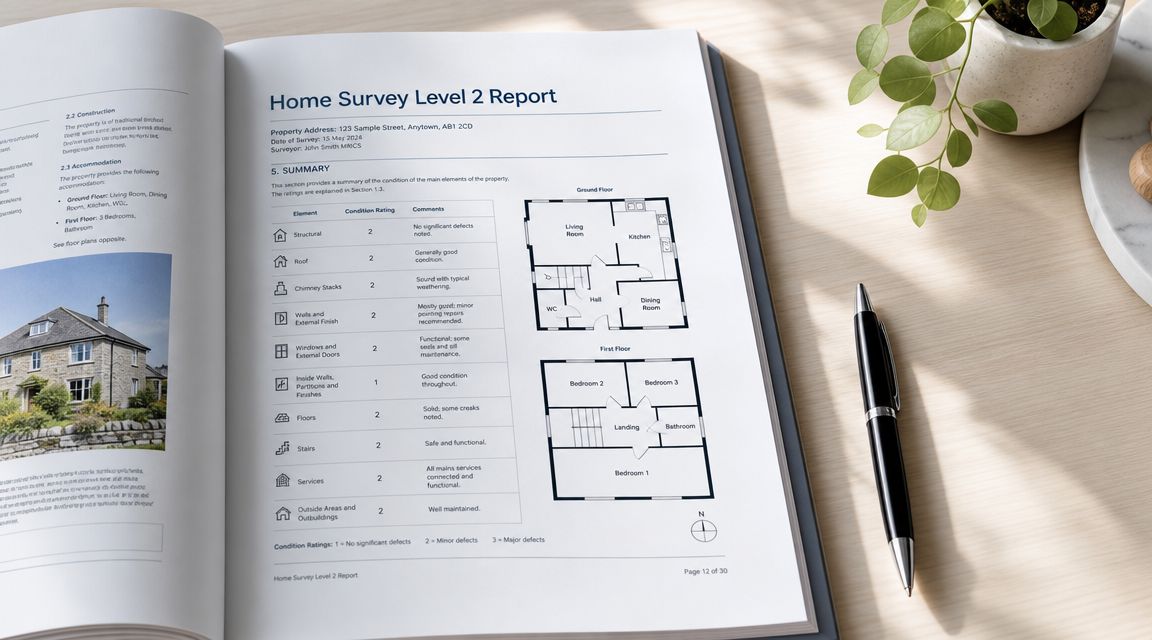
Most reports follow the building from outside to inside, then on to services and grounds. You'll usually see comments on the roof, chimneys, walls, windows, rainwater goods, internal walls and ceilings, floors, joinery, services, drainage, and the site around the property.
For each part, the surveyor normally gives you three things:
Some reports also flag legal or conveyancing points for your solicitor. That could include questions about alterations, guarantees, shared boundaries, or paperwork that should be checked before exchange.
This is where expectations matter. A Level 2 is a non-invasive, visual inspection. RICS states that surveyors only carry out a visual inspection, inspect external surfaces from ground level, and check concealed areas only where safe and accessible, as set out in the RICS Home Survey Level 2 standard.
That means the surveyor isn't there to dismantle the property. They won't typically lift carpets, move heavy furniture, open up walls, or verify hidden defects behind finishes.
So if a buyer asks, “Will a Level 2 tell me everything wrong with the house?” the honest answer is no. It tells you a lot about what is visible and what visible clues suggest. It does not remove all uncertainty.
If an important area is covered, sealed, boxed in, or inaccessible, the report should be read as a warning to investigate further if the risk matters to you.
This is why context is so important. A clear report on a simple modern home is one thing. A visually tidy older home with layers of alteration is another.
If you want more background on the report structure itself, this guide explaining RICS house survey levels gives useful additional context.
A Level 2 survey often earns its keep by spotting problems that aren't dramatic enough to jump out during a viewing, but are serious enough to affect your budget or your confidence.
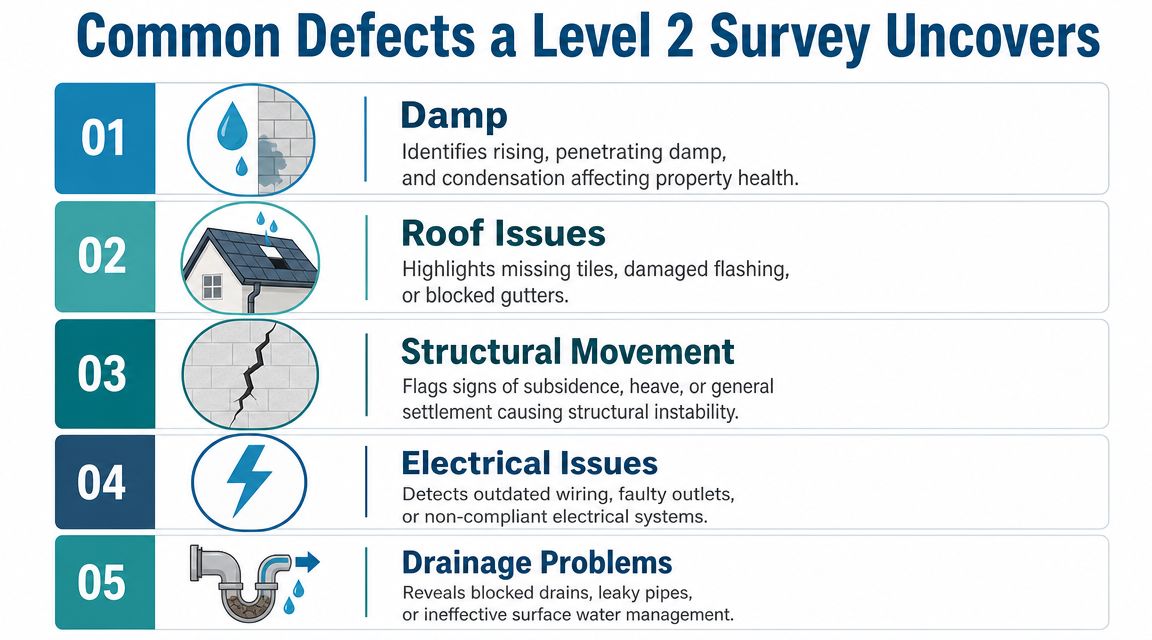
The most common findings tend to be familiar ones.
A visual inspection can also flag where a defect might be more than a cosmetic issue. Cracking, for example, isn't always structural movement. But the pattern, width, and location can tell a surveyor whether it looks routine or whether it needs escalation.
Later in the process, some buyers also need specialist repair input. If movement or slab performance becomes part of the conversation, it helps to understand how contractors approach ground-bearing structures and remedial works. In that context, reading about expert concrete foundation services can give useful background on what foundation-related work involves.
Here's a short explainer that shows the kind of issues buyers often worry about before and after a survey:
A defect finding is not automatically a deal-breaker. Most homes have defects. The question is whether they are manageable, priced in, and properly understood.
That's where buyers sometimes go wrong. They either panic at every amber rating or dismiss a red one because the kitchen looked nice. The sensible approach sits in the middle. Treat the report as a filter. It tells you which issues are routine, which ones affect value or safety, and which ones need a specialist opinion before you commit.
For most buyers, this part is refreshingly straightforward. A Level 2 survey is one of the more standardised products in residential due diligence, so the cost and timing are usually easier to anticipate than people expect.
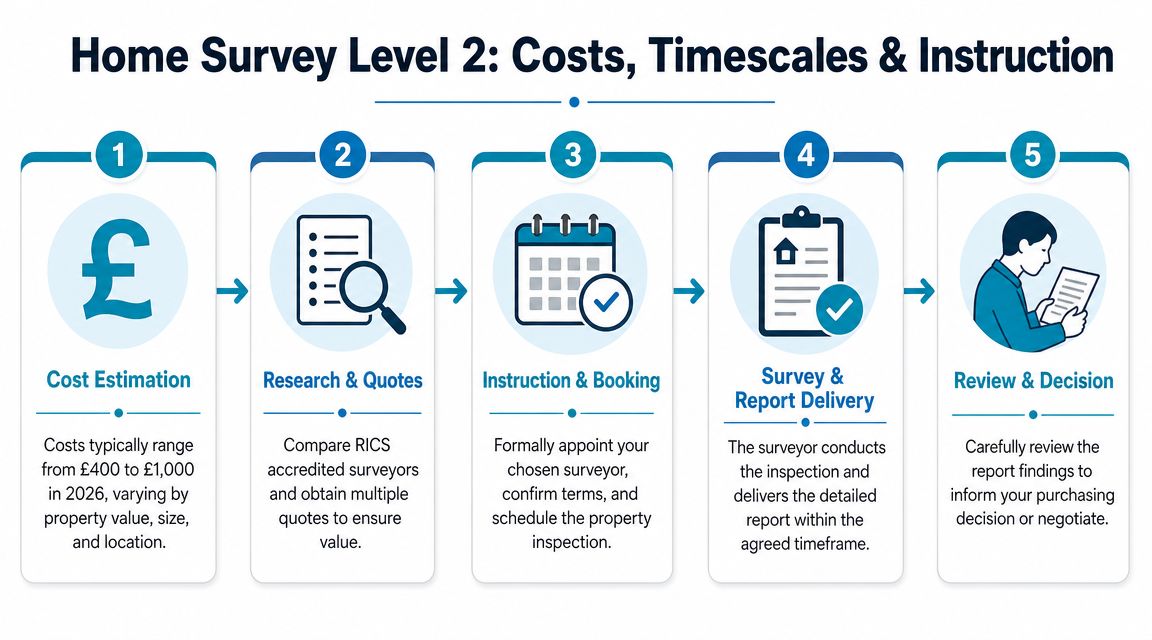
UK guidance places a RICS Level 2 survey typically between £400 and £1,000, with an average around £445, and states that the on-site inspection usually takes 2 to 4 hours, with the report typically delivered within 3 to 5 working days, according to Legal & General's guide to choosing a survey.
Those figures matter because they show what Level 2 usually is in practice. It's a relatively quick, mainstream inspection. It isn't a drawn-out forensic exercise, and it isn't priced like one either.
The instruction process works best when you keep it simple and ask the right questions early.
Confirm the property basics
Give the surveyor the address, property type, asking price, and whether it's a house, flat, bungalow, or maisonette.
Mention anything unusual upfront
If the home is older, altered, extended, or visibly tired, say so before booking. That helps determine whether Level 2 is still appropriate.
Ask what version you're getting
Make sure you know whether you are booking survey only or survey and valuation.
Check turnaround expectations
Ask when the inspection can take place and when you should expect the report back.
Read the terms of engagement
The scope, assumptions, and limitations are made clear.
If you want to understand RICS survey costs in a bit more detail before instructing, that can help you compare quotes on a like-for-like basis.
One practical route is using Survey Merchant, which connects buyers with a nationwide panel of qualified surveyors for instructions such as Level 2 and Level 3 surveys. That kind of platform can be useful if you want quotes and matching without having to ring around multiple firms yourself.
Price matters, but fit matters more. A cheap survey on the wrong property type is poor value, even if the quote looks attractive.
The report only becomes valuable when you use it properly. Buyers who get the most from a Level 2 don't stop at reading the ratings. They convert the findings into decisions.
That matters even more in an older housing market. England's housing stock has a high average age, and 38% of homes were built before 1946, which increases the chance that a visually based Level 2 may not reveal every underlying issue, as noted in MV Surveying's discussion of common issues uncovered in Level 2 homebuyer surveys.
Start with the Condition Rating 3 items. These are the points most likely to affect price negotiations, lender comfort, or your willingness to proceed.
Then sort each issue into one of three buckets:
| Action route | What it means |
|---|---|
| Get quotes | Ask relevant contractors to price the work so you know the likely financial impact |
| Ask questions | Raise legal, planning, guarantee, or alteration issues with your solicitor |
| Seek a specialist opinion | Instruct a damp specialist, structural engineer, roofer, electrician, or drainage contractor where the report recommends further investigation |
Once you have that information, your options become much clearer.
This is the part many buyers underestimate. A Level 2 is often best used as the first filter, not the final word.
If the property is older, has a history of alteration, shows signs of movement, or has concealed areas that couldn't be assessed properly, a further specialist report can be the difference between informed risk and blind risk. The survey has still done its job in that situation. It has identified uncertainty early enough for you to act on it.
The smartest use of a Level 2 isn't expecting certainty. It's using the report to decide where certainty matters enough to investigate further.
When buyers get into difficulty, it's usually because they treat the report as a pass or fail certificate. It isn't. It's a decision tool. Use it to challenge assumptions, obtain quotes, speak to your solicitor, and decide whether the deal still works on the facts.
If you're ready to arrange a survey or want help choosing the right level for the property you're buying, Survey Merchant can connect you with an appropriate qualified surveyor for your instruction and help you move from uncertainty to a clearer purchase decision.
Survey Merchant provides vetted RICS surveyors across 100+ UK locations at fixed fees:
→ Level 2 Home Survey (HomeBuyer Report)
→ Level 3 Building Survey (full structural survey)
→ RICS Red Book property valuations
→ Party wall surveyors — notices, awards & schedules of condition
→ Expert witness surveyors — CPR Part 35 reports for property disputes