Building Surveying
Jul 16, 2026
What is a structural survey? The UK buyer's complete guide
Confused about what is a structural survey? Discover its meaning, importance, and how it protects your property investment in our complete guide.

Many property buyers arrive at the term “structural survey” expecting a clear, official definition and leave more confused than when they started. That confusion is justified. What a structural survey actually entails depends heavily on who you ask, what property you are buying, and what specific concerns prompted the survey in the first place. This article will give you a precise understanding of the structural survey definition, when you need one, what it covers, and how to use the findings to protect your investment throughout the buying process.
| Point | Details |
|---|---|
| Structural survey terminology | The term ‘structural survey’ is unofficial; ‘structural assessment’ or ‘investigation’ is preferred in UK guidance. |
| Purpose of structural surveys | Surveys focus on assessing building safety, stability, and identifying structural defects requiring repair. |
| Survey process overview | Typical surveys follow staged procedures including inspection, possible testing, and detailed reporting with recommended next steps. |
| Choosing the right survey | Select survey level based on property condition and risks; clarify scope upfront with your surveyor. |
| Using survey results | Structural reports guide repair planning, quotations, and negotiations, but do not uncover every hidden defect. |
Here is the first thing worth knowing: the term “structural survey” has no fixed legal or technical meaning in the UK. According to government guidance, “structural survey” is not clearly defined and can be open to interpretation, so the government recommends using “structural assessment” and “structural investigation” instead. That distinction matters enormously. If you commission a “structural survey” without agreeing precisely what that means with your engineer or surveyor, you may receive a report that does not answer your actual questions.
In professional practice, structural assessments tend to follow a staged workflow. Understanding those stages helps you know what you are paying for and what to expect:
The critical point is scope agreement at the outset. Without it, you risk receiving a report that covers what the surveyor assumed you wanted rather than what you actually needed. Keeping up with the latest trends in structural reports can also help you understand what a thorough, modern report should look like before you commission one.
Not every property purchase requires a structural survey. Understanding where it sits relative to other survey types is what allows you to make the right call.
| Survey type | What it covers | Intrusiveness | Typical trigger |
|---|---|---|---|
| Condition survey | General visual overview of building condition | Non-intrusive | Routine check or commercial stock assessment |
| RICS Level 2 (HomeBuyer report) | Condition ratings for key elements, market valuation | Mostly visual | Standard residential purchases |
| RICS Level 3 (building survey) | Detailed inspection of fabric and defects | Moderately intrusive | Older, unusual, or high-value properties |
| Structural survey or investigation | Specific focus on structural integrity and stability | Can be highly intrusive | Signs of cracking, subsidence, or planned alterations |
Structural surveys are typically commissioned when safety and structural stability are genuinely in question, such as visible cracking or suspected subsidence flagged in an earlier inspection. They are not a substitute for a building survey and are not always necessary for a standard purchase of a modern, well-maintained property.
Common triggers for commissioning a structural survey include:
The areas a structural survey covers typically include foundations, load-bearing walls, beams, lintels, roof structure, and floor joists. The scope you agree will determine which of these are examined in depth. Understanding the distinction between condition surveys and structural surveys beforehand will help you ask the right questions when briefing your surveyor.

Knowing a survey is needed is one thing. Knowing what actually happens during it is another. Structural surveys often begin from a red flag identified in a prior survey and include recommendations on next steps, including intrusive testing if required.
A typical structural assessment follows this sequence:
“A structural report without clear next steps is, frankly, only half a report. The real value lies not in the list of problems but in the guidance that tells you what to do about them and in what order.”
One area buyers frequently underestimate is the limitation of access. Not every structural element can be safely or practically inspected. Cavity walls, concealed steelwork, and buried foundations may only be partially assessed without significant disruption. This is not a failure of the process. It is an inherent reality of inspecting existing buildings, and a good report will flag what could not be examined and recommend whether further investigation is warranted.
Understanding the full property survey workflow in the UK will help you see where the structural survey sits relative to mortgage valuations and legal completion.
Pro Tip: Ask your surveyor to confirm in writing before the inspection exactly which elements will be examined and which are outside scope. This prevents surprises in the report and ensures you can seek additional opinions on anything excluded.
Buyers often assume all structural surveys are broadly similar. They are not. The scope, depth, and cost vary considerably depending on what you commission and who you instruct.
| Survey level | Provided by | Intrusiveness | Best for |
|---|---|---|---|
| RICS Level 2 (HomeBuyer) | Chartered surveyor | Visual only | Modern properties in reasonable condition |
| RICS Level 3 (building survey) | Chartered surveyor | Moderate, including accessible roof spaces and subfloor areas | Pre-1930s properties, unusual construction, significant works planned |
| Structural assessment | Structural engineer | Variable, can be highly intrusive with opening up | Specific structural concerns, subsidence, alterations |
| Structural investigation | Structural engineer | Intrusive, may include sampling and laboratory testing | Complex structural problems requiring evidence |
The RICS Level 3 building survey is the most thorough option offered by chartered surveyors, including intrusive inspection and detailed reporting on defects and repair options. However, it is not the same as instructing a structural engineer to investigate a specific problem. The two serve different purposes and are not interchangeable.
The right choice depends on several factors:
Understanding the importance of a structural engineer survey is particularly relevant when purchasing older or altered properties where a chartered surveyor alone may not have the specialist knowledge required.
Pro Tip: When briefing any surveyor or engineer, be explicit about your intended use of the building, any alterations you are planning, and the specific concerns that prompted the survey. Surveyors tailor their scope to what you tell them, and vague instructions produce vague reports.
Preparation on your part significantly affects what you get back from the survey. Structural surveys may require access to concealed areas with temporary disruption and higher costs, so clear scope definition avoids reporting gaps before you even begin.
Follow these steps to prepare effectively:
Once you have the report, use it actively. Do not simply file it. Share relevant sections with contractors to obtain repair quotes before exchange. Use the findings to negotiate a reduction in the agreed purchase price or to require the vendor to carry out remediation before completion. A thorough structural report is negotiating evidence, not just technical documentation.
Pro Tip: Always ask your surveyor to indicate which recommendations are urgent, which are precautionary, and which represent longer-term maintenance. Prioritising findings saves you from overspending on non-urgent works immediately after purchase.
Learning how to prepare for a property survey in advance makes the entire process smoother and reduces the risk of gaps in coverage.
Here is a perspective that most buyers do not hear until after they have paid for a report they cannot use: the single biggest problem with structural surveys is not the quality of the inspection. It is the quality of the brief.
Buyers routinely expect a structural survey to function like a comprehensive safety audit, one that will automatically reveal every hidden defect and assign a clear value to necessary repairs. That is not what most surveys deliver, and it is not what most surveyors are contracted to produce. Without clear next steps in structural reports, buyers struggle to translate findings into repair scopes, quotes, and negotiation evidence.
The reports that genuinely empower buyers do three things well. They describe what was found with specificity. They explain the likely cause and significance. And they tell you, in plain terms, what to do next and in what order. When a report simply notes “cracking observed to south gable wall, further investigation recommended,” without explaining whether that crack is cosmetic settlement or active structural movement, it creates anxiety without creating clarity.
The buyers who get the most value from structural surveys are those who treat the surveyor as a professional adviser, not just a report-writing service. They ask questions during the inspection. They request a follow-up conversation to walk through the findings. And they push back on vague language until they understand what the report actually means for their purchase.
Keeping pace with the latest developments in structural reporting also equips you to recognise when a report meets the standard you should expect and when it falls short.
Pro Tip: Before commissioning any structural survey, write down the three questions the report must answer for your purchase decision to proceed with confidence. Share those questions with your surveyor at the outset and confirm that the agreed scope will address all three.
Navigating a structural survey is far less stressful when you have the right professional in your corner from the start. Survey Merchant connects property buyers and owners across the UK with qualified, vetted surveyors who specialise in exactly the kind of assessment your property requires.

Whether you need a detailed building survey for an older residential property, a specialist assessment for a commercial property, or an independent RICS valuation to support a purchase or mortgage, Survey Merchant’s panel of multidisciplinary experts can be matched to your specific needs. Every surveyor in the network is assessed for qualifications, experience, and reliability, so you are not left guessing whether you have the right person for the job. Start your survey search today and get the clarity your property decision deserves.
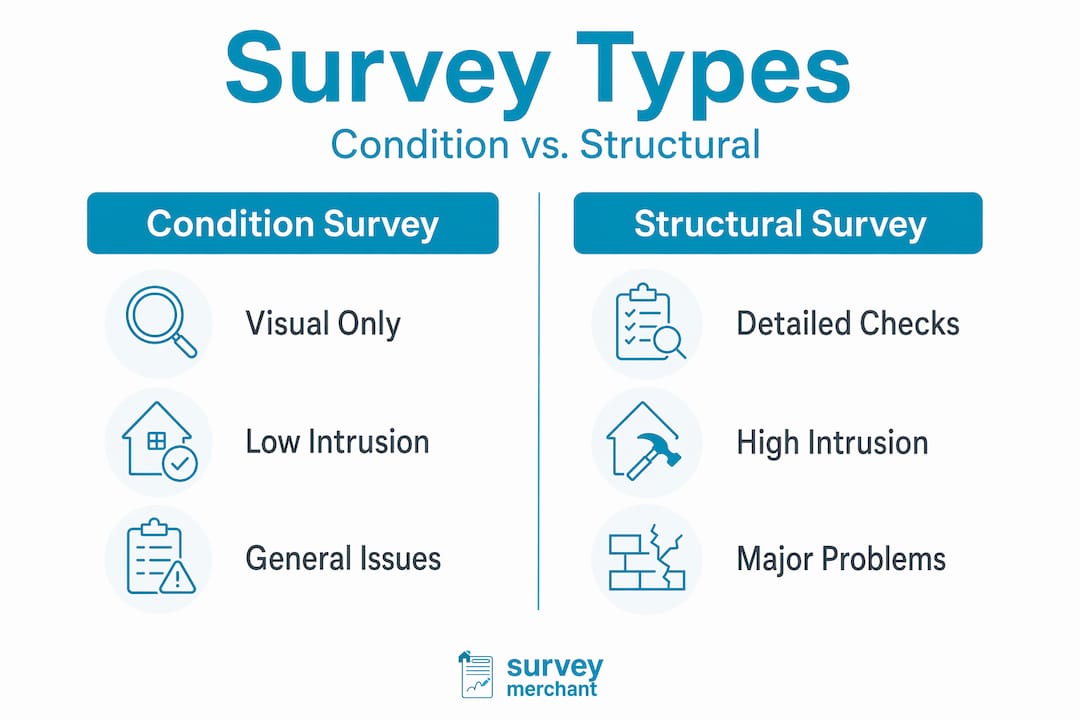
A condition survey is a visual and non-intrusive inspection focusing on general building condition, whereas a structural survey involves detailed investigation of structural stability and may include intrusive testing of specific elements.
You should commission a structural survey if there are signs of cracking or subsidence, if the property is old or has undergone significant alterations, or if you plan major structural works such as wall removals or extensions after purchase.
No. Structural investigations are constrained by accessibility, meaning concealed elements may not be fully assessed; inconclusive findings typically prompt targeted specialist investigations rather than definitive answers.
You will receive a detailed report describing observed structural conditions alongside clear recommendations for repair, monitoring, or further specialist investigation to guide your next steps.
Survey Merchant provides vetted RICS surveyors across 100+ UK locations at fixed fees:
→ Level 2 Home Survey (HomeBuyer Report)
→ Level 3 Building Survey (full structural survey)
→ RICS Red Book property valuations
→ Party wall surveyors — notices, awards & schedules of condition
→ Expert witness surveyors — CPR Part 35 reports for property disputes