Building Surveying
Jul 16, 2026
Role of a chartered surveyor: your guide to property assurance
Discover what a chartered surveyor does in the UK, from RICS home surveys and Red Book valuations to party wall agreements and compliance advice.

Many property owners and buyers assume a surveyor’s job begins and ends with putting a number on a building. That assumption is understandable, but it leaves a costly gap in understanding. Chartered surveyors in the UK perform a wide spectrum of work: from structural defect diagnosis and party wall compliance to formal property valuations and development planning advice. With RICS Red Book standards underpinning the profession, the advice you receive from a qualified surveyor carries legal weight and professional accountability that no online estimate can replicate. This guide explains precisely what chartered surveyors do, why their specialisms matter, and how to get the most from their expertise.
| Point | Details |
|---|---|
| Chartered surveyor essentials | Chartered surveyors offer critical advice and assurance for property owners and buyers in the UK. |
| Compliance and protection | RICS standards and chartered status provide regulated, ethical service and legal protection in transactions. |
| Specialisms and practical help | Surveyors specialise in home surveys, valuations, party wall agreements, and defect diagnosis to minimise risks. |
| Choose RICS-regulated experts | Opting for a RICS chartered surveyor ensures quality, compliance, and liability cover. |
The short answer is: far more than most buyers realise. A chartered surveyor is a professionally trained expert regulated by the Royal Institution of Chartered Surveyors (RICS), and their remit spans almost every stage of a property transaction or development project. Understanding those responsibilities helps you know exactly when to bring one in and what to expect.
Core services include:
The choice between a Level 2 and Level 3 survey is not always obvious. A Victorian terraced house, for instance, might appear in good order but carry hidden defects in its solid-wall construction that only a Level 3 assessment would uncover. Getting this decision wrong at the outset can cost thousands in unforeseen repairs after completion.
Pro Tip: Before instructing any surveyor, verify their RICS membership on the RICS public register. Membership confirms they are bound by a professional code of conduct, carry indemnity insurance, and complete ongoing continuing professional development (CPD).
The breadth of the role means chartered surveyors are involved at virtually every stage of property ownership, not just the point of purchase. Whether you are remortgaging, extending, or selling, their input adds measurable value.
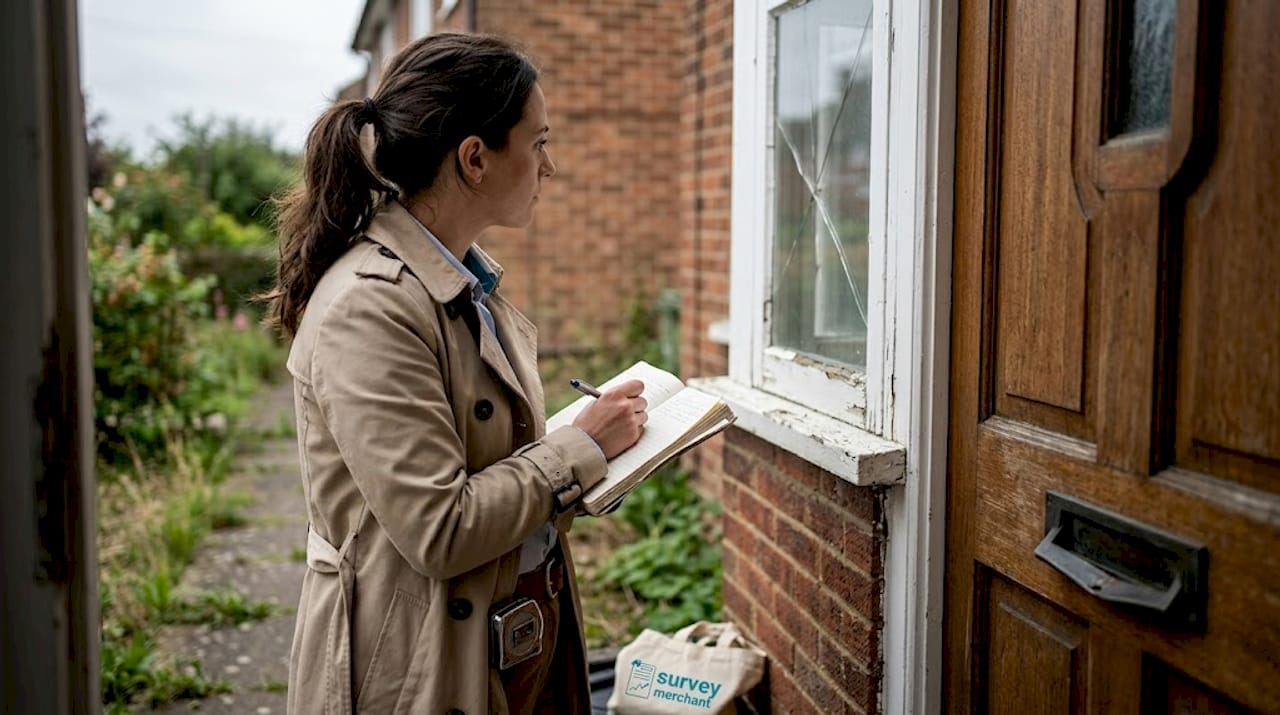
Chosen well, a surveyor’s specialism can be the difference between a smooth transaction and a protracted legal dispute. The profession is not monolithic. Surveyors concentrate in distinct areas, and matching the right specialism to your situation is important.
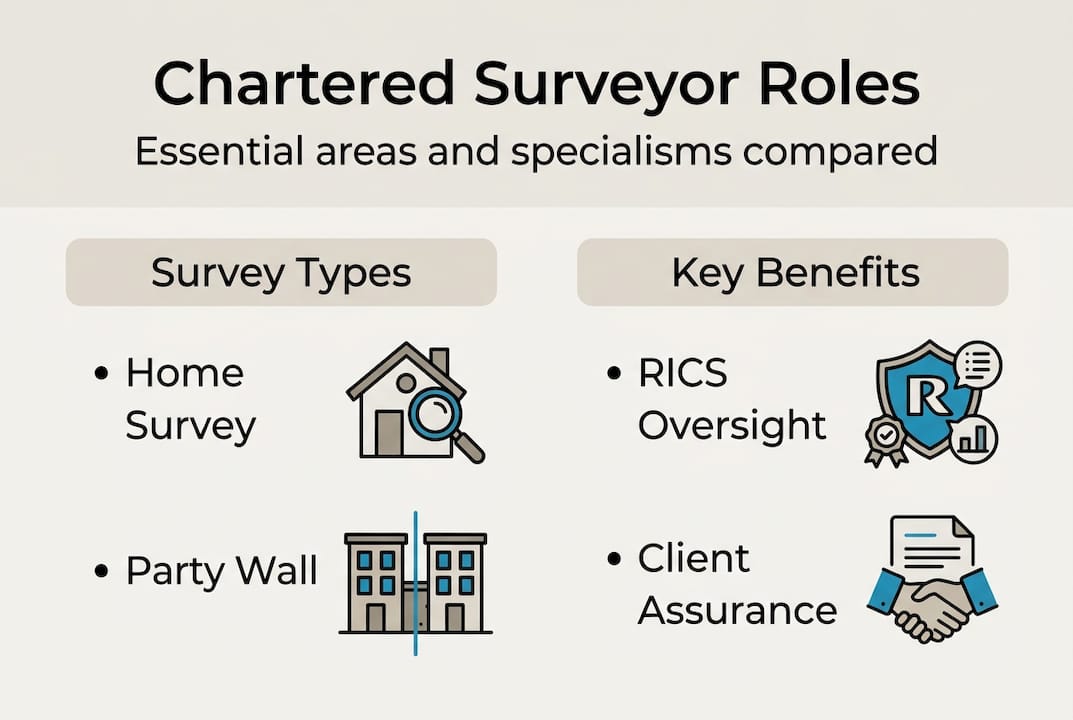
Key surveyor specialisms include:
Party wall matters deserve particular attention because many homeowners only discover the legal requirements after building work has already started. If you plan to extend, excavate near a boundary, or work on a shared wall, you are almost certainly required to serve formal notice on your neighbours. A specialist surveyor manages this process and, if a dispute arises, acts as an impartial adjudicator. Our party wall agreement guide explains exactly when the Act applies, and if you are trying to avoid party wall disputes with your neighbours, early professional involvement is the most reliable route.
RICS chartered vs non-RICS surveyors
| Feature | RICS chartered surveyor | Non-RICS surveyor |
|---|---|---|
| Regulatory oversight | RICS regulated | None or minimal |
| Professional indemnity | Mandatory | Not required |
| Code of conduct | Enforced | Variable |
| CPD requirements | Mandatory | No formal requirement |
| Redress scheme | Available | Not guaranteed |
| Report credibility | Lender-accepted | Often not accepted |
The majority of property disputes in the UK that require impartial technical resolution are handled by RICS-regulated professionals, reflecting the high degree of trust the profession commands with courts, lenders, and local authorities. You can explore the full range of party wall resources for additional guidance on specific scenarios.
Property valuation is often treated as a simple exercise in looking up comparable sales. It is not. A robust valuation draws on formal methodology, sector knowledge, and strict standards designed to protect every party in a transaction.
The three core valuation approaches are:
Within these three approaches, five valuation methods are recognised, including the profits method and the residual method for development land. Each has a specific use case.
Valuation method and typical use case
| Method | Typical use case |
|---|---|
| Comparable | Residential purchase, mortgage |
| Investment/capitalisation | Commercial property, rental assets |
| Discounted cash flow | Long-term investment appraisals |
| Profits | Pubs, hotels, care homes |
| Residual | Development land, planning scenarios |
| Depreciated replacement cost | Specialist buildings, insurance |
All formal valuations instructed for secured lending, tax, or legal proceedings must comply with Red Book Global Standards, making accuracy and impartiality a professional obligation rather than a courtesy. This is why survey comparison guides and formal RICS valuation reports are not interchangeable: one informs a purchase decision, the other has legal standing.
Pro Tip: If your valuation is required for mortgage, probate, or a tribunal, always request a Red Book-compliant report. A non-compliant report, however well intentioned, may be rejected by lenders or HMRC.
Surveyors working in construction and land also draw on cost and residual methods when advising on development viability. This makes them valuable not just at the point of purchase but throughout a property’s lifecycle.
It is entirely legal for someone without RICS membership to call themselves a surveyor and offer property reports. That fact alone should prompt caution. The distinction between a chartered and a non-chartered surveyor is significant in practice.
Risks of instructing a non-chartered surveyor:
A RICS-regulated surveyor operates within a framework that protects you as the client. The difference between RICS and non-RICS surveyors comes down to accountability: one professional is answerable to a regulator, the other is not.
RICS chartered vs non-chartered: accountability comparison
| Accountability factor | RICS chartered | Non-chartered |
|---|---|---|
| Bound by ethics charter | Yes | No |
| Insured for errors | Yes (mandatory) | Not guaranteed |
| Lender-recognised reports | Yes | Rarely |
| Subject to disciplinary action | Yes | No |
| Required CPD hours | Yes | No |
“Regulated professionals bring structured accountability that protects buyers, owners, and lenders alike. Opting for an unregulated report to save money can expose you to far greater costs if the advice later proves incorrect.”
For any transaction involving a mortgage, an estate sale, planning permission, or a dispute, using a RICS chartered surveyor is the only prudent choice.
Most guides treat chartered surveyors as a single-purpose tool: commission a report, get a figure, move on. That framing undersells the profession considerably.
What experienced surveyors bring is pattern recognition built across hundreds of cases. They notice the signs of a botched conversion, a poorly maintained drainage run, or a boundary dispute waiting to happen. A Level 3 survey on a complex property is not just a list of defects: it is a risk assessment written by someone who has seen similar buildings fail in similar ways.
The overlooked value lies in early engagement. Most buyers instruct a surveyor after agreeing a price and entering the conveyancing process. At that stage, the surveyor can report on defects, but renegotiating the price based on findings requires the buyer to have leverage they may not feel they possess. Engaging a surveyor before making an offer, particularly on older or unusual properties, can sharpen your negotiating position considerably.
Party wall matters and compliance advice are also routinely left too late. Surveyors involved early in a project can flag potential objections, suggest design modifications, and manage neighbour relations before they become legal obligations. That kind of proactive input rarely appears in standard guides.
Understanding what chartered surveyors do is the first step. Finding the right one for your specific situation is the next.

Survey Merchant connects property owners and buyers across the UK with RICS-qualified surveyors for home surveys, valuations, party wall matters, defect investigations, and more. Whether you are based in the capital and need London-based surveying services, searching for Liverpool surveyors, or need Reading-based surveyors, our panel covers a broad range of locations and specialisms. Every professional on our network is vetted for RICS compliance, giving you confidence from the first instruction. Submit your requirements today and we will match you with the right surveyor for your property and your budget.
A Level 2 Survey suits standard, modern properties and covers condition ratings for key elements, while a Level 3 provides deeper analysis of structure, defects, and repair costs, making it the right choice for older or complex homes.
RICS chartered surveyors are regulated, insured, and bound by a professional code of ethics, offering greater liability protection in transactions compared to unregulated alternatives whose reports may not be accepted by lenders.
Surveyors follow Red Book Global Standards for all formal valuations and adhere to legislation such as the Party Wall etc. Act 1996, ensuring every assessment and recommendation meets legal requirements.
Yes. Chartered surveyors manage the full party wall process, including serving notices, drafting awards, and resolving disputes, ensuring compliance under the Act and protecting all parties involved.
Survey Merchant provides vetted RICS surveyors across 100+ UK locations at fixed fees:
→ Level 2 Home Survey (HomeBuyer Report)
→ Level 3 Building Survey (full structural survey)
→ RICS Red Book property valuations
→ Party wall surveyors — notices, awards & schedules of condition
→ Expert witness surveyors — CPR Part 35 reports for property disputes