Leasehold
Sep 4, 2026
How Survey Findings Shape Commercial Lease Terms
Use pre-lease surveys, schedules of condition and Red Book valuations to reduce repair risk, secure landlord works and negotiate rent.

A survey can change the whole lease deal before you sign. I’d use it to cut repair risk, press for landlord works, push on rent, limit service charge exposure, and reduce the chance of a large dilapidations claim at the end.
Here’s the article in plain terms:
A few figures stand out. A schedule of condition often costs £1,500 to £3,000. And if a survey points to £120,000 of works over a 10-year term, I’d use that cost in talks on rent cuts, rent-free time, or a landlord payment towards the works.
The main point is simple: survey findings only help if I turn them into lease wording. That means carving out known defects, attaching the schedule of condition before signing, setting out landlord works clearly, and keeping a dated record from day one.
| Survey type | What I’d use it for | Main lease effect |
|---|---|---|
| Building survey / condition report | Find defects and likely repair costs | Push on rent, works and repair wording |
| Schedule of condition | Record the start state with photos | Cut lease-end repair and dilapidations risk |
| Red Book valuation | Show how condition affects rental value | Support lower rent, rent-free periods or contributions |
If I had to boil the whole piece down to one line, it would be this: the survey is not just a report - it is deal evidence.
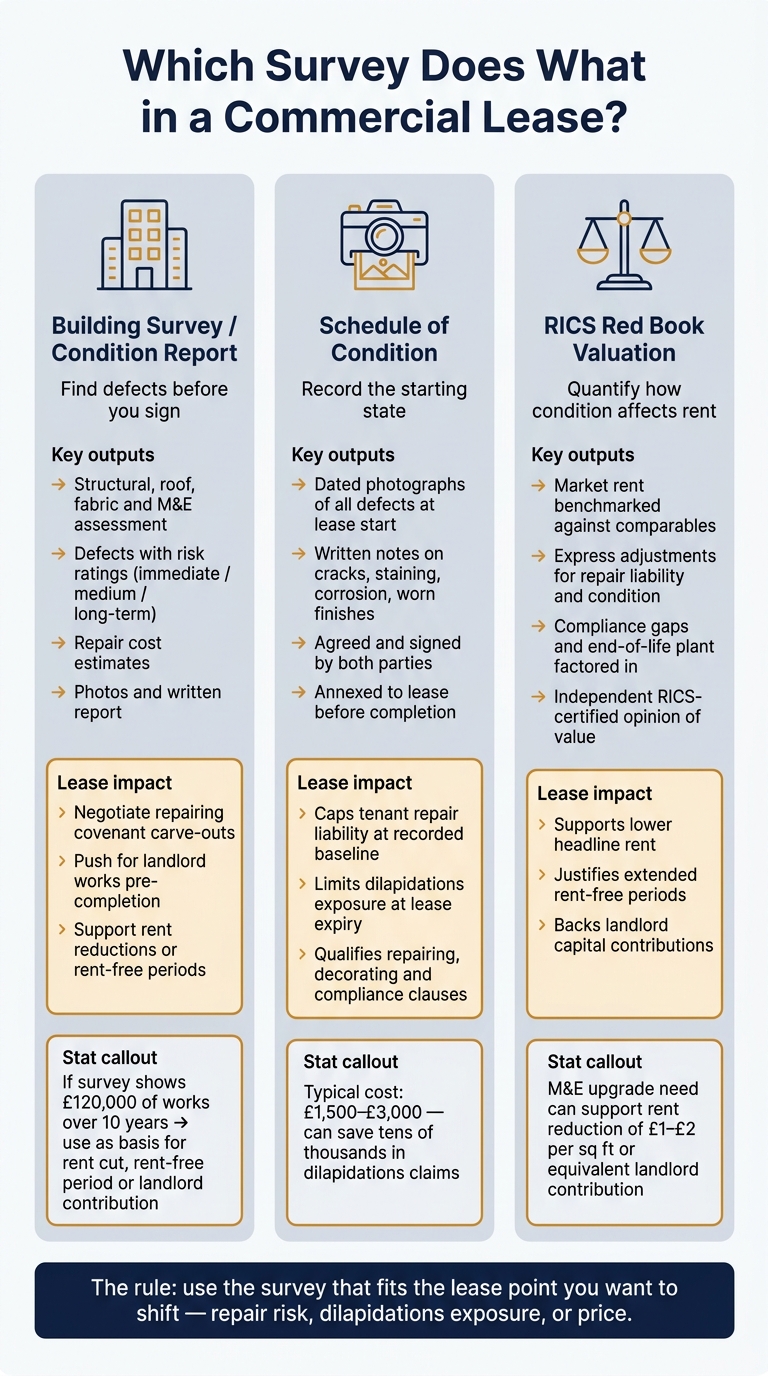
Commercial Lease Survey Types: How Each One Protects Tenants
Not every survey carries the same clout in a commercial lease negotiation. The ones that most often move the dial are pre-lease building surveys or condition reports, schedules of condition, and RICS Red Book valuations. Each one does a different job. Put simply, you use the survey that fits the lease point you want to shift: repair risk, dilapidations exposure, or price.
A pre-lease building survey gives you a technical snapshot of the property. It looks at the structure, roof, fabric, finishes, services, fire safety, and drainage. It will usually set out defects, photos, risk ratings, and repair cost estimates. Findings are often grouped by timing, such as immediate, medium-term, and long-term works [2][4].
That matters because these findings can be used straight in negotiations. If the roof is near the end of its life, or an M&E upgrade will be needed soon, that can support a request for landlord works before completion, a rent-free period, or a tighter repairing covenant [5][7]. A condition report is usually shorter, so it tends to fit smaller or more straightforward lettings.
In England and Wales, commercial leases are largely buyer-beware. That makes a pre-lease survey especially important on an FRI lease [3].
Use the findings to focus on the points that affect cost most:
A schedule of condition records the state of the property on a fixed date, using notes and dated photographs. It logs defects already there at the start, such as cracking, staining, corrosion, and worn finishes [9].
If it is annexed to the lease and linked to the repairing covenant, it can limit the tenant’s duty to keeping the premises no worse than that recorded baseline [8][11][13]. In plain terms, if an item is already shown in the schedule when the term starts, it should not later be treated as a tenant breach at lease expiry. RICS guidance says the schedule must be appended to the lease before signing if it is to have contractual effect [6][12].
That baseline then becomes the reference point for any later dilapidations claim.
A RICS Red Book valuation comes into play when condition, repair liability, or lease incentives may affect the rent or the overall deal. The valuer begins with comparable market rents and then makes express adjustments for the property’s condition and the cost burden of repair. Repair liabilities, compliance gaps, and plant that is close to replacement can all support a lower rent, a rent-free period, or a capital contribution.
For instance, if the building survey shows that an M&E upgrade is needed, that might support a rent reduction of £1 to £2 per sq ft, or a matching landlord contribution towards the works [10].
That evidence can then feed straight into rent and incentive talks.
| Survey Type | Output | Lease Impact |
|---|---|---|
| Building Survey / Condition Report | Defects, risk ratings, cost estimates | Supports rent, works and covenant carve-outs |
| Schedule of Condition | Photographic baseline | Caps repair and dilapidations exposure |
| RICS Red Book Valuation | Market rent adjusted for condition | Supports rent, rent-free periods and contributions |
Use the survey findings to shape the lease wording before heads of terms are locked in. That’s the point where you still have room to move. The aim is simple: link the defects found in the survey directly to the repairing covenant before the lease is signed.
Start by pulling out the main defects from your pre-lease survey and grouping them under broad headings such as structure, roof, external envelope, mechanical and electrical services, environmental hazards and statutory compliance. Then line those points up against the draft repairing clause, the decoration covenant and any compliance-with-laws wording.
The phrase to watch is keep in good and substantial repair. It sounds standard, but it can shift a lot of risk onto the tenant. If the covenant is not qualified, it can make the tenant liable for defects that were already there at the start. So if the survey shows known roof problems or M&E defects, those items should be carved out or capped.
The lease should be drafted to exclude known defects flagged in the survey and to stop the tenant being pushed into improving the premises beyond the condition already recorded. The survey gives you the evidence to back up each carve-out.
A schedule of condition can be used to qualify the repairing and decoration clauses, so the tenant’s liability is capped at the recorded starting condition. It should also be cross-referenced in the repairing, decorating and compliance clauses, so one clause does not quietly cancel out the cap set by another.
For example, the lease can say that decoration must be carried out to a standard no better than the schedule of condition. In the same way, compliance duties can be made subject to the state of the premises as shown in that schedule.
For the schedule to do its job, it should be prepared by an independent chartered building surveyor, agreed by the landlord and formally attached to the lease before completion.
Survey evidence helps show which repairing structure is realistic to negotiate and what level of risk comes with each option.
| Covenant Structure | Tenant's Repair Responsibility | Landlord's Responsibility | Dilapidations Exposure |
|---|---|---|---|
| Full Repairing & Insuring (FRI) | All repairs, internal, external and structural | None | High - tenant may have to return premises in good repair, including pre-existing defects if the covenant is unqualified |
| FRI subject to Schedule of Condition | Repairs to maintain the documented baseline | Structural or external elements excluded by the schedule | Medium - limited to deterioration beyond the recorded starting condition |
| Internal Repairing Only | Interior finishes, non-structural partitions and internal services | Main structure, roof and external fabric | Low - internal wear and tear and tenant fit-out |
If defects will cost a lot to fix, use the survey as leverage to negotiate the rent, secure incentives or require the landlord to carry out works.
A survey report isn't just there to flag defects. It gives you something far more useful in a deal: evidence. And that evidence can help you push on rent, incentives and landlord works in a way that feels grounded, not plucked out of thin air.
Ask your surveyor for a costed schedule of works split into three periods:
Then spread that cost over the lease term so you can show the annual burden. That figure gives you a starting point for talks on rent, rent-free periods and landlord contributions.
Say the survey points to a £120,000 works bill over a 10-year term. That can support a rent reduction, a rent-free period or a landlord contribution of a similar amount. It shifts the conversation from "we want a better deal" to "here is the cost we are taking on". That's a much easier case for a landlord - and their lender - to accept.
The same applies if the tenant is happy to do the repairs. A costed schedule can back up a request for a cash contribution from the landlord or a longer rent-free period. If the survey shows £80,000 of external repairs are needed before the first winter, and the fit-out period is three months, it makes sense to ask for another four to six months rent-free to cover the spend and the knock-on effect on the business. In the UK, landlords often prefer rent-free periods over writing a cheque because it helps preserve the headline rent for valuation.
If the survey finds structural defects, major plant at end-of-life, or statutory non-compliance such as fire safety or asbestos management issues, you have a solid basis to insist that the landlord does named works before the lease completes.
Your solicitor should put a separate landlord's works schedule into the agreement for lease. Each item needs to be clearly defined. For example:
"renew flat roof to current BS/EN standard with a 20-year warranty"
That wording should also state whether the item is a condition precedent to completion or a post-completion item with a fixed longstop date and remedies if the landlord misses it.
Survey data also helps when you're dealing with service charge risk. If the report shows that cladding, roof covering or major M&E plant is close to the end of its useful life, ask for a cap on annual service charge - for example, £10 per sq ft indexed - or a separate cap for major works. You can also use the survey to limit service charge exposure and to exclude non-recoverable improvements, especially where the works only bring the building up to the standard it should already have met.
Without those findings, the tenant has far less room to manoeuvre.
Survey findings change the bargaining position.
| Area | With evidence | Without evidence |
|---|---|---|
| Rent adjustment | Reduction or enhanced incentives linked to documented repair costs | Tenant accepts market rent regardless of building condition |
| Landlord works | Detailed schedule with defined scope, standards and completion dates | Little leverage; property usually accepted as-is |
| Incentive package | Rent-free period or cash contribution sized to actual CAPEX requirements | Incentives based on generic market averages, not building-specific needs |
| Service charge protections | Defined caps, inherent defect exclusions, and fair apportionment of major works costs | Tenant assumes full liability for all shared repair and maintenance costs |
Without survey evidence, tenants tend to negotiate on principle. With a costed survey report, they negotiate on facts.
A pre-lease survey doesn’t stop being useful once the lease is signed. It keeps working in the background for the whole term.
The same survey that helps shape rent and repair terms can also protect you at lease expiry. If a landlord later serves a schedule of dilapidations - sometimes months or even years later, and often for a six-figure sum - the survey report, schedule of condition and date-stamped photographs may become your main evidence. That entry record is the benchmark if a dilapidations claim comes later.
RICS data shows average settlements drop sharply when surveyors act for either side. That tells you something simple: a clear record at the start matters. So tenants should treat the pre-lease file as part of the lease itself, not just an extra document.
Keep the survey report, annexed schedule, dated photographs, plans and landlord correspondence together in one file. Label each item clearly and cross-reference it to the survey report. It also helps to sort everything into dated digital folders, with separate sub-folders for the pre-lease survey, landlord works, tenant works, interim inspections and the exit survey.
Why bother being this tidy? Because when a rent review comes up, a break date gets close, or a dilapidations schedule lands, you don’t want to be hunting through old emails and loose files. Under the dilapidations pre-action protocol, response deadlines are tight, so the record needs to be ready before termination.
Mid-lease inspections are often worth commissioning at key points in the term. Rent review dates and the period before a break option are sensible times to do this. These interim surveys can pick up creeping problems, such as roof deterioration or failing mechanical plant, before they become costly end-of-term issues.
They also build an audit trail of the property’s condition at different stages of the lease. That can help if the landlord later argues that a defect got worse while you were in occupation.
Without your own baseline record, your room to push back is much smaller. It becomes harder to challenge items that were already there, harder to argue that the proposed works go beyond repair and amount to betterment, and harder to rely on supersession where the landlord’s own redevelopment plans make some repairs pointless.[1][14][16] The strongest defence is a tenant-held baseline, not a landlord-only claim file.
| Feature | Pre-Lease and Exit Survey Strategy | Landlord-Prepared Schedule Only |
|---|---|---|
| Cost | Higher upfront professional fees at two stages | No upfront cost |
| Evidence strength | Strong independent baseline; clear "before and after" comparison | Weaker; no record to counter pre-existing defects |
| Dispute risk | Lower; scope and standard agreed at the outset | Higher; tenant is reactive and has less leverage |
| Control over the claim narrative | Tenant shapes the narrative from day one | Landlord controls the scope of alleged breaches |
| Settlement outcome | Better placed to negotiate reductions | Greater risk of accepting inflated claims |
Take a simple example. If the original survey clearly recorded an aged but serviceable roof, the tenant can push back on a claim for full replacement by pointing to that starting condition and arguing for a narrower repair scope.[14][15] Without that record, rebutting the landlord’s claim is far tougher.
Survey findings only count when they make it into the lease.
Use the report to tighten repair liability, secure any required works, and back up rent or incentive talks. But that only helps if the survey is done early enough.
Instruct the survey before heads of terms so it shapes the deal instead of just documenting it. That matters most on internal-repairing and FRI leases.
A clear baseline also puts you in a stronger position during dilapidations talks at lease end.
The same record should then be written into the signed lease and kept with the lease file. Before completion, turn the survey into lease wording: amend the repairing covenant, agree any excluded defects, attach a schedule of condition where needed to cap liability at the recorded baseline, and record who will carry out any pre-let works. Keep the survey, photos and agreed defect list with the lease file. That is the point where survey evidence becomes contractual protection.
Survey Merchant connects property owners and occupiers with specialist surveyors for building surveys, schedules of condition, dilapidations and Red Book valuations.
Ideally, instruct a surveyor as soon as the Heads of Terms are agreed, and before you sign the lease.
That gives everyone enough time for the inspection, the report, and the landlord’s surveyor to review the Schedule of Condition. Move early, and you’ll usually have more room to negotiate repair duties, rent concessions, or how defects are dealt with.
A Schedule of Condition is often the best way to limit dilapidations risk. It gives you a dated, photographic record of the property's condition at the start of the lease. That matters because it helps stop claims for damage or disrepair that was already there before the tenant moved in.
For tenants, the strongest protection usually comes when the Schedule of Condition is properly prepared, attached to the lease, and then relied on as evidence if there's a dispute about the state of the property at the end of the term.
Yes. Survey findings can help you negotiate lower rent before you sign the lease.
If a survey flags repairs, structural defects, or compliance issues, you can use that report as evidence when speaking with the landlord. In plain terms, if the property needs work, you may be able to ask for lower rent or a rent-free period to reflect the cost and hassle of putting those issues right.
Survey Merchant can connect you with surveyors who provide the technical evidence you need to back up your position before finalising the lease.
Survey Merchant provides vetted RICS surveyors across 100+ UK locations at fixed fees:
→ Level 2 Home Survey (HomeBuyer Report)
→ Level 3 Building Survey (full structural survey)
→ RICS Red Book property valuations
→ Party wall surveyors — notices, awards & schedules of condition
→ Expert witness surveyors — CPR Part 35 reports for property disputes