We use cookies to improve your experience on our site, analyze site traffic, and assist in our marketing efforts. By clicking "Accept all," you agree to the storing of cookies on your device. You can choose to "Reject all" non-essential cookies. For more information, please read our Cookie Policy.
Awaab's Law Is Coming to Private Rentals: Consultation Closes 18 December 2026 — What Landlords and Tenants Need to Know About Damp and Mould Surveys (November 2026)
MHCLG's consultation on extending Awaab's Law to private rentals closes 18 December 2026. The proposed timescales, how they compare with social housing, and what a compliant damp and mould survey must include.
A £7,000 council fine is already possible for landlords who ignore Category 1 hazards. Now the government wants to go further, and the consultation on extending Awaab's Law to the private rented sector could reshape how every rented home in England handles a damp and mould complaint.
Awaab's Law has governed social housing since 27 October 2025. On 9 October 2026, the Ministry of Housing, Communities and Local Government (MHCLG) opened a consultation asking whether the same strict, clock-ticking duties should apply to private landlords too. The consultation closes at 11.59pm on 18 December 2026. For anyone who owns, lets, rents or surveys property in England, this is not abstract policy, it is a preview of enforceable timescales that could soon apply to your tenancy agreement.
Key Takeaways
MHCLG's consultation on extending Awaab's Law to private rentals runs 9 October to 18 December 2026.
Proposed rules would cover nearly all HHSRS hazards, with damp and mould likely prioritised if rollout is phased.
No start date is fixed; options range from 2027 to 2029, with 2027 the earliest feasible date.
Awaab's Law would become an implied term in every tenancy, opening the door to breach-of-contract claims.
A properly documented, RICS-standard damp and mould survey is the strongest evidence either side can produce if timescales become law.
What the Private Rented Sector Consultation Actually Covers
The social housing version of Awaab's Law already sets firm deadlines. Emergency hazards must be investigated and made safe within 24 hours. Significant hazards, including damp and mould, must be investigated within 10 working days, with a written summary sent to the tenant within 3 working days of that investigation, the hazard made safe within 5 working days, preventative works started within 5 working days, and works physically begun within 12 weeks. A second phase, due 30 November 2026 subject to parliamentary approval, adds excess cold and heat, falls, structural collapse, fire and explosion, electrical hazards and domestic hygiene hazards.
The private rented sector consultation asks whether a similar framework should apply to every rented home in England, covering all Housing Health and Safety Rating System (HHSRS) hazards except overcrowding. If introduced in phases, damp and mould together with emergency hazards would come first, mirroring the social housing approach.
Housing Minister Matthew Pennycook said: "Irrespective of tenure, all renters have the right to live in a safe and decent home." NRLA chief executive Ben Beadle added: "For too long bad actors across the rental sectors have been able to ignore standards and regulations already in place."
Crucially, Awaab's Law would become an implied term in every private tenancy. That means tenants could sue for breach of contract, and courts could order repairs, compensation and costs. Landlords would have a defence if they could show they took all reasonable steps to meet a deadline, which makes a documented, professional survey trail essential rather than optional.
The Proposed Private-Sector Timescales at a Glance
No decision has been made yet. The consultation sets out several options for each duty, and respondents are being asked which they prefer.
Duty
Options under consultation
Respond to an emergency hazard
12, 24 or 48 hours
Investigate a potential significant hazard
5, 10 or 15 working days
Make a significant hazard safe
3, 5 or 10 working days
Start preventative works
3, 5 or 10 working days (plus 12 weeks to begin physical works)
Send written summary to tenant
1, 3 or 5 working days, or no requirement at all
Earliest possible start date
2027, 2028 or 2029
Even the loosest option on the table, a 15-working-day investigation window with no written summary requirement, is far tighter than many landlords currently manage informally. The tightest options mirror the social housing regime almost exactly. Either way, the direction of travel is clear: faster response, better paperwork.
What a Compliant Damp and Mould Survey Must Include
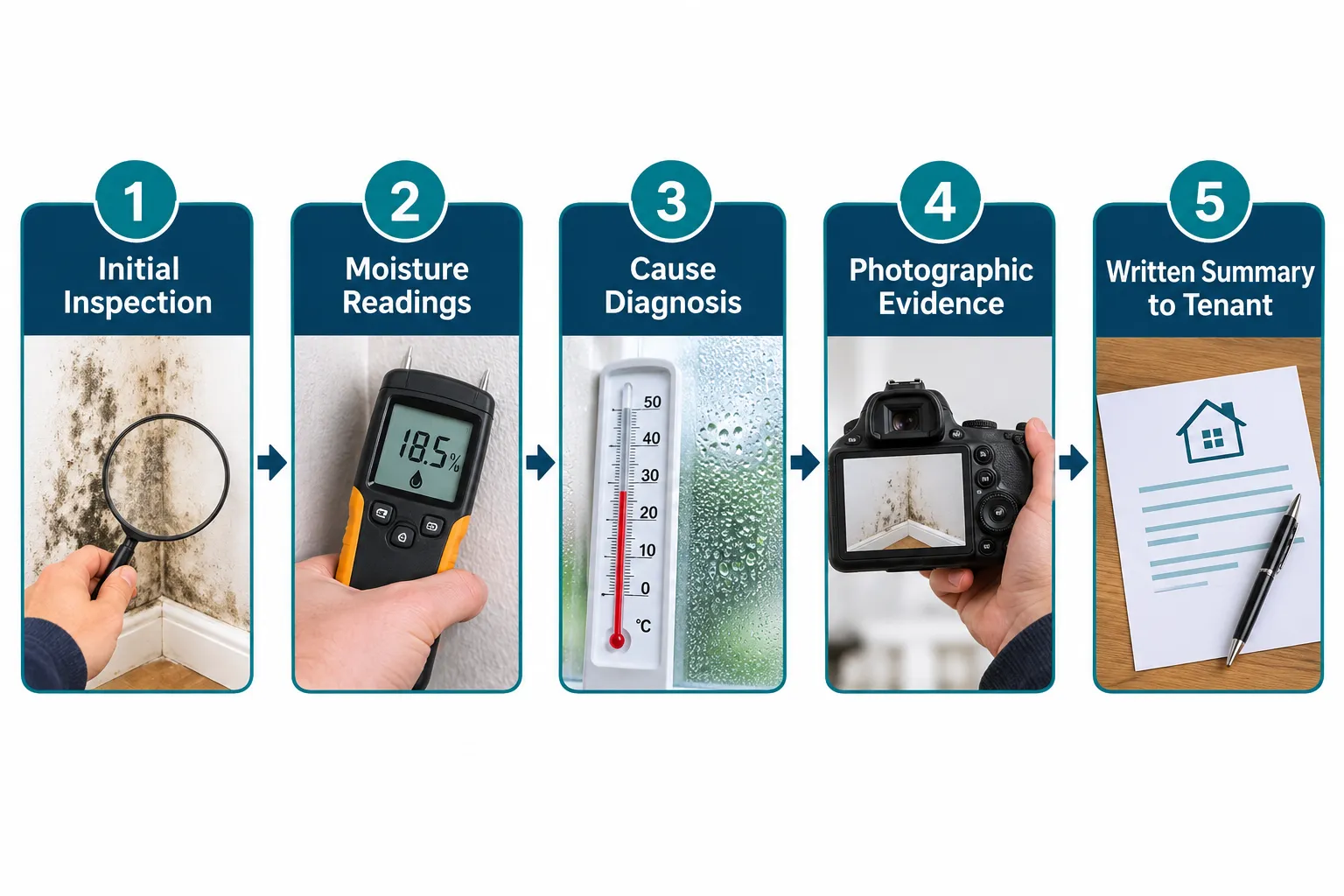
Whatever timescale ultimately applies, the content of the investigation will matter as much as the speed. A survey that would satisfy an Awaab's-Law-style deadline needs to go well beyond a quick visual glance. At minimum, it should record:
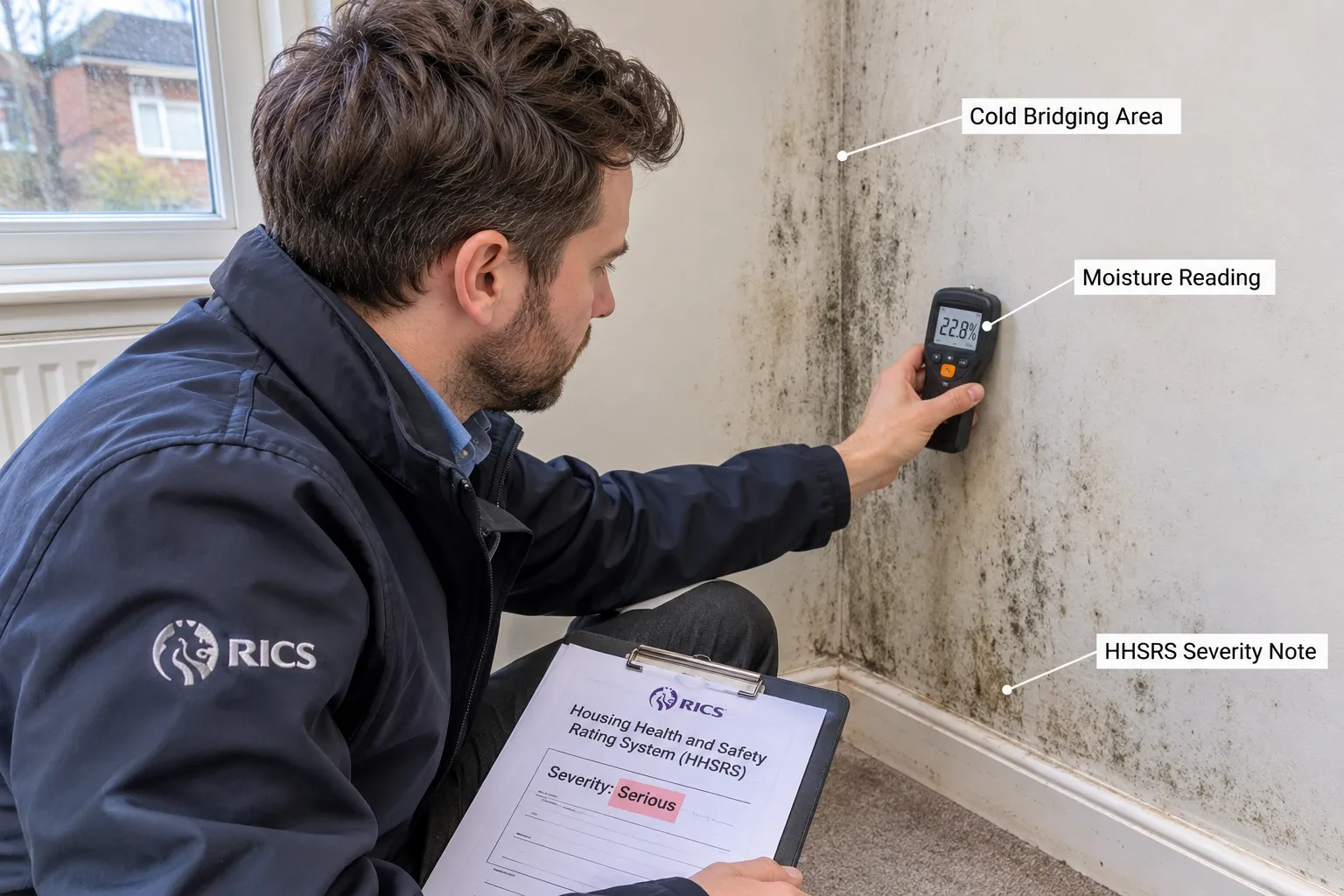
Cause diagnosis: a clear distinction between condensation, rising damp and penetrating damp, including assessment of ventilation, cold bridging and any active leaks.
Moisture readings: quantified readings taken with a calibrated meter, not just a visual impression, logged against specific locations in the property.
Photographic evidence: dated, location-tagged photographs showing the extent and pattern of damp or mould growth.
Severity and HHSRS rating: an assessment of whether the hazard would be classed as Category 1 or Category 2 under the Housing Health and Safety Rating System.
Recommended remedial works and timescales: specific, prioritised actions with realistic timeframes, distinguishing urgent safety works from longer-term structural fixes.
A written summary suitable for the tenant: plain-English findings that could be handed over within the proposed 1, 3 or 5 working-day window.
This is also where an independent RICS surveyor's report differs sharply from a contractor's quote. A contractor is typically assessing what work they can sell, not conducting an impartial diagnosis. A RICS-qualified surveyor has no commercial stake in the remedial works recommended, which matters enormously if a dispute ever reaches a court or a future private rented sector ombudsman, expected in 2028.
How Landlords Can Run a Pre-Emptive Condition Audit
With the landlord database opening for registration in the West Midlands on 15 December 2026 and rolling out nationally until all eligible properties are registered by 14 November 2027, landlords have a narrow window to get ahead of scrutiny. A pre-emptive condition audit, essentially a proactive damp and mould survey before any complaint arises, gives landlords:
A baseline record showing the property's condition before any tenant dispute begins.
Early identification of ventilation or cold-bridging issues before they escalate into Category 1 hazards.
Evidence of "all reasonable steps" taken, which is the statutory defence proposed in the consultation.
A head start on compliance ahead of tax changes from April 2027, when property income tax rates rise to 24%, 44% and 49% following the Autumn Budget on 28 October 2026.
This also sits against a backdrop of wider reform. The Renters' Rights Act commenced on 1 May 2026, ending Section 21 and moving tenancies onto a periodic footing, meaning tenants can no longer be served a quick no-fault notice if a damp dispute turns sour. Documentation is now a landlord's main protection.
What Tenants Should Document
Tenants are not powerless while the consultation runs its course. Since June 2026, councils can already fine landlords up to £7,000 for failing to take reasonably practicable steps to remove Category 1 hazards, and a well-documented complaint makes enforcement far easier. Tenants should:
Keep dated photographs of mould growth, condensation and any leaks, updated regularly.
Record every written report to the landlord or agent, including dates and method (email, letter, portal message).
Note any health effects or damage to belongings, with dates.
Request copies of any survey or inspection report commissioned by the landlord.
Why an Independent RICS Survey Report Carries More Weight
A contractor's quote answers one question: what will it cost to fix this? A RICS surveyor's report answers a different and more important set of questions: what exactly is wrong, why is it happening, how severe is it under HHSRS, and what needs to happen and by when. That distinction becomes decisive if a landlord needs to prove "all reasonable steps" were taken, or if a tenant needs independent evidence for a breach-of-contract claim once Awaab's Law extends to the private sector.
Landlords and letting agents preparing for this shift, and tenants who want an impartial second opinion, can book an independent damp and mould survey with a RICS surveyor through Survey Merchant, which matches property owners and tenants with qualified professionals across the UK.
FAQ
When does the Awaab's Law private rented sector consultation close? The consultation closes at 11.59pm on 18 December 2026. Responses submitted after this deadline will not be considered.
Will Awaab's Law definitely apply to private rentals? Not yet confirmed. The consultation is still gathering views on scope and timescales, and the earliest feasible start date is 2027, with 2028 or 2029 also under consideration.
What happens if a landlord misses a deadline under the proposed rules? Because Awaab's Law would be an implied tenancy term, tenants could sue for breach of contract, with courts able to order repairs, compensation and costs. Landlords would have a defence if they could show they took all reasonable steps.
Does damp and mould already carry penalties for private landlords? Yes. Since June 2026, councils can fine landlords up to £7,000 for failing to take reasonably practicable steps to remove Category 1 hazards, separate from any future Awaab's Law duties.
Conclusion
The consultation on extending Awaab's Law to the private rented sector marks a turning point for England's rental market. Even though no start date or final timescale has been confirmed, the direction is unmistakable: faster, better-documented responses to damp and mould will become a legal expectation, not a goodwill gesture. Landlords should use the months before the consultation closes to commission proactive condition surveys, tighten record-keeping and prepare for the landlord database. Tenants should start documenting issues now, since existing £7,000 fines already apply to unresolved Category 1 hazards. Whichever side of the tenancy agreement you sit on, an independent, RICS-standard damp and mould survey is the single most valuable document you can hold if these rules become law.
Related guides
No items found.
Book a RICS surveyor
Survey Merchant provides vetted RICS surveyors across 100+ UK locations at fixed fees:
When does the Awaab's Law private rented sector consultation close?
The consultation closes at 11.59pm on 18 December 2026. Responses submitted after this deadline will not be considered.
Will Awaab's Law definitely apply to private rentals?
Not yet confirmed. The consultation is still gathering views on scope and timescales, and the earliest feasible start date is 2027, with 2028 or 2029 also under consideration.
What happens if a landlord misses a deadline under the proposed rules?
Because Awaab's Law would be an implied tenancy term, tenants could sue for breach of contract, with courts able to order repairs, compensation and costs. Landlords would have a defence if they could show they took all reasonable steps.
Does damp and mould already carry penalties for private landlords?
Yes. Since June 2026, councils can fine landlords up to £7,000 for failing to take reasonably practicable steps to remove Category 1 hazards, separate from any future Awaab's Law duties.