We use cookies to improve your experience on our site, analyze site traffic, and assist in our marketing efforts. By clicking "Accept all," you agree to the storing of cookies on your device. You can choose to "Reject all" non-essential cookies. For more information, please read our Cookie Policy.
What Is a Quantity Surveyor? 2026 UK Guide to Roles & Fees
Everything UK homeowners, landlords and developers need to know about quantity surveyors in 2026: duties by project stage, fee structures, qualifications to check, 2026 cost trends and how to appoint the right QS.
A quantity surveyor (often shortened to QS) is the construction professional who manages the money on a building project. Whether you are planning a rear extension, converting a loft, refurbishing a rental property or developing a small site, understanding what a quantity surveyor does – and when it pays to appoint one – can save you thousands of pounds and a great deal of stress. This 2026 UK guide explains the quantity surveyor’s role, typical fees, qualifications to look for, and how a QS differs from a building surveyor, structural engineer or architect.
Key takeaways
A quantity surveyor is a cost and contract specialist who estimates, controls and reports on the financial side of construction work from feasibility to final account.
Fees are usually a percentage of the construction cost (commonly cited as around 0.5–2%), a fixed fee for a single report, or a time charge for small jobs – always agreed in writing before work starts.
You are most likely to need a QS for larger extensions, self-builds, listed or conservation-area properties, multi-unit developments, commercial fit-outs and construction disputes.
In 2026 cost advice matters more than ever: BCIS forecasts tender prices to rise 14.1% by Q3 2031, while RICS reports skills shortages cutting capacity across the surveying profession.
A QS is not the same as a building surveyor: one prices and controls the work, the other inspects the fabric of the building and diagnoses defects.
Check qualifications and accreditation (RICS, CIOB or equivalent), relevant experience and professional indemnity insurance before you appoint anyone.
What is a quantity surveyor?
A quantity surveyor is a chartered construction professional who manages the cost, contracts and financial risk of a building project. A QS prepares budgets and cost plans, measures and prices the work, runs the tender, values work in progress and agrees the final account, so the client pays a fair price for what is built.
A quantity surveyor checks the cost plan against the drawings so the budget reflects what will really be built.
The Royal Institution of Chartered Surveyors (RICS) describes the QS as the “financial linchpin” of any construction job. In practice the role sits between the client, the designer and the builder: the architect decides what is built, the structural engineer decides how it stands up, and the quantity surveyor works out what it will cost and keeps that number honest as the project progresses. If you are weighing up which professional you need, our guide to the different types of surveyors in the UK is a useful starting point.
What does a quantity surveyor do?
The day-to-day work of a quantity surveyor changes with each stage of a project. Early on the QS is a forecaster; during construction they are a controller; at the end they are an auditor. The main tasks, as set out by RICS and the National Careers Service, include:
Feasibility and budget advice – establishing whether the scheme is affordable before design fees are spent.
Cost planning – building an elemental cost plan from early sketches and refining it as the design develops.
Measurement and bills of quantities – breaking the work down trade by trade so builders price the same thing and quotes can be compared like for like.
Tendering and contract advice – preparing tender packages, analysing quotes, negotiating and recommending the right form of contract (for example a JCT contract).
Interim valuations – checking how much work has actually been done before each stage payment is released to the contractor.
Change control and value engineering – pricing variations, finding savings elsewhere when quotes come in high, and managing risk and contingency.
Final account – agreeing the true cost of the finished project, including any extras and omissions.
Claims and disputes – advising on contractual entitlements, loss and expense, and acting as an expert on cost matters.
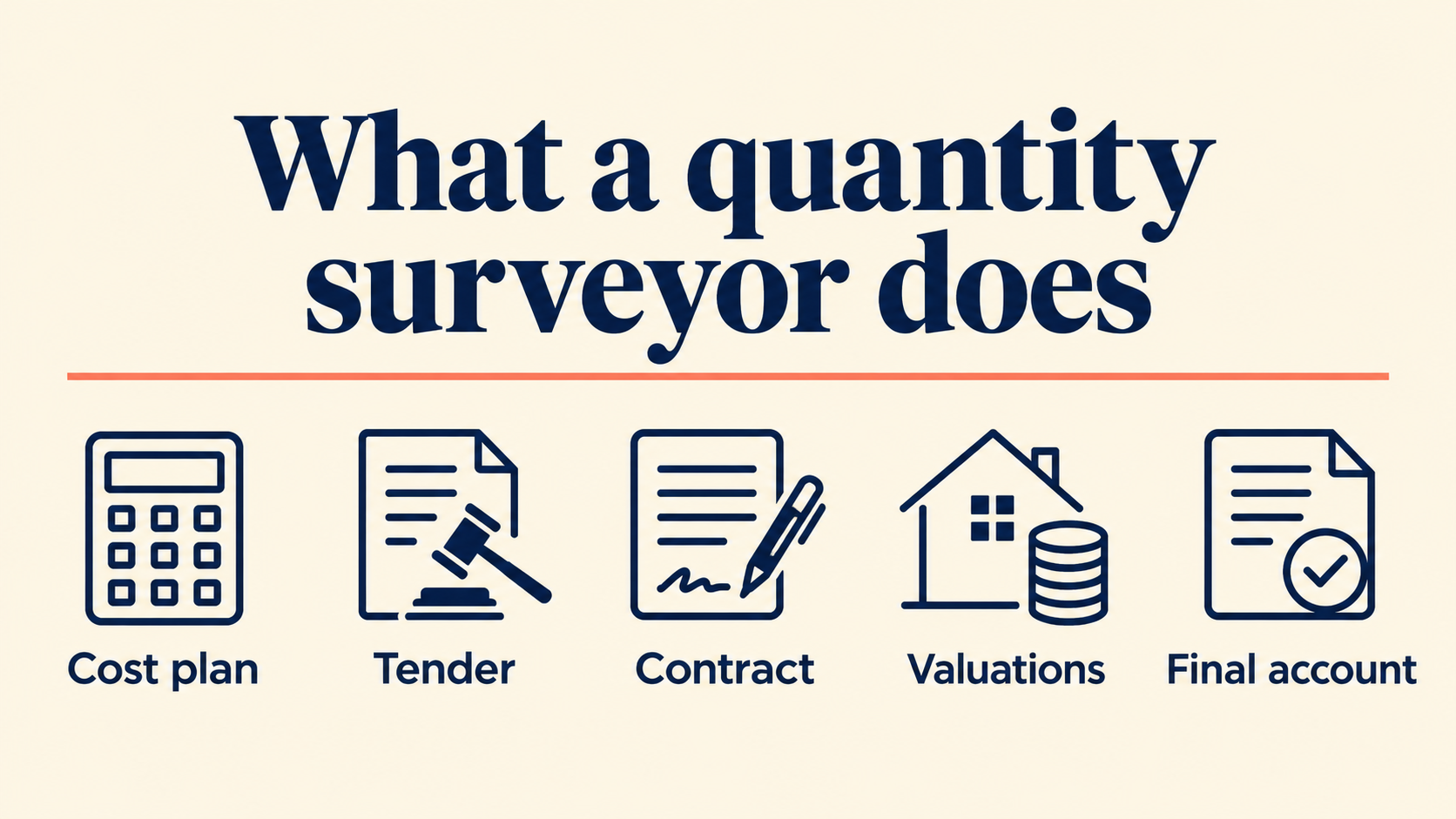
From cost plan to final account: the five stages where a QS adds the most value.
Client’s QS vs contractor’s QS
There are two sides to the profession. A client’s (or private practice) QS works for you, the person paying for the project, and focuses on budgets, tender documents and protecting your money. A contractor’s QS works for the building firm, is usually site-based, manages subcontractors and submits the contractor’s valuations. On larger jobs both will exist and will negotiate the final account between them. For a homeowner, “appointing a quantity surveyor” almost always means a client-side QS.
Quantity surveyor vs building surveyor, structural engineer and architect
Searches for “quantity surveyor” are often really a question about which professional to call. The table below sets out the differences.
Professional
Core question they answer
Typical outputs
When you need them
Quantity surveyor
What will it cost, and are we paying the right amount?
Cost plan, bill of quantities, tender report, valuations, final account
Extensions, self-builds, developments, refurbishments, disputes over cost
Building surveyor
What condition is the building in and what needs fixing?
Level 2 or Level 3 survey, defect reports, specifications, dilapidations
Buying a property, diagnosing defects, specifying repairs, party wall matters
Structural engineer
Will it stand up safely?
Calculations, beam designs, structural reports
Removing walls, new openings, basements, subsidence
Architect
What should it look like and how will it work?
Drawings, planning and building regulations applications
Design-led projects, planning applications
If your problem is a crack in a wall, damp or a roof that needs replacing, you need a building surveyor rather than a QS. If you are removing a load-bearing wall you will also need a structural engineer. Many projects use all of these professionals, and a QS will often be the one who coordinates the money between them.
When do you need a quantity surveyor?
Not every project justifies a QS. A small, simple single-storey extension built by a reputable local builder on a fixed-price quote may not need one. The case for appointing a quantity surveyor grows with the size, complexity and risk of the job:
Large or complex extensions and loft conversions – where quotes vary widely and specification choices swing the price. See our guides to house extension costs in 2026 and loft conversion costs for benchmark figures.
Self-build and custom-build homes – where the budget must be proved to a lender and cash flow managed over many months.
Listed buildings and conservation areas – where permitted materials and methods are expensive and easy to under-estimate.
Landlords and portfolio owners – pricing refurbishments, planned maintenance and energy upgrades across several properties.
Developers and small sites – appraisals, cost plans and contractor payment checks for multi-unit schemes.
Commercial tenants and landlords – fit-outs, and pricing a schedule of dilapidations at the end of a lease.
Disputes – when a builder’s final account is contested, or where an independent view of costs is needed as expert evidence.
Involving a QS early, before the design is fixed, is when cost advice is cheapest to act on.
The single most important piece of advice is timing. Involve the QS at the earliest design stage: changes made on paper cost almost nothing, while changes made on site after the contractor is appointed are priced at a premium. If you plan to manage the build yourself, a QS can also be appointed for high-risk elements only, such as groundworks or the structural frame. Our guide to project management for refurbishments explains how cost control fits into the wider programme.
How much does a quantity surveyor cost in the UK in 2026?
There is no national fee scale: RICS withdrew its indicative fee scales in 2000, so quantity surveyor fees are negotiated for each appointment. Three structures are common.
Fee structure
How it works
Typical basis quoted in UK guidance
Best suited to
Percentage fee
A percentage of the final construction cost, usually paid in stages
Around 0.5–2% of contract value (Designing Buildings); “typically around 2%” for domestic projects (Homebuilding & Renovating)
Full-service appointments on extensions, self-builds and developments
Fixed (lump-sum) fee
An agreed price for a defined scope, such as a cost plan or a single report
Quoted per job; early online cost estimates are available for under £500
One-off reports, feasibility checks, second opinions
Time charge
Hourly or daily rate, often with a fee cap
Rates vary widely by seniority and region; agree a cap in writing
Small, urgent or open-ended tasks such as dispute support
Whichever structure you use, obtain two or three quotes, make sure each covers the same scope of services, and get the fee agreement in writing before work starts. A good QS will usually recommend holding a contingency of roughly 5–10% of the estimated build cost for the unexpected – and will tell you honestly when a scheme does not stack up. On a £100,000 extension, a fee of 1–2% is £1,000–£2,000; a single mispriced tender or an uncontrolled variation can easily cost more than that.
Why cost advice matters more in 2026
The economic backdrop makes professional cost control unusually valuable this year:
Rising build costs. On 8 October 2026 the Building Cost Information Service (BCIS) published its updated five-year forecast, predicting building costs will rise about 14% and tender prices 14.1% by the third quarter of 2031. Its General Building Cost Index was already showing 4.3% annual growth, with chief economist Dr David Crosthwaite noting that “elevated energy and materials costs continue to put pressure on the construction supply chain”. In other words, a quote that was accurate a year ago may no longer be.
Falling output, busy repair market. ONS figures published on 15 October 2026 show total construction output fell 0.2% in August 2026 – the fourth consecutive monthly fall – while repair and maintenance work grew 0.4% in the month. Contractors are competing hard for domestic work, which is good news for clients who tender properly.
Skills shortages. The RICS Surveying skills report: UK snapshot, published in November 2026, found 63% of surveying firms say shortages have reduced their capacity to meet demand and 33% report increased costs or inefficiencies. Quantity surveying was already named among the professions with the most acute shortages in RICS’s October 2025 survey. We discuss what this means for booking a surveyor in our analysis of the RICS skills snapshot – the short version is: appoint early.
Quantity surveyor qualifications: what to check before you appoint
“Quantity surveyor” is not a protected title, so anyone can use it. What protects you is accreditation and insurance. According to the National Careers Service, the usual routes into the profession are an RICS-accredited degree or postgraduate conversion course, or a Level 6 degree apprenticeship taking three to five years. From there a QS may become an Associate (AssocRICS) or Chartered (MRICS) member of RICS, or a chartered member of the Chartered Institute of Building (CIOB). Before appointing, check:
Accreditation – membership of RICS, CIOB or another recognised professional body, which brings a code of conduct, continuing professional development and a complaints procedure. Our guide to verifying surveyor credentials explains how to check a register.
Relevant experience – a QS who prices hospitals is not necessarily the right fit for a Victorian terrace extension. Ask for examples of similar projects.
Professional indemnity insurance – essential, and a requirement of RICS regulation for firms.
Clear scope and fee letter – which stages are included, what is excluded, and how additional services will be charged.
Independence – a client-side QS should have no financial link to the contractors tendering for your work.
How to appoint a quantity surveyor: a five-step checklist
1. Define the project – share drawings, your budget ceiling and your timescale so the QS can scope their service.
2. Decide the level of service – a one-off cost plan, tender support only, or full involvement through to final account.
3. Get two or three quotes – compare scope, not just price, and ask who will personally do the work.
4. Check credentials and insurance – accreditation, experience, PI cover and references.
5. Agree terms in writing – fee basis, payment stages, deliverables and what happens if the project is paused or cancelled.
Why choose Survey Merchant for your quantity surveying and cost advice?
Survey Merchant is an independent UK surveying practice with a panel of suitably qualified, accredited surveyors regulated or accredited by bodies such as RICS, CIOB and RPSA, among others. When you tell us about your project we match you with the right discipline for the job – whether that is cost advice, a building survey to establish the condition of the property before you commit to works, or a valuation to check that your spend will be reflected in the property’s worth. Clients choose us because we offer:
An accredited panel matched to the task – RICS, CIOB and RPSA-accredited professionals selected for their experience with your type of property and project.
Nationwide UK coverage with local knowledge – surveyors who understand regional build costs and local contractors.
Transparent, competitive fixed fees – agreed in writing before any work begins, with no hidden extras.
Fast turnaround – prompt appointments and clear, jargon-free reports you can act on.
Impartial advice – no ties to contractors or developers, so the figures you receive are the ones that protect you.
End-to-end support – from the first feasibility question through surveys, cost advice and dispute support if things go wrong.
A quantity surveyor manages the cost and contracts of a construction project. They prepare feasibility budgets and cost plans, measure and price the work in a bill of quantities, run the tender, advise on the building contract, value work in progress before stage payments, control variations and agree the final account with the contractor.
How much does a quantity surveyor cost in the UK?
There is no national fee scale. UK guidance typically quotes percentage fees of around 0.5–2% of the construction cost for a full service, fixed fees for single reports such as a cost plan, or time charges with a cap for small tasks. Always get two or three quotes for the same scope and agree the fee in writing before work starts.
What is the difference between a quantity surveyor and a building surveyor?
A quantity surveyor deals with the money: estimating, tendering, valuing and controlling the cost of building work. A building surveyor deals with the fabric of the building: inspecting its condition, diagnosing defects such as damp or movement, and specifying repairs. For a property purchase you need a building surveyor; for pricing and controlling a build you need a QS.
Do I need a quantity surveyor for a house extension?
Not always. A small, straightforward extension on a fixed-price quote from a reputable builder may not need one. A QS becomes worthwhile for larger or structurally complex extensions, listed or conservation-area properties, self-builds and any project where quotes vary widely, because their fee is usually a small fraction of the savings and risk they control.
What qualifications should a quantity surveyor have?
Look for accreditation with a recognised professional body such as RICS (AssocRICS or MRICS) or CIOB, which brings a code of conduct and complaints procedure. Most QSs hold an RICS-accredited degree or postgraduate conversion course, or have completed a Level 6 degree apprenticeship. Also check relevant project experience and professional indemnity insurance.
How do you become a quantity surveyor in the UK?
According to the National Careers Service, the main routes are an RICS-accredited quantity surveying degree, a postgraduate conversion course for graduates in other subjects, or a Level 6 degree apprenticeship with a surveying or construction firm lasting three to five years. Candidates then work towards AssocRICS or chartered MRICS status through RICS assessments.