We use cookies to improve your experience on our site, analyze site traffic, and assist in our marketing efforts. By clicking "Accept all," you agree to the storing of cookies on your device. You can choose to "Reject all" non-essential cookies. For more information, please read our Cookie Policy.
RICS Warns the Surveying Skills Shortage Is Cutting Capacity: Half of UK Respondents Report an Impact, and What It Means for Homebuyers Booking a Survey (November 2026)
RICS's UK skills snapshot finds 50% of respondents report a critical or moderate impact from skills shortages, with mid-career surveyors hardest to recruit. What homebuyers should check, from booking early to choosing the right survey level.
Half of UK respondents to a new RICS survey say skills shortages are having a critical or moderate impact on their organisations. That is the headline finding of the RICS Surveying Skills Report UK Snapshot, reported by Property Industry Eye on Friday 6 November 2026. It lands in a week when the Bank of England raised interest rates and a major index showed house prices falling, leaving buyers more reliant than ever on a thorough, well-judged survey.
This article sets out what the report actually says, what it does not say, and what homebuyers can sensibly do about it.
Key Takeaways
50% of UK respondents to the RICS Surveying Skills Report say skills shortages are having a critical or moderate impact on their organisations.
Of those reporting effects, 63% say shortages are reducing their capacity to meet demand and 55% lack the time or resources to train existing staff.
62% of respondents answering the question cite a lack of mid-career and experienced surveyors as the biggest recruitment challenge.
58% feel unprepared or only slightly prepared for AI-driven workflows, while just 12% feel well or very well prepared.
The report covers the whole surveying profession, not just home surveys, and publishes no waiting times. Booking early and choosing a RICS-regulated surveyor remain sensible precautions.
What the New RICS Report Found
The RICS Surveying Skills Report UK Snapshot was published by the Royal Institution of Chartered Surveyors (RICS) in November 2026. It follows the global report, Surveying skills report 2026: investigating the skills gap, published on 15 October 2026 and based on responses from RICS members around the world. The published summaries do not state the sample size.
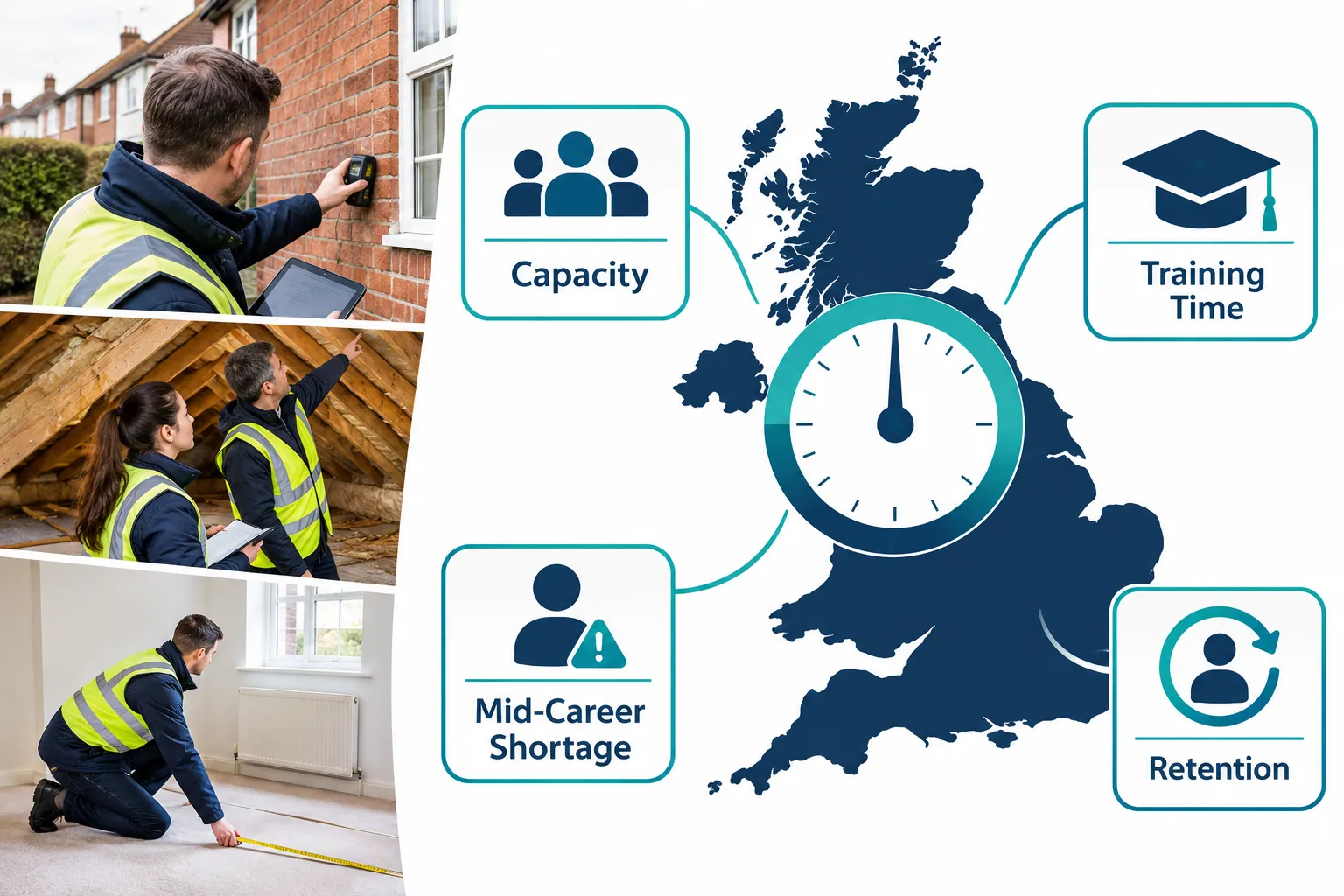
The central figure is stark: 50% of UK respondents say skills shortages are having a critical or moderate impact on their organisations. Of those reporting an effect, 63% say the shortage is reducing their capacity to meet demand, and 55% say they lack sufficient time or resources to train existing employees. Put simply, many firms are stretched and are struggling to pass experience on to newer staff.
Globally, the picture is similar. The 15 October 2026 global report found that over 50% of respondents describe the skills shortage as critical or moderate, and 55% say shortages are reducing their capacity to meet demand. On the published figures, the UK picture is broadly in line with the global one.
Why Mid-Career Surveyors Are the Real Bottleneck
Recruitment difficulty is not spread evenly across career stages. 62% of respondents answering the question cite a lack of mid-career and experienced surveyors as the biggest challenge, ahead of the 47% citing shortages of graduates and early-career professionals and the 43% citing staff retention.
Experienced surveyors bring judgement that cannot easily be fast-tracked.
Training new entrants takes time that many firms say they do not have.
Retention problems compound the gap when experienced staff leave.
Justin Young, RICS chief executive, said: "Surveyors are essential to delivering the homes and infrastructure the UK needs." He said the profession must attract new entrants, retain experienced surveyors and improve access to training.
AI Readiness and Skills Priorities
Technology is both a hoped-for solution and a source of concern. 58% of UK respondents feel unprepared or only slightly prepared for generative AI, AI analytics and AI-driven workflows, and only 12% feel well or very well prepared. Even so, 30% name AI, automation and digital tools among their top three approaches to tackling future skills shortages.
On skills priorities, communication, collaboration and stakeholder management rank at 47%, level with critical thinking and learning agility, also at 47%. Data analytics, digital tools and advanced technologies follow at 44%. The most popular response to future shortages is upskilling existing employees, chosen by 42%.
James Garner, head of AI and data at Gleeds, said: "AI must become a core, formally assessed part of surveying education. The profession's future depends on it."
Key Figures at a Glance
Measure
Figure
UK respondents reporting a critical or moderate impact from skills shortages
50%
Of those reporting effects: reduced capacity to meet demand
63%
Of those reporting effects: insufficient time or resources to train staff
55%
Citing a lack of mid-career and experienced surveyors as the biggest recruitment challenge
62%
Citing shortages of graduates and early-career professionals
47%
Citing staff retention
43%
Feeling unprepared or only slightly prepared for AI
58%
Feeling well or very well prepared for AI
12%
Choosing upskilling existing employees as a response to future shortages
42%
Global respondents describing the shortage as critical or moderate
Over 50%
What RICS Is Doing, and the Market Backdrop
RICS says it is modernising membership routes, developing professional pathways in sustainability and data analytics, adapting training and continuing professional development, and developing a new modular qualification approach aligned with Skills England recommendations. These are long-term structural responses, not quick fixes.
Meanwhile, the wider housing market is giving buyers extra reason to lean on good survey evidence. The Bank of England raised Bank Rate from 3.75% to 4% on Thursday 5 November 2026, and the Lloyds House Price Index published on 6 November 2026 showed UK house prices 1.2% lower than a year earlier. With borrowing costs higher and prices softer, buyers are more cautious and more reliant on solid, independent evidence about a property's condition when they negotiate.
Important caveat: the RICS report covers the whole surveying profession, including quantity surveying, commercial property, land and infrastructure as well as residential surveying. It does not publish waiting times for home surveys. The guidance below is practical inference, not a finding of the report.
Practical Steps for Homebuyers Booking a Survey
With the profession reporting reduced capacity and a scarcity of experienced staff, buyers can protect themselves with a few sensible habits.
Book the survey as soon as your offer is accepted. Do not wait until exchange is looming.
Check the surveyor is RICS-regulated. Regulation brings professional standards and a route to redress.
Choose the right level of RICS Home Survey. Level 1 suits newer, conventional properties in good condition. Level 2 suits most conventional houses and flats in reasonable condition. Level 3 suits older, larger, altered or unusual properties, or homes in poor condition.
Ask who will actually inspect the property. It is reasonable to ask about the surveyor's experience with similar homes.
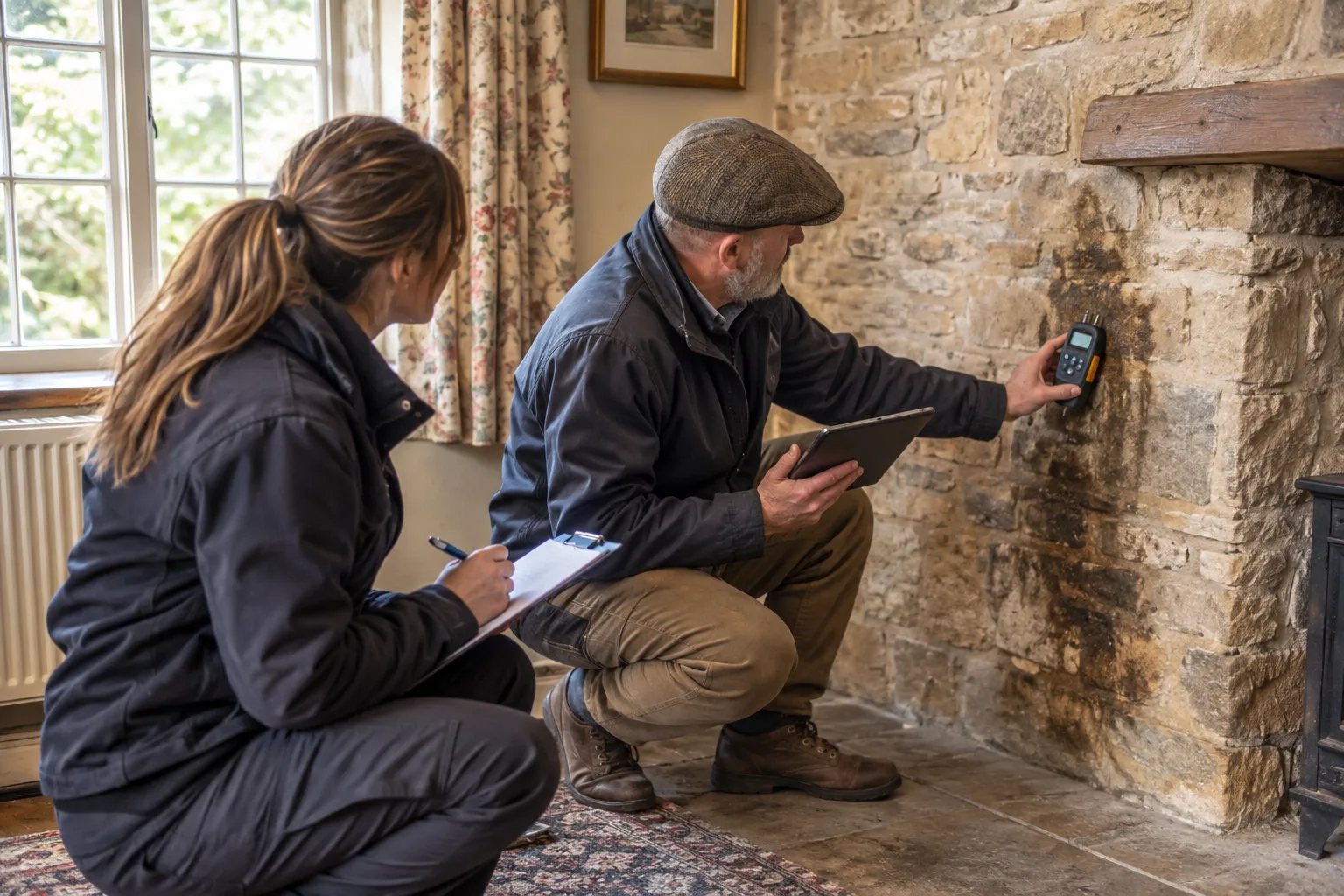
Do not skip a survey to save time. A physical inspection by a qualified surveyor cannot be replaced by an automated valuation or an AI tool. Technology can speed up reporting, but judging damp, structural movement, roofs and services needs experience, which is exactly the mid-career expertise the report says is scarce.
Frequently Asked Questions
What does the RICS Surveying Skills Report measure? It records how RICS members across the whole profession, not just residential surveyors, see skills shortages, recruitment difficulty and AI readiness in their organisations.
Does the report say home surveys will take longer to book? No. The report does not publish waiting times for home surveys. Its capacity and training findings relate to the profession generally.
Why are mid-career surveyors the pressure point? 62% of respondents answering the question cite a lack of mid-career and experienced surveyors as the biggest recruitment challenge. That experience takes years to build and cannot be replaced quickly.
Can AI replace a home survey? No. Technology can speed up reporting, but assessing damp, structural movement, roofs and services still requires an experienced surveyor inspecting the property in person.
What should I do differently when booking a survey now? Book as soon as your offer is accepted, confirm the surveyor is RICS-regulated, choose the survey level that matches the property, and ask who will carry out the inspection.
Conclusion
The RICS skills snapshot is a story about capacity and experience across the surveying profession, not a warning that home surveys are becoming unavailable. Half of UK respondents report a meaningful impact, and the scarcity of mid-career surveyors is the sharpest pressure point. For buyers facing higher borrowing costs and softer prices, the sensible response is straightforward: book early, check RICS regulation, pick the right survey level, ask who will inspect, and do not skip the survey to save time. The Survey Merchant can connect you with a local RICS surveyor to help you buy with confidence.
Related guides
No items found.
Book a RICS surveyor
Survey Merchant provides vetted RICS surveyors across 100+ UK locations at fixed fees: