Building Surveying
Aug 2, 2026
Surveyor lead generation methods: a 2026 guide
Discover effective surveyor lead generation methods for 2026. Learn to attract qualified clients through SEO, paid ads, and more.

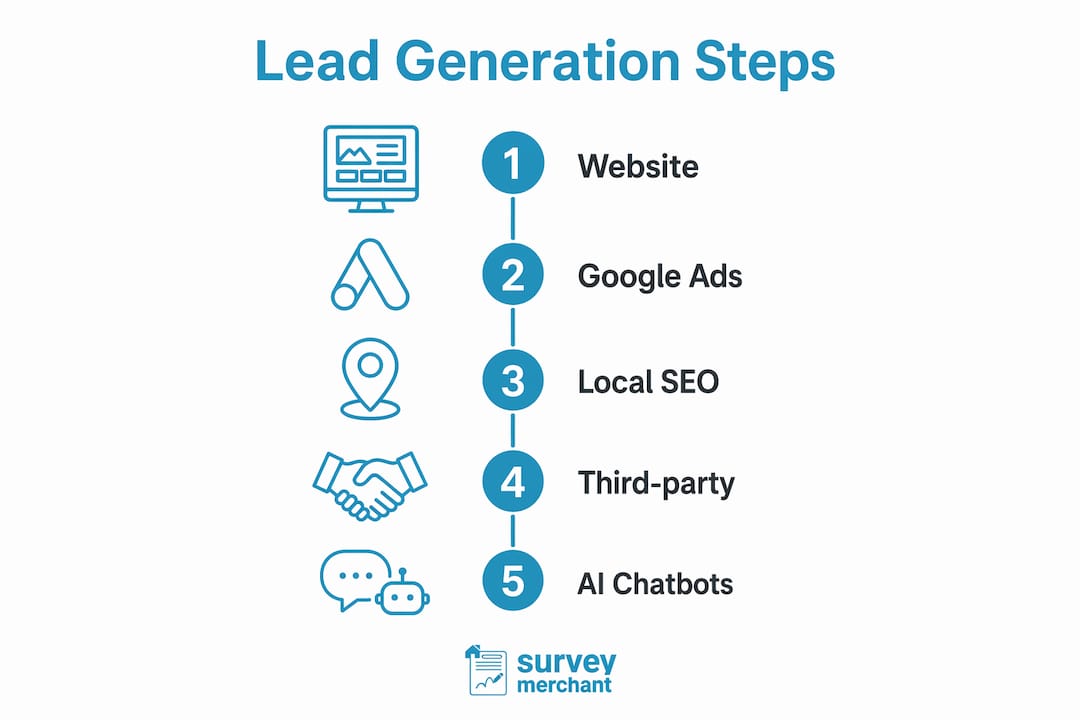
Surveyor lead generation methods are the combination of paid search, local SEO, conversion-focused websites, and specialist marketplaces that bring qualified clients to your door. The most effective firms in 2026 do not rely on one channel. They run segmented Google Ads campaigns, maintain a polished Google Business Profile, and use third-party platforms like Surveymerchant to fill gaps in their pipeline. This guide covers each method in practical depth, so you can build a predictable flow of enquiries rather than waiting on word of mouth.
A conversion-focused website is the foundation of every other lead generation effort. Without it, paid traffic and SEO work send potential clients to a page that fails to convert. Surveying websites succeed when they load fast on mobile, carry clear trust signals, and include dedicated service pages for building surveys, party wall matters, valuations, and structural assessments.
Each service page should answer the questions clients ask before picking up the phone. That means including typical timescales, pricing guidance, and a clear explanation of what the survey covers. Pre-qualification logic and detailed FAQs on your site reduce unqualified enquiries and save your team significant time. Clients who arrive informed are far more likely to convert.
Your Google Business Profile is equally non-negotiable. A complete profile with consistent categories, service areas, photos, and a steady stream of reviews drives visibility in the Google Map Pack. That Map Pack placement is often the first result a property buyer or solicitor sees when searching for a surveyor locally. Treat your profile as a live marketing asset, not a one-time setup.
Pro Tip: Add a FAQ section directly to your Google Business Profile using the Q&A feature. Answering common questions there captures clients who never reach your website.
Google Ads is the fastest channel for new surveying enquiries. Results arrive within 7–14 days, making it the right tool when you need pipeline quickly. Mid-size firms report generating £30,000–£80,000 in monthly revenue directly attributable to well-run campaigns. That figure reflects what is possible with proper setup, not a guaranteed baseline.

The critical mistake most surveying firms make is running a single generic campaign. Segmenting campaigns per survey type doubles conversion rates by keeping high-intent traffic focused. A client searching for “party wall surveyor London” has a completely different need from one searching for “homebuyer survey Bristol.” Mixing them into one campaign dilutes your budget and your message.
Build separate campaigns for each core service:
Use call-only ads alongside standard search ads. Call tracking attributes each phone enquiry to the exact campaign and keyword that generated it. That data tells you which services produce the best cost per acquisition, so you can shift budget accordingly.
| Campaign type | Target keyword example | Buyer intent |
|---|---|---|
| Party wall | “party wall surveyor near me” | Immediate, pre-build |
| Building survey | “level 3 building survey cost” | Pre-exchange, research |
| Valuation | “RICS valuation for mortgage” | Immediate, lender-driven |
| Structural | “structural engineer survey quote” | Urgent, defect-driven |
| Commercial | “commercial building survey London” | Project-stage, high value |
A 2025 case study for a chartered surveying firm showed a party wall PPC campaign generating 57 leads at £62.43 CPA with an estimated 960% ROAS. That result came from tight keyword targeting and a dedicated landing page, not a generic homepage.
Pro Tip: Create a unique landing page for each campaign rather than sending all traffic to your homepage. A page built around one service converts at a significantly higher rate.
Local SEO takes longer than paid search to deliver results. An optimised programme takes 4–12 months to mature, but by month 12 it produces leads from multiple sources at a lower cost per lead than paid-only approaches. That lower cost compounds over time. A firm that invests in local SEO in january will be paying far less per enquiry by december than a firm relying solely on Google Ads.
The Map Pack is the primary prize. Ranking in the top three local results for searches like “building surveyor [city]” or “party wall surveyor near me” generates consistent, high-intent traffic without a cost per click. Achieving that ranking requires a combination of Google Business Profile signals, local backlinks, and on-site content that matches local search terms.
“The firms generating the most predictable leads treat local SEO as a long-term asset, not a quick fix. They publish content, collect reviews, and build local authority month after month. By year two, their cost per lead is a fraction of what paid search costs.”
Content marketing sits at the heart of a strong local SEO strategy. A blog post explaining what a Level 3 building survey covers, or a guide to party wall agreements for homeowners, attracts clients at the research stage. Those clients often convert weeks later when they are ready to instruct. Pairing that content with AI-enhanced SEO tactics can accelerate ranking timelines considerably.
Third-party lead platforms connect surveyors directly with clients at the moment of decision. The client is already searching for a surveyor. The platform captures that intent and delivers the enquiry to you. That removes the need to build and maintain your own marketing infrastructure from scratch. The trade-off is cost per lead and competition with other surveyors on the same platform.
Surveymerchant operates as a specialist platform within the UK property sector, matching clients with qualified surveyors across building surveys, valuations, party wall matters, and commercial property assessments. Joining a network like this gives smaller firms access to a ready-made pipeline while their own digital marketing matures. The top surveyor marketplaces in 2026 vary in cost structure, lead quality, and service specialisms, so comparing them before committing is worth the time.
| Approach | Speed to first lead | Cost structure | Control over brand |
|---|---|---|---|
| Google Ads | 7–14 days | Pay per click | High |
| Local SEO | 4–12 months | Time and content | High |
| Third-party platform | Immediate | Per lead or subscription | Low to medium |
| AI chatbot on website | Immediate | Monthly software fee | High |
AI voice agents and chatbots qualify leads around the clock, filtering out enquiries that fall outside your service area or budget range before they reach your team. That automation increases the volume of leads you can handle without adding administrative staff. A chatbot on your website can ask about property type, location, survey type needed, and timeline, then pass only viable enquiries to your inbox.
Pro Tip: Use an AI chatbot to pre-qualify leads outside business hours. A client who gets an instant response at 10pm is far more likely to instruct you than one who waits until the next morning.
The most common mistake is treating a website as a digital brochure. A brochure tells people who you are. A lead generation website asks visitors to take action. Firms that move to conversion-focused design see measurable improvements in enquiry rates without increasing their advertising spend. The fix is straightforward: add a prominent quote request form above the fold, include social proof near every call to action, and remove anything that distracts from the next step.
Single-channel dependency is the second major pitfall. Successful surveying firms are omnipresent, using multiple channels and tracking ROAS and KPIs across all of them. A firm that relies entirely on referrals is one slow quarter away from a serious pipeline problem. A firm that relies entirely on Google Ads is one algorithm change away from the same.
Common mistakes to address immediately:
Surveying enquiries slow during the festive period. That slowdown is predictable, which means it is preventable. Reduce paid search spend in late december and redirect that budget to content production or email nurture sequences. When the market picks up in january and february, you will have fresh content ranking and a warmer audience to convert.
Tracking is non-negotiable at scale. Set up Google Analytics 4, connect it to your Google Ads account, and define conversion goals for form submissions, phone calls, and quote requests. Review performance monthly. Cut campaigns that consistently deliver a high cost per acquisition and reinvest in those that do not.
The most effective surveyor lead generation strategy combines segmented paid search, local SEO, a conversion-focused website, and specialist platforms to build a pipeline that does not depend on any single channel.
| Point | Details |
|---|---|
| Website as conversion tool | Build dedicated service pages with FAQs, pricing guidance, and clear calls to action. |
| Segment your PPC campaigns | Separate campaigns per service type double conversion rates versus generic campaigns. |
| Invest in local SEO early | Local SEO matures in 4–12 months but delivers the lowest cost per lead long term. |
| Use platforms to fill gaps | Third-party platforms like Surveymerchant provide immediate leads while internal marketing builds. |
| Track every channel | Measure ROAS and cost per acquisition monthly and cut underperforming spend. |
The firms that grow consistently share one habit: they treat marketing as a system, not a task. They do not run a Google Ads campaign for three months, decide it is too expensive, and abandon it. They test, measure, adjust, and keep going. The firms that stall are usually the ones waiting for referrals to pick back up or running a website that has not changed since 2019.
AI is the most significant shift I have seen in lead qualification in years. Surveyors who have added chatbots to their websites are handling enquiry volumes that would have required a part-time administrator two years ago. The technology is not complicated to deploy, and the cost is modest relative to the time it saves. Firms that ignore it are leaving a genuine competitive advantage on the table.
The uncomfortable truth about surveyor marketing is that most firms underinvest until they have a pipeline problem. By then, Google Ads takes two weeks to spin up, local SEO takes months, and the referral network has gone quiet. The right time to build your marketing infrastructure is when you do not urgently need it. That is when you can test calmly, learn what works for your specific services and geography, and build a system that runs reliably. Waiting for a slow quarter to start is the most expensive approach of all.
— Surveymerchant editorial team
Surveymerchant connects qualified surveyors with clients across the UK who are actively searching for professional surveying services.
Whether you specialise in commercial property surveys, party wall matters, or building surveying services, Surveymerchant’s platform puts your firm in front of clients at the point of decision. The network also covers RICS valuation services, giving multi-disciplinary firms a single platform to capture leads across their full service range. Joining the Surveymerchant network is a practical way to supplement your own marketing while your longer-term SEO and paid search efforts mature.
Google Ads delivers results within 7–14 days and is the fastest channel for new surveying enquiries. Third-party platforms like Surveymerchant also provide immediate leads by connecting you with clients already searching for a surveyor.
Local SEO takes 4–12 months to mature fully. By month 12, an optimised programme produces leads from multiple sources at a lower cost per lead than paid search alone.
Segmenting campaigns by service type, such as party wall, building survey, and valuation, doubles conversion rates compared to running a single generic campaign. Each service attracts a different buyer intent, and separate campaigns keep messaging and budget focused.
AI chatbots qualify leads around the clock by asking about property type, location, and survey requirements before passing viable enquiries to your team. This increases the volume of leads you can handle without adding administrative staff.
Track cost per acquisition, ROAS, and conversion rate for each channel monthly. Call tracking is also non-negotiable, as it attributes phone enquiries to the exact campaign or keyword that generated them.
Survey Merchant provides vetted RICS surveyors across 100+ UK locations at fixed fees:
→ Level 2 Home Survey (HomeBuyer Report)
→ Level 3 Building Survey (full structural survey)
→ RICS Red Book property valuations
→ Party wall surveyors — notices, awards & schedules of condition
→ Expert witness surveyors — CPR Part 35 reports for property disputes