We use cookies to improve your experience on our site, analyze site traffic, and assist in our marketing efforts. By clicking "Accept all," you agree to the storing of cookies on your device. You can choose to "Reject all" non-essential cookies. For more information, please read our Cookie Policy.
Septic Tank Regulations UK 2026: Rules, Costs & Buyer Guide
England's septic tank rules in 2026: the general binding rules, new SR2025 standard permits, written notice on sale, and typical costs of £1,500 to £18,000 to put a non-compliant system right.
If you are buying, selling or already own a home that is not connected to a mains sewer, the septic tank regulations UK homeowners must follow are no longer something you can leave to the conveyancer. In England the rules are set by the Environment Agency’s general binding rules for small sewage discharges, and in 2026 they have been refreshed twice: new standard rules permits were published on 20 April 2026 and the ground-discharge guidance was updated on 23 July 2026. This guide explains what the rules require, what changed this year, what it costs to put a non-compliant system right, and how a suitably qualified, accredited surveyor protects you before you commit to a rural purchase.
Key takeaways
Septic tanks in England must comply with the Environment Agency’s general binding rules: no more than 2 cubic metres a day to ground, or 5 cubic metres a day to surface water via a treatment plant, with no permit needed if every rule is met.
A septic tank must never discharge directly into a ditch, stream or river. Since 1 January 2020 such systems must be replaced with a treatment plant, converted to a drainage field or connected to the mains, and GOV.UK expects the fix “as soon as possible”, usually within 12 months.
When a property is sold, the seller must give the buyer written notice describing the system, its location, any changes, maintenance requirements and records, and the parties should agree who pays for any upgrade as a condition of sale.
2026 brought three new standard rules permits (SR2025 No 5, 6 and 7, published 20 April 2026) and a 23 July 2026 guidance update allowing engineered ground and drainage mounds built to BS 6297:2007.
Putting a non-compliant system right typically costs between £6,000 and £18,000 for a treatment plant, or £1,500 to £8,000 for a new drainage field, so the position should be established before exchange, not after.
A Level 3 building survey will inspect visible drainage but cannot test it; where a private system is present, Survey Merchant’s accredited surveyors will advise on a specialist drainage or CCTV survey before you commit.
What are the septic tank regulations in the UK?
In England, septic tank regulations are the Environment Agency’s general binding rules, made under the Environmental Permitting (England and Wales) Regulations 2016. A system that meets every rule needs no permit; one that fails any rule is unlawful until it is fixed or permitted. Scotland, Wales and Northern Ireland run separate regimes.
Private drainage is a routine finding in rural surveys. Establishing whether the system meets the general binding rules should happen before exchange.
The rules are published on GOV.UK: general binding rules for small sewage discharges to the ground and the companion page for discharges to a surface water. They apply to anyone who is responsible for the discharge, described as the “operator”, which for most homes means the owner-occupier. Rules 1 to 14 apply to every discharge regardless of age; rules 15 to 21 apply to discharges started on or after 1 January 2015; and rules 22 and 23 apply to new discharges started on or after 2 October 2023.
The core rules every septic tank owner must meet
Volume limits: no more than 2 cubic metres (2,000 litres) a day to ground, or 5 cubic metres (5,000 litres) a day to surface water. Larger discharges must connect to the public sewer where reasonable or hold a permit.
Domestic sewage only: the system must treat household sewage and must not cause pollution of groundwater or surface water.
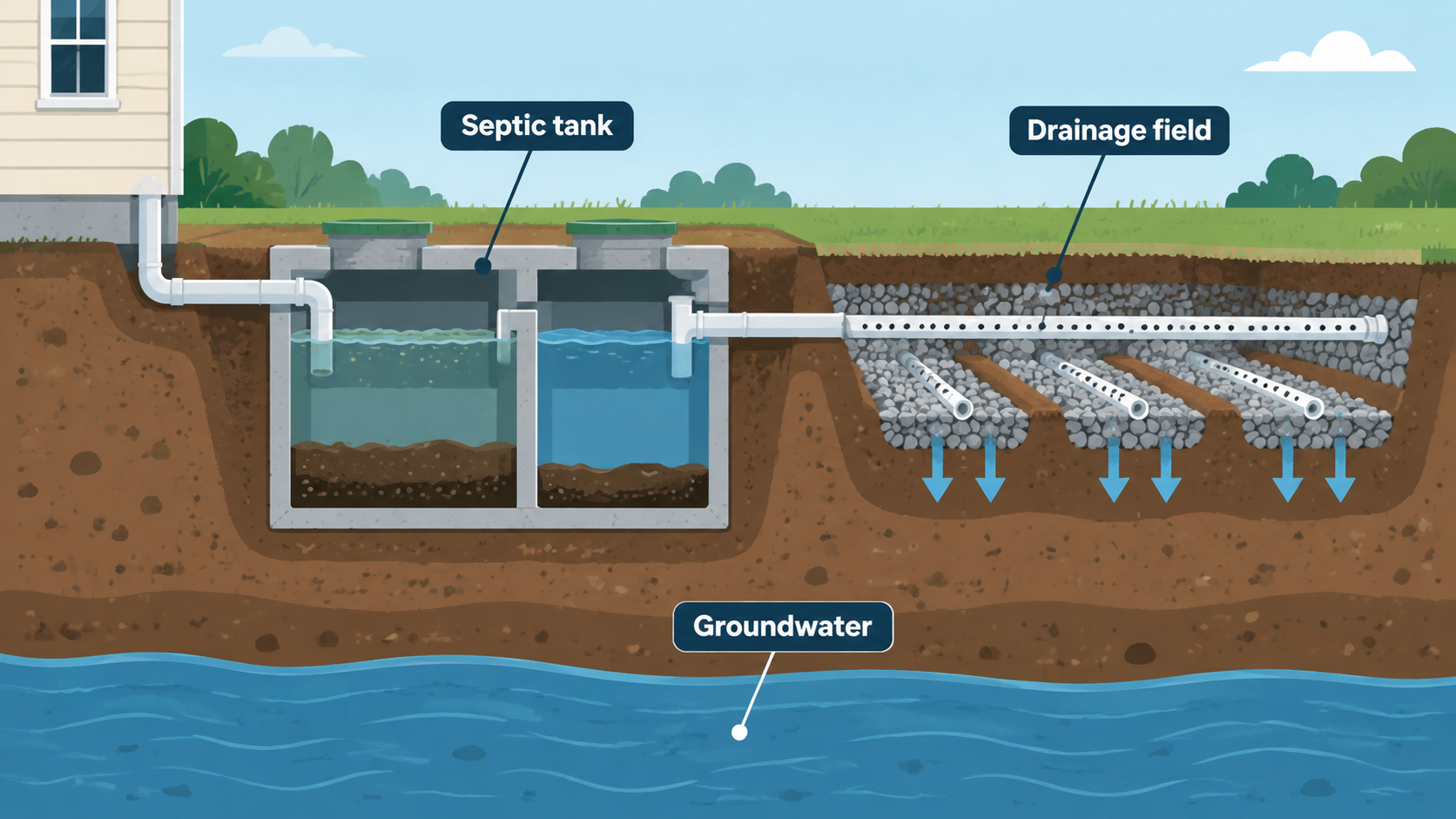
The right equipment for the route: a discharge to ground needs a septic tank or treatment plant feeding a drainage field; a discharge to a watercourse needs a small sewage treatment plant, never a septic tank alone.
Standards: new tanks and plants must meet BS EN 12566 and new drainage fields must follow BS 6297:2007. Older equipment is judged against the standard in force when it was installed, and systems from before 1983 need not meet a British Standard at all.
Separation distances: a ground discharge cannot meet the rules if a public foul sewer is within 30 metres of any boundary of the property, if it sits in groundwater source protection zone 1, within 50 metres of a private water supply, in ancient woodland, or within 50 metres of a SSSI, SAC, SPA or Ramsar site.
Maintenance: the system must be maintained to the manufacturer’s instructions by a competent person, desludged at least once a year by a registered waste carrier, and repaired or replaced if it leaks, blocks or smells.
On sale: the operator must tell the new operator in writing that a discharge is in place (rule 13), covered in detail below.
What changed in 2026?
Two developments this year matter for buyers and owners. First, following Standard Rules Consultation No 32 (which ran from 1 October to 12 November 2025, with the Environment Agency’s response published on 2 February 2026), three new standard rules permits were published on 20 April 2026. These give owners of systems that cannot meet the general binding rules a cheaper, faster route than a bespoke permit, typically determined in around 20 working days rather than several months:
SR2025 No 5: treated domestic effluent to ground at more than 2 but no more than 5 cubic metres a day, available for new discharges.
SR2025 No 6: up to 1.5 cubic metres a day to ground through a shallow drainage system that does not meet BS 6297, but only where it replaces a discharge in place before 2 October 2023.
SR2025 No 7: up to 5 cubic metres a day to surface water using equipment that is not to the British Standard, or to a watercourse that does not always flow, again only to regularise a discharge that existed before 2 October 2023.
After consultation the Environment Agency reduced the screening distance from potable water supplies from 250 metres to 125 metres, tied the public-sewer screening distance to the number of properties served (30 metres for a single home), relaxed the ammoniacal nitrogen limit on principal and secondary A aquifers from 5 to 10 mg/l, and dropped the annual effluent testing requirement.
Second, on 23 July 2026 the GOV.UK ground-discharge guidance was amended to confirm that engineered ground with reduced percolation and drainage mounds can meet the general binding rules, provided they are not in a floodplain, achieve a minimum percolation value (Vp) of 15 and are located, designed and built in line with BS 6297:2007. This is helpful on heavy clay sites where a conventional drainage field previously failed the percolation test.
Can a septic tank discharge to a ditch, stream or river?
No. A septic tank only provides primary settlement, and its effluent is not clean enough to go into a watercourse. The 1 January 2020 deadline for ending direct discharges to surface water has passed, and GOV.UK now simply says that if your septic tank discharges directly to a watercourse you must, as soon as possible, do one of three things: connect to the public foul sewer, replace the tank with a small sewage treatment plant, or install a drainage field that meets the rules for discharges to ground. You must have plans to complete the work within a reasonable timescale, usually 12 months, and the Environment Agency can require a faster fix if pollution is occurring.
A compliant ground discharge: settled effluent leaves the tank and percolates through a drainage field of perforated pipes in gravel trenches, never straight into a watercourse.
Septic tank rules when selling or buying a property
Property sales are one of the three most common ways non-compliant systems come to light, alongside pollution complaints and planning applications. Rule 13 of the general binding rules requires the seller to give the buyer written notice that a small sewage discharge is being carried out. GOV.UK says that notice should include:
a description of the treatment and drainage systems;
the location of the main parts of both systems and the discharge point;
details of any changes made to either system;
how the systems should be maintained, plus the maintenance manual if available;
maintenance records, if available.
Where the tank discharges to a watercourse, the Environment Agency expects buyer and seller to agree who will replace or upgrade the system and to record it as a condition of sale. In practice the question is also asked on the Law Society’s TA6 Property Information Form, which our TA6 form guide walks through, and a CON29DW drainage and water search will tell you whether the property is connected to a public sewer but will not confirm that an off-mains system complies.
What a building survey will and will not tell you
Under the RICS Home Survey Standard a surveyor carrying out a Level 3 building survey will inspect visible drainage, lift accessible inspection chamber covers where safe, note the presence and apparent type of a private system and flag obvious signs of trouble such as ponding, odours or lush growth over the drainage field. What a general survey cannot do is test the system, trace the discharge point or confirm compliance with the general binding rules. That is why the report will usually recommend a specialist drainage survey, often with CCTV, before exchange. If you are still deciding between survey levels, our Level 2 versus Level 3 comparison explains why older rural properties almost always justify the fuller inspection.
How much does it cost to make a septic tank compliant?
Costs vary with ground conditions, access and the size of the household, but current UK trade price guides give a consistent picture. The figures below draw on the 2026 cost guides published by BookaBuilderUK and MyJobQuote (updated 28 September 2026).
Work required
Typical 2026 cost
Typical timescale
Site survey and percolation test
£250 to £1,000
1 day (plus 24–48 hours soak)
Annual desludging / emptying
£150 to £300
Half a day
New drainage field (soakaway) to BS 6297
£1,500 to £8,000
2 to 5 days
Replacement septic tank with drainage field
£6,000 to £10,000+
3 to 7 days
Small sewage treatment plant, supplied and installed
£6,000 to £18,000
3 to 7 days
Removal and disposal of old tank
£500 to £2,000
1 day
Building control fee (England)
£150 to £400
n/a
Running costs for a treatment plant are typically £100 to £300 a year in electricity, with pump or blower replacement at £300 to £800 every few years. Set against a purchase price, these sums are modest, but they are large enough to justify renegotiation if the seller has not disclosed a non-compliant system. Our guide to negotiating the price after a survey explains how to use a quotation for remedial works as evidence.
Do you need planning permission or building regulations approval?
Replacing a tank or installing a new treatment plant or drainage field is building work covered by Part H of the Building Regulations, so you will need either a building control application or an installer registered with a competent person scheme, and the general binding rules themselves (rule 16) require that any necessary planning and building control approvals are in place. A like-for-like replacement in the same position rarely needs planning permission, but a new discharge point, a system serving more than one dwelling, or works in a conservation area or near a protected site may. A building regulations completion certificate for the installation is a document any buyer should ask to see.
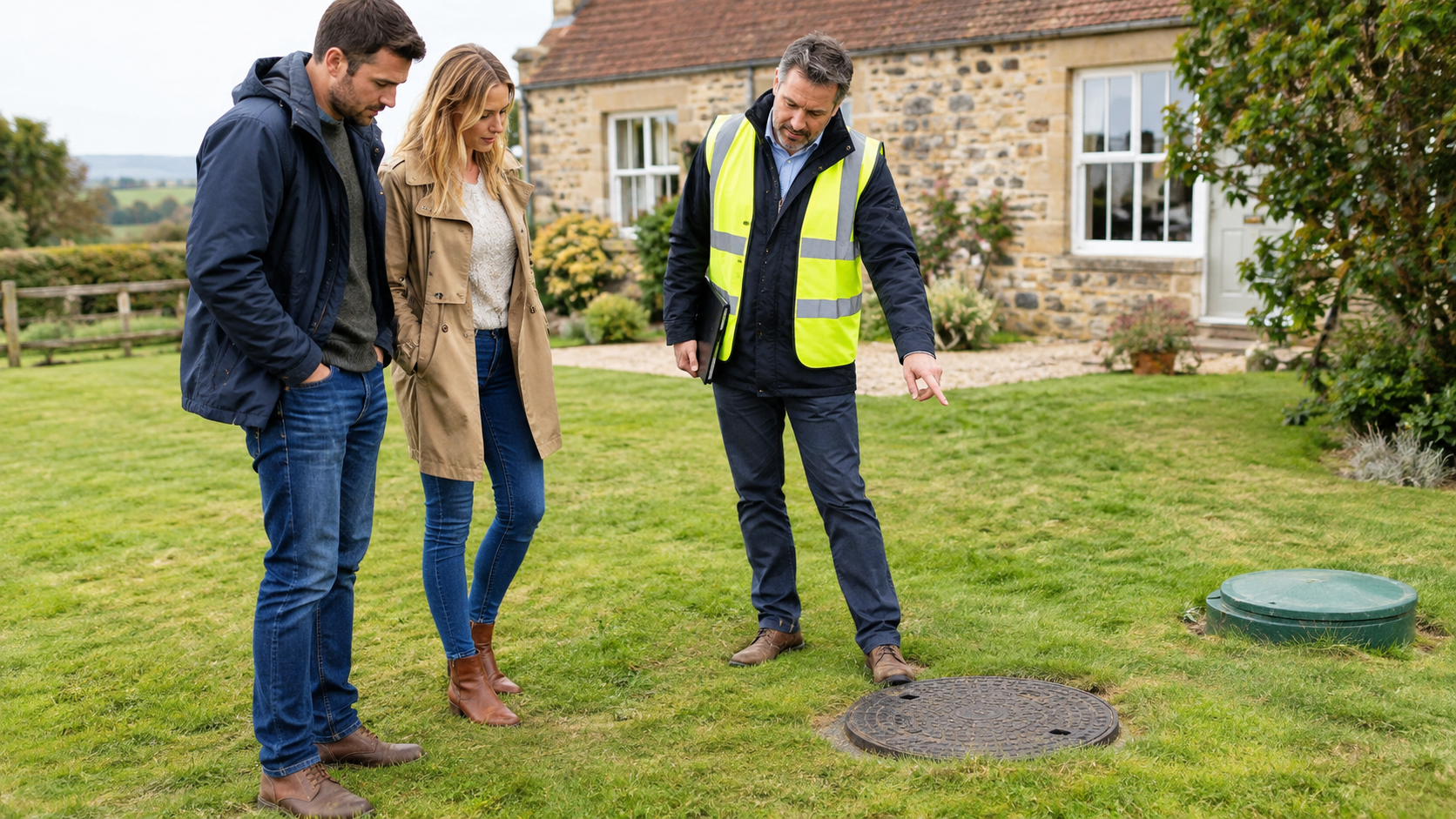
Ask the surveyor to show you the tank, the inspection chambers and the likely line of the drainage field so you understand what you are taking on.
How to check a septic tank before you buy: a surveyor’s checklist
Identify the system type. Septic tank, cesspit (a sealed holding tank with no outlet that needs frequent emptying) or package treatment plant. Cesspits are not covered by the general binding rules at all and cost far more to run.
Find the discharge point. Does the outlet go to a drainage field, or to a ditch or stream? A direct watercourse discharge from a septic tank is non-compliant today.
Measure the distances. Is there a public sewer within 30 metres of the boundary? Is there a well or borehole within 50 metres? Is the site in a source protection zone or near a SSSI? These can rule out the general binding rules entirely.
Ask for the paperwork. The rule 13 written notice, installation certificate, building control sign-off, manufacturer’s manual and at least one year of emptying receipts.
Look at the ground. Soggy patches, surface effluent, unusually green grass or a smell over the drainage field point to a failed soakaway.
Check the capacity. A tank sized for a two-bedroom cottage will not cope with a five-bedroom extension; volume above 2 cubic metres a day needs a permit.
Commission a drainage survey. A CCTV survey and, where a new field is likely, a percolation test will turn an unknown into a costed item you can negotiate on.
What happens if you ignore the septic tank regulations?
Operating a discharge that neither meets the general binding rules nor has a permit is an offence under the Environmental Permitting (England and Wales) Regulations 2016. The Environment Agency can serve enforcement notices requiring the discharge to stop or be regularised, and can prosecute where pollution is caused. Just as importantly for a homeowner, a non-compliant system is a disclosure issue on sale, a potential insurance problem and a frequent cause of neighbour disputes where effluent crosses a boundary. If you discover a problem after completion and it was not disclosed, our guide to the options when a survey finds problems sets out the practical and legal routes.
Scotland, Wales and Northern Ireland
The general binding rules apply to England only. In Scotland, discharges from septic tanks must be registered with SEPA under the Controlled Activities Regulations, and the registration passes to the new owner on sale. In Wales, Natural Resources Wales requires registration of small sewage discharges and applies its own binding rules. In Northern Ireland, a consent to discharge from the NIEA is required. A suitably qualified surveyor familiar with the local regime will confirm which applies and what documents to request.
Why choose Survey Merchant for your septic tank and drainage advice?
Buying a property with private drainage is exactly the situation where an impartial, properly accredited surveyor earns their fee many times over. Survey Merchant offers:
An accredited panel matched to the job. Our surveyors are regulated or accredited by recognised UK bodies including RICS, CIOB and RPSA, and we match the right specialist to rural, listed and off-mains properties.
Nationwide coverage with local knowledge. From Cornwall to Cumbria, our surveyors know the local ground conditions, source protection zones and building control practices that decide whether a drainage field will pass.
Fast turnaround. We understand that a survey often sits on the critical path to exchange, so we prioritise prompt inspections and reports.
Transparent, competitive fixed fees. You know the cost before you instruct, with no hidden extras.
Impartial advice. We do not sell tanks or installation, so our recommendation to commission a drainage survey or walk away is made in your interest only.
End-to-end support. From choosing between a Level 2 and Level 3 survey to interpreting a CCTV report and preparing a renegotiation, we support you through to completion.
Book a building survey with Survey Merchant today, or contact our team for a fixed-fee quotation on any rural or off-mains property.
In England, septic tanks and small sewage treatment plants must meet the Environment Agency's general binding rules, made under the Environmental Permitting (England and Wales) Regulations 2016. Meet every rule and no permit is needed; fail any rule and the discharge is unlawful until it is fixed or permitted. Scotland, Wales and Northern Ireland have separate regimes.
Can a septic tank discharge into a ditch or stream?
No. Since 1 January 2020 a septic tank must not discharge directly to surface water. GOV.UK says you must, as soon as possible and usually within 12 months, connect to the public sewer, replace the tank with a small sewage treatment plant, or install a compliant drainage field.
Do I need a permit for my septic tank?
Not if your discharge meets all of the general binding rules, including the 2 cubic metre a day limit to ground (5 cubic metres to surface water via a treatment plant). You will need a permit if you exceed those volumes, are in groundwater source protection zone 1, are near a protected site, or cannot meet another rule. Since 20 April 2026 three new standard rules permits (SR2025 No 5, 6 and 7) offer a quicker route than a bespoke permit.
What must a seller tell a buyer about a septic tank?
Rule 13 requires the seller to give the buyer written notice that a small sewage discharge is in place, describing the treatment and drainage systems, their location and discharge point, any changes made, how to maintain them and any maintenance records. Where the tank discharges to a watercourse, who pays for the upgrade should be agreed as a condition of sale.
How much does it cost to replace a septic tank in the UK?
2026 trade price guides put a replacement septic tank with drainage field at around £6,000 to £10,000 or more, a small sewage treatment plant supplied and installed at £6,000 to £18,000, and a new drainage field alone at £1,500 to £8,000. A site survey and percolation test cost roughly £250 to £1,000, and annual emptying £150 to £300.
Does a house survey check the septic tank?
A Level 3 building survey inspects visible drainage, lifts accessible inspection covers and notes the type and condition of a private system, but it does not test the drains or confirm compliance with the general binding rules. Where a septic tank or treatment plant is present, Survey Merchant's accredited surveyors will recommend a specialist CCTV drainage survey and, where a new field is likely, a percolation test before exchange.