We use cookies to improve your experience on our site, analyze site traffic, and assist in our marketing efforts. By clicking "Accept all," you agree to the storing of cookies on your device. You can choose to "Reject all" non-essential cookies. For more information, please read our Cookie Policy.
Building Regulations Completion Certificate: 2026 UK Guide
A 2026 UK guide to the building regulations completion certificate: what it is, who issues it, timescales, costs, and your options (copy, regularisation, indemnity insurance, independent survey) if it is missing.
A building regulations completion certificate is the piece of paper that proves your extension, loft conversion or structural alteration was inspected and signed off as compliant with the Building Regulations. It sounds like a formality, yet in 2026 it is one of the first documents a buyer’s solicitor, a mortgage lender or an insurer will ask to see. Without it, a sale can stall, a remortgage can be refused and you can be left paying for indemnity insurance or a retrospective “regularisation” application. This guide explains what a building regulations completion certificate is, who issues it, how long it takes, what to do if yours is missing, and how a suitably qualified, accredited surveyor can help you fix the problem before it costs you a sale.
Key takeaways
A building regulations completion certificate confirms that building work was inspected and found to comply with the Building Regulations. In England and Wales it is issued by your local authority building control team, or as a “final certificate” by a private Registered Building Control Approver (RBCA).
GOV.UK states you will usually receive a completion certificate within 8 weeks of finishing compliant work under a full plans application.
Under Regulation 17 of the Building Regulations 2010, a certificate is evidence, but not conclusive evidence, of compliance – so a buyer’s own survey still matters.
If the certificate is missing, you have three main routes: request a copy, apply for a regularisation certificate (work after 11 November 1985, local authority only), or take out building regulations indemnity insurance.
2026 has brought real change: the Building Safety Regulator became a standalone body in January 2026 and is prioritising faster completion (Gateway 3) certificates, while Wales introduced a new building control regime on 1 July 2026.
An independent defect or pre-sale inspection by an accredited surveyor (RICS, CIOB or RPSA) is the fastest way to establish whether unsigned-off work is actually sound.
What is a building regulations completion certificate?
A building regulations completion certificate is a formal document issued by a building control body after the final inspection of a project. It confirms that, so far as the inspector could reasonably ascertain, the completed work complies with the applicable requirements of the Building Regulations. It is separate from planning permission: planning says you may build; the completion certificate says the work was built correctly.
The legal basis in England and Wales is Regulation 17 of the Building Regulations 2010. A local authority must issue a certificate once it has been notified that work is complete and has been able to satisfy itself, “after taking all reasonable steps”, that the relevant requirements have been met. Crucially, Regulation 17(4) states that the certificate is evidence – but not conclusive evidence – that those requirements were complied with. That single clause is why experienced conveyancers still recommend a proper building survey even where paperwork is in order.
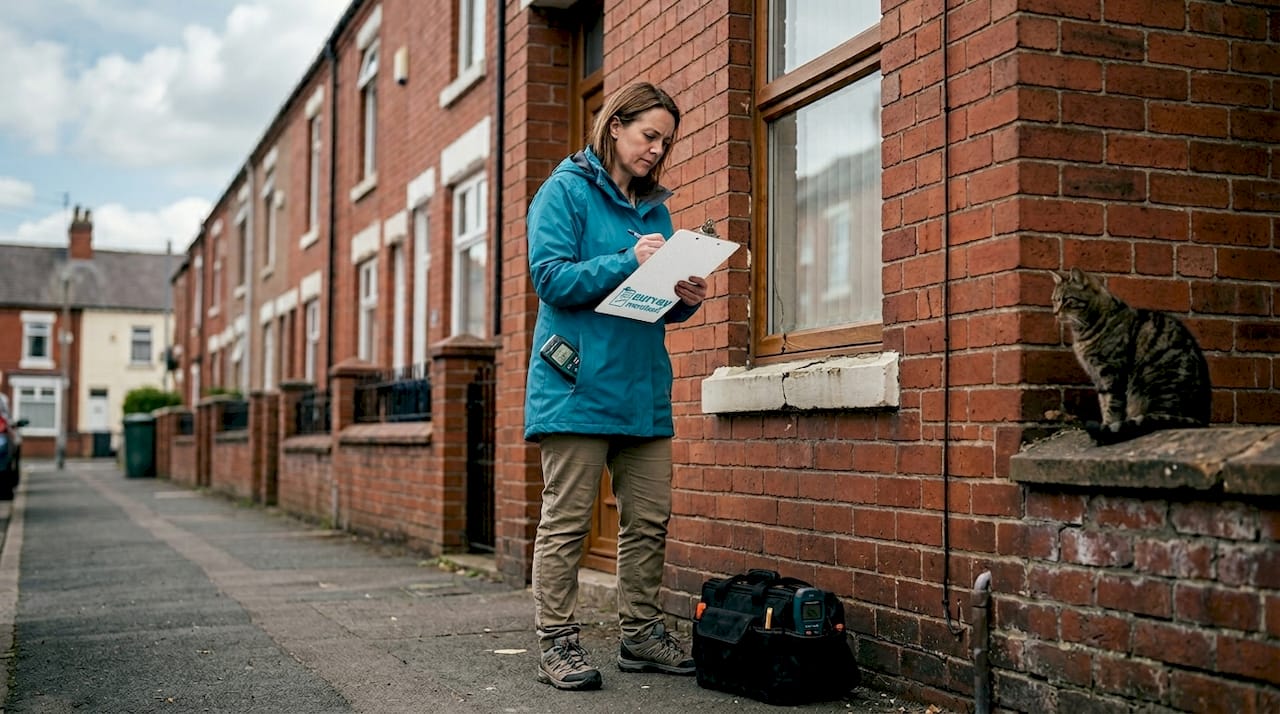
A building regulations completion certificate follows a final inspection of the finished work – but it is not a substitute for an independent survey.
Completion certificate vs final certificate
The wording depends on who supervised the work. If your local authority building control team inspected the job, you receive a completion certificate. If you used a private building control provider, you receive a final certificate instead, and the provider notifies the council so the work is recorded on the council’s register. Since the Building Safety Act reforms, private providers in England and Wales are known as Registered Building Control Approvers (RBCAs) rather than “approved inspectors”, and individual inspectors must be Registered Building Inspectors. Both documents do the same job in a conveyancing file.
Which works need one?
Most structural, thermal, fire-safety, drainage and electrical work is “building work” under the regulations. Common domestic examples that should end with a certificate include:
Single- and two-storey extensions, garage and basement conversions.
Re-roofing, new roof structures and replacing more than 50% of a roof covering.
Replacement windows and doors, new boilers and heating systems, and most electrical work in kitchens, bathrooms and outdoors (Part P).
New or altered drainage, underpinning and structural repairs.
Some of this work – windows, boilers, electrics, cavity insulation – can be self-certified under a government-approved competent person scheme such as FENSA or Gas Safe. In those cases the installer registers the work and you receive a scheme certificate rather than a council one. It has the same status for conveyancing purposes, so keep it safe.
How do you get a building regulations completion certificate?
The route depends on the type of application you (or your builder) made before work started. The table below summarises the options in England for non-higher-risk buildings, based on current GOV.UK and Planning Portal guidance.
Route
Who inspects
Typical timing
What you receive
Full plans application
Local authority building control
Decision within 5 weeks (or 2 months by agreement); certificate usually within 8 weeks of completion
Completion certificate
Building notice
Local authority building control
Work can start 2 days after notice; certificate after final inspection
Completion certificate (no formal plan approval)
Initial notice via an RBCA
Registered Building Control Approver
Agreed with the approver; final inspection at completion
Final certificate (copied to the council)
Competent person scheme
Registered installer self-certifies
Installer notifies the scheme, usually within 30 days
Scheme certificate (e.g. FENSA, Gas Safe)
Regularisation
Local authority only
Inspection, possible opening-up and remedial works, then decision
Regularisation certificate (retrospective)
Step by step
Notify before you start. Submit full plans or a building notice to the council, or appoint an RBCA who serves an initial notice. Under the current regime the applicant must also name a principal designer and principal contractor for most projects – roles the panel's professionals can fill through our principal designer service.
Book stage inspections. Foundations, damp-proof course, drains, structural steels, insulation and fire-stopping are all checked at set points. Missing a stage inspection is the most common reason a certificate is withheld.
Notify completion. Regulation 16 requires the person carrying out the work to notify building control within five days of completion. Ask for the completion certificate explicitly.
Final inspection and certificate. The inspector visits, requests any outstanding paperwork (structural calculations, electrical and gas certificates, SAP or air-test results) and issues the certificate if satisfied.
File it. Keep the certificate with your title deeds, planning approval and warranties. You will need it when you sell, remortgage or claim on insurance.
How much does a building regulations completion certificate cost?
There is no separate fee for the certificate itself – it is included in the building control charge you paid with your application. Local authorities set their own charges based on the type of work, number of inspections and floor area, while RBCAs negotiate fees directly. What does cost extra is doing things in the wrong order. Regularisation applications typically attract a premium over the standard charge, and you may also have to pay for opening-up works, a structural engineer’s report or remedial work before a certificate is granted. Copies of an existing certificate are cheap by comparison: many councils charge a modest administration fee, often in the region of £30–£40 including VAT.
What if you have no building regulations completion certificate?
This is the situation that generates most of the searches for this topic, and it usually surfaces at the worst possible time – when a buyer’s solicitor raises an enquiry or a lender’s valuer notes an extension with no paperwork. You have three realistic options, and a fourth that supports all of them.
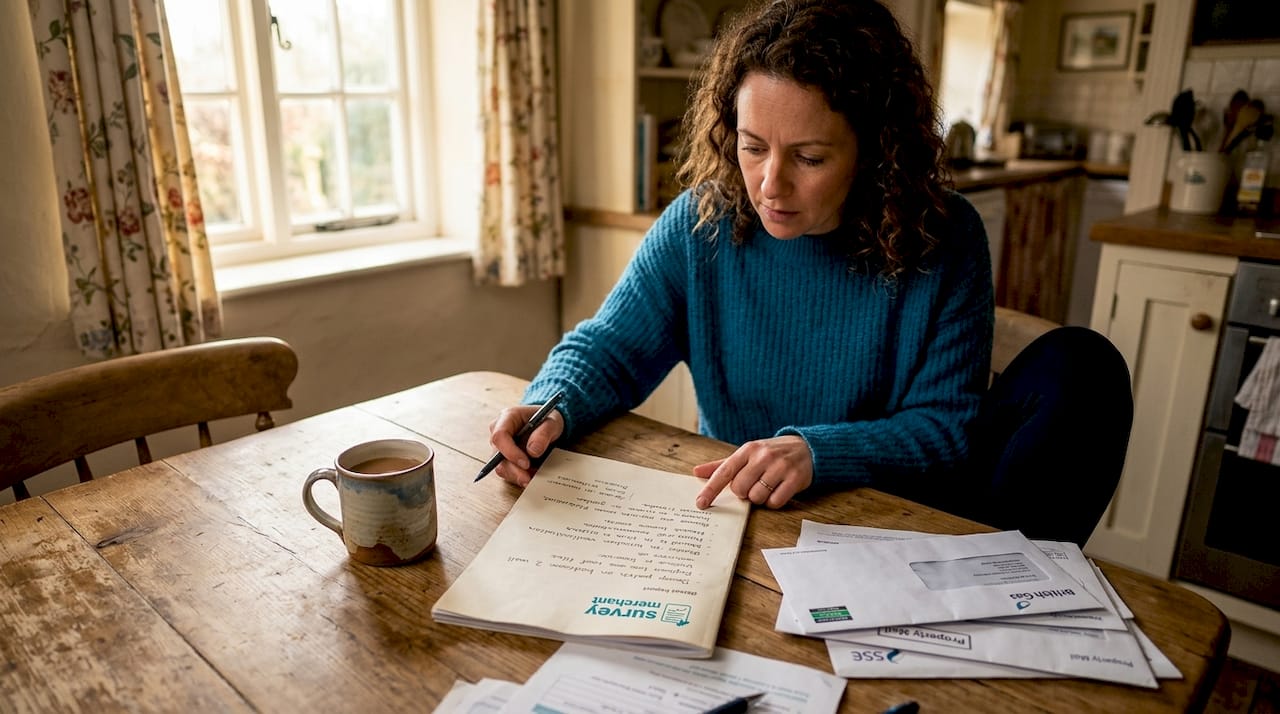
Discovering that a completion certificate is missing is common – a clear plan and an independent inspection usually resolve it.
Option 1: Request a copy
If the work was inspected but the paperwork has gone astray, contact the building control body that supervised it. Councils keep a register of completion certificates and can usually supply a copy for an administration fee; your conveyancer can often obtain it through the council’s online systems. If an approved inspector or RBCA was used, ask them for a copy of the initial notice and final certificate. The HomeOwners Alliance notes that before 2013 councils were not required to issue completion certificates in every case, so for older work a “final inspection letter” may be all that exists – and that is normally acceptable to lenders.
Option 2: Apply for a regularisation certificate
Regularisation is retrospective approval for work carried out without consent on or after 11 November 1985. According to the Planning Portal, the council will inspect the work to determine whether it complies, and “exposure, removal and/or rectification” may be required to prove it. Only a local authority can grant regularisation – an RBCA cannot – and councils commonly limit applications to work under roughly 10–15 years old. It is the only route that gives you a genuine certificate, which is why it is the best option if you are not selling imminently or if the buyer’s lender refuses indemnity cover.
Option 3: Building regulations indemnity insurance
If timing is tight, a one-off indemnity policy arranged by a conveyancer protects the buyer (and their lender) against the cost of enforcement action. The HomeOwners Alliance puts typical premiums at around £20–£300 depending on the property value – for example roughly £175 on a £500,000 home. Two warnings: the policy usually cannot be taken out until 12 months after the work was completed, and it is invalidated if anyone contacts the council about the missing certificate. It also insures against enforcement, not against the work being defective. Our guide to when to use indemnity insurance explains the trade-offs in more detail.
Option 4: Get the work independently inspected
Whichever route you choose, the underlying question is the same: is the work actually sound? An indemnity policy does not fix a sagging steel or an unsupported chimney breast, and a regularisation application goes far more smoothly if you already know what the inspector will find. A specific defect report on the unsigned-off element, or a full Level 3 building survey for buyers, gives you evidence-based answers. Where a structural alteration is involved, a structural engineer’s report with calculations is often exactly what building control will ask for.
Option
Best for
Indicative cost
Main drawback
Copy of existing certificate
Work that was inspected; paperwork lost
Council admin fee (often c. £30–£40)
Only works if an inspection actually happened
Regularisation certificate
Unauthorised work after 11 Nov 1985; not selling immediately
Premium on standard charge plus any opening-up and remedial works
Time, disruption and possible remedial costs
Indemnity insurance
Imminent sale; work over 12 months old
Typically £20–£300
Void if the council is contacted; does not cover defects
Independent surveyor inspection
Any of the above – buyers and sellers
From a few hundred pounds for a specific defect report
Not a certificate in itself, but the evidence behind one
Can you sell or remortgage a house without a completion certificate?
Yes, but expect friction. A buyer can proceed without a certificate, and most lenders will accept an indemnity policy or a satisfactory regularisation certificate. Some lenders, however, will not lend on a property where a significant structural alteration has no paperwork at all, and a cautious buyer may negotiate a price reduction or retention. In practice the seller who arrives with a copy certificate, a recent survey of the works and – where needed – a structural engineer’s letter is in a far stronger position than one who simply offers to pay for indemnity insurance. For buyers, our article on suing a builder for poor workmanship explains your remedies if unsigned-off work turns out to be defective.
What has changed in 2026?
Building control has been reshaped by the Building Safety Act 2022, and 2026 is a milestone year:
Building Safety Regulator (BSR) reform. In January 2026 the BSR moved out of the Health and Safety Executive to become a standalone public body sponsored by the Ministry of Housing, Communities and Local Government. Its plan for April 2026 to March 2027 prioritises clearing backlogs and streamlining the “Gateway 3” completion certificate process for higher-risk buildings (RIBA, 2026). For flat owners in buildings of seven storeys or 18 metres and above, this is the body that now issues your completion certificate, with the process set out on GOV.UK.
Wales: new regime from 1 July 2026. Wales introduced a higher-risk building regime with its own application type, added information requirements for full plans applications (including principal designer and contractor details), partial completion certificates, and extra checks on regularisation applications (Planning Portal, 16 June 2026).
Registered Building Control Approvers. The switch from “approved inspectors” to registered approvers and registered inspectors is now fully in force, so check that any private provider you appoint appears on the GOV.UK register.
The direction of travel is clear: more documentation, named dutyholders, and a firmer expectation that completion evidence exists. Homeowners who commission work in 2026 should treat the completion certificate as a deliverable in the building contract, not an afterthought. Our building regulations guide and permitted development rights 2026 guide cover the wider framework.
A suitably qualified, accredited surveyor can inspect unsigned-off work and tell you exactly what building control will look for.
How an accredited surveyor helps with building regulations compliance
Building control inspectors check compliance at fixed points; they do not act for you, and they will not tell a buyer whether an extension is well built. A suitably qualified, accredited surveyor – regulated or accredited by bodies such as RICS, CIOB or RPSA – fills that gap. Typical instructions include:
Pre-purchase inspection of extensions, loft conversions or wall removals with no completion certificate, so buyers know what they are taking on.
Pre-sale “compliance health check” for sellers, identifying missing certificates early and advising on copy, regularisation or indemnity routes.
Specific defect reports and structural engineer’s reports that building control will accept in support of a regularisation application.
Acting as principal designer or contract administrator on new projects so that inspections are booked and the certificate is obtained as part of the job.
Expert evidence where unsigned-off work has caused a dispute with a builder or a neighbour.
Choosing the right professional matters: anyone can call themselves a surveyor, so always confirm accreditation and professional indemnity insurance. Our guide to what a building surveyor does explains the qualifications to look for.
Why choose Survey Merchant for your building regulations completion certificate issue?
Whether you are a buyer who has just discovered an unsigned-off extension, a seller facing a solicitor’s enquiry, or a homeowner planning work in 2026, Survey Merchant makes it straightforward to get the right expert on the case:
Accredited panel matched to the job – suitably qualified surveyors and engineers accredited across RICS, CIOB and RPSA, so a defect report, structural assessment or principal designer appointment is handled by the right specialist.
Nationwide UK coverage with local knowledge – surveyors who understand how your local authority building control team approaches regularisation and copy certificates.
Fast turnaround – prompt inspections and clear, lender-friendly reports when a sale or remortgage is waiting on answers.
Transparent, competitive fixed fees – a clear quote before you commit, with no hidden extras.
Impartial, end-to-end support – independent advice on whether to copy, regularise or insure, and help preparing the evidence building control will want to see.
Ready to resolve a missing certificate or plan a compliant project? Explore our building surveying services or contact our team for a fast, no-obligation quote from an accredited surveyor.
What is a building regulations completion certificate?
It is a formal document issued by a building control body – your local authority or a Registered Building Control Approver – after the final inspection of building work, confirming that the work complies with the Building Regulations so far as could reasonably be ascertained. Under Regulation 17 of the Building Regulations 2010 it is evidence, but not conclusive evidence, of compliance.
How long does it take to get a building regulations completion certificate?
GOV.UK states you will usually receive a completion certificate within 8 weeks of completing compliant work under a full plans application. Delays normally arise where stage inspections were missed, paperwork such as structural calculations or electrical certificates is outstanding, or remedial work is needed before sign-off.
What happens if you do not have a building regulations completion certificate?
You can request a copy from the council or approver if the work was inspected, apply to the local authority for a retrospective regularisation certificate (work carried out after 11 November 1985), or arrange building regulations indemnity insurance through a conveyancer. An independent inspection by an accredited surveyor helps you choose the right route and shows whether the work is actually sound.
Can you sell a house without a building regulations completion certificate?
Yes, but expect enquiries from the buyer's solicitor and lender. Most transactions proceed with an indemnity policy or a regularisation certificate, though some lenders will not lend where a major structural alteration has no paperwork. Sellers who provide a copy certificate or a recent survey of the works are in a much stronger negotiating position.
How much does building regulations indemnity insurance cost?
According to the HomeOwners Alliance, a one-off policy typically costs around £20–£300 depending on the property value – for example roughly £175 on a £500,000 home. The policy usually cannot be taken out until 12 months after the work was finished and becomes void if the council is contacted about the missing certificate.
Is a completion certificate the same as planning permission?
No. Planning permission confirms you are allowed to carry out the development; the building regulations completion certificate confirms the completed work was inspected and meets construction standards for structure, fire safety, insulation, drainage and electrics. Many projects need both, and buyers' solicitors will ask for each separately.