Building Surveying
Jul 16, 2026
Role of surveyor in investment: what you must know
Discover the vital role of surveyor in investment. Ensure smart property decisions with accurate valuations and risk assessments.

A surveyor’s role in investment is to deliver legally binding property measurements, accurate valuations, and structural risk assessments that protect your capital before you commit to a purchase. Without this professional input, investors routinely overpay, inherit hidden defects, or face boundary disputes that erode returns. In UK property investment, the standard industry term for this function is chartered surveying, governed by the Royal Institution of Chartered Surveyors (RICS). Understanding what a surveyor does in investments is not optional knowledge. It is the foundation of every sound property decision.
The role of a surveyor in investment covers four core functions: boundary determination, structural assessment, valuation, and legal documentation. Each function directly affects the price you pay, the mortgage you secure, and the legal standing of your ownership.
Boundary surveys resolve potential disputes by establishing precise legal property limits using historical deeds and county records, producing court-admissible documentation. For investors, this matters most when acquiring land for development or properties with shared boundaries, where an unresolved encroachment can block planning permission entirely.
Valuation is equally critical. Surveyors’ valuation reports aid mortgage lending and protect investors by revealing structural risks that affect purchase price, mortgage approvals, and yield estimations. A lender will not release funds on a property with a compromised roof or subsidence without a surveyor’s sign-off.

Licensed Professional Land Surveyors produce certified, legally binding documents that carry a professional seal and signature, accepted by courts, lenders, and title companies. This legal weight is what separates a surveyor’s report from any informal property inspection.
Residential surveys focus on structural condition, damp, roof integrity, and services. Commercial surveys go further, covering compliance with building regulations, fire safety, asbestos registers, and environmental liabilities. The scope difference reflects the greater financial exposure in commercial investment and the more complex legal frameworks that govern it.
Pro Tip: Always confirm whether your surveyor holds RICS accreditation before commissioning any report. RICS membership signals professional liability cover, which means you have legal recourse if the report misses a material defect.
Choosing the wrong survey type is one of the most common and costly mistakes investors make. The RICS framework offers three levels for residential properties, while commercial investments require specialist reports including ALTA/NSPS Land Title Surveys.
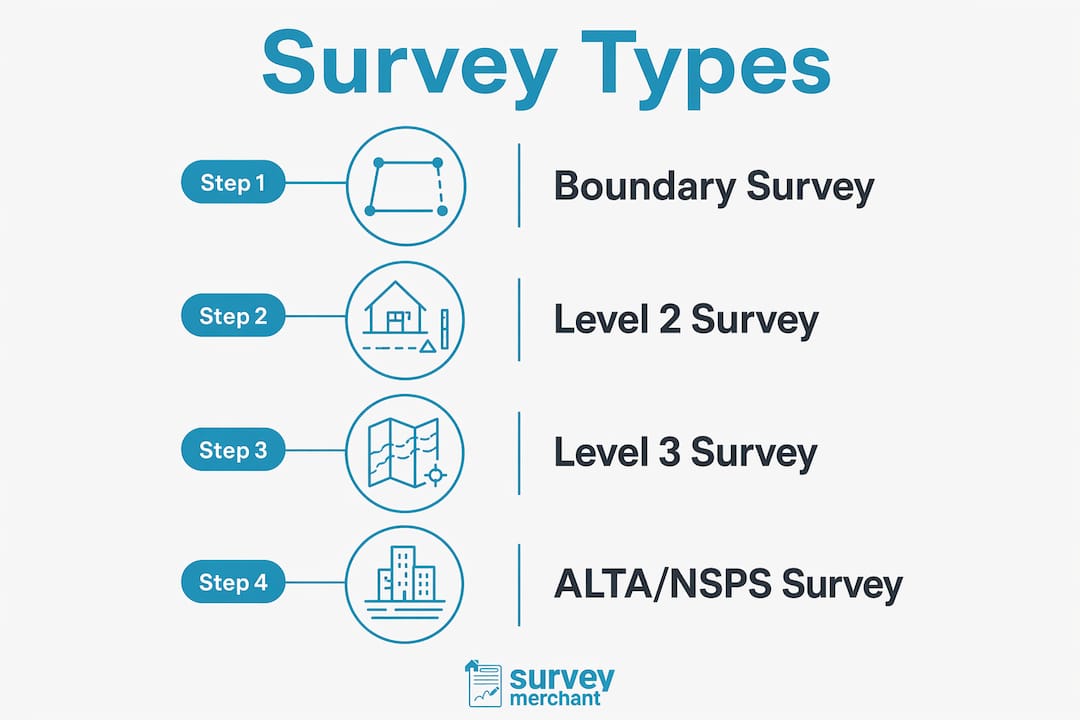
ALTA/NSPS Land Title Surveys are required for commercial real estate transactions involving institutional lenders. These surveys disclose boundary lines, improvements, easements, and encroachments. That level of disclosure is non-negotiable when a lender is underwriting a multi-million-pound commercial acquisition.
Surveyor fees reflect expertise, legal liability, research, and complex calculations, not simply the time spent on site. A fee that looks high often represents significant professional indemnity exposure that protects you as the client.
| Survey Type | Scope | Best For | Typical Cost |
|---|---|---|---|
| Boundary Survey | Legal property limits, deed cross-referencing | Land purchases, dispute resolution | £500–£2,000 |
| RICS Level 2 (HomeBuyer) | Condition rating, visible defects, valuation | Standard residential purchases | £400–£1,000 |
| RICS Level 3 (Full Building) | Structural detail, defects, maintenance advice | Older, complex, or high-value properties | £600–£1,500+ |
| Commercial Building Survey | Full structural, compliance, environmental checks | Commercial investment properties | £1,500–£5,000+ |
| ALTA/NSPS Land Title Survey | Boundaries, easements, encroachments, improvements | Institutional commercial transactions | £2,000–£5,000+ |
For investments over £1 million, RICS Level 3 commercial building surveys are widely recommended to mitigate latent defects risk. A latent defect is one that is not visible during a standard inspection. Discovering it after completion can cost far more than the survey itself.
Understanding the difference between Level 2 and Level 3 surveys is the single most useful decision you can make before instructing a surveyor on an investment property.
Pro Tip: For any property built before 1930 or with an unusual construction type, commission a Level 3 survey regardless of the purchase price. Older properties carry hidden risks that a Level 2 report is not designed to capture.
Surveyors influence investment returns in three direct ways: they validate the price you pay, they identify costs you have not yet budgeted for, and they give you negotiating power at the point of exchange.
Professional surveys map physical features such as buildings, utilities, and topography, providing the detailed data that supports planning applications, construction permits, and investment risk assessment. Without this mapping, a development appraisal is built on assumptions rather than facts.
Consider a practical example. An investor acquires a Victorian terrace in Birmingham for £320,000. A Level 3 survey reveals defective chimney stacks, failing damp-proof courses, and a partially collapsed rear outrigger roof. The surveyor’s report quantifies remedial costs at £35,000. The investor renegotiates the purchase price down by £28,000 and factors the remaining £7,000 into the refurbishment budget. Without the survey, that £35,000 would have been an unplanned liability discovered after completion.
The benefits of hiring a surveyor for investment extend beyond the transaction itself. Surveyors support rental income estimations by identifying which defects would require immediate remedy under the Homes (Fitness for Human Habitation) Act 2018, directly affecting the timeline to first rental income. They also flag boundary issues that could complicate future sale or remortgage.
Here is where surveyors create negotiating leverage:
Working effectively with a surveyor requires preparation before you instruct, clarity during the process, and discipline in applying the findings afterwards.
Select the right survey type first. Use the RICS framework as your guide. Consult the guide to which survey you need before approaching any surveyor, so you arrive with a clear brief rather than relying on the surveyor to upsell.
Verify credentials before instructing. Investors should verify surveyor credentials such as RICS membership and understand survey report contents before commissioning. RICS membership confirms professional indemnity insurance and adherence to a published code of conduct.
Ask the right questions upfront. Before commissioning, ask: What is included and excluded from the report? Will the surveyor provide a reinstatement cost assessment? Does the fee include a verbal debrief? A verbal debrief is particularly valuable because written reports use condition ratings that require interpretation.
Time the survey correctly. Commission the survey after your offer is accepted but before you instruct your solicitor to exchange contracts. This gives you the maximum window to renegotiate or withdraw without financial penalty.
Use the report as a negotiation document. Do not treat the survey as a pass or fail verdict. Treat it as a costed list of risks. Share the relevant sections with your solicitor and use the surveyor’s cost estimates to support a price reduction request.
Integrate findings into your investment model. Every defect the surveyor identifies is a future capital expenditure. Add those costs to your acquisition model and recalculate your projected yield and return on investment before proceeding.
Investing with a surveyor’s help is most effective when you treat the professional relationship as collaborative rather than transactional. The surveyor knows the property. You know your investment criteria. The best outcomes come from combining both.
The importance of surveyors in investments lies in their ability to convert physical property conditions into financially quantifiable risks that protect your capital at every stage of acquisition.
| Point | Details |
|---|---|
| Surveyors protect capital | Structural and boundary reports prevent costly surprises after contracts are exchanged. |
| Survey type determines value | RICS Level 3 and ALTA surveys provide the depth required for high-value or complex investments. |
| Reports create negotiating power | Documented defect costs give investors evidence to renegotiate purchase prices before exchange. |
| RICS credentials are non-negotiable | Only RICS-accredited surveyors carry professional indemnity cover that protects you legally. |
| Timing the survey correctly matters | Commission after offer acceptance but before exchange to retain maximum flexibility. |
The most persistent misunderstanding I encounter is that a surveyor is simply a box-ticking exercise required by the mortgage lender. Investors who hold that view are the ones who call me six months after completion, having discovered a structural issue that was entirely visible to a trained eye.
I have seen a commercial investor in Manchester proceed without a full building survey on a retail unit because the asking price felt low enough to absorb any issues. The asbestos-containing materials in the ceiling tiles alone cost £22,000 to remove before the unit could be legally occupied. A commercial building survey would have cost £2,500 and flagged the issue before exchange.
The surveyor’s role in property appraisal has also changed with technology. Drone surveys, thermal imaging, and 3D laser scanning now allow surveyors to assess areas that were previously inaccessible without scaffolding. These tools do not replace professional judgement. They extend it. An investor who insists on a surveyor using current inspection technology is getting a materially better risk assessment than one who accepts a visual-only report.
My consistent recommendation is this: treat the survey fee as the cheapest insurance you will ever buy on a property investment. The cost is fixed. The risk it mitigates is open-ended.
— Surveymerchant
Surveymerchant connects property investors and buyers across the UK with RICS-accredited surveyors matched to their specific investment needs. Whether you require a commercial property survey for an institutional acquisition or a Level 3 building survey for a high-value residential investment, Surveymerchant’s panel covers the full range of professional surveying disciplines.

Surveymerchant also provides access to RICS valuation services and specialist defect reporting for investors who need a precise cost liability assessment before committing capital. Every surveyor on the Surveymerchant panel carries professional indemnity cover and RICS accreditation, giving you the legal protection your investment deserves.
A surveyor measures, assesses, and values a property to produce legally binding reports that inform purchase decisions, mortgage applications, and risk management. Their findings directly affect the price paid and the financial viability of the investment.
RICS Level 3 building surveys are the standard recommendation for high-value or complex investment properties. For commercial acquisitions involving institutional lenders, ALTA/NSPS Land Title Surveys are typically required.
Surveyors identify structural defects, boundary issues, and compliance risks that reduce a property’s true market value. Their reports give investors documented evidence to negotiate lower purchase prices or factor remedial costs into their acquisition model.
RICS accreditation confirms that a surveyor carries professional indemnity insurance and adheres to a regulated code of conduct. For investment transactions, this credential is the minimum standard you should accept before commissioning any report.
Commission the survey after your offer is accepted but before your solicitor exchanges contracts. This timing gives you the maximum opportunity to renegotiate the price or withdraw without financial penalty if the report reveals material issues.
Survey Merchant provides vetted RICS surveyors across 100+ UK locations at fixed fees:
→ Level 2 Home Survey (HomeBuyer Report)
→ Level 3 Building Survey (full structural survey)
→ RICS Red Book property valuations
→ Party wall surveyors — notices, awards & schedules of condition
→ Expert witness surveyors — CPR Part 35 reports for property disputes