Building Surveying
Jul 16, 2026
Why property surveys matter: protect your investment
Wondering why property surveys are required? Discover how they protect your investment by uncovering hidden issues before you buy.

Plenty of UK buyers reach exchange of contracts believing their mortgage valuation has done the hard work. It hasn’t. A mortgage valuation tells your lender the property is worth lending against. It tells you almost nothing about whether the roof is failing, the walls are damp, or the foundations are quietly shifting. Every year, thousands of homeowners discover expensive structural problems only after they’ve signed on the dotted line, problems that a proper survey would have flagged weeks earlier. This article explains exactly what property surveys involve, why they genuinely matter, and how they can save you far more than they cost.
| Point | Details |
|---|---|
| Surveys uncover hidden issues | Surveys reveal problems like damp, subsidence, and structural faults that are easy to miss during viewings. |
| Save money and stress | A survey can help you negotiate price or budget for repairs before buying, preventing costly surprises. |
| RICS standards offer clarity | The 2026 RICS updates ensure clearer reports, advanced technology and better protection for buyers. |
| Mortgage valuation is not enough | A lender’s valuation is not a substitute for a full property survey addressing condition and risks. |
| Surveys give you power | Survey findings equip you for negotiation and informed decision-making, not just reassurance. |
A property survey is a professional inspection of a building’s physical condition, carried out by a qualified surveyor. Unlike a mortgage valuation, which is completed for the benefit of your lender, a survey is commissioned by and for you. Understanding what does a surveyor do is a good starting point if you’ve never been through the process.
Surveyors use visual inspections of all accessible areas and apply the RICS (Royal Institution of Chartered Surveyors) traffic light rating system. Condition ratings run from 1 (no repair needed) through 2 (repairs or replacement required but not urgent) to 3 (serious defects requiring immediate attention). This system makes the report readable at a glance, even if you have no construction background.
Surveys identify structural defects, damp, subsidence, and roof issues that simply aren’t visible during a standard viewing. Sellers tidy up; surveyors look behind the surface. Common findings include rising damp in older properties, cracked lintels above windows, flat roof deterioration, and inadequate drainage.
When is a survey required?
The guide for first-time buyers covers the full timeline in detail, but the short answer is: if money is changing hands over a property, a survey belongs in the process.
| Survey level | What it covers | Best suited for | Typical cost |
|---|---|---|---|
| Level 1 (Condition Report) | Basic condition overview, traffic light ratings | Modern, conventionally built homes in good condition | £300–£500 |
| Level 2 (HomeBuyer Report) | Detailed condition ratings, advice on defects, market valuation option | Standard residential properties up to around 30 years old | £400–£900 |
| Level 3 (Building Survey) | In-depth structural analysis, repair recommendations, cost estimates | Older, larger, or unusual properties | £700–£1,500+ |
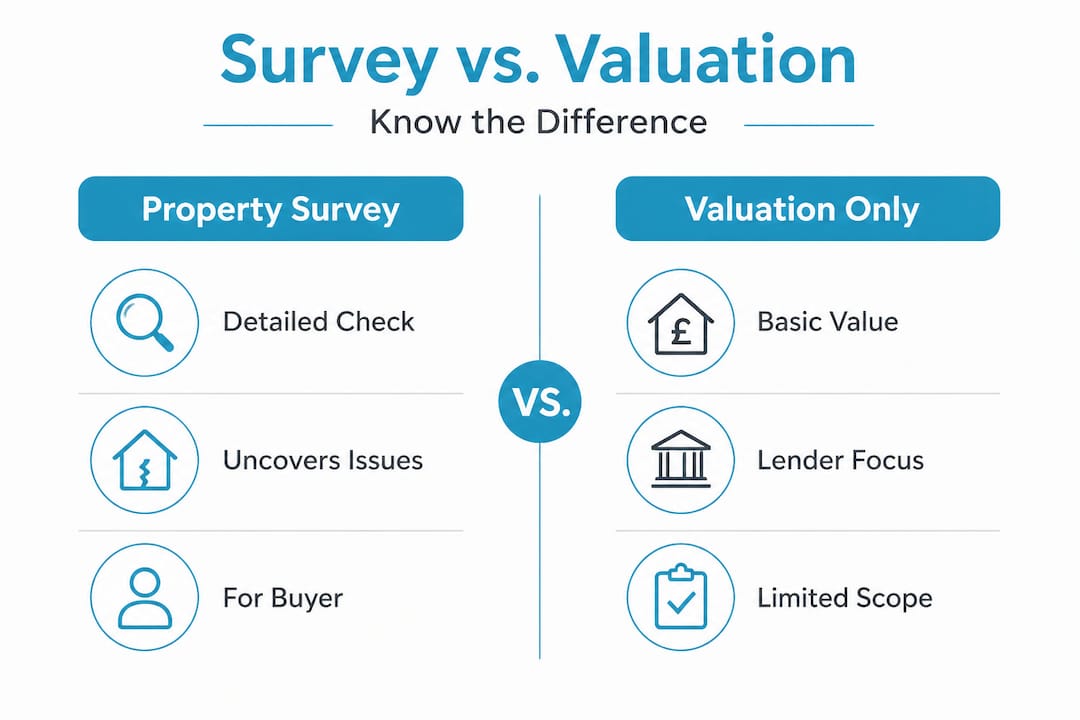
A mortgage valuation is not on this list because it is not a survey. It is a brief visit, sometimes just a desktop exercise, designed to confirm lending security. Buyers who rely on it alone are taking a genuine financial risk.
With the basics covered, let’s dig into why skipping a survey is often a costly mistake, and why they’re more than just a tick-box exercise.
Surveyors are trained to spot things untrained eyes miss entirely. Hairline cracks in a party wall may indicate active movement. Slightly bouncy floorboards can point to wet rot in joists below. Staining on a chimney breast might suggest persistent water ingress that hasn’t yet caused visible mould. None of these will show up in a vendor’s photos or on a Saturday afternoon viewing.
The financial case is compelling. According to RICS survey benefit data, surveys help with price negotiation for 23% of buyers, assist 25% in budgeting for repairs, and prompt specialist investigations for a further 21%. Those aren’t small numbers. Nearly one in four buyers who commission a survey use it to push the purchase price down.
Typical outcomes surveys make possible:
Statistic to note: Survey fees typically run from £300 to £1,500. Subsidence repairs can cost between £10,000 and £50,000. Roof replacements on a standard semi frequently exceed £8,000. One undiscovered defect can wipe out years of survey savings.
The benefits of an RICS surveyor extend beyond simply cataloguing problems. A good report gives you a clear priority list, distinguishing between cosmetic issues and urgent structural matters.
Pro Tip: Don’t assume a near-new property is risk-free. New builds can hide defects including poor brickwork, inadequate insulation, and incomplete drainage connections. Always commission at least a Level 1 report, and consider a snagging survey specifically designed for new constructions.
The emotional costs of skipping a survey also deserve recognition. Discovering a serious defect six months after you’ve moved in, when your savings are already stretched and your mortgage is committed, creates enormous stress. Surveys put you in control of the decision rather than leaving you to discover problems by living with them.
Now that you appreciate the value, it’s crucial to select the right survey. Here’s how the main types compare so you can make an informed choice.
Choosing a survey type comes down to three factors: the property’s age, its construction type, and your risk appetite. A modern flat in a 2015 development is a very different proposition from an Edwardian terrace with original sash windows and a history of extension work.
Level 1 (Condition Report) suits buyers who are confident in the property’s overall state and want a structured, independent confirmation. It uses the traffic light system without detailed commentary, making it quick to read but limited in depth. It’s rarely appropriate for properties over 20 years old or anything with visible signs of wear.
Level 2 (HomeBuyer Report) is the most commonly commissioned survey in England and Wales. It provides condition ratings with explanatory notes, highlights any urgent defects, and may include a reinstatement cost assessment. Level 2 data shows it suits detailed assessment for conventional homes, making it the default recommendation for most standard residential purchases.
Level 3 (Building Survey) goes furthest. It examines the structure in detail, describes the materials used, assesses the severity of any defects, and often includes indicative repair costs. For any property built before 1919, for converted buildings, listed properties, or anything with a complex layout or extended footprint, a Level 3 is the appropriate choice. It is also worth commissioning if you plan significant renovation work and need a baseline condition report.
In Scotland, the seller must provide a Home Report before the property goes on the market. It includes a Single Survey (broadly equivalent to a Level 2), an Energy Report, and a Property Questionnaire. Buyers can request an updated survey if the Home Report is more than 12 weeks old, and are strongly advised to do so.
Optional survey add-ons worth considering in 2026:
The RICS standard updates provide full guidance on how these additions integrate with standard survey reports.
Surveying isn’t standing still. Significant changes have made the process more effective and insightful in recent years, and buyers benefit directly from understanding what’s changed.
The updated 2026 RICS standard clarifies the boundaries between survey levels, integrates drone and thermal imaging technology, introduces an energy and retrofit focus, and creates specific protocols for flooded properties and listed or protected buildings. These changes reflect the reality that housing stock is ageing and climate-related risks are growing.
Key updates in the 2026 RICS Home Survey Standard:
“The revised standard represents a meaningful step forward in making survey reports genuinely useful to buyers, not just professional documents filed and forgotten.” This reflects the broader shift in the profession towards client-centred reporting.
Understanding when surveys are required under these new standards is particularly relevant if you’re buying an older property, purchasing near a flood plain, or dealing with a listed building where permitted development rights are restricted.
Pro Tip: Before booking a surveyor, ask them directly whether they’re working to the 2026 RICS Home Survey Standard and whether they use drone or thermal imaging where relevant. A surveyor still using outdated methods or report formats is a warning sign worth heeding.
While it may be tempting to save money upfront, here’s what skipping a survey can really cost you. The consequences extend beyond an unexpected repair bill.
Worst-case scenarios that surveys typically prevent:
The risks of skipping surveys aren’t just financial. Properties with undisclosed defects are harder to insure, harder to sell, and harder to remortgage. You can find yourself trapped in a property that no longer reflects the price you paid.
It’s also worth remembering what survey data confirms: 23% of buyers negotiated a price reduction after their survey, and 25% used the findings to plan repair budgets before committing. These buyers were protected. Those who skipped the survey had none of that information and none of that leverage.
A mortgage valuation does not fill this gap. It is a lender’s tool, not yours. It checks whether the property secures the loan. It does not tell you whether the property is safe, structurally sound, or worth the purchase price from your perspective. Those are different questions, and only a proper survey answers them.
Consulting property condition guides before you start your property search helps you understand what to look for and what questions to ask, even before a surveyor gets involved.
Most buyers approach a property survey as a protective measure, a way of checking there’s nothing catastrophically wrong. That’s a perfectly reasonable starting point, but it undersells what a survey actually does for you.
Experienced buyers and property investors treat survey reports as negotiation documents first. When a Level 3 report identifies £15,000 worth of required roofing work and timber treatment, that’s not bad news. That’s a structured argument for reducing the agreed price, or for requesting the work is completed before exchange. Vendors who want a clean sale will often negotiate. Those who won’t are often telling you something important about the property’s true condition.
The survey workflow process gives you a clear picture of how to use findings constructively throughout the transaction, not just as a reason to proceed or withdraw.
A good surveyor is genuinely your ally in the transaction. They have no interest in the sale completing. Their job is to tell you the truth about the property. That independence is valuable in a process where estate agents, solicitors, and vendors all have reasons to want the deal to close smoothly and quickly.
The uncomfortable truth is that buying without a survey is not brave or pragmatic. It’s penny wise and pound foolish. Even seasoned property investors, people who understand buildings and markets far better than most first-time buyers, rarely purchase without commissioning a Level 2 or Level 3 report. They’ve seen what skipping a survey can cost. The upfront saving of £500 to £700 is trivial compared to the potential exposure.
What most articles on this subject overlook is the post-purchase application of survey findings. Even if the sale completes without price negotiation, a detailed survey report gives you a prioritised maintenance plan for the first three to five years of ownership. You know which issues are urgent, which can wait, and roughly what each will cost. That kind of visibility is worth paying for regardless of what else the survey reveals.
If you want to put these insights into action, here’s how to get expert help and ensure your next move is protected.
Survey Merchant connects buyers, homeowners, and property professionals with qualified, impartial surveyors across the UK. Whether you need a residential building survey, commercial property surveys for a business premises, or specialist party wall surveyors for planned works, the platform matches you with the right expert for your specific property and circumstances.

Our panel covers building surveying services for properties of all ages and types, as well as RICS valuation services for remortgaging, probate, and matrimonial purposes. All surveyors on the platform are vetted, qualified, and working to the current RICS standards. Getting a quote is straightforward, and you’ll be matched with a local expert who knows your property type and area. Don’t leave your investment to chance.
Property surveys are not legally mandatory in most of the UK, but they are strongly recommended by RICS because a mortgage valuation is insufficient to protect buyers. Scotland is the exception, where sellers must provide a Home Report before marketing.
A mortgage valuation confirms lending security for your lender, while a survey assesses the property’s physical condition for you. Surveys identify structural defects, damp, and other issues that a valuation simply doesn’t examine.
Costs range from around £300 for a basic Condition Report to over £1,500 for a full Building Survey on a large or complex property. Given that post-purchase repair costs can easily exceed the survey fee many times over, it represents strong value for money.
Yes. Even new builds can have defects including poor workmanship, incomplete drainage, and structural issues. Surveys identify problems missed during construction, and a snagging survey specifically tailored to new builds is a sensible investment alongside the developer’s own warranty.
Survey Merchant provides vetted RICS surveyors across 100+ UK locations at fixed fees:
→ Level 2 Home Survey (HomeBuyer Report)
→ Level 3 Building Survey (full structural survey)
→ RICS Red Book property valuations
→ Party wall surveyors — notices, awards & schedules of condition
→ Expert witness surveyors — CPR Part 35 reports for property disputes