Building Surveying
Jul 16, 2026
The role of impartial surveys in property transactions
Discover the role of impartial surveys in property transactions. Get unbiased insights to protect your investment and make informed decisions.

An impartial survey is defined as an independent professional inspection of a property’s condition, carried out by a qualified surveyor who has no financial interest in the transaction’s outcome. The role of impartial surveys is to give buyers, sellers, and homeowners an objective picture of what they are buying, selling, or living in, free from the influence of estate agents, lenders, or vendors. This is fundamentally different from a mortgage valuation, which exists to protect the lender, not you. The Royal Institution of Chartered Surveyors (RICS) sets the professional standards that govern these inspections across the UK, and any surveyor worth instructing will hold RICS membership as a baseline qualification.
RICS categorises residential surveys into three distinct levels, each designed for a different type of property and buyer need. Knowing which level applies to your situation is the first practical decision you face.

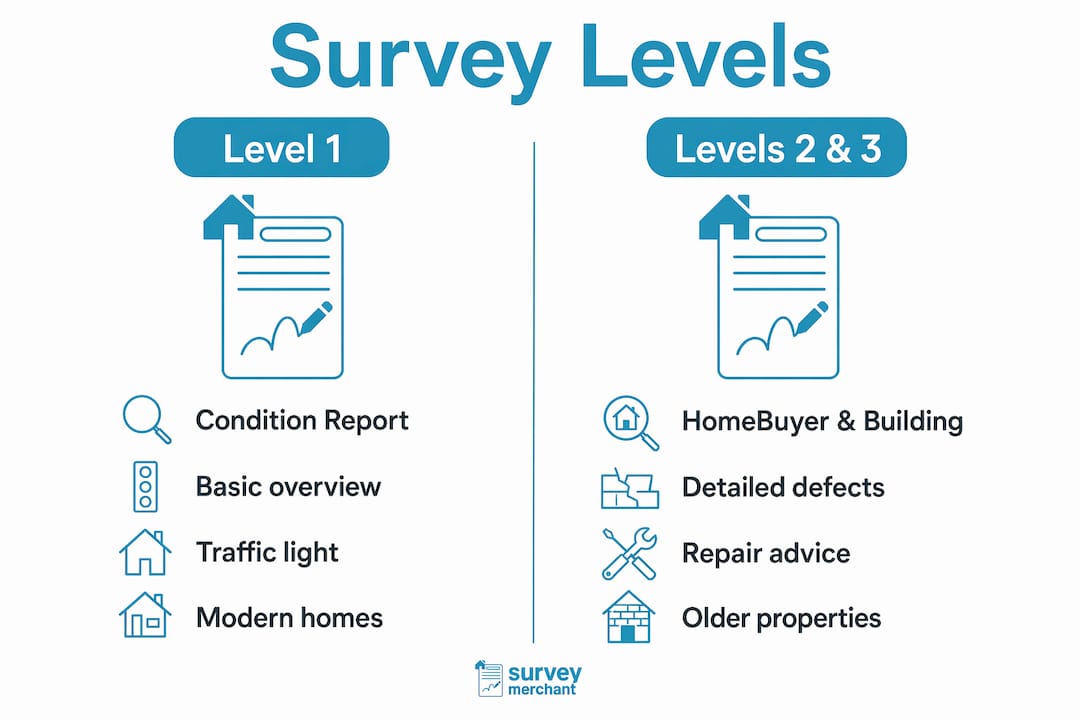
A Level 1 Condition Report is the most basic option. It uses a traffic light rating system to flag the condition of different parts of the property and suits modern homes in good condition where no major concerns are expected. It does not include repair advice or a valuation.
A Level 2 Home Survey is the most commonly recommended option for standard residential properties. It identifies defects, provides repair advice, and can include an optional market valuation. This level balances cost against detail and works well for properties built after 1930 that have not been significantly altered.
A Level 3 Building Survey is the most thorough option available. RICS recommends it for properties built before 1930, those with major alterations, or any home where structural concerns exist. It provides a full analysis of construction, materials, and defects, including advice on repair methods and likely costs.
The table below summarises the key differences:
| Survey level | Best suited for | Defect detail | Repair advice | Valuation option |
|---|---|---|---|---|
| Level 1 Condition Report | Modern, good-condition homes | Basic traffic light ratings | No | No |
| Level 2 HomeBuyer Report | Standard post-1930 properties | Moderate detail | Yes | Optional |
| Level 3 Building Survey | Pre-1930, complex, or altered homes | Full structural analysis | Yes | Optional |
Choosing the wrong level is a common and costly mistake. A buyer who commissions a Level 1 report on a Victorian terrace may receive a clean bill of health on paper, only to discover dry rot in the roof timbers after completion. Matching the survey level to the property type is not optional; it is the foundation of sound due diligence.
Pro Tip: If you are unsure which level to choose, read the differences between Level 2 and Level 3 surveys before instructing a surveyor. The cost difference between levels is small compared to the cost of missing a serious defect.
The benefits of impartial surveys extend well beyond satisfying a lender’s requirements. For buyers, sellers, and homeowners alike, an unbiased inspection changes the financial and legal dynamics of a transaction in concrete ways.
For sellers, commissioning a survey before listing a property is an underused tactic. A pre-sale survey removes uncertainty from negotiations and signals transparency to buyers, which can accelerate the sale process.
Pro Tip: Skipping a survey is a false economy. Under English property law, the principle of ‘buyer beware’ applies, meaning sellers have no obligation to disclose hidden defects. The cost of a survey is a fraction of the cost of a structural repair you did not know you were buying.
Survey outcomes shape decisions at every stage of a property transaction, from the initial offer through to exchange of contracts. Understanding this influence helps you use a survey report as the practical tool it is, rather than treating it as a formality.
Adjusting or withdrawing an offer. Buyers review survey findings before exchange of contracts. If the report reveals significant defects, you can reduce your offer to reflect the cost of repairs, or withdraw entirely if the issues are too serious. This is one of the clearest examples of how surveys influence decisions in real transactions.
Budget planning for repairs and maintenance. A Level 3 Building Survey does not just identify defects; it estimates repair costs and prioritises them by urgency. That information feeds directly into your financial planning for the first years of ownership.
Impact on mortgage lending. Lenders sometimes instruct their own valuers after a buyer’s survey reveals significant issues. A survey that flags structural movement or subsidence can prompt a lender to reduce the loan amount or attach conditions to the mortgage offer. Knowing this in advance gives you time to reassess your financing.
Insurance implications. Insurers ask about known defects when you apply for buildings insurance. A survey report creates a documented record of the property’s condition at the point of purchase. That record protects you if a dispute arises later about whether a defect was pre-existing.
Pro Tip: Ask your surveyor to walk you through the report findings in person or by phone. Written reports use condition ratings and technical language that can be misread. A ten-minute conversation often clarifies which defects are urgent and which are routine maintenance.
Knowing which property survey you need before you make an offer puts you in a stronger position from the outset. Buyers who commission surveys early, rather than at the last minute before exchange, have more time to act on the findings.
Several persistent misunderstandings cause buyers to undervalue or misuse surveys. Each one carries a real financial risk.
Understanding these distinctions changes how you approach a purchase. A survey is not a guarantee. It is the best available evidence about a property’s condition at the time of inspection, and that evidence is far better than none.
Impartial surveys, conducted by RICS-qualified professionals, are the most reliable tool buyers have for assessing property condition and protecting their financial interests before exchange of contracts.
| Point | Details |
|---|---|
| RICS survey levels | Choose Level 1, 2, or 3 based on property age, type, and complexity. |
| Mortgage valuations are not surveys | A lender’s valuation protects the bank, not you; always commission a separate survey. |
| Negotiation power | Survey findings give you documented evidence to renegotiate price or request repairs. |
| Survey limitations | Surveyors inspect only visible areas; hidden defects behind walls may not be reported. |
| ‘Buyer beware’ applies | Sellers have no legal duty to disclose defects; a survey is your primary protection. |
The most common regret I hear from buyers is not that they commissioned a survey. It is that they chose the wrong level, or that they read the report without fully understanding what the condition ratings meant.
A Level 2 report on a 1920s semi-detached property is not the same as a Level 3 Building Survey. The difference is not just price. It is the depth of investigation, the analysis of construction methods, and the specificity of repair advice. Buyers who choose the cheaper option on an older property often do so because they assume the property “looks fine.” Structural issues rarely look like anything from the outside.
The other pattern I see repeatedly is buyers treating the survey as a box-ticking exercise rather than a decision-making tool. A report that flags Category 3 defects (requiring urgent attention) is not a reason to panic. It is a reason to get repair quotes, go back to the seller, and make an informed decision. That is exactly what the survey is for.
My recommendation is straightforward. Instruct a RICS-qualified surveyor before you exchange contracts, not after. Choose the survey level that matches the property, not the one that fits your budget. And read the report with the surveyor, not alone at midnight before exchange day.
— N
Surveymerchant operates as a specialist platform connecting property buyers, sellers, and homeowners with RICS-qualified surveyors across the UK. Every surveyor on the Surveymerchant panel is independent, meaning their assessment is not influenced by estate agents, lenders, or vendors.

Whether you need a Level 2 HomeBuyer Report for a standard purchase or a full Level 3 Building Survey for an older or complex property, Surveymerchant matches you with the right professional for your specific situation. The platform also covers commercial property surveys for buyers and owners outside the residential market. Getting an impartial assessment before you commit is the single most effective step you can take to protect your investment.
An impartial property survey is an independent inspection carried out by a RICS-qualified surveyor who has no financial interest in the transaction. It assesses the visible condition of the property and reports findings objectively to the buyer or homeowner.
No. A mortgage valuation is carried out for the lender’s benefit and may not involve a physical visit. It does not provide the detailed condition analysis that a Level 2 or Level 3 survey delivers.
Level 1 suits modern homes in good condition. Level 2 suits standard properties built after 1930. Level 3 is recommended for properties built before 1930, those with significant alterations, or any home where structural concerns exist.
Yes. Survey findings are factual evidence you can use to renegotiate the purchase price or ask the seller to carry out repairs before completion. Buyers review survey reports before exchange of contracts specifically for this purpose.
No. Surveyors inspect only visible and accessible areas and do not open walls or lift floor coverings. Hidden defects may remain undisclosed, which is why the survey report always includes a limitation notice on this point.
Survey Merchant provides vetted RICS surveyors across 100+ UK locations at fixed fees:
→ Level 2 Home Survey (HomeBuyer Report)
→ Level 3 Building Survey (full structural survey)
→ RICS Red Book property valuations
→ Party wall surveyors — notices, awards & schedules of condition
→ Expert witness surveyors — CPR Part 35 reports for property disputes