Building Surveying
Aug 9, 2026
Building survey options 2026: which level do you need?
Explore building survey options 2026 to find the right choice for your property. Discover costs and expert insights for informed decisions.

For most standard UK purchases, a RICS Level 2 HomeBuyer Report is the right call. If the property is pre-1930, listed, has had significant alterations, or shows visible defects, go straight to a Level 3 Building Survey. New builds in excellent condition with a warranty are the one scenario where a Level 1 Condition Report may suffice.
Quick 2026 cost reference:
For a typical property purchase, budget roughly £700–£1,000 for an appropriate survey package including any likely specialist follow-ups. These figures reflect 2026 market conditions across the UK.
Two things to do before you book: confirm the surveyor holds RICS membership via the official Find a Member tool, and use a platform like Surveymerchant to match with verified local surveyors rather than picking blindly from a search result.
Common scenarios at a glance:
The RICS Home Survey Standard sets out three distinct levels of residential survey. Each one is a different product with a different scope, not simply a “basic, standard, premium” version of the same thing.
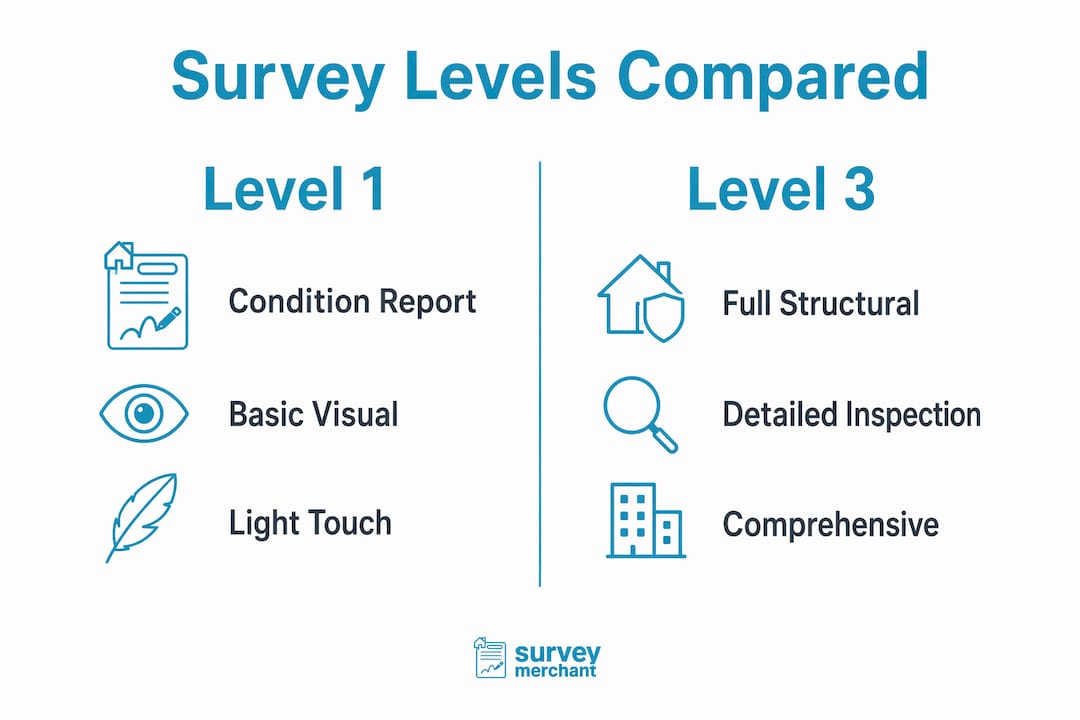
The lightest-touch option. A Level 1 gives you a visual inspection and a traffic-light rating system showing which parts of the property need attention. It does not include repair advice, a valuation, or any testing of the building fabric or services. Think of it as a health-check snapshot rather than a diagnosis.
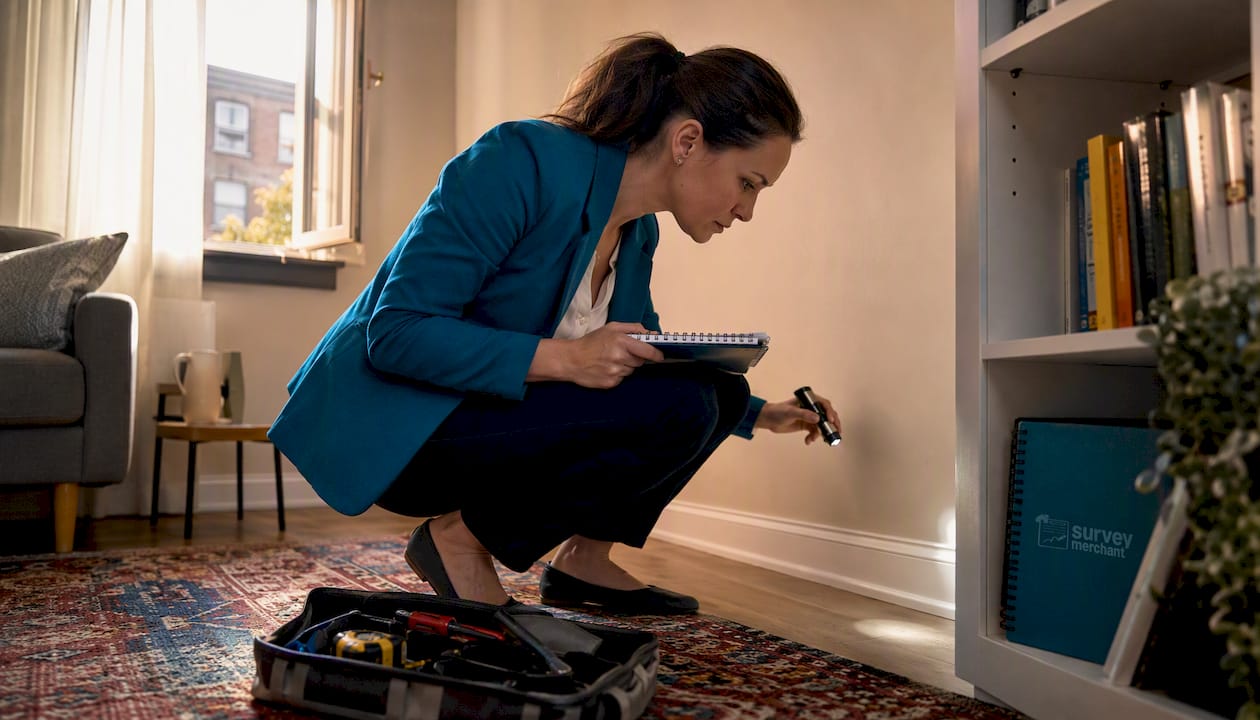
Suitable for: conventional houses, flats, or bungalows built from standard materials and in good condition. New builds with a developer warranty are the clearest use case.
The most widely commissioned survey in the UK. A Level 2 covers a more thorough visual inspection of the building, its services, and the grounds. The surveyor will access roof spaces, basements, and cellars where it is safe to do so, and the report describes the condition of each element with an assessment of how serious any defects are.
You can commission a Level 2 as survey-only, or as survey with valuation. The valuation add-on gives you the surveyor’s professional opinion on market value and an insurance reinstatement figure — useful if you want one document covering both condition and price. The RICS guidance is clear that this level suits conventional properties built from common materials and in reasonable condition.
The most detailed option. A Level 3 involves a thorough inspection of the structure and fabric of the property, including observation of services in normal operation where the occupier permits. The report describes how the property is built, what materials are used, identifies visible and potential hidden defects, proposes likely causes, outlines remedial options, and explains the consequences of not acting. Where agreed in advance, the surveyor can also provide repair cost estimates.

Suitable for: large, older, or run-down properties; unusual or altered buildings; listed structures; anything pre-1930; and any purchase where you are planning major works. A Level 3 Building Survey typically runs to a substantially longer report than a Level 2.
| Feature | Level 1 | Level 2 (survey only) | Level 2 (with valuation) | Level 3 |
|---|---|---|---|---|
| Visual inspection depth | Basic | Intermediate | Intermediate | Detailed |
| Traffic-light condition ratings | Yes | Yes | Yes | Yes |
| Repair advice | No | Limited | Limited | Full |
| Maintenance schedule | No | No | No | Yes |
| Valuation included | No | No | Yes | Optional (if agreed) |
| Insurance reinstatement figure | No | No | Yes | Optional |
| Identifies hidden defect risks | No | Partial | Partial | Yes |
| Repair cost estimates | No | No | No | Yes (if agreed) |
| Typical report length | Short | Medium length | Medium length | Long detailed report |
Costs vary by property size, age, location, and the surveyor’s experience. The table below shows typical 2026 UK price bands for each level.
| Survey level | Typical UK range | London / high-value premium |
|---|---|---|
| Level 1 (Condition Report) | £300–£900 | Up to £900 in London/high-value areas |
| Level 2 (HomeBuyer Report) | £400–£1,000 | Up to £1,000 in London/high-value areas |
| Level 3 (Building Survey) | £600–£1,500+ | Can exceed £1,500 for large or high-value properties, especially in London |
Property value and size are the two biggest drivers. Surveyors typically scale fees against purchase price, so a £600,000 detached house will cost more to survey than a £200,000 flat even at the same level. Age matters because older properties take longer to inspect and require more detailed reporting. Location affects pricing too: London and the South East consistently sit at the top of the range, while the Midlands and North tend to come in lower.
Urgency may add a premium if you need a report within a few days. Add-on valuations on a Level 2 survey generally increase the base fee by some amount.
A Level 2 or Level 3 report often flags concerns that need a specialist to investigate further. Common add-on surveys and their typical 2026 cost ranges:
| Specialist survey | Typical cost range |
|---|---|
| Damp & timber investigation | £150–£500 |
| Electrical Installation Condition Report (EICR) | £150–£400 |
| CCTV drain survey | £100–£350 |
| Structural engineer report | £500–£1,500 |
These are separate commissions, not included in the RICS survey fee. Budget for at least one if the main report raises concerns.
The right level depends on what you are buying, not just what you want to spend. Work through this checklist before you book.
Special cases: conversions (barn, office, church) almost always warrant a Level 3. A property that looks fine on a viewing but has had a damp-proof course injection, recent replastering, or fresh paint throughout deserves extra scrutiny — these can be signs of cosmetic concealment.
Pro Tip: If you are hesitating between Level 2 and Level 3, paying extra for a Level 3 survey is often justified on properties over 50 years old. A single costed recommendation in the report — say, a roof structure that needs £8,000 of work — can repay the upgrade fee many times over in negotiation leverage alone.*
A RICS surveyor works through the property systematically: external walls, roof covering and chimneys, windows and doors, gutters and downpipes, then internally through each room covering ceilings, walls, floors, and built-in joinery. The loft space is inspected where safely accessible, as are basements and cellars. Services (gas, electricity, plumbing, heating) are observed in normal operation but are not tested.
What the surveyor will not do is equally important to understand.
RICS Level 2 and Level 3 surveys are non-intrusive by default. The surveyor will not lift floorboards, remove plasterwork, open up walls, or disturb finishes. If a concealed defect exists behind a tiled bathroom wall or beneath a concrete screed floor, it will not be found unless the surveyor has specific reason to suspect it and recommends a targeted intrusive investigation.
This is not a limitation unique to any one surveyor — it is the defined scope of the RICS Home Survey Standard. The practical consequence is that a survey gives you the best available picture from a visual inspection, not a guarantee that no defects exist.
Do surveyors check every room? Yes, all rooms that are accessible and safe to enter are inspected. Rooms that are locked, blocked by furniture, or unsafe to enter will be noted as uninspected in the report.
When the report flags a concern, the right response is to commission a specialist intrusive test before exchange. A pre-purchase damp survey from a specialist contractor, for example, can confirm whether a damp reading is rising damp, condensation, or a plumbing leak — three very different repair bills. Similarly, a CCTV drain survey will reveal root ingress or collapsed sections that no visual inspection can detect.
Understanding the boundary between what a RICS survey covers and what a specialist covers is one of the most practical things a buyer can know before exchange.
This distinction matters more than most buyers realise. A lender’s mortgage valuation is commissioned by the bank or building society to protect their security interest in the property. It answers one question: is this property worth at least the amount we are lending? It is not designed to tell you what condition the property is in.
The differences in practice:
The practical risk of relying on a valuation alone is real. A property can pass a lender’s valuation and still have a failing roof, active damp, or structural movement that will cost tens of thousands of pounds to address. Buyers who rely only on valuations risk missing defects that affect both the price they should pay and the safety of the building.
The RICS guidance puts it plainly: your mortgage lender’s valuation report is not a survey. An independent survey tells you the actual condition of the property — information that is genuinely useful during price negotiations and that helps you avoid expensive surprises after you have moved in.
Finding the right surveyor takes about 20 minutes if you know what to check. Cutting corners here is where buyers create problems for themselves.
Getting two or three fixed-fee quotes is sensible practice. The cheapest quote is not always the worst, but a quote that is significantly below the market range for the property type deserves a direct question about what has been left out.
Pro Tip: Surveymerchant’s matching service connects buyers with RICS surveyors near you who have been verified for credentials and local experience — useful if you want to skip the cold-search process and get to a shortlist faster.
The difference between a specialist contractor survey and an RICS-regulated survey is also worth understanding before you book: a specialist (damp surveyor, structural engineer) investigates a specific concern in depth, while the RICS surveyor gives you the whole-property picture.
Receiving a thick Level 3 report can feel daunting. The key is to work through it systematically rather than react to the headline defect list.
The benefits of commissioning a building survey extend well beyond the inspection day itself. The report is a working document for the entire purchase process.
Verification is a five-minute task that most buyers skip. It should not be optional.
Step 1: Go to the RICS website and use the Find a Member search. Enter the surveyor’s name and firm. Confirm their membership is current and that they are registered for residential surveying work.
Step 2: Ask for a sample report from a comparable property. A good surveyor will provide one without hesitation. A reluctant response is informative.
Step 3: Confirm PI insurance limits in writing. For a £500,000 purchase, you want cover that reflects the potential cost of a missed major defect.
Step 4: For specialist properties, ask about conservation accreditation, historic building experience, or any relevant CPD the surveyor has completed in the past two years.
On timing: a Level 1 survey typically takes 1–2 hours on site with a short report turnaround. A Level 2 takes 2–3 hours on site with a report delivered within 5–10 working days. A Level 3 takes 3–6 hours on site (longer for larger properties) with a report typically delivered within 10–14 working days. Build these timelines into your purchase programme — a delayed survey can push back exchange.
The RICS Home Survey Standard exists precisely to set minimum expectations for what a surveyor must deliver. When you verify RICS membership, you are confirming the surveyor is bound by that standard and subject to RICS disciplinary procedures if they fall short.
A costed recommendation in a Level 3 report is one of the most underused tools in a buyer’s negotiation. RICS-qualified surveyors emphasise that the report’s value lies not just in the defect list but in the actionable, costed recommendations that give buyers a factual basis for renegotiation. On a £400,000 purchase, a well-used survey report can easily recover its fee several times over.
For most UK buyers in 2026, the single most important step before exchange is commissioning the right RICS survey level for the property type, then using the costed findings to negotiate.
| Point | Details |
|---|---|
| Match level to property type | Level 2 for conventional 1930–2010 properties; Level 3 for pre-1930, altered, listed, or unusual builds. |
| Budget realistically for 2026 | Level 1 typically £300–£900; Level 2 £400–£1,000; Level 3 £600–£1,500+; allow extra for specialist follow-ups. |
| Verify RICS membership | Use RICS Find a Member and confirm professional indemnity insurance before booking any surveyor. |
| Surveys are non-intrusive | Hidden defects behind walls or under floors will not be found; commission specialist tests if the report flags concerns. |
| Surveymerchant for verified matching | Use Surveymerchant to find and book RICS-qualified surveyors matched to your property type and location. |
The pattern that comes up most often is buyers treating the mortgage valuation as a proxy for a survey. It is not. A valuation tells the lender the property is worth lending against. It tells you almost nothing about what you are actually buying.
The second most common mistake is choosing the wrong survey level to save a few hundred pounds. A buyer who commissions a Level 2 on a 1920s terrace with a recently replastered ground floor, then discovers active rising damp and failing lath-and-plaster ceilings after moving in, has not saved money. They have deferred a much larger problem.
What actually works is straightforward: match the survey level to the property’s age and complexity, verify the surveyor’s credentials before booking, and treat the report as a negotiating document, not just a list of things to worry about. A costed Level 3 report on a period property can often be used to negotiate a significant price reduction or to have the seller carry out repairs before completion.
The buyers who get the best outcomes are not the ones who spend the least on surveys. They are the ones who use the survey findings actively. That means reading the report the same day it arrives, getting contractor quotes within a week, and going back to the seller with specific figures rather than vague concerns.
Surveymerchant’s matching approach is built around exactly this: connecting buyers with local RICS surveyors who know the property types in their area, produce detailed costed reports, and are available to talk through findings. The hiring checklist earlier in this article covers what to ask before you book.
Surveymerchant connects UK property buyers directly with RICS-qualified surveyors across the country, matched to your property type, location, and survey level. Every surveyor on the panel has been verified for current RICS membership and professional indemnity insurance. You pay the surveyor directly for their services; Surveymerchant’s role is to make the matching process faster and more reliable than a cold search.
Whether you need a Level 2 HomeBuyer Report on a standard purchase or a full Level 3 Building Survey on a period property, the platform gives you access to surveyors with relevant local experience. For buyers who also need a formal RICS valuation, valuation services are available through the same panel.
Get your survey matched and booked at surveymerchant.com/services/building-surveying.
The following sources were used in preparing this guide and are worth bookmarking for your own verification.
Survey Merchant provides vetted RICS surveyors across 100+ UK locations at fixed fees:
→ Level 2 Home Survey (HomeBuyer Report)
→ Level 3 Building Survey (full structural survey)
→ RICS Red Book property valuations
→ Party wall surveyors — notices, awards & schedules of condition
→ Expert witness surveyors — CPR Part 35 reports for property disputes