We use cookies to improve your experience on our site, analyze site traffic, and assist in our marketing efforts. By clicking "Accept all," you agree to the storing of cookies on your device. You can choose to "Reject all" non-essential cookies. For more information, please read our Cookie Policy.
Retrospective Planning Permission: 2026 UK Guide & Costs
Retrospective planning permission in 2026: what it is under section 73A, the 4-year and 10-year rules, fees from 1 April 2026, refusal and enforcement risks, and how an accredited surveyor helps.
Retrospective planning permission is the route you take when building work or a change of use has already happened without the consent it needed. Perhaps a builder assured you the extension was permitted development, perhaps you bought a house with an undocumented loft conversion, or perhaps the council has written to you. Whatever the trigger, the rules in England changed significantly in April 2024 and planning fees rose again on 1 April 2026, so this 2026 guide explains exactly how retrospective planning permission works, what it costs, the risks if it is refused, and how a suitably qualified, accredited surveyor can strengthen your application.
Key takeaways
Retrospective planning permission is a normal planning application made under section 73A of the Town and Country Planning Act 1990 for work already carried out; the council judges it on its planning merits as if it had not yet been built.
The fee is the same as an ordinary application: from 1 April 2026 that is £548 for a householder extension and £272 for outbuildings, fences and walls in England, after a 3.8% uplift.
Since 25 April 2024 councils have ten years to take enforcement action against most unauthorised building work; the old four-year rule survives only for work substantially completed before that date.
You get one chance to regularise a breach: if a retrospective application is refused and an enforcement notice follows within two years, you cannot argue the planning merits again on appeal.
Refusal can lead to an enforcement notice requiring demolition or reinstatement, and ignoring a notice is a criminal offence.
Accurate as-built drawings, a clear planning statement and, where relevant, a structural or condition report from an accredited surveyor give an application the best chance of approval.
What is retrospective planning permission?
Retrospective planning permission is planning permission granted for development that has already been carried out without consent. You apply under section 73A of the Town and Country Planning Act 1990, pay the standard fee, and the council assesses the completed work against current planning policy exactly as it would a new proposal. Approval regularises the breach; refusal can lead to enforcement.
A completed extension that exceeded permitted development limits is one of the most common reasons homeowners need retrospective planning permission.
The Planning Portal makes two points that catch people out. First, a council may invite you to apply, but that is not a promise that permission will be granted. Second, if the application is refused, the council can issue an enforcement notice requiring you to put things back as they were. Retrospective permission is therefore a genuine test of whether the work is acceptable, not a paperwork exercise.
When do you need retrospective planning permission?
You need it whenever development that required planning permission has been carried out without it and the time limit for enforcement has not yet expired. Typical examples include:
A rear or side extension that is deeper, taller or closer to the boundary than permitted development rights allow.
A loft conversion with a dormer that exceeds the volume allowance or faces the highway.
An outbuilding, garden room or annexe used as separate living accommodation.
Changing the use of a building, for example converting a house into flats or an HMO where an Article 4 direction applies.
Work in a conservation area or on Article 4 land where permitted development rights have been withdrawn.
Building something different from what the approved drawings showed, or breaching a planning condition.
Two situations are often confused with retrospective permission. If the work is lawful because it fell within permitted development, or because the enforcement time limit has passed, you do not need planning permission at all and should apply instead for a lawful development certificate. And if the problem is missing building control sign-off rather than planning consent, the remedy is a regularisation application for a building regulations completion certificate; planning permission never cures a building regulations breach.
How long do councils have to take enforcement action in 2026?
The time limits decide whether a retrospective application is necessary at all. The Levelling-up and Regeneration Act 2023 replaced the long-standing four-year rule with a single ten-year period, and the change took effect on 25 April 2024. The government’s planning enforcement guidance on GOV.UK sets out the current position, which depends on when the work was finished:
Type of breach
Substantially completed or began
Time limit for enforcement
Building operations (extensions, dormers, outbuildings)
Before 25 April 2024
4 years from substantial completion
Building operations
On or after 25 April 2024
10 years from substantial completion
Change of use to a single dwellinghouse
Before 25 April 2024
4 years
Change of use to a single dwellinghouse
On or after 25 April 2024
10 years
Any other change of use or breach of condition
Any date
10 years
In practice, an extension finished in early 2022 is already immune from enforcement and can be certified as lawful, whereas an identical extension finished in the summer of 2024 remains exposed until 2034. Dating substantial completion accurately is therefore the first job in any case, and a surveyor’s inspection of materials, weathering and construction details is often the decisive evidence.
How do you apply for retrospective planning permission?
The process mirrors an ordinary application. The main difference is that you are describing what exists rather than what you propose, and you tick the box on the form confirming that the work has already been carried out.
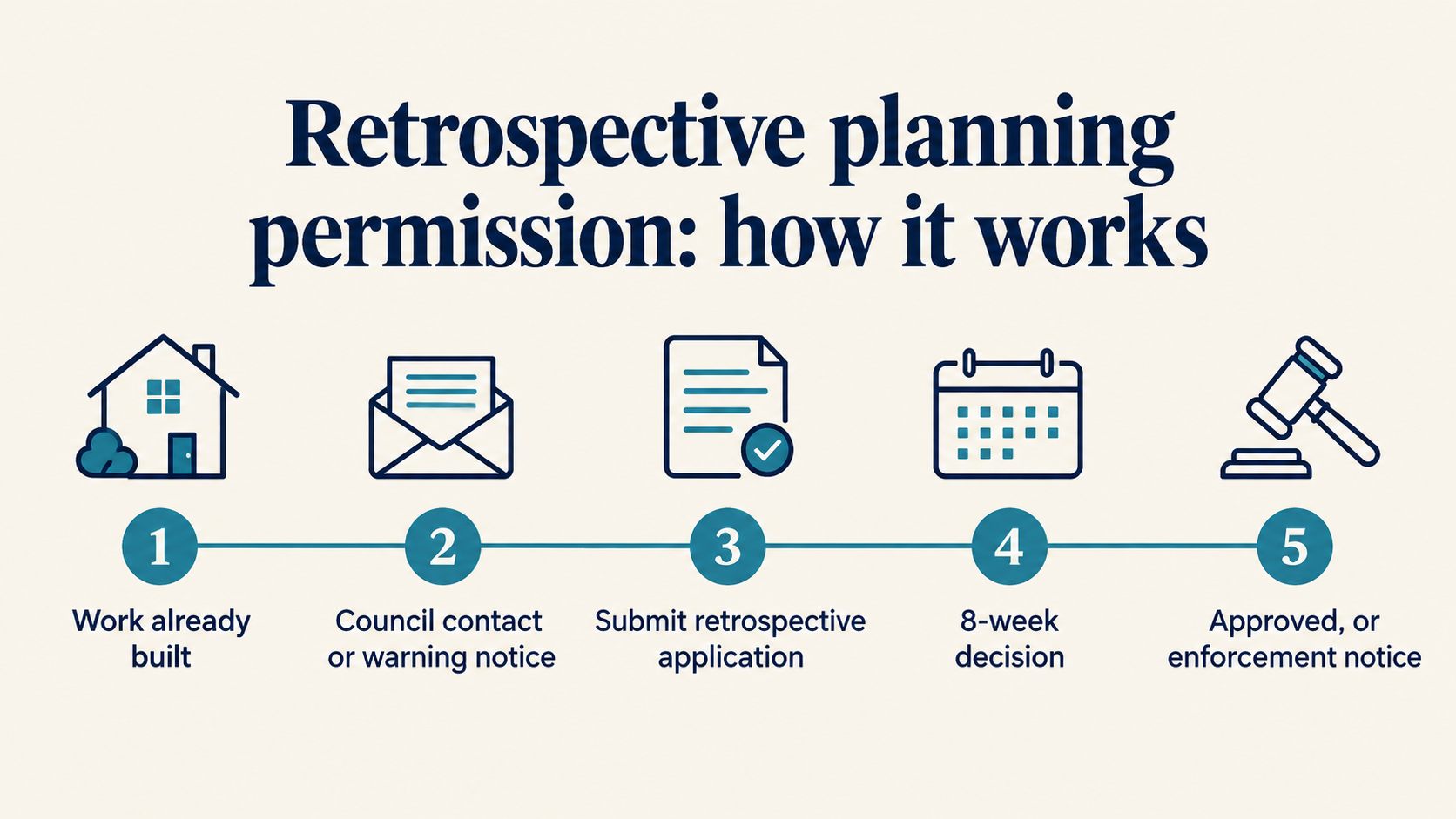
The five stages of a retrospective planning application, from completed work to a decision.
Step 1: establish the facts. Confirm what was built, when it was substantially completed, whether any of it was permitted development, and whether an Article 4 direction, conservation area or listed status applies. Check our guide to pre-application advice versus a full application if you are unsure whether to sound out the council first.
Step 2: commission as-built drawings. Scaled existing plans, elevations and sections, plus a site location plan with the boundary outlined in red and a block plan. Councils validate against a local checklist and reject drawings that are inaccurate or unscaled.
Step 3: prepare a planning statement. Explain how the development complies with the local plan and the National Planning Policy Framework, address neighbour amenity, design and parking, and propose mitigation such as obscure glazing or landscaping where it helps.
Step 4: submit and pay. Apply through the Planning Portal or directly to the council. The determination period is eight weeks for householder and minor applications and thirteen weeks for major schemes, running from validation.
Step 5: consultation and decision. Neighbours are notified and can comment. The officer may visit. Permission may be granted, granted with conditions, or refused.
Retrospective permission is decided on the same policies as any other application, so the fact that the work exists carries no weight either way. Councils are specifically told not to treat an invitation to apply as a promise of approval.
How much does retrospective planning permission cost in 2026?
There is no penalty fee. The application fee is the same as if you had applied before starting work. English fees rose by 3.8% on 1 April 2026 in line with the September 2025 CPI figure, as announced by the Planning Portal on 30 January 2026. The Planning Portal’s fee schedule for England from 1 April 2026 gives the figures below.
Application type (England, from 1 April 2026)
Fee
Typical determination period
Householder: extension or alteration to a single house
£548
8 weeks
Householder: outbuilding, garden room, gates, fences or walls
£272
8 weeks
Alterations to two or more houses or flats
£1,083
8 weeks
Change of use of a building to one or more dwellings
£610 per dwelling (fewer than 10)
8 weeks
Other change of use of a building or land
£610
8 weeks
Removal or variation of a condition (householder)
£89
8 weeks
Lawful development certificate for existing works (alternative route)
Same as the full application fee
8 weeks
Budget separately for professional drawings, a planning statement and any specialist reports. Those typically cost more than the council fee, but they are also what determines the outcome. One further cost applies in Community Infrastructure Levy charging areas: GOV.UK guidance confirms that a retrospective permission is not eligible for CIL relief or exemptions other than the minor development exemption, so a self-build or residential extension that would ordinarily have been exempt may become liable.
What happens if retrospective planning permission is refused?
A refusal does not by itself require you to remove anything. The council must decide whether it is expedient to take enforcement action, and it may negotiate changes instead. If it does act, the usual tool is an enforcement notice, which specifies the breach, the steps required to remedy it, and a compliance period. Failing to comply with an enforcement notice once it takes effect is a criminal offence that can result in prosecution and an unlimited fine, and the council can carry out the works itself and recover the cost.
The appeal position changed in April 2024 and is now stricter. Under the enforcement guidance on GOV.UK, a person who has undertaken unauthorised development has only one opportunity to obtain planning permission after the event. Where an enforcement notice is issued on or after 25 April 2024, after a related retrospective application was made, and within two years of that application ceasing to be under consideration, you cannot appeal the notice on ground (a), the ground that permission ought to be granted. You can still appeal a refused retrospective application to the Planning Inspectorate in the normal way, so the practical lesson is to make the application count and to lodge any appeal promptly. The council can also decline to determine a retrospective application altogether if an enforcement notice has already been issued.
What is an enforcement warning notice?
Since 25 April 2024 councils in England can issue an enforcement warning notice under section 172ZA of the Act. It is a formal invitation to submit a retrospective application where the council thinks there is a reasonable prospect of permission being granted, and it sets a deadline. There is no right of appeal against the notice itself, and issuing it counts as taking enforcement action, which stops the immunity clock. If you receive one, treat it as an opportunity: a well-prepared application within the deadline is usually far cheaper than the alternative.
Accurate as-built drawings and a site plan are mandatory for every retrospective application.
Retrospective planning permission vs a lawful development certificate
Choosing the wrong route wastes the fee and can weaken your position. The comparison below shows the difference.
Route
Use it when
Council’s test
Neighbours consulted?
Retrospective planning permission (s.73A)
The work needed permission and the enforcement time limit has not expired
Planning merits against local and national policy
Yes
Lawful development certificate (s.191)
The work was permitted development, or the time limit has passed
Law and evidence only, on the balance of probability
No
Section 73 or non-material amendment
Permission exists but what was built differs from the drawings
Whether the variation is acceptable
Depends on scale
Selling or buying a home with unauthorised work
Unconsented alterations surface constantly in conveyancing. Sellers must answer questions about building work and consents, and a Level 3 building survey will flag any extension, dormer or outbuilding that appears to lack approval. Buyers then choose between negotiating a price reduction, taking out indemnity insurance, or insisting the seller regularises the position. Indemnity policies are invalidated if anyone contacts the council, so they are a stop-gap; for work completed after 25 April 2024 that cannot yet be immune, a retrospective application before marketing is usually the cleaner solution and supports the asking price.
Planning enforcement in 2026: what has changed?
Two developments this year matter for anyone weighing up a retrospective application. First, the 3.8% fee uplift on 1 April 2026 confirmed by the Planning Portal means the householder fee now stands at £548, up from £528. Second, the Local Government and Social Care Ombudsman reported in February 2026 on rising complaints about the lack of planning enforcement by councils, describing under-resourced enforcement teams, as summarised by Bevan Brittan LLP on 2 June 2026. Slow enforcement is not a reason to ignore a breach: with the ten-year rule now in force, an unauthorised extension stays exposed for far longer, and neighbours who feel ignored are increasingly likely to escalate complaints.
How a surveyor helps with retrospective planning permission
A retrospective application is won on evidence and detail, which is what surveyors provide. A suitably qualified, accredited surveyor can:
Inspect the completed works and produce accurate measured as-built drawings that satisfy the council’s validation checklist.
Establish the date of substantial completion from construction details, materials and documents, which decides whether the four-year or ten-year rule applies.
Check the works against permitted development limits so you apply for the right consent, and only for the elements that need it.
Prepare a specific defect or condition report where the council or a buyer questions the quality of the structure, and coordinate a structural engineer’s report if needed.
Identify parallel obligations such as building regulations regularisation, listed building consent and party wall matters, and manage them through one point of contact via project management.
Surveyors regulated or accredited by bodies such as the Royal Institution of Chartered Surveyors (RICS), the Chartered Institute of Building (CIOB) and the Residential Property Surveyors Association (RPSA) work to published professional standards and carry professional indemnity insurance. That matters if a planning officer, an inspector or a future buyer later challenges the drawings or the dating evidence.
Why choose Survey Merchant for your retrospective planning permission?
A refused retrospective application costs you the fee, months of uncertainty and, under the 2024 rules, your only chance to argue the merits. We recommend Survey Merchant because the service is built to avoid that outcome:
Accredited panel matched to the job. Survey Merchant’s panel includes surveyors regulated or accredited by RICS, CIOB and RPSA among others, so measured surveys, condition inspections and structural assessments each go to the right specialist.
Nationwide UK coverage with local expertise. Surveyors in more than 100 locations who know their local authority’s validation requirements, Article 4 directions and conservation area constraints.
Fast turnaround. Prompt site visits and drawings so you can meet an enforcement warning notice deadline or get an application validated before a sale stalls.
Transparent, competitive fixed fees. A clear quote agreed before you instruct, with no surprises.
Impartial advice. If the works are lawful and a certificate is the better route, or if the application is unlikely to succeed as built, you will be told plainly and shown the alternatives.
End-to-end support. From the first feasibility check through drawings, dating evidence, building control and party wall notices, one point of contact throughout.
Retrospective planning permission is planning permission granted for development that has already been carried out without consent. You apply under section 73A of the Town and Country Planning Act 1990, pay the normal fee, and the council assesses the completed work against current planning policy exactly as it would a new proposal. If granted, the breach is regularised; if refused, the council can take enforcement action.
How much does retrospective planning permission cost in 2026?
There is no penalty fee: the application fee is the same as for a normal application. From 1 April 2026 the fee in England is £548 for a householder extension or alteration and £272 for outbuildings, garden rooms, gates, fences and walls, following a 3.8% uplift. Drawings, a planning statement and any specialist reports are extra.
What is the 10-year rule for retrospective planning permission?
Since 25 April 2024 councils in England have ten years from substantial completion to take enforcement action against unauthorised building work and changes of use to a single dwelling. The old four-year rule still applies to building work substantially completed, or dwellings created, before 25 April 2024. Once the time limit has passed, the work is immune and you can apply for a lawful development certificate instead.
What happens if retrospective planning permission is refused?
A refusal does not automatically mean demolition, but the council can issue an enforcement notice requiring you to remove or alter the work within a set period. Failing to comply with an enforcement notice is a criminal offence with an unlimited fine. You can appeal the refusal to the Planning Inspectorate, but since April 2024 you cannot argue the planning merits again on an enforcement notice appeal if the notice was issued within two years of your refused application.
Can I sell a house without retrospective planning permission?
You can, but buyers' solicitors will ask about consents and a Level 3 building survey will usually flag undocumented extensions or conversions. Buyers may negotiate a price reduction, ask for indemnity insurance or insist on regularisation. For work completed after 25 April 2024, which cannot yet be immune, applying for retrospective permission before marketing is usually the cleaner route.
How long does a retrospective planning application take?
Councils have eight weeks from validation to decide householder and minor applications and thirteen weeks for major schemes, although extensions of time are often agreed. Neighbours are consulted for at least 21 days and an officer may visit. Accurate as-built drawings and a clear planning statement prepared by an accredited surveyor help avoid validation delays and requests for further information.