We use cookies to improve your experience on our site, analyze site traffic, and assist in our marketing efforts. By clicking "Accept all," you agree to the storing of cookies on your device. You can choose to "Reject all" non-essential cookies. For more information, please read our Cookie Policy.
Lawful Development Certificate: 2026 UK Guide & Costs
Everything you need to know about lawful development certificates in 2026: proposed vs existing certificates, fees from 1 April 2026, the 4-year and 10-year rules, evidence, timescales, appeals and how an accredited surveyor helps.
A lawful development certificate (LDC) is the only formal way to prove that building work or a use of land is lawful in planning terms. Whether you are about to build a rear extension under permitted development, need to regularise a loft conversion finished years ago, or are selling a house with an undocumented outbuilding, a lawful development certificate turns your own interpretation of the rules into a binding council decision. This 2026 guide explains what a lawful development certificate is, what it costs from April 2026, how the 4‑year and 10‑year rules now work, what evidence you need and how a suitably qualified, accredited surveyor can make the application succeed first time.
Key takeaways
A lawful development certificate is a legal decision by your local planning authority under sections 191 and 192 of the Town and Country Planning Act 1990; it is not planning permission and does not judge design or neighbour impact.
There are two types: a certificate of lawfulness of proposed use or development (CLOPUD) for work you have not yet started, and a certificate of lawfulness of existing use or development (CLEUD) for work or uses already in place.
From 1 April 2026 the fee in England is half the equivalent planning fee for a proposed certificate (£274 for a householder extension) and the full fee for an existing one (£548), following a 3.8% uplift.
Since 25 April 2024 a single 10‑year immunity period applies to breaches that occurred on or after that date; the old 4‑year rule survives only for extensions substantially completed, or dwellings created, before it.
Councils have eight weeks to decide; a refusal, or no decision, can be appealed to the Planning Inspectorate, which looks only at the evidence, not the planning merits.
Accurate measured drawings and a well-organised evidence bundle are what win certificates, so instruct a suitably qualified, accredited surveyor before you apply.
What is a lawful development certificate?
A lawful development certificate is a formal decision by a local planning authority confirming that a proposed or existing use, building operation or breach of condition is lawful for planning purposes. Once granted, the council cannot take enforcement action against the development described in the certificate, provided the facts on which it was issued do not change.
The certificate is created by sections 191 and 192 of the Town and Country Planning Act 1990. The Planning Portal makes two points that catch people out: applying is not compulsory, and the certificate is not a substitute for planning permission. An LDC simply records that planning permission is not needed, either because the work is permitted development or because the time for enforcement has run out.
An LDC gives you a legal record that your extension, outbuilding or change of use is lawful in planning terms.
The two types of certificate
Certificate of lawfulness of proposed use or development (CLOPUD), section 192. Confirms in advance that what you intend to build or do would be lawful. Most householder applications are CLOPUDs for extensions, loft conversions, porches and garden rooms that fall within permitted development rights.
Certificate of lawfulness of existing use or development (CLEUD), section 191. Confirms that something already built, an existing use, or a failure to comply with a condition has become immune from enforcement because the relevant time limit has expired, or was never a breach at all.
When do you need a lawful development certificate?
You never strictly need one, but there are five situations where the certificate earns its fee many times over:
Before building under permitted development. The limits in the General Permitted Development Order are measured in centimetres and cubic metres. A CLOPUD confirms your interpretation before you spend money on construction.
When selling a property. Buyers’ solicitors ask about extensions and alterations in the standard property information form. Without paperwork, a sale can stall or the buyer may demand a price reduction or indemnity insurance.
When remortgaging or borrowing. Lenders and their valuers want reassurance that a converted loft, annexe or outbuilding is lawful and not at risk of an enforcement notice.
After an old, unconsented alteration. If the time limit for enforcement has passed, a CLEUD converts an uncertain position into a documented one.
When a council questions your use. If you receive a planning contravention notice or an enforcement warning notice, a certificate application can be the quickest route to resolving it, provided the evidence is strong.
How much does a lawful development certificate cost in 2026?
Planning fees in England rose by 3.8% on 1 April 2026, in line with the September 2025 CPI figure. The fee for a lawful development certificate is tied to the fee that a planning application for the same development would attract. The Planning Portal’s fee schedule for England from 1 April 2026 sets the following:
Type of certificate
Typical householder example
Fee from 1 April 2026
Proposed use or operation (CLOPUD)
Rear extension or loft conversion to a house
£274 (half the £548 householder fee)
Proposed use or operation (CLOPUD)
Garden room, outbuilding, gates or fences within the curtilage
£136 (half the £272 fee)
Existing use or operation (CLEUD)
Extension or loft conversion already built
£548 (same as the full application fee)
Existing use or operation (CLEUD)
Outbuilding already built
£272
Existing use (CLEUD)
Change of use of a building or land
£610
Existing, non-compliance with a condition
Breach of a planning condition
£309 (added to any other fee due)
Two notes on cost. First, the council fee is only part of the budget: you will also need scaled existing and proposed drawings, a location plan and, for an existing-use certificate, an evidence bundle. A professional drawing package typically costs more than the application fee itself, so it pays to get it right once. Second, a certificate for proposed works to a listed building has no fee, but listed building consent is a separate regime and a suitably qualified surveyor should advise before any work starts.
What are the 4‑year and 10‑year rules in 2026?
The immunity periods are the heart of every existing-use certificate. The Levelling-up and Regeneration Act 2023 rewrote them. According to the Planning Inspectorate’s GOV.UK notice, the commencement regulations, SI 2024/452, brought the changes into force on 25 April 2024:
The former four-year limit for building operations and for changes of use to a single dwellinghouse was abolished. A single ten-year period now applies to all breaches of planning control.
The ten-year limit applies where operational development was substantially completed on or after 25 April 2024, or where a change of use to a single dwellinghouse occurred on or after that date.
Work substantially completed, or a dwelling created, before 25 April 2024 still benefits from the four-year rule, so many extensions finished in 2021 or 2022 have already become immune.
Councils gained enforcement warning notices and the Inspectorate can dismiss enforcement and LDC appeals for undue delay by the appellant.
The practical consequence in 2026 is stark. A loft conversion completed in March 2024 can be certified as lawful today; an identical conversion completed in June 2024 cannot be certified until 2034 and is exposed to enforcement in the meantime. Dating the completion of works precisely is therefore the single most important task in a CLEUD application.
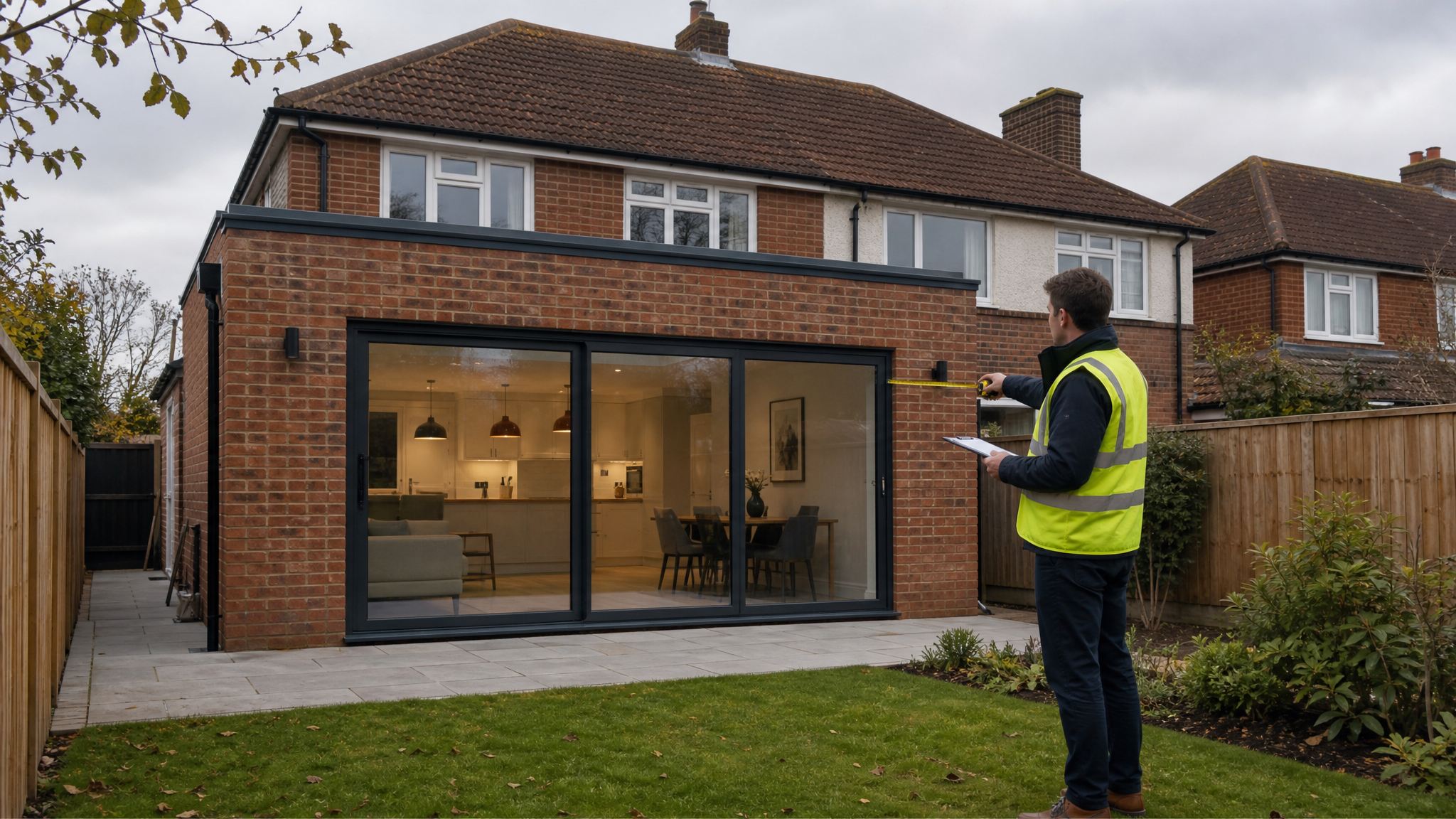
Precise measurements from the original rear wall decide whether an extension sits within permitted development limits.
How do you apply for a lawful development certificate?
Applications are made to the local planning authority, usually through the Planning Portal. The process is the same across England, although validation checklists vary by council:
Step 1: confirm the route. Decide whether you need a proposed (section 192) or existing (section 191) certificate and check for Article 4 directions, conservation area status or planning conditions that remove permitted development rights.
Step 2: commission measured drawings. Existing and proposed plans, elevations and sections at a recognised scale, plus a site location plan with the boundary outlined in red. A measured survey removes guesswork about the position of the original rear wall, ridge height and curtilage coverage.
Step 3: assemble the evidence. For a CLOPUD, a statement showing how each limit in the relevant GPDO class is met. For a CLEUD, dated evidence that the work was substantially completed or the use began before the relevant cut-off.
Step 4: submit and pay. Complete the application form, upload the documents and pay the fee. The council validates the application before the eight-week clock starts.
Step 5: respond to queries. Officers may ask for clarification or a site visit. Prompt, well-documented replies keep the determination on schedule.
Step 6: decision. The certificate, if granted, describes precisely what is lawful. Keep it with the deeds; solicitors will ask for it on sale.
Because the council is deciding a question of law and fact, not planning merit, neighbours have no right to object to an LDC application and the design of the scheme is irrelevant. That is a significant advantage over a planning application for borderline cases.
What evidence do you need for an existing use certificate?
The burden of proof is on the applicant, and the test is the balance of probability. Councils assess whether the evidence is sufficiently precise and unambiguous to show the development or use has continued for the required period. The strongest bundles combine independent, dated documents with sworn statements:
Statutory declarations or affidavits from the owner, previous owners, builders and neighbours, setting out dates and facts they personally know.
Dated photographs, including historic aerial imagery and street-view captures showing the building at key dates.
Builders’ invoices, receipts for materials, building control completion certificates and warranty documents.
Council tax, utility and insurance records showing continuous residential use for a change-of-use certificate.
Tenancy agreements, electoral roll entries and correspondence addressed to the property.
Evidence gaps are the most common reason for refusal. A surveyor’s inspection report can supplement the paperwork by describing the age and condition of materials, weathering and construction details consistent with the claimed completion date. Where the unauthorised works also lack building regulations sign-off, a separate building regulations completion certificate or regularisation application will be needed; planning lawfulness does not cure a building control breach.
Lawful development certificate vs planning permission vs retrospective permission
Route
What it decides
Council’s test
Neighbour consultation
Typical timescale
Lawful development certificate
Whether the work or use is lawful without permission
Law and evidence only
None
8 weeks
Householder planning permission
Whether a scheme outside permitted development is acceptable
Planning merits against local and national policy
Yes, usually 21 days
8 weeks
Retrospective planning permission
Whether completed unauthorised work is acceptable
Planning merits, as if not yet built
Yes
8 weeks, often longer
Prior approval (larger home extension)
Whether a 6 m or 8 m rear extension can proceed
Impact on neighbours’ amenity only
Yes, 21 days
42 days
If your works are recent and outside permitted development, retrospective permission is the only remedy; an LDC will be refused however good the evidence. Conversely, if the immunity period has passed, applying for retrospective permission invites the council to assess merits it can no longer enforce against, so a CLEUD is normally the better route.
Why lawful development certificates matter when buying or selling
Undocumented extensions are among the most frequent causes of delayed sales. During conveyancing the seller is asked about alterations and consents, and a Level 3 building survey will note any extension, loft conversion or outbuilding that appears to lack approvals. Buyers then face a choice: accept the risk, negotiate a reduction, insist on indemnity insurance, or ask the seller to obtain a certificate. Indemnity policies cover the cost of enforcement but are invalidated if anyone contacts the council, so they are a stop-gap rather than a solution.
For sellers, obtaining a CLEUD before marketing removes the issue entirely and supports the asking price. For buyers, a certificate is worth asking for whenever a property has been altered, particularly where the works were completed after 25 April 2024 and cannot yet be immune. An independent valuation can also quantify the effect of an unresolved planning risk on market value.
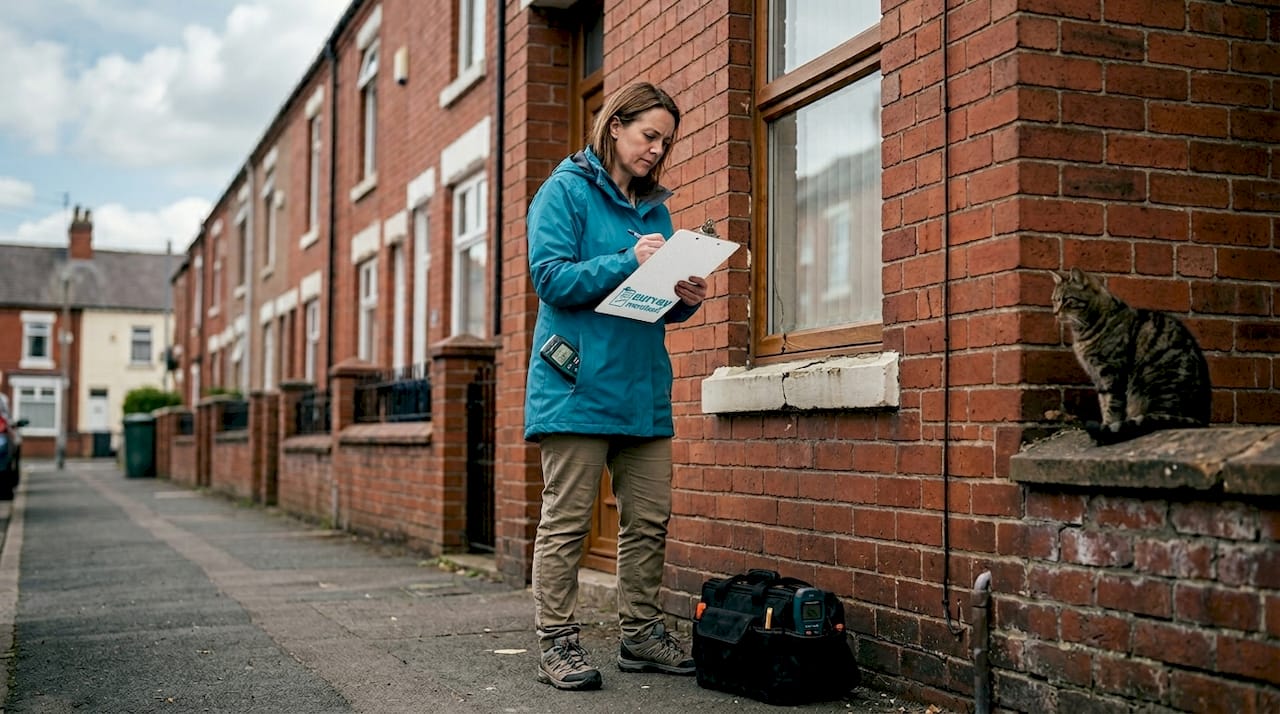
Scaled drawings and a red-line location plan are mandatory for every LDC application.
How a surveyor helps with a lawful development certificate
A lawful development certificate is won or lost on precision, and precision is what surveyors provide. A suitably qualified, accredited surveyor can:
Produce measured existing and proposed drawings that satisfy the council’s validation checklist.
Check the proposal against every limit in the relevant GPDO class, including the 50% curtilage rule and the loft volume allowance, as explained in our permitted development rights guide.
Inspect existing works and prepare a report on their age, construction and completion date to support a CLEUD.
Advise on the structural design of the scheme so the drawings submitted for the certificate match what is actually built.
Identify parallel obligations: building regulations approval, listed building consent, and notices under the Party Wall etc. Act 1996 where an extension is built at the boundary. Our party wall surveyors can serve notices in step with the LDC application.
Coordinate the whole process through project management when the certificate is one stage of a larger refurbishment.
Surveyors regulated or accredited by bodies such as the Royal Institution of Chartered Surveyors (RICS), the Chartered Institute of Building (CIOB) and the Residential Property Surveyors Association (RPSA) work to published professional standards and carry professional indemnity insurance. That matters if a council or a future buyer later challenges the drawings or the evidence. For the broader picture of what planners expect, see the role of surveys in planning permission.
Why choose Survey Merchant for your lawful development certificate?
Getting a certificate refused costs you the fee, weeks of delay and, if you have already built, a much weaker negotiating position with the council. We recommend Survey Merchant because the service is designed to avoid exactly that:
Accredited panel matched to the job. The panel includes surveyors regulated or accredited by RICS, CIOB and RPSA among others, so measured surveys, condition inspections and structural design each go to the right specialist.
Nationwide UK coverage with local knowledge. Surveyors across England and Wales who know their local authority’s validation requirements, Article 4 directions and conservation area constraints.
Fast turnaround. Prompt site visits and drawings so the eight-week determination period starts sooner rather than later.
Transparent, competitive fixed fees. A clear quote agreed up front, with no surprises when the invoice arrives.
Impartial advice. If the works are outside permitted development or the immunity period has not yet run, you will be told plainly and shown the best alternative route.
End-to-end support. From the first feasibility check through drawings, evidence, party wall notices and building control, one point of contact throughout.
A lawful development certificate is a formal decision by your local planning authority, made under sections 191 and 192 of the Town and Country Planning Act 1990, confirming that a proposed or existing use, building operation or breach of condition is lawful for planning purposes. It is not planning permission; it records that permission is not needed or that enforcement is time-barred.
How much does a lawful development certificate cost in 2026?
From 1 April 2026 the fee in England is half the equivalent planning application fee for a proposed certificate and the full fee for an existing one. For a householder extension that means £274 for a proposed certificate and £548 for an existing one; smaller outbuildings are £136 and £272 respectively. Drawings and evidence preparation are extra.
What is the difference between the 4-year rule and the 10-year rule?
Since 25 April 2024 a single ten-year immunity period applies to all breaches of planning control that occurred on or after that date. The old four-year rule still applies to building works substantially completed, or changes of use to a single dwelling that occurred, before 25 April 2024. Most other breaches, including other changes of use, were always subject to the ten-year rule.
How long does a lawful development certificate take?
The council has eight weeks from validation to decide the application. If it refuses, grants a certificate in different terms, or fails to decide within eight weeks, you can appeal to the Planning Inspectorate, which considers only whether the evidence proves lawfulness, not the planning merits.
Do I need a lawful development certificate for permitted development?
No, it is optional, but it is strongly recommended. A certificate confirms in writing that your extension, loft conversion or outbuilding falls within permitted development limits, protects you from enforcement action if the council later disagrees, and reassures buyers, conveyancers and lenders when you sell or remortgage.
What evidence do I need for a certificate of lawful existing use?
You must prove, on the balance of probability, that the work was substantially completed or the use began before the relevant cut-off and has continued since. Strong evidence includes statutory declarations from owners, builders and neighbours, dated photographs and aerial imagery, invoices, building control certificates, council tax and utility records. A surveyor's inspection report can corroborate the age of the works.