We use cookies to improve your experience on our site, analyze site traffic, and assist in our marketing efforts. By clicking "Accept all," you agree to the storing of cookies on your device. You can choose to "Reject all" non-essential cookies. For more information, please read our Cookie Policy.
A 2026 UK guide to non standard construction: PRC, steel-frame, timber-frame, thatch and MMC homes, the designated defective list, PRC certificates, mortgages, insurance, identification and surveys.
If a valuer, estate agent or survey report has described a property as “non standard construction”, you are probably wondering what that actually means for you. In short, non standard construction is any house that was not built in the conventional UK way – brick or stone walls with a slate or tile roof. It covers everything from post-war precast concrete council houses and steel-framed semis to timber frames, thatched cottages and modern modular homes. The label is not a verdict on quality, but it does change how lenders, insurers and buyers treat the property, and it almost always means you should commission a more detailed survey before you commit. This 2026 guide explains the main construction types, the “designated defective” list, what it means for your mortgage and insurance, how to identify a non-standard house, and the survey you need.
Key takeaways
Non standard construction means a property that is not built from brick or stone with a slate or tiled roof – typically precast or in-situ concrete, steel frame, timber frame, or unusual walling and roofing materials.
The Building Research Establishment (BRE) has catalogued around 450 non-traditional house types built in the UK between 1918 and 1975; most are perfectly habitable, but a small group of concrete systems were designated “defective” under the Housing Defects Act 1984 (now Part XVI of the Housing Act 1985).
Most non-standard homes are mortgageable, but with a smaller pool of lenders, often a larger deposit and a lender-requested structural report. Unrepaired designated-defective homes are usually cash-buyer only unless a PRC certificate exists.
A RICS Home Survey Level 3 (building survey) or a bespoke structural report from a suitably qualified, accredited surveyor is the right survey for almost every non-standard property.
Freshness note: RICS consulted (19 August to 14 October 2025) on a second edition of its Home Survey Standard with new guidance on “additional risk” dwellings, and the government’s Future Homes and Buildings Standard (published 24 March 2026) will reshape how new homes are built from 2028.
What is non standard construction?
Non standard construction (also called non-traditional construction) describes any residential property whose walls or roof are not built using conventional methods: brick, block or stone walls with a pitched slate or tiled roof. Typical examples are precast reinforced concrete (PRC) panel houses, in-situ poured concrete, steel or timber frames, thatched or flat roofs, and modern modular homes.
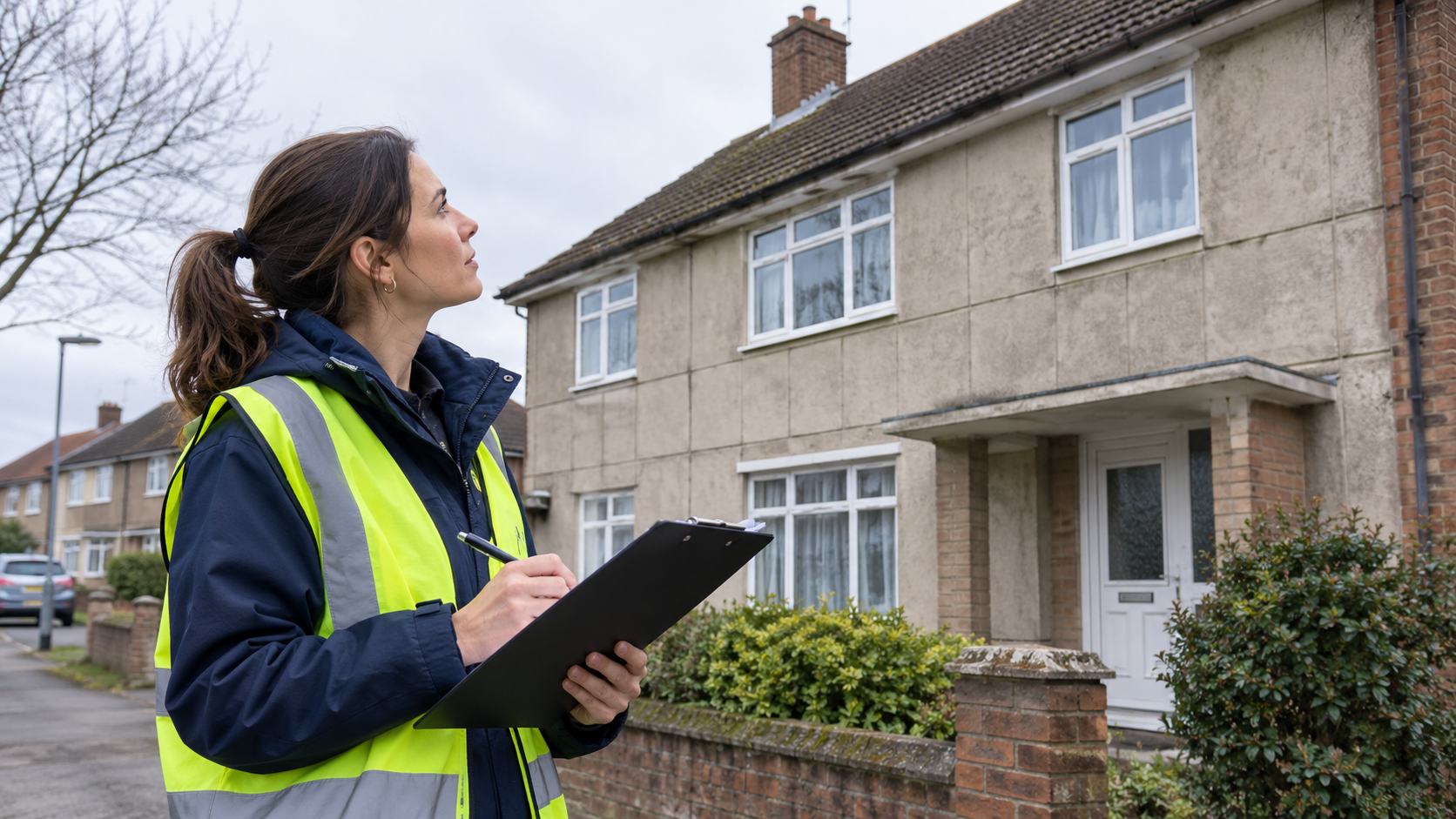
A suitably qualified surveyor inspecting a 1950s precast concrete panel house – one of the most common non standard construction types in the UK.
The term is a lending and insurance classification as much as a building one. A 1920s Airey house, a 1970s timber-framed estate home and a 2024 factory-built modular house are all “non-standard”, yet they carry very different levels of risk. That is why a good survey matters more than the label itself.
Why were so many non-standard houses built?
After both World Wars, Britain faced acute housing shortages and a lack of skilled bricklayers. Local authorities and private builders turned to prefabricated and system-built methods that could be erected quickly by semi-skilled labour. The BRE’s reference work Non-traditional houses: Identifying non-traditional houses in the UK 1918–75 catalogues roughly 450 distinct house types from this period, grouped into four classes: metal framed, precast concrete, in-situ concrete and timber framed. Industry estimates commonly put the number of surviving non-standard homes at around 1.5 million, although the Office for National Statistics confirmed in a July 2025 Freedom of Information response that it does not use the terms “non-standard” or “non-traditional” in its official classifications, so precise national figures are not published.
Types of non standard construction in the UK
The table below summarises the main categories, well-known examples and what they usually mean for buyers in 2026. Lender policies differ and change without notice, so always confirm the current position with a broker and your surveyor.
Category
Common examples
Designated defective?
Typical lender and survey position
Precast reinforced concrete (PRC)
Airey, Cornish Unit, Orlit, Unity, Woolaway, Wessex, Reema Hollow Panel
Yes – most PRC systems
Usually unmortgageable unless repaired to an approved scheme and covered by a PRC certificate; structural report always needed
Increasingly accepted with a recognised warranty, a stated design life and accreditation such as BOPAS
Which non-standard houses are “designated defective”?
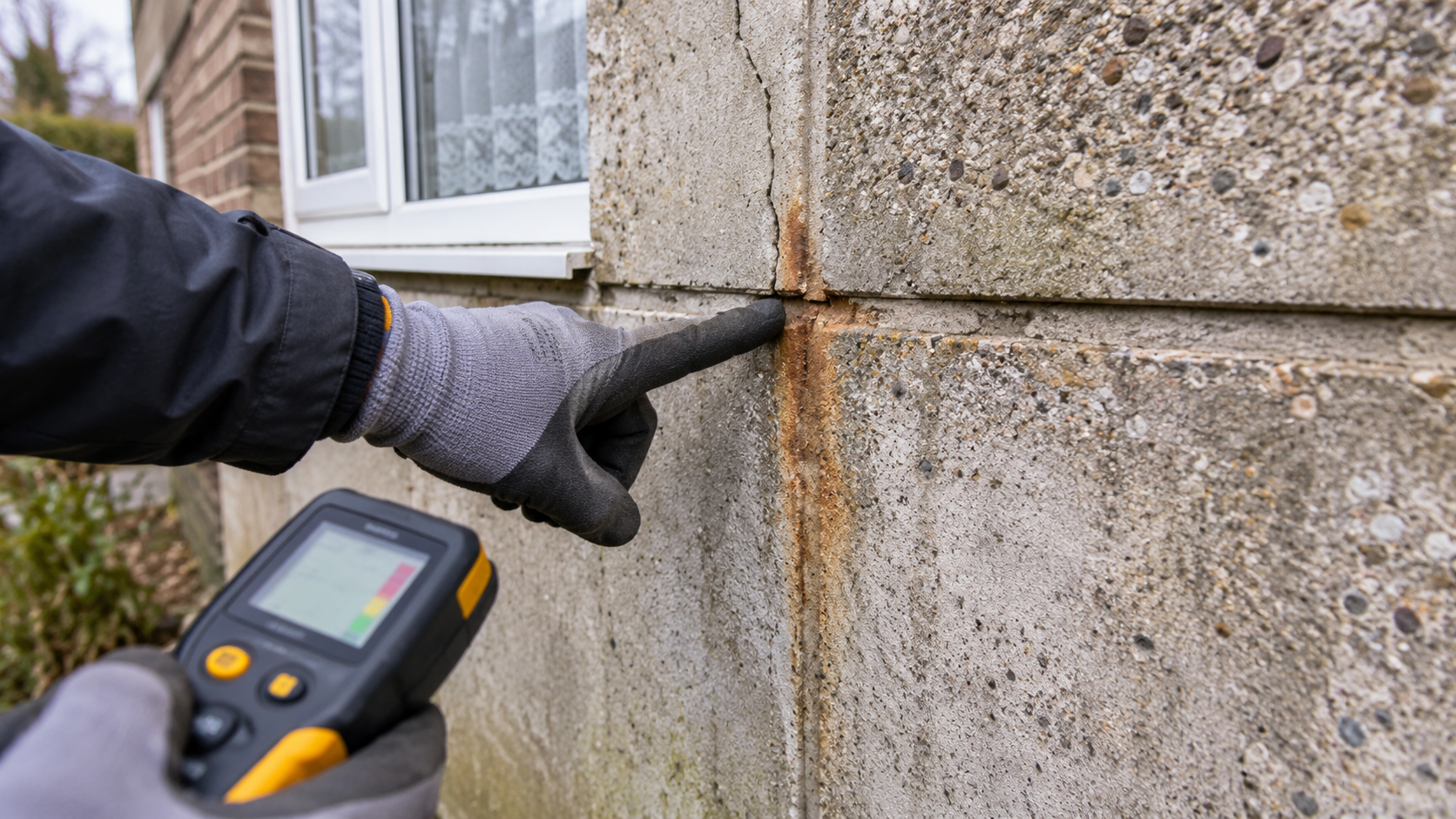
In the early 1980s the BRE investigated widespread problems in post-war precast concrete housing – principally carbonation of the concrete and corrosion of the steel reinforcement, which can crack and spall the panels and, in the worst cases, compromise the structure. Parliament responded with the Housing Defects Act 1984, which allowed the Secretary of State to designate classes of building as defective where a defect in design or construction had become widely known and substantially reduced the value of affected homes. Those provisions were consolidated into Part XVI of the Housing Act 1985, and the designations – covering well over 30 precast and two in-situ concrete systems – still determine how lenders treat these houses today.
Cracking and rust staining at a panel joint are classic warning signs of reinforcement corrosion in precast concrete houses.
What is a PRC certificate?
A PRC certificate confirms that a designated-defective precast concrete house has been structurally repaired to a licensed, lender-approved scheme – typically by removing the original concrete panels and rebuilding the external walls in brick or block, tied to a new or strengthened structure – and that the work was inspected and signed off by a structural engineer. With a valid certificate, a restricted group of lenders will consider the property; without one, an unrepaired designated-defective house is normally limited to cash buyers. If you are buying such a home, ask the seller for the certificate and the original repair specification at the outset, and have your surveyor review both.
Can you get a mortgage on a non standard construction house?
Yes, in most cases, but expect more friction than with a brick-and-tile property. Lenders worry about long-term durability, repair costs and resale demand, so they manage that risk in three ways: a narrower set of acceptable construction types, a lower maximum loan-to-value, and extra evidence requirements.
High-street banks are generally the strictest. Several publish named construction criteria; Nationwide, for example, states that timber-framed homes with a brick, block or reconstituted-stone outer leaf built in 1970 or after are treated as traditional construction, while other non-traditional methods are assessed on their exact system name and year built, and MMC homes are considered subject to evidence of a 30-year design life, warranty and accreditation such as BOPAS.
Building societies are often more flexible and may have type-specific policies for steel frame, concrete or thatch.
Specialist lenders have the widest criteria but charge higher rates.
Specialist brokers reported in 2026 that maximum loan-to-value on many non-standard types sits around 75–85 per cent, meaning a deposit of 15–25 per cent, with some lenders capping steel-frame lending at 65–70 per cent. One broker’s September 2026 tracker of 19 UK lenders found only three would consider BISF steel-framed houses by name, twelve would consider steel frame in general and nine published an outright refusal – a useful illustration of how narrow the market can be. The valuer’s flag frequently triggers a request for a full structural report before the lender will proceed, so budget for it early. If the valuation comes back lower than expected, our guide to down valuations and what to do next explains your options, and our article on what a mortgage valuation actually checks shows why a valuer’s inspection is no substitute for your own survey.
Can you insure a non standard construction home?
Usually, yes, but not always with mainstream insurers. Repair costs are less predictable, so premiums tend to be higher and some providers decline certain types outright. Specialist non-standard buildings cover is widely available; brokers typically quote a modest annual premium above standard cover for steel-frame or concrete homes, with thatch and listed properties at the higher end. Always declare the construction type accurately – an inaccurate declaration can void a policy – and make sure the sum insured reflects the true rebuild cost rather than the market value, because rebuilding an unusual structure often costs more per square metre than a standard house.
How do you tell if a house is non standard construction?
Many non-standard houses have been rendered, clad or re-roofed over the decades, so looks can deceive. Work through these checks:
Read the paperwork. The seller’s property information form, previous survey reports, the mortgage valuation and any PRC certificate or structural repair documentation.
Check the date and the street. Estates built between the late 1940s and early 1970s, particularly former council housing, are the most likely candidates. Look at neighbouring houses of the same design – one may show the original panels or frame.
Look for visual clues. Panel joints, a grid of vertical and horizontal lines beneath render, rust staining, steel columns visible in the loft or garage, shallow floor-to-ceiling voids, or unusually thin walls at window reveals.
Ask Building Control. Local authority building control records and the original housing department may hold the system name.
Commission a survey. A suitably qualified, accredited surveyor – whether regulated by RICS, CIOB, RPSA or another recognised body – will identify the construction type, usually by name, and report on its condition.
Confirming the system name matters because lenders assess, say, a Wimpey No-Fines house very differently from an Airey house, even though both are concrete. Our guide to RAAC concrete risks and surveys covers a related but distinct material that surveyors also look out for in post-war buildings.
Which survey do you need for a non standard construction property?
The RICS Home Survey Standard sets out three survey levels. For a non-standard house, a Level 2 HomeBuyer-style report is rarely enough: it is designed for conventional properties in reasonable condition. The appropriate options are:
RICS Home Survey Level 3 (building survey). The most thorough standard inspection, covering structure, materials, defects and repair options. Ideal for steel-frame, timber-frame, concrete, thatch and older or altered properties. See our guide to what a Level 3 survey involves and our 2026 house survey cost guide.
Bespoke structural report. Where a lender asks for a “full structural report” on a PRC, BISF or other system-built house, a structural engineer or specialist surveyor inspects the frame or panels specifically, often with intrusive checks such as opening up cladding or testing concrete.
Specialist tests. Mundic screening in Cornwall and Devon, carbonation and chloride testing on concrete, timber-frame moisture and decay checks, and thatch condition reports.
A Level 3 building survey gives buyers of steel-framed and other non-standard homes the evidence lenders and insurers ask for.
Before instructing anyone, check their credentials and professional indemnity cover – our article on how to verify a surveyor’s credentials in the UK explains how. Experience with the specific house type is more valuable than any single letter after a name.
What is changing in 2026?
Three developments are worth knowing about if you are buying, selling or remortgaging a non-standard home this year:
RICS Home Survey Standard, second edition. RICS ran a consultation from 19 August to 14 October 2025 on an updated standard that proposes clearer definitions of the three survey levels, guidance on “additional risk” dwellings, and new services such as retrofit assessments and drone inspections. RICS members continue to follow the first edition until the second takes effect, but expect surveyors to become more explicit about construction-type risks in their reports.
Future Homes and Buildings Standard. Published by the government on 24 March 2026 for new homes in England from 2028, it bans gas boilers in new homes and requires solar panels and much higher insulation standards. Industry commentators expect this to accelerate factory-built timber-frame and MMC housing – the next generation of “non-standard” homes, albeit with warranties and accreditation designed to satisfy lenders from day one.
Tightening lender transparency. More lenders now publish named construction criteria online, and broker trackers (such as the September 2026 BISF survey mentioned above) show the panel for older steel and concrete systems remains narrow. Checking criteria before you offer is cheaper than discovering a decline after survey.
Is it worth buying a non standard construction house?
It can be. Non-standard homes are often noticeably cheaper than equivalent brick houses, many are generously sized with large gardens, and a well-maintained steel-frame or No-Fines house can be a sound long-term home. The trade-offs are a smaller lender and insurer pool, higher borrowing and insurance costs, slower resale and, for unrepaired defective types, the risk of being unable to sell to anyone but a cash buyer. The sensible approach is to price the risk in: obtain a Level 3 survey or structural report, get written confirmation of lending and insurance before exchange, factor any repair or upgrade costs into your offer, and think about who will buy the house from you in ten years’ time.
Selling a non standard construction house
If you are the seller, prepare the evidence buyers’ lenders will ask for: the system name, any PRC certificate and repair documents, recent structural or roof reports, and insurance details. A pre-sale survey from an accredited surveyor can shorten the chain, reduce renegotiation and give buyers confidence. Estate agents must not mislead buyers about construction type, so be upfront from the listing stage.
Why choose Survey Merchant for your non standard construction survey?
Non-standard properties are exactly where experience counts. Survey Merchant matches each job to a suitably qualified, accredited surveyor from a panel regulated by bodies including RICS, CIOB and RPSA, selecting professionals with a track record on the relevant house type – precast concrete, steel frame, timber frame, cob, thatch or modern modular. Our coverage is nationwide across the UK, so we can draw on local knowledge of the estates and systems common to your area. We offer transparent, competitive fixed fees agreed before we start, fast turnaround so your purchase is not held up, and impartial advice that tells you plainly whether a property is a sound buy and what lenders are likely to require. From Level 3 building surveys and structural reports to RICS Red Book valuations and post-purchase defect advice, we support you end to end. Explore our building surveying services or contact our team today for a fixed-fee quote on your non standard construction survey.
It means a house that was not built using conventional UK methods: brick, block or stone walls with a slate or tiled roof. Common examples are precast or poured concrete houses, steel-framed and timber-framed homes, thatched or flat-roofed properties, cob or flint walls and modern modular homes. The term is used mainly by lenders, insurers and surveyors.
Can you get a mortgage on a non standard construction house?
Usually yes, but from a smaller pool of lenders and often with a larger deposit of around 15 to 25 per cent. Lenders assess the exact system name and year built, and frequently ask for a Level 3 survey or structural engineer's report. Unrepaired designated-defective precast concrete houses are normally cash-buyer only unless a valid PRC certificate exists.
How do I tell if a house is non standard construction?
Check the seller's paperwork and any previous surveys, look at the build date and neighbouring houses for panel joints or a visible steel frame, ask local authority building control for records, and commission a survey from a suitably qualified, accredited surveyor who can identify the construction system by name.
Is it worth buying a non standard construction house?
It can be. These homes are often cheaper and generously sized, and many are structurally sound. Weigh that against higher borrowing and insurance costs, a narrower pool of future buyers and, for unrepaired defective types, limited resale. Always obtain a Level 3 survey or structural report and written lending and insurance confirmation before exchange.
What is a PRC certificate and do I need one?
A PRC certificate confirms that a designated-defective precast reinforced concrete house has been structurally repaired to a licensed, lender-approved scheme and signed off by a structural engineer. If you are buying a designated-defective type such as an Airey, Cornish Unit, Unity or Woolaway house with a mortgage, lenders will almost always require one.
Which survey do I need for a non standard construction property?
A RICS Home Survey Level 3 (building survey) or a bespoke structural report is the right choice for almost all non-standard homes. Some lenders specify a full structural report for concrete or steel-framed houses, and specialist tests such as mundic screening in Cornwall and Devon or a thatch condition report may also be needed.