We use cookies to improve your experience on our site, analyze site traffic, and assist in our marketing efforts. By clicking "Accept all," you agree to the storing of cookies on your device. You can choose to "Reject all" non-essential cookies. For more information, please read our Cookie Policy.
Everything UK buyers need to know about the RICS Level 1 survey (Condition Report) in 2026: what is inspected, what is left out, typical fees, who it suits, and the upcoming RICS Home Survey Standard 2nd edition.
A Level 1 survey – officially the RICS Home Survey Level 1, and still widely known as a Condition Report – is the most basic of the three RICS home survey levels. It gives you a short, objective snapshot of a property’s visible condition using simple traffic-light ratings, without the repair advice or in-depth analysis you get from a Level 2 or Level 3 survey. In 2026 it typically costs between £300 and £900, and it is only really suitable for modern, conventionally built homes that already look to be in good order. This guide explains exactly what a Level 1 survey covers, what it leaves out, what it costs, and how to decide whether it is enough for the home you are buying.
Key takeaways
A Level 1 survey is a visual-only inspection that rates the main elements of a home green, amber or red; it does not include repair advice, cost estimates or a valuation.
Typical 2026 fees are £300–£900 depending on the property’s value and size, which is usually only £100–£200 less than a far more useful Level 2 survey.
It suits modern (broadly post-2000), standard-construction homes in visibly good condition, including many new-build flats and houses; it is not recommended for period, altered, extended or neglected properties.
The RICS Home Survey Standard (1st edition, in force since 1 March 2021) still governs all three levels; RICS confirmed on 28 September 2026 that the 2nd edition is now expected in Q1 2027.
If you have any doubts about the property, most buyers are better served by a Level 2 HomeBuyer Survey; Level 3 is the right choice for older or unusual homes.
Whatever level you choose, use a suitably qualified, accredited surveyor – Survey Merchant’s nationwide panel is matched to the property and the level you need at a fixed fee.
What is a Level 1 survey?
A Level 1 survey is the entry-level RICS home survey: a brief visual inspection by a qualified surveyor that produces a concise Condition Report. It rates each main element of the property green, amber or red, highlights obvious risks and legal issues, and recommends further investigation where needed, but it gives no advice on repairs, costs or ongoing maintenance.
The three survey levels were introduced by the RICS Home Survey Standard, which became mandatory for RICS members on 1 March 2021 and replaced the old Condition Report, HomeBuyer Report and Building Survey names. Level 1 is the direct successor to the Condition Report. If you are new to the survey system, our explainer on the RICS Home Survey Standard and its three levels is a useful starting point.
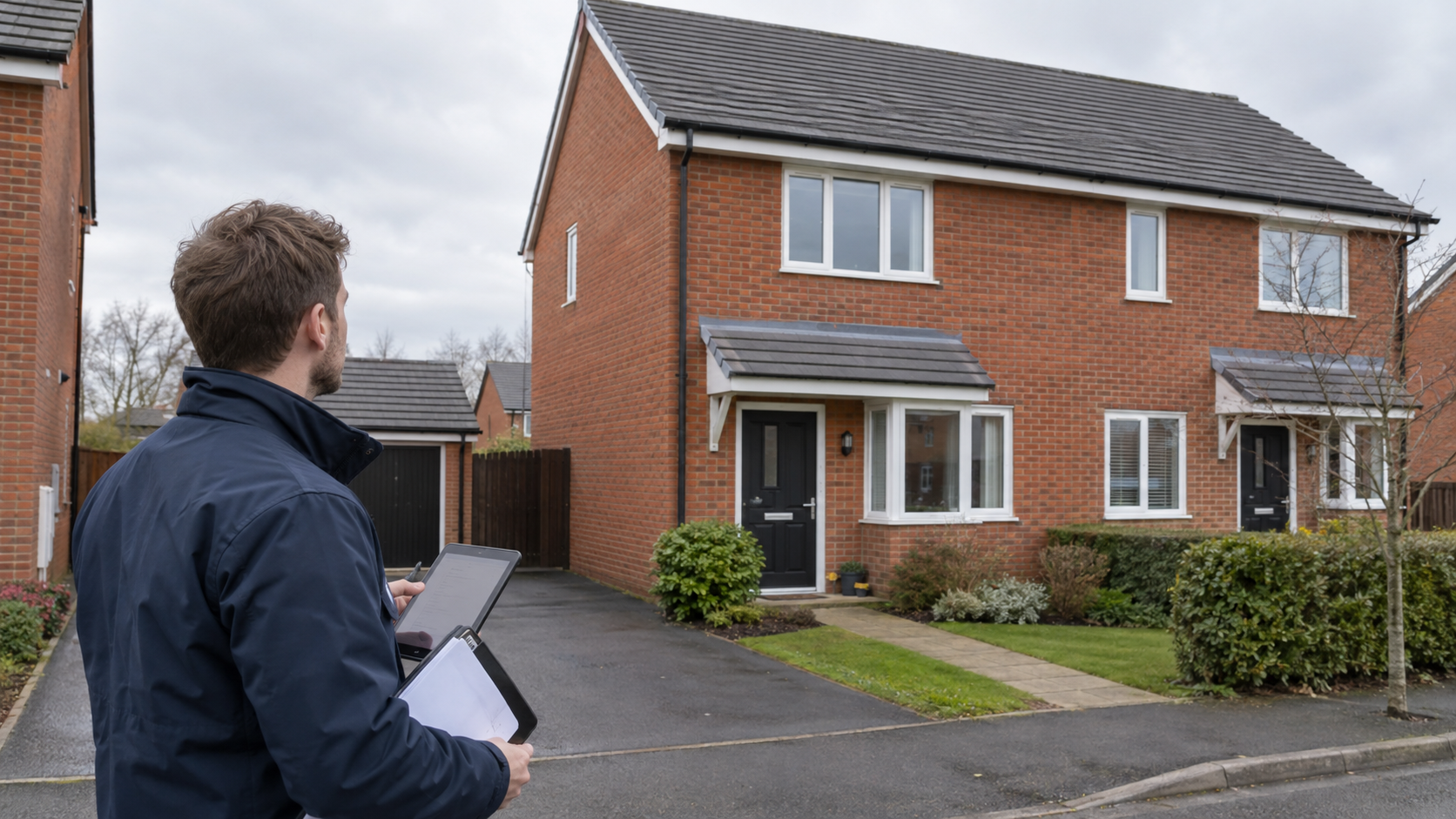
A Level 1 survey is designed for modern, conventionally built homes that already appear to be in good condition.
What does a Level 1 survey include?
Under the Home Survey Standard, a Level 1 inspection is visual and less extensive than the inspections carried out at Levels 2 and 3. The surveyor does not carry out tests on the building fabric or services, does not lift carpets or floorboards, and does not move heavy furniture. What you receive is a succinct report that:
Describes the construction and condition of the building, its services (such as electrics, heating and drainage, on a visual basis only) and the grounds on the day of inspection.
Uses the standard RICS condition ratings: Condition Rating 1 (green – no repair currently needed), Condition Rating 2 (amber – defects that need repair or replacement but are not serious or urgent) and Condition Rating 3 (red – serious defects needing urgent repair, replacement or further investigation).
Flags obvious risks to the building, its occupants or the grounds – for example, a flat roof that appears to be at the end of its life, or signs of damp around a window.
Notes legal matters your conveyancer should look into, such as whether consents may be needed for alterations.
Recommends further investigation where the surveyor cannot reach a conclusion with reasonable confidence.
Reports are short – typically 10 to 20 pages – and the inspection itself usually takes one to two hours on site, with the written report normally following within three to seven working days. Our guide to understanding the RICS condition ratings explains how to read the traffic lights in more detail.
What a Level 1 survey does not include
This is where most of the disappointment with Level 1 surveys comes from. The Condition Report deliberately excludes:
Repair advice – it tells you an element is amber or red, but not how it should be fixed.
Cost estimates – there are no indicative repair costs to help you renegotiate the price.
Maintenance advice – nothing on how to look after the property in future.
A valuation or reinstatement (rebuild) cost for insurance purposes.
Any detailed investigation of hidden areas, roof voids that are not easily accessible, or the cause of defects.
In practice, if the report comes back with any amber or red ratings you will almost certainly need to commission further advice, which is why many buyers find it more economical to start with a Level 2 survey.
Level 1 vs Level 2 vs Level 3 survey
The table below summarises how the three RICS home survey levels compare in 2026. Fee ranges are drawn from the HomeOwners Alliance’s house survey cost guide (updated 5 October 2026) and reflect typical UK prices rather than a quote for any specific property.
Feature
Level 1 (Condition Report)
Level 2 (HomeBuyer Survey)
Level 3 (Building Survey)
Inspection depth
Visual only, least extensive
Visual, more thorough; roof space and accessible areas checked
Detailed and extensive; includes concealed areas where accessible
Condition ratings
Yes (1–3)
Yes (1–3)
Yes (1–3), with detailed commentary
Repair advice
No
Yes, outline advice
Yes, detailed, with options and priorities
Cost of repairs
No
Not usually (some surveyors add estimates)
Often included or available on request
Valuation
No
Optional (Level 2 survey and valuation)
Optional, separately agreed
Best suited to
Modern, standard-construction homes in good condition
Conventional homes in reasonable condition, built after about 1900
Older, unusual, altered, extended or poorly maintained homes
Level 1 is the cheapest RICS survey, but the saving over a Level 2 is often smaller than buyers expect. According to the HomeOwners Alliance (updated October 2026), fees scale with the property’s value and size:
Property value
Level 1 survey
Level 2 survey
Level 3 survey
£100,000–£249,000
£300–£500
£400–£600
£630–£800
£250,000–£349,000
£500–£600
£600–£700
£800–£900
£350,000–£499,000
£600–£700
£700–£800
£900–£1,100
£500,000–£1,000,000
£700–£900
£800–£1,000
£1,000–£1,500
Other 2026 price guides put typical Level 1 fees for smaller homes lower still – roughly £300–£400 for a flat or studio and £350–£475 for a three-bedroom semi – but the pattern is consistent: a Level 2 survey usually costs only around £100–£200 more than a Level 1 on the same property, and delivers considerably more useful information. Our house survey cost guide for 2026 breaks down what drives Level 2 and Level 3 fees.
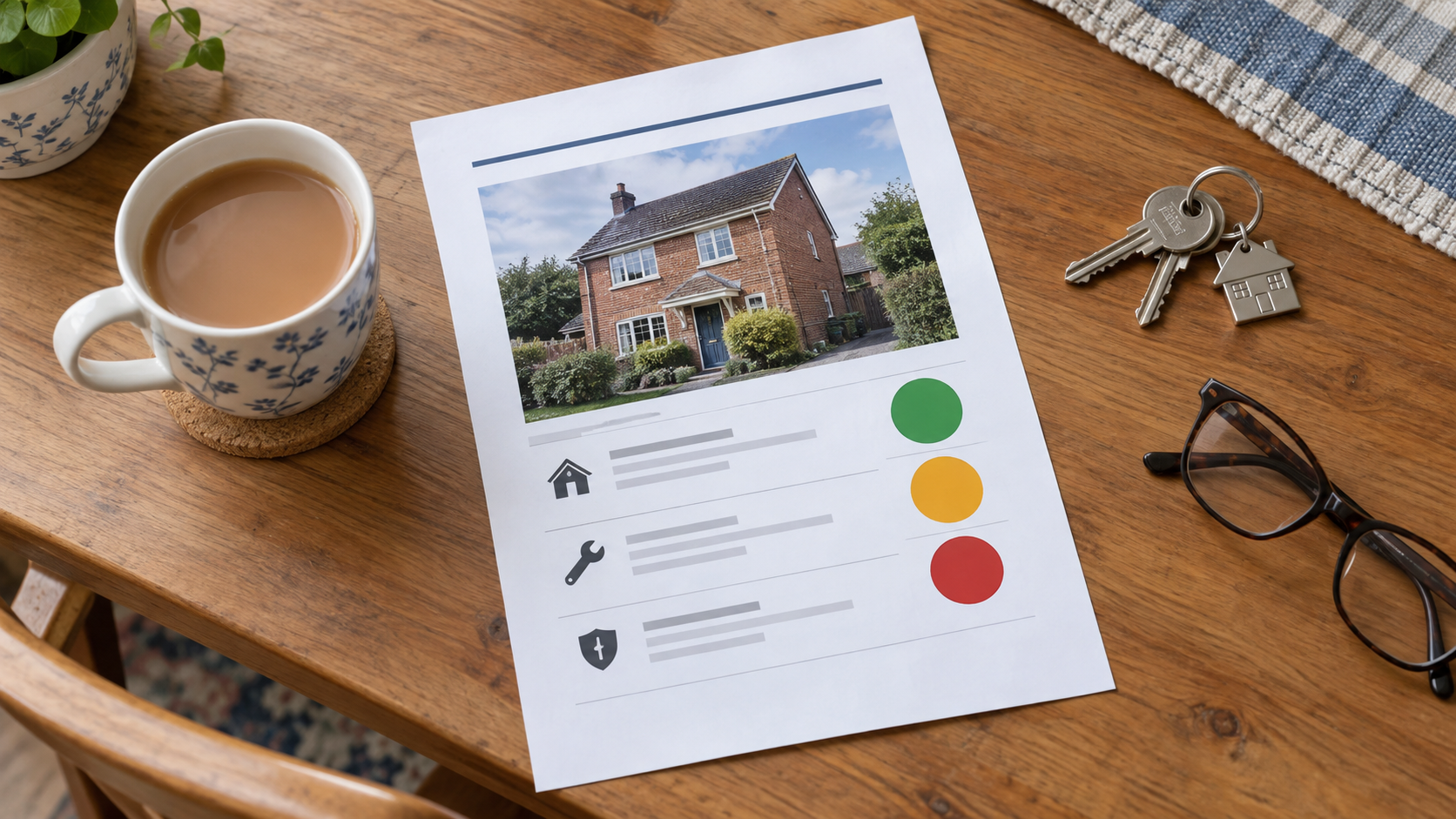
A Level 1 Condition Report rates each element green, amber or red, but does not explain how to fix problems or what they will cost.
Who is a Level 1 survey suitable for?
The Home Survey Standard is explicit that Level 1 is for “conventionally built, modern homes in satisfactory condition” and is not suited to older or complex properties, or to homes in neglected condition. In practice, a Level 1 survey can be a sensible choice when:
The property was built in roughly the last 20–25 years, using standard brick-and-block or timber-frame construction, and has not been significantly altered or extended.
It is a new-build or nearly new flat or house where a 10-year structural warranty is in place and you simply want an independent, objective check before exchange.
You are a cash buyer or landlord who wants a low-cost sense-check on a modern property in visibly good order, rather than a full diagnostic report.
Budget is extremely tight and the alternative is no survey at all – a Level 1 is always better than relying solely on a mortgage valuation, which is for the lender’s benefit rather than yours.
Bear in mind that even on a brand-new home, a dedicated snagging survey on a new build will usually pick up far more than a Level 1 inspection, because it is designed to find finishing defects rather than simply rate overall condition.
When you should not rely on a Level 1 survey
Choose at least a Level 2 survey – and consider a Level 3 – if any of the following apply:
The property is Victorian, Edwardian, inter-war or otherwise more than about 50 years old.
It is listed, in a conservation area, thatched, timber-framed (historic), or of non-standard construction such as prefabricated concrete or steel frame.
It has been extended, converted (for example a loft or garage conversion) or substantially renovated.
You can already see cracks, damp staining, sagging roofs, uneven floors or signs of past repairs.
You plan major works after purchase and want advice on what is feasible.
Instruction and terms. You confirm the level of survey, the property details and the fee. Under the Home Survey Standard, the surveyor must agree written terms of engagement that set out the scope and limitations before starting.
Desktop checks. The surveyor reviews basic information about the property’s location, age and construction, and may check public sources such as the planning portal.
The inspection. A visual inspection of the inside and outside of the property, usually lasting one to two hours. Roof spaces and underfloor areas are only looked at from the access hatch where that is safe and practical.
The report. A concise written report with condition ratings for each element, a summary of risks and legal issues, and recommendations for further investigation where necessary.
Follow-up. Many surveyors will talk the findings through with you by phone. If there are amber or red ratings, your next step is usually a specialist report or an upgrade to a more detailed survey.
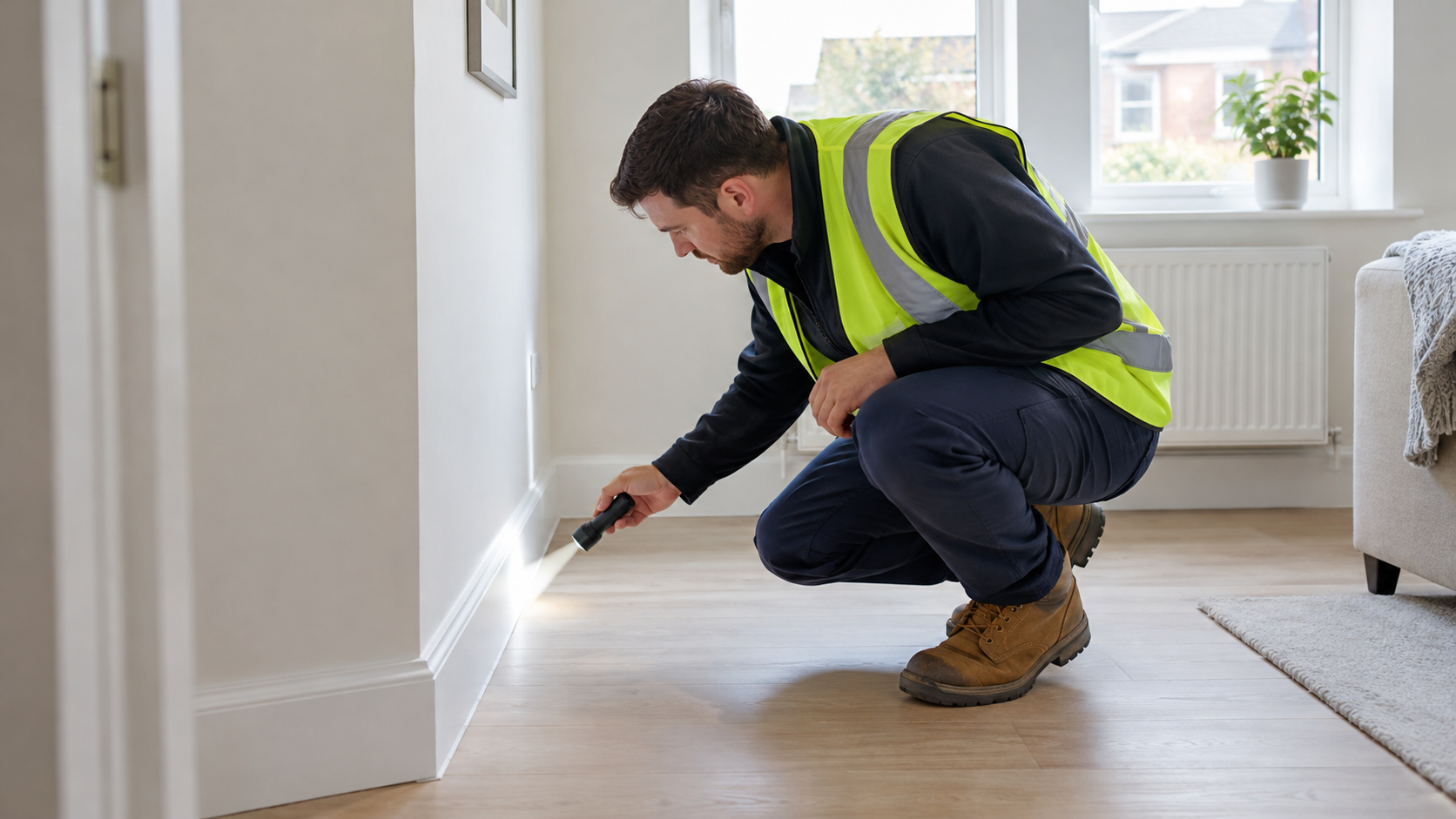
Level 1 inspections are visual only: the surveyor looks for obvious defects but does not test services or open up the building fabric.
Level 1 survey vs a mortgage valuation
Buyers sometimes assume the lender’s mortgage valuation is a survey. It is not. A mortgage valuation is a brief assessment, commissioned by and for the lender, to confirm the property is adequate security for the loan; in many cases it is carried out as a desktop or drive-by exercise with no internal inspection at all. A Level 1 survey, by contrast, is commissioned by you, involves a physical inspection, and is written for your benefit. If you want to understand the difference in more detail, see our guide to what a mortgage valuation is.
What is changing in 2026 and 2027: the RICS Home Survey Standard 2nd edition
All three survey levels are defined by the RICS Home Survey Standard, and that standard is being rewritten. RICS consulted on a draft 2nd edition between 19 August and 14 October 2025, receiving more than 1,000 comments. The consultation proposals included clearer requirements for each level “from Home Survey Level 1 to Level 3”, a duty on surveyors to help clients understand the differences between levels and the risks of choosing the wrong one, and a requirement that only suitably qualified members (not trainees) inspect the property and sign the report.
In its most recent progress update, published on 28 September 2026 and clarified on 6 October 2026, RICS confirmed that drafting of the remaining sections is complete and that it now intends to publish the 2nd edition in Q1 2027, subject to the impact of the Government’s home buying and selling reforms. Until then, RICS members must continue to work to the current 1st edition, so the Level 1 scope described in this article still applies to any survey booked in 2026.
Separately, RICS is still exploring a possible home survey regulatory scheme (similar to its Valuer Registration Scheme) and has said it will wait for the updated standard to be finalised before deciding how such a scheme would fit. The Government’s reform roadmap for buying and selling homes in England and Wales, which envisages more upfront property information and potentially a property condition assessment, could also change how and when condition information is produced; our summary of the home buying and selling reform roadmap explains the proposals.
Is the market making surveys more important in 2026?
Yes. The RICS UK Residential Market Survey for September 2026 (published 8 October 2026) reported a net balance of –22% for new buyer enquiries and –32% for house prices, with new sales instructions turning positive (+6%) for the first time since mid-2025. In other words, buyers are cautious and stock is rising, which gives purchasers more room to walk away or renegotiate when a survey reveals problems. That leverage is only useful if your survey actually explains the problems – one more reason many buyers choose Level 2 over Level 1 in the current market.
Choosing a surveyor for a Level 1 survey
Whichever level you book, make sure the inspection is carried out by a suitably qualified, accredited surveyor. In the UK that generally means a member of RICS (MRICS, FRICS or AssocRICS), or a surveyor accredited by another recognised body such as the Chartered Institute of Building (CIOB) or the Residential Property Surveyors Association (RPSA), which runs its own Home Condition Survey broadly equivalent to Level 2. Check that the firm carries professional indemnity insurance, ask to see a sample report, and confirm the surveyor has local knowledge of the property type. Our guide on how to verify a surveyor’s credentials walks through the checks.
Why choose Survey Merchant for your Level 1 survey?
Survey Merchant makes it simple to book the right RICS home survey – Level 1, Level 2 or Level 3 – anywhere in the UK:
Accredited panel, matched to the job. Our panel includes suitably qualified surveyors regulated or accredited by bodies such as RICS, CIOB and RPSA, and we match each instruction to a surveyor with the right experience for the property type and survey level.
Impartial advice on the right level. If a Level 1 survey is not appropriate for the property you are buying, we will tell you – and explain why a Level 2 or Level 3 would protect you better.
Nationwide coverage with local expertise. Surveyors who know the housing stock in your area, from new-build estates to period terraces.
Transparent, competitive fixed fees. You know the cost before you instruct, with no hidden extras.
Fast turnaround. Prompt inspection dates and clear, plain-English reports so your purchase keeps moving.
End-to-end support. From choosing the survey to understanding the findings and arranging any specialist follow-up reports.
A Level 1 survey (RICS Home Survey Level 1, formerly the Condition Report) is the most basic RICS home survey. A qualified surveyor carries out a visual inspection and rates each main element of the property green, amber or red, flagging obvious risks and legal issues, but gives no repair, cost or maintenance advice.
How much does a Level 1 survey cost in 2026?
Typical UK fees in 2026 range from about £300 to £900 depending on the property's value and size, with most flats and smaller houses at the lower end. A Level 2 survey usually costs only £100–£200 more on the same property.
Is a Level 1 survey worth it?
It can be, for a modern, standard-construction home that is visibly in good condition, or where the alternative is no survey at all. For most buyers, and for any property over about 50 years old, altered, extended or showing visible defects, a Level 2 or Level 3 survey offers far better value because it explains the problems and how to fix them.
What does a Level 1 survey not include?
A Level 1 survey excludes repair advice, repair cost estimates, maintenance advice, a valuation and any detailed investigation of hidden areas. If the report returns amber or red ratings you will usually need further specialist advice.
Is a Level 1 survey suitable for a new-build flat?
A Level 1 survey can give an independent condition check on a new-build flat covered by a structural warranty, but a dedicated snagging survey will usually find far more finishing defects. Many buyers choose a snagging inspection or a Level 2 survey instead.
How long does a Level 1 survey take?
The on-site inspection normally takes one to two hours and the written Condition Report typically follows within three to seven working days, although timings vary with the surveyor's workload and the property.