We use cookies to improve your experience on our site, analyze site traffic, and assist in our marketing efforts. By clicking "Accept all," you agree to the storing of cookies on your device. You can choose to "Reject all" non-essential cookies. For more information, please read our Cookie Policy.
Tree Preservation Order UK 2026: Rules, Consent & Fines
Everything UK homeowners, buyers and extenders need to know about tree preservation orders in 2026: TPO types, how to check, the free consent application, exemptions, 2026 prosecutions, conservation area notices and survey advice.
A tree preservation order (TPO) is one of the few planning controls that can turn a routine bit of garden maintenance into a criminal offence. Prune the wrong branch on a protected oak, or let a contractor fell a tree you assumed was yours to remove, and you could face an unlimited fine and a legal duty to replant. In 2026 councils across England are still prosecuting homeowners and tree surgeons for exactly that. This guide explains what a tree preservation order is, how to check whether a tree on or near your property is protected, how to apply for consent, which exemptions really apply, what the penalties are, and why TPOs matter when you are buying, extending or surveying a home.
Key takeaways
A tree preservation order is made by the local planning authority under the Town and Country Planning Act 1990 to protect trees, groups of trees or woodlands “in the interests of amenity”. Once made, you need the council’s written consent to cut down, top, lop, uproot, wilfully damage or wilfully destroy a protected tree.
There is no national TPO map. You check with the district, borough or unitary council (not the county council), ideally in writing, and ask the tree officer to confirm the position before any work starts.
Applying for consent is free, the council has eight weeks to decide, and consent normally lasts two years. Refusals and conditions can be appealed to the Planning Inspectorate.
Destroying a protected tree is punishable by an unlimited fine; lesser breaches carry a fine of up to £2,500. Courts must take into account any financial benefit gained, and the landowner usually has to plant a replacement.
Trees in a conservation area are protected even without a TPO: you must give the council six weeks’ notice under section 211 before most works.
Protected trees affect subsidence risk, extension plans and the value of a property, so a suitably qualified, accredited surveyor should flag them during a pre-purchase survey or before you commit to building work.
What is a tree preservation order?
A tree preservation order is a written order made by a local planning authority in England that makes it a criminal offence to cut down, top, lop, uproot, wilfully damage or wilfully destroy a specified tree, group of trees or woodland without the authority’s written consent. TPOs are made under Part VIII of the Town and Country Planning Act 1990 and governed by the Town and Country Planning (Tree Preservation) (England) Regulations 2012.
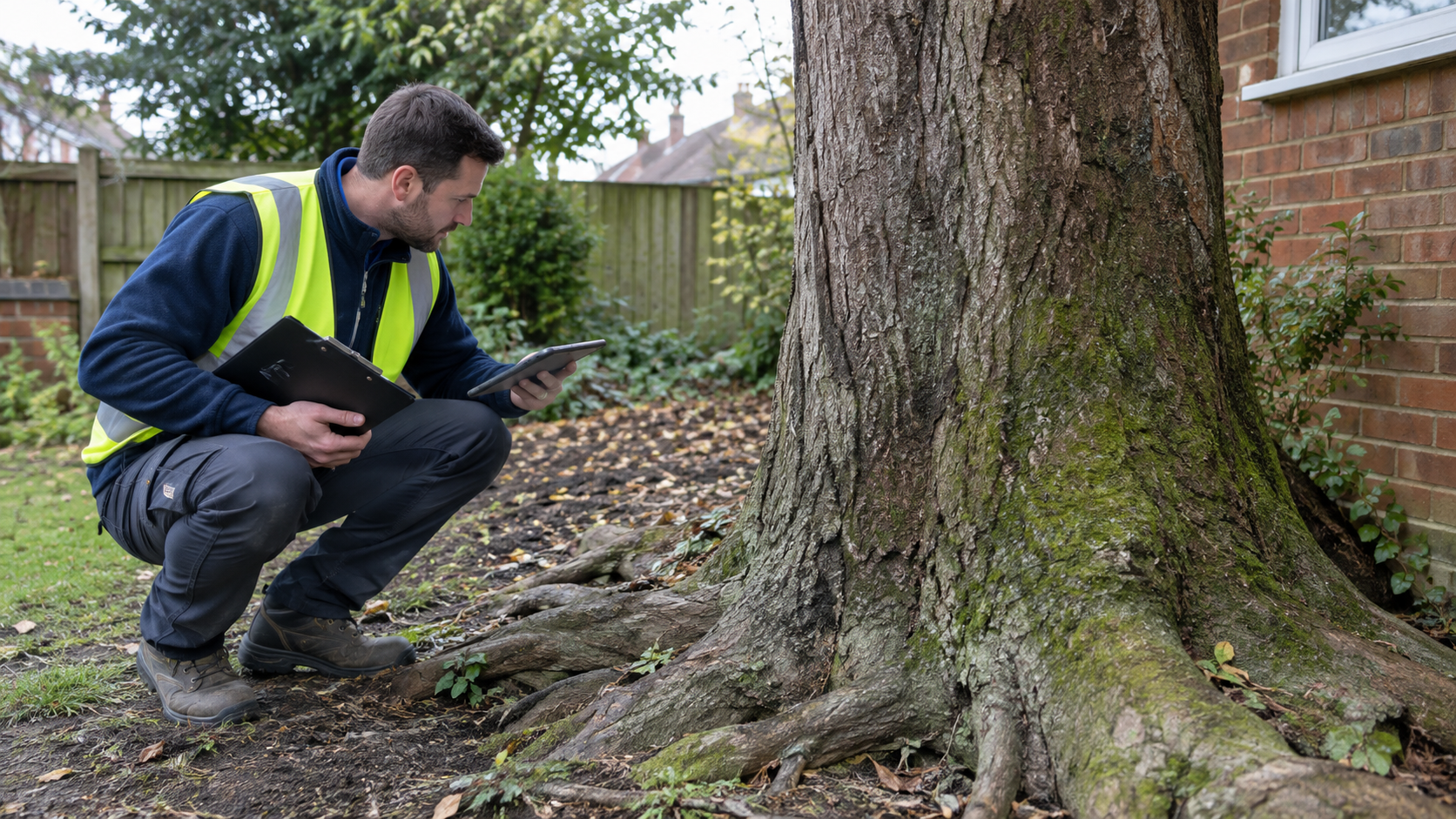
Mature garden and street trees in suburban England are the most common subjects of a tree preservation order.
Councils can make an order wherever it is “expedient in the interests of amenity”. The law does not define amenity, but GOV.UK planning guidance says authorities look at how visible the tree is to the public, its individual and collective impact on the landscape, and any wider value such as screening, rarity or historical significance. Scotland, Wales and Northern Ireland run separate regimes, so everything below applies to England unless stated otherwise.
The four types of TPO
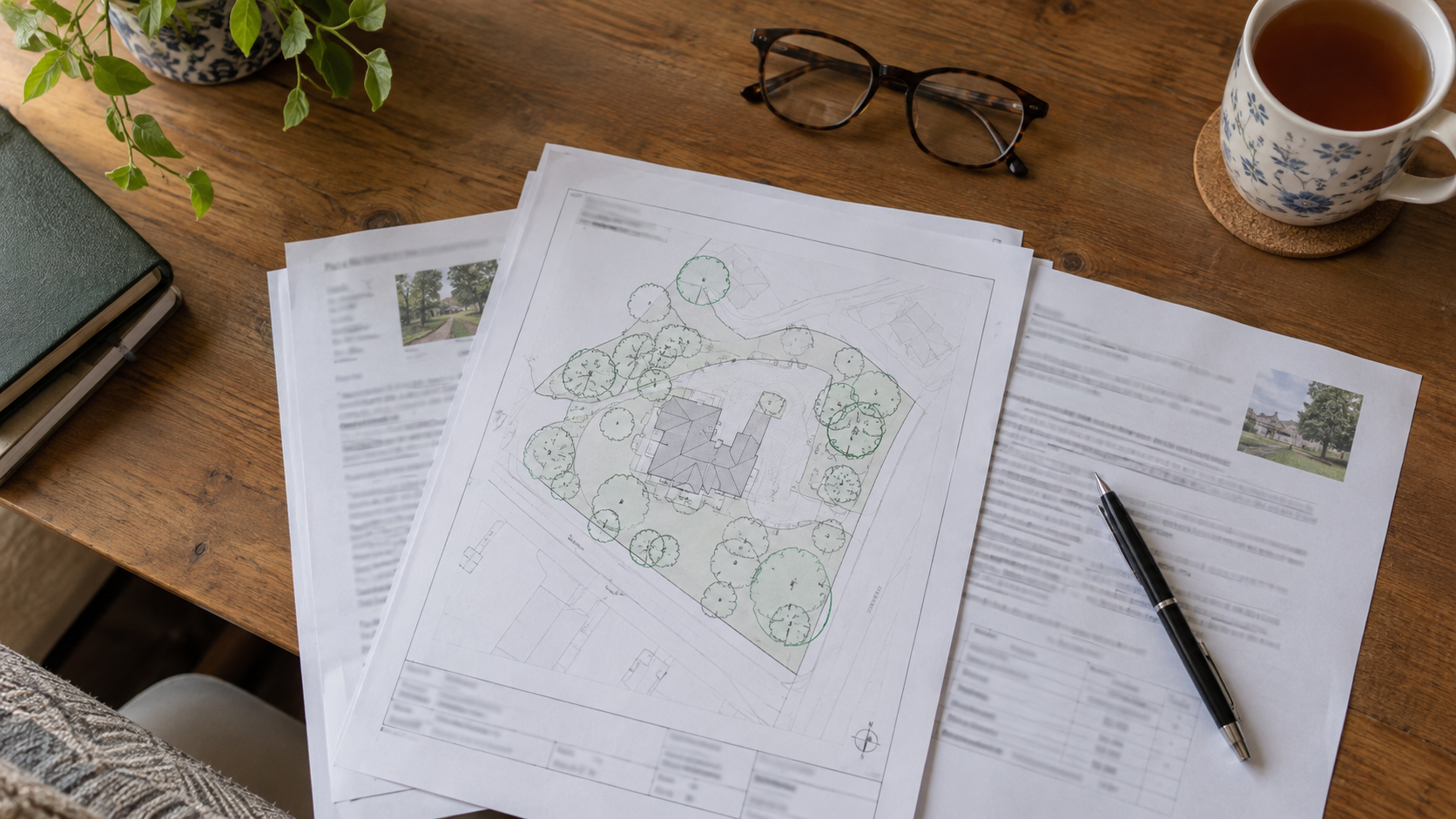
Individual: a single named tree, usually plotted on the order plan with a reference such as T1.
Group: several trees protected together because their collective value is greater than any one specimen.
Area: all trees of a specified type standing within a defined boundary on the date the order was made. Trees planted later are not automatically covered. GOV.UK describes this category as a short-term emergency measure.
Woodland: every tree within the boundary, including saplings and self-seeded trees that grow after the order is made.
Shrubs and hedges are not normally protected, although a line of mature trees in an old hedge can be. An order takes effect on the day it is made, lasts provisionally for six months, and must be confirmed within that window or it lapses. Anyone with an interest in the land is served a Regulation 5 notice and has at least 28 days to object on any grounds. There is no right of appeal against a council making or confirming an order.
How do I check if a tree has a TPO?
This is the question that catches most people out, because protected trees are not labelled and the register is held locally. Follow these steps before you so much as book a tree surgeon:
Ask the right council. TPOs are made by the district, borough, city or unitary authority, not the county council. Most publish a searchable map or a TPO register on their planning pages.
Check conservation area status at the same time. A tree can be protected by a conservation area even if no TPO exists (see below).
Confirm with the tree officer. Online registers can lag behind newly made orders. A quick email asking for written confirmation protects you if a dispute arises later.
Review your conveyancing pack. The local authority search (CON29) returns during a purchase should reveal TPOs and conservation areas affecting the property. If you are already in the buying process, ask your conveyancer and your surveyor to cross-check.
Look at neighbouring land. A TPO on a neighbour’s tree still binds you: you cannot cut back overhanging branches of a protected tree without consent, even though the common-law right to prune to the boundary would otherwise apply.
If you are buying, a Level 3 building survey will note large trees close to the house and recommend further checks where they could affect foundations or drains. Our guide to Level 3 house surveys explains what the surveyor looks at and why mature trees are flagged.
What work needs consent under a tree preservation order?
Any cutting down, topping, lopping, uprooting, wilful damage or wilful destruction of a protected tree needs the council’s written consent. Government guidance confirms that cutting roots also requires consent, and arboricultural practice treats soil compaction, trenching for services or laying hard surfaces over the root protection area as damage. In practical terms that means you need consent for:
felling or removing a tree;
crown reduction, crown lifting, thinning or pollarding;
removing live limbs, including branches overhanging your garden from a neighbour’s protected tree;
excavating foundations, drains or driveways within the root protection area;
root pruning to deal with subsidence or drain damage.
Removing dead branches from a living tree does not need consent, and routine maintenance such as clearing leaves or mulching is unaffected. The order does not oblige you to maintain the tree to any particular standard, and the council cannot require you to carry out work simply because the tree is protected.
How to apply for consent to work on a protected tree
Applications are made on the standard tree works form, either through the Planning Portal or directly to the council. There is no application fee. A valid application needs:
a plan clearly identifying the tree or trees;
a precise description of the work (for example “crown reduce by 2 metres to previous reduction points”, not “tidy up”);
your reasons for the work;
supporting evidence where relevant, such as an arboricultural report, a structural engineer’s report on subsidence, or a drainage survey.
A clear site plan and a precise description of the works are the two things councils most often ask applicants to resubmit.
The council should check the application is valid within three working days and must decide within eight weeks. It can grant consent unconditionally, grant it subject to conditions (replanting is the most common), or refuse. If it refuses, imposes conditions you object to, or fails to decide within eight weeks, you can appeal to the Secretary of State via the Planning Inspectorate under Regulation 19 of the 2012 Regulations. Consent normally lasts two years. Where a refusal or condition causes you loss, a compensation claim of at least £500 can be made within 12 months of the decision.
TPO process at a glance
Stage
Timescale or rule
Notes
Council makes a TPO
Takes effect immediately; provisional for 6 months
Must be confirmed within 6 months or it lapses
Objection window
At least 28 days from the Regulation 5 notice
Objections can be made on any grounds; no appeal once confirmed
Application for consent to work on a tree
No fee; council validates within 3 working days; decision within 8 weeks
Appeal to the Planning Inspectorate on refusal, conditions or non-determination
Consent validity
2 years by default
Council may set a different period in the decision
Dead tree exemption
5 working days’ written notice before felling
Dead branches on a living tree need no notice
Conservation area tree (no TPO)
6 weeks’ notice under section 211
Council may make a TPO in that window; work may proceed within 2 years if it does not
Compensation claim after refusal
Minimum £500; within 12 months of the decision
Claimed from the local planning authority
Prosecution for destroying a tree
Unlimited fine; triable either way
Court must consider any financial benefit gained
Lesser breach (e.g. unauthorised pruning)
Fine up to level 4, currently £2,500
Summary offence in the magistrates’ court
Which exemptions apply to a tree preservation order?
The 2012 Regulations narrowed the old “dead, dying or dangerous” exemption, and many of the prosecutions reported in 2025 and 2026 involve people who assumed an exemption applied when it did not. The main exemptions in England are:
Dead trees: you may remove a dead tree after giving the council five working days’ written notice. A dying or unhealthy tree is not a dead tree.
Dangerous trees: you may carry out only the work needed to remove an immediate risk of serious harm, and must notify the council in writing as soon as practicable afterwards. Keep photographs and, ideally, a written opinion from a qualified arboriculturist, because you carry the burden of proving the danger.
Fruit trees: work on commercial fruit trees in the course of a business, and pruning cultivated fruit trees in line with good horticultural practice, is exempt.
Full planning permission: works that are strictly necessary to implement a full (not outline) planning permission are exempt. Permitted development rights do not qualify, so an extension built without a planning application gives no cover for touching a protected tree. See our guide to permitted development rights in 2026.
Other statutory exemptions: work by or for statutory undertakers, compliance with an Act of Parliament, preventing or abating a legal nuisance (a genuine actionable nuisance, not leaf-fall or shade), and work by the Environment Agency or drainage bodies.
What are the penalties for breaching a tree preservation order?
Section 210 of the Town and Country Planning Act 1990 creates two offences. Cutting down, uprooting or wilfully destroying a protected tree, or wilfully damaging it in a way likely to destroy it, is triable either way and carries an unlimited fine in both the magistrates’ court and the Crown Court (the former £20,000 magistrates’ cap was removed in 2015). Section 210(3) requires the court to have particular regard to any financial benefit that has accrued or is likely to accrue from the offence, which is why cases involving development plots or improved views attract the largest penalties. Any other contravention, such as unauthorised pruning, is a summary offence with a maximum fine at level 4 on the standard scale, currently £2,500. Anyone who “causes or permits” the work is also liable, so the landowner, the tree surgeon and a managing agent can all be prosecuted. You can read the section in full on legislation.gov.uk.
Recent prosecutions: what the courts are doing in 2025 and 2026
Newport, August 2025: Newport Crown Court dismissed a homeowner’s appeal against a £16,000 fine for felling a 100-year-old protected lime tree. The court assessed the uplift in property value at around £50,000 and awarded the council £100,000 in costs, according to the counsel’s report of the case (published 28 August 2025).
East Hertfordshire, January 2026: a Tewin resident who felled nine protected hornbeams pleaded guilty at Stevenage Magistrates’ Court on 23 January 2026 and was ordered to pay £7,652.70 in total (a £2,307 fine, £923 victim surcharge and £4,422.70 costs). He cited a 2020 surveyor’s report and a tree falling on his house in 2021 in mitigation, but had not applied for consent, as reported by the Bishop’s Stortford Independent.
North Devon, May 2026: a tree surgeon and four residents of Magnolia Close, Barnstaple, pleaded guilty at Barnstaple Magistrates’ Court on 5 May 2026 to damaging eight protected woodland trees whose canopies had been removed, cutting their height by around 10 metres. The contractor was ordered to pay £4,252 and each resident £780. North Devon Council said no one had checked whether a TPO applied.
The common thread is simple: nobody checked. The sums involved are modest compared with the Newport case, but each defendant also acquired a criminal record and, in the woodland case, the trees are permanently disfigured.
The duty to replant
If a protected tree is removed in breach of the order, or removed because it was dead or dangerous, the landowner must plant a replacement of appropriate size and species in the same place as soon as reasonably practicable. The replacement is automatically covered by the original TPO, the duty passes to subsequent owners of the land, and the council can enforce it with a tree replacement notice. That is worth remembering if you are buying a plot where a tree has recently disappeared.
Trees in conservation areas: the six-week notice rule
Trees in a conservation area that are not covered by a TPO are protected by section 211 of the 1990 Act. Before cutting down, topping, lopping or uprooting a tree with a trunk diameter over 75 mm measured at 1.5 m above ground (100 mm where the work is thinning to help other trees grow), you must give the council six weeks’ written notice. The council cannot refuse a section 211 notice, but it can respond by making a TPO within the six weeks. If it does not, you may carry out the notified work within two years. Carrying out works without notice is an offence with the same penalties as breaching a TPO, and the replanting duty applies. If you are planning work on a period property, our guide to conservation area rules covers the wider restrictions on extensions, windows and boundary treatments.
Why a tree preservation order matters to buyers, owners and surveyors
A TPO is not just a gardening issue. It shapes the structural risk profile of a house, what you can build, and what the property is worth.
A protected tree close to the house changes the surveyor’s advice on subsidence risk, drainage and extension design.
Subsidence and shrinkable clay
Tree roots drawing moisture from shrinkable clay are the leading cause of domestic subsidence in the UK. Insurer Zurich reported in June 2023 that in a typical year around 60% of subsidence claims are caused by root-induced clay shrinkage, and that the industry recorded roughly 23,000 domestic subsidence claims in 2022, the highest since 2018. Where the offending tree is protected, you cannot simply remove it: your surveyor or engineer will need to evidence the link between the tree and the movement, and the council will weigh that evidence against the tree’s amenity value before granting consent. Our guide on how surveyors check for subsidence explains the monitoring and investigation involved, and if you have noticed movement already, read why cracks appear in walls.
Extensions, drives and outbuildings
Any development near a protected tree will normally require a BS 5837:2012 tree survey, an arboricultural impact assessment and a tree protection plan as part of the planning application. Councils routinely refuse schemes that encroach on the root protection area, and planning conditions often require fencing around the tree for the duration of the build. Factor this into the budget and design early; our house extension cost guide for 2026 and our overview of the role of surveys in planning permission show where tree constraints add cost and time.
Valuation and resale
A protected tree can add value through character and screening, or reduce it where it blocks light, limits development potential or sits close to foundations on clay. A valuer preparing a Red Book report will note the TPO and any related structural evidence, and buyers’ lenders may ask for a structural engineer’s report where cracking is present. Disclosing the TPO on the Property Information Form (TA6) is expected, and failing to do so can lead to claims after completion.
Practical checklist before you touch any tree
Check the council’s TPO register and conservation area map, then get written confirmation from the tree officer.
Instruct a competent arboriculturist to specify the work; vague descriptions are the main cause of invalid applications.
Submit the free tree works application and diarise the eight-week decision date.
If you believe a tree is dead or dangerous, photograph it, obtain a written professional opinion and give the required notice. Do only the minimum necessary.
Ask your contractor to show you the consent before starting. Reputable tree surgeons will refuse to work on a protected tree without it.
If the tree is implicated in subsidence or drain damage, commission a survey first so your application is backed by evidence.
Why choose Survey Merchant for your tree preservation order survey?
When a protected tree sits near a house you own, are buying or want to extend, the questions are structural, legal and financial at the same time. Survey Merchant brings those strands together:
Accredited, correctly matched surveyors: our panel includes suitably qualified surveyors accredited or regulated by bodies such as RICS, CIOB and RPSA, so a subsidence investigation, a pre-purchase Level 3 survey and a pre-planning condition report each go to the right specialist.
Nationwide coverage with local knowledge: surveyors who know the clay belts of London and the South East, and the local council tree officers and validation requirements, deliver more useful reports.
Fast turnaround: when an eight-week consent clock or an exchange deadline is running, we prioritise inspection dates and report delivery.
Transparent fixed fees: you receive a clear quote before you instruct, with no surprise extras.
Impartial, evidence-led advice: we are independent of tree contractors and developers, so our recommendations reflect the condition of the building and the risk to it, not a sales target.
End-to-end support: from identifying a TPO during a building survey to providing the structural evidence a council expects with a tree works application, and liaising with your planning consultant or solicitor where disputes arise.
Whether you need a pre-purchase building survey, a subsidence investigation or a valuation that properly reflects a protected tree, contact Survey Merchant for a fixed-fee quote today.
How do I find out if a tree has a tree preservation order?
Check the TPO register or map on your district, borough or unitary council's planning website, check whether the property is in a conservation area, and ask the council's tree officer for written confirmation. There is no national TPO map, and online registers can lag behind newly made orders.
Can I cut down a tree with a TPO on my own property?
Not without the council's written consent. You must submit a free tree works application explaining the work and your reasons; the council has eight weeks to decide. The only exemptions are narrow, such as a dead tree (five working days' notice) or work urgently needed to remove an immediate danger.
What is the fine for breaching a tree preservation order in 2026?
Cutting down, uprooting or wilfully destroying a protected tree carries an unlimited fine in both the magistrates' court and the Crown Court, and the court must consider any financial benefit gained. Lesser breaches such as unauthorised pruning carry a fine of up to 2,500 pounds. Prosecutions in 2026 have resulted in total payments from 780 pounds to over 7,600 pounds per defendant, and a 2025 Newport case upheld a 16,000 pound fine plus 100,000 pounds in costs.
Does a tree preservation order apply to trees in a conservation area?
Trees in a conservation area are protected even without a TPO. You must give the council six weeks' written notice under section 211 of the Town and Country Planning Act 1990 before felling or pruning a tree with a trunk over 75 mm in diameter at 1.5 m. The council may respond by making a TPO; if it does not, the work can proceed within two years.
Can I prune a neighbour's protected tree that overhangs my garden?
No. The usual common-law right to cut overhanging branches back to the boundary does not override a TPO. You need the council's consent for any live-branch pruning, even on the parts overhanging your land. Removing dead wood from a living tree is allowed without consent.
How does a tree preservation order affect a house survey or extension?
A surveyor will flag large protected trees near the house because tree roots in shrinkable clay are the leading cause of UK subsidence, and because you cannot simply remove the tree to solve the problem. Extensions or driveways near a protected tree normally need a BS 5837 tree survey and a tree protection plan with the planning application, which adds cost and time. A suitably qualified, accredited surveyor can provide the evidence a council expects.