We use cookies to improve your experience on our site, analyze site traffic, and assist in our marketing efforts. By clicking "Accept all," you agree to the storing of cookies on your device. You can choose to "Reject all" non-essential cookies. For more information, please read our Cookie Policy.
UK Rental Market September 2026: Zoopla Shows Average Rent Hits £1,343 as Supply Squeezes
Zoopla's September 2026 Rental Market Report reveals average UK rents have reached £1,343, up 2.6% year-on-year, as supply falls to its lowest level in three years and Zoopla revises its full-year growth forecast up to 4-5%.
Zoopla's September 2026 Rental Market Report puts the average UK rent for a new let at £1,343 a month, up 2.6% (£30) year-on-year. Rents are climbing faster than the national average in roughly three-quarters of local markets, rental stock sits about 25% below pre-pandemic levels, and the strongest increases are concentrated in northern England, reversing the supply recovery seen between 2024 and 2025.
Key Takeaways
Average UK rent for new lets reached £1,343 in September 2026, a 2.6% annual rise, according to Zoopla.
Outside London, the average rent is £1,097, up around 2.5% year-on-year.
Rental supply has fallen for the first time in three years, down 3% annually and 6% in August 2026 alone.
Rents are rising faster than the national average in about 75% of local areas.
Zoopla has revised its 2026 rental growth forecast upward, from 2-3% to 4-5% by year-end.
Tenant demand per listing has hit roughly 5.3 enquiries, up 6% year-on-year.
Weak landlord investment, higher financing costs, and stricter regulation are limiting new rental stock.
Cheaper rental markets, those under £750 a month, are seeing annual growth of about 5.4%.
What Does the Zoopla September 2026 Rental Report Say
Zoopla's September 2026 Rental Market Report confirms that rental affordability has become the defining story of the autumn housing cycle, with the average new-let rent at £1,343 a month, a fresh record for the national market.
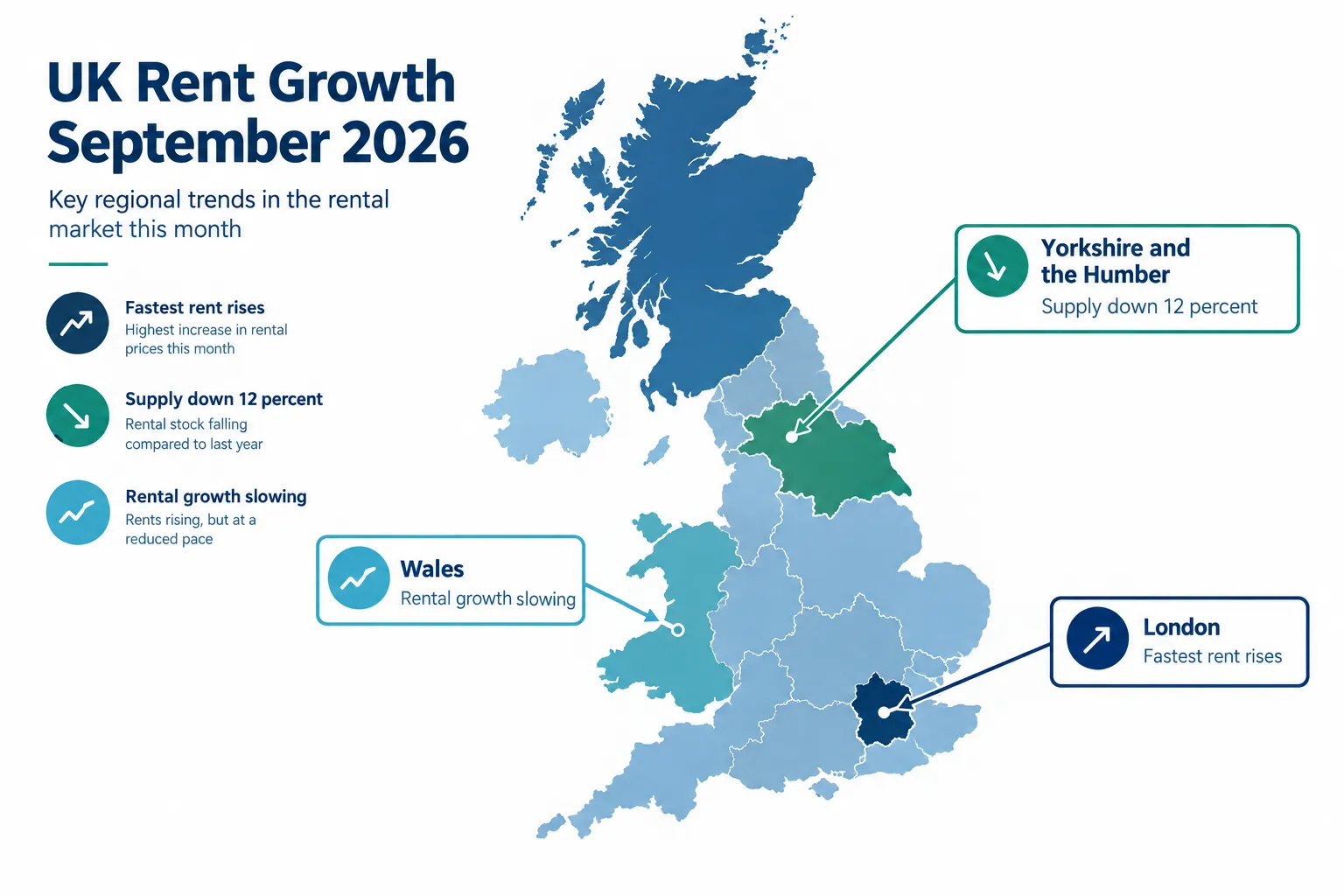
Regional rent trends across the UK in September 2026
The report breaks the headline figure down further: UK average (including London) is £1,343 per month, up 2.6% year-on-year; UK average excluding London is £1,097 per month, up around 2.5%; rents are rising faster than the national average in about 75% of local areas tracked by Zoopla; and available rental homes sit roughly 25% below pre-pandemic levels, a structural shortfall that predates the current acceleration.
London continues to pull the national average upward, but the report's most notable finding is the breadth of the increase. When three in four local markets are outpacing the national growth rate, the pressure is no longer confined to a handful of hotspots. It is a shared experience across most of the country.
Why Is UK Rental Market Supply So Tight in 2026
Rental supply is tight because fewer landlords are adding new stock while demand from renters keeps climbing, a combination Zoopla says has ended three years of gradual supply recovery. The result is a market where every available property attracts more competition than it did twelve months ago.
Several forces are converging: falling landlord investment as new buy-to-let purchases slow; supply reversing since May 2026, with the number of new listings running below 2025 levels; a sharp August drop, with available rental properties falling 6% in August 2026 alone compared with August 2025; and rising mortgage rates pushing would-be first-time buyers back into renting.
Common mistake: assuming the supply squeeze is a London-only phenomenon. In fact, Yorkshire and the Humber has recorded supply falls of around 12%, sharper than London's 6% drop, showing the shortage is a national issue rather than a capital-city one.
How Much Has Rent Increased Compared to Last Year
UK rents for new lets rose 2.6% year-on-year to £1,343 in September 2026, up from £1,313 a year earlier, according to Zoopla. That annual growth rate has been climbing steadily through the year: February 2026 saw 1.6% annual rental growth; July 2026 growth accelerated to 2.6% with average rent around £1,340; September 2026 holds near 2.6% with the average edging up to £1,343.
This is not a one-off spike. It is a re-acceleration after a period of relative calm, and Zoopla's forecasters now expect the annual rate to reach 4-5% by the close of 2026 as supply keeps tightening. Renters signing a new tenancy in September 2026 are, on average, paying £30 a month more than they were in September 2025.
Regional Snapshot from Zoopla's Report
Region
Rent trend
Supply change
Notes
London
Fast rise
Down ~6%
Highest absolute rents nationally
Yorkshire and the Humber
Fast rise
Down ~12%
Sharpest supply fall of any region
Wales
Slowing
Up ~7%
Only major region with rising supply
Sub-£750 markets
Growth ~5.4%
Tight
More than double the national rate
The pattern suggests that cheaper, historically overlooked rental markets, often in the North and in parts of Wales's neighbouring English regions, are now absorbing some of the sharpest cost increases, hitting lower-income tenants hardest.
Is £1,343 Average Rent Affordable
A national average of £1,343 a month stretches most single incomes and many dual-income households, particularly outside London where wages are typically lower even though rents there average £1,097. Affordability depends heavily on location, household income, and whether a tenant is renting alone or sharing costs.
Zoopla's own commentary frames affordability as the key brake on future rent growth: landlords cannot push rents indefinitely if tenant incomes fail to keep pace. Even so, media coverage of the September report describes a gloomy forecast for tenants, warning that rises, while still below general inflation, are set to accelerate further into 2026.
What Renters Can Do About Rising Costs
Renters facing rising costs in September 2026 have practical levers: negotiate at renewal, widen the search radius, consider flat-shares, and act quickly on new listings given the current 5.3 enquiries per property. First-time renters, who lack an existing tenancy to fall back on, are hit hardest because they enter the market cold, often competing against multiple applicants for a single property.
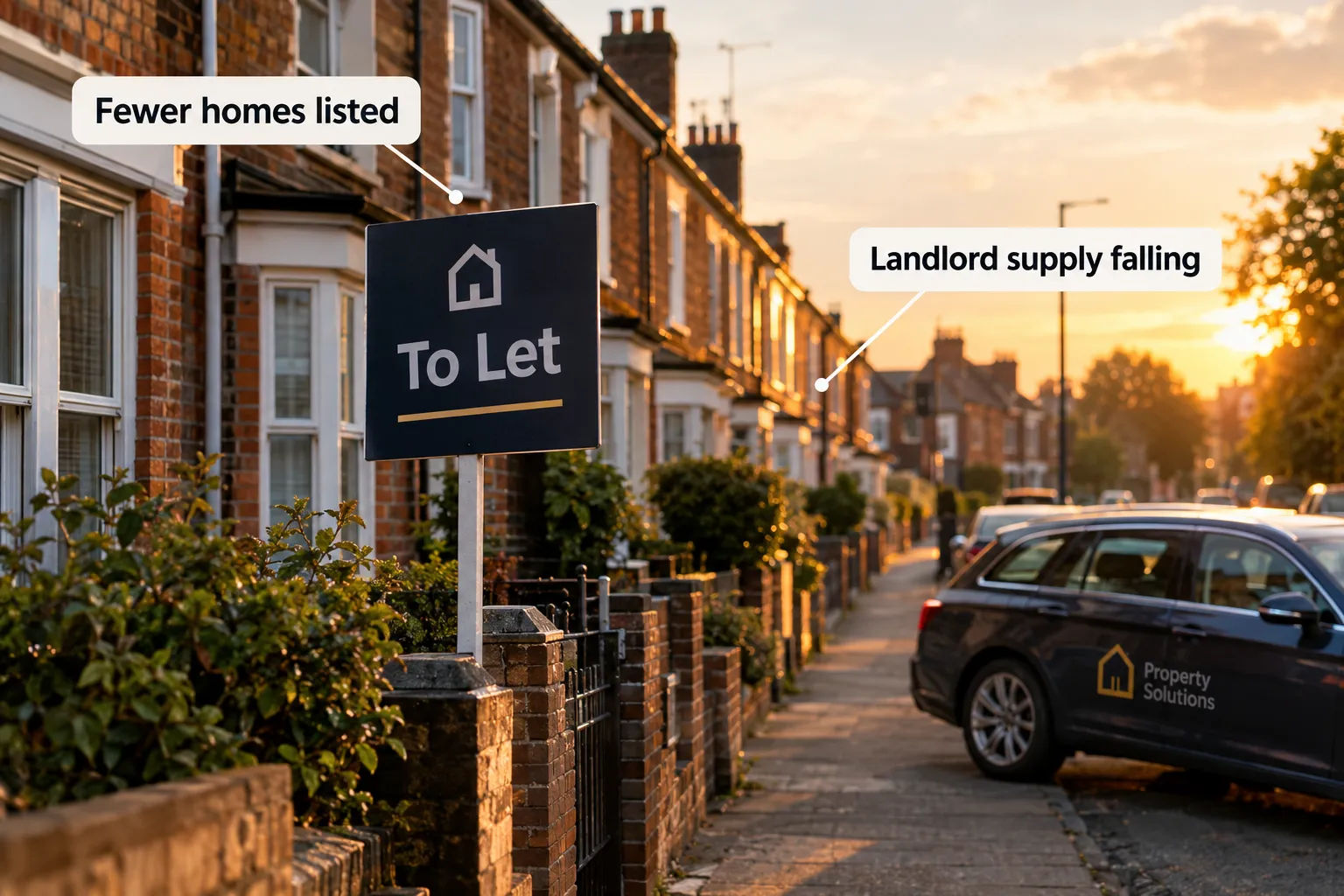
Fewer rental homes are reaching the market as landlord supply falls
Practical steps for tenants right now: check the local growth rate, not just the national figure; move fast on viewings; negotiate before renewal using comparable local listings as leverage; consider slightly cheaper regions if flexible on location, though note that sub-£750 markets are seeing the fastest annual growth of all at around 5.4%; and budget for a longer search since first-time renters especially should allow extra weeks before a move-in date.
Are Landlords Leaving the Rental Market
Some landlords are scaling back or exiting, while others are simply not reinvesting in new rental stock, and this pullback in investment is a central driver of the current supply squeeze. It is less a mass exodus than a slow-down in the pipeline of new rental homes reaching the market. Higher financing costs for buy-to-let mortgages squeeze yields; greater regulation raises compliance costs; and tax pressures reduce the attractiveness of expanding a portfolio.
Zoopla explicitly links low levels of new landlord investment, alongside tenants renting for longer, to its forecast of 4-5% rent growth by the end of 2026. Fewer landlords entering the market, combined with existing tenants staying put longer, means fewer properties cycle back onto the open rental market each month.
Will UK Rents Continue to Rise After September 2026
Yes. Zoopla's own forecast, updated as part of the September 2026 report, points to annual rent growth of 4-5% by the end of 2026, up from the current 2.6% rate, driven by tightening supply and resilient demand. Earlier in 2026, Zoopla had pencilled in a more modest 2-3% for the full year, but the pace of supply losses since May forced a revision upward.
For landlords, this signals room to raise rents at renewal, tempered by the affordability ceiling. For tenants, it signals that waiting for conditions to ease is unlikely to pay off in the near term. For property surveyors and valuers, rising rental yields feed directly into investment appraisals and should be reflected in updated rental comparables when valuing buy-to-let stock.
FAQ
What is the average UK rent as of September 2026? Zoopla's September 2026 Rental Market Report puts the average UK rent for a new let at £1,343 a month, up 2.6% year-on-year.
Why are rents rising faster in some areas than others? Local supply and demand imbalances vary by region. Areas like Yorkshire and the Humber have seen supply fall by around 12%, driving faster rent growth, while Wales has seen supply rise 7% and growth slow.
Is rental supply really 25% below pre-pandemic levels? Yes, according to the September 2026 report's supply analysis, current rental stock sits around a quarter below pre-pandemic availability, on top of a fresh 3% annual decline and a 6% drop in August 2026 alone.
Will rents keep rising for the rest of 2026? Zoopla forecasts annual rent growth accelerating to 4-5% by year-end 2026, up from the current 2.6%, due to falling supply and steady demand.
Are landlords leaving the rental market? Not en masse, but new landlord investment has slowed sharply, and existing landlords face higher financing costs and regulation, which limits new rental stock reaching the market.
Conclusion
The UK rental market in September 2026 is, at its core, a supply story. Demand has not spiked dramatically, but the pipeline of new rental homes has thinned for the first time in three years, and that alone is enough to push growth from 1.6% in February to 2.6% by September, with 4-5% forecast by year-end. For tenants, the practical response is to move fast, negotiate hard at renewal, and treat sub-£750 markets with caution. For landlords, the current climate rewards those still investing. For surveyors and letting professionals, updating rental comparables and yield assumptions now, rather than waiting for the year-end figures, will produce more accurate advice for clients navigating this tightening market.
Related guides
No items found.
Book a RICS surveyor
Survey Merchant provides vetted RICS surveyors across 100+ UK locations at fixed fees: