Building Surveying
Aug 2, 2026
How to qualify leads for surveyors: a practical guide
Discover how to qualify leads for surveyors effectively. Streamline your process and convert more inquiries into projects with essential strategies.

Lead qualification for surveyors is the methodical process of filtering and scoring potential clients to ensure your time and resources focus on viable property surveying projects. Without a structured approach, surveyors waste hours on site visits that never convert, chasing enquiries from clients outside their service area or without the authority to commission work. The solution is a combination of structured intake questions, modern lead scoring, and digital tools that together form what the industry calls a lead qualification framework. This guide covers the essential steps, scoring models, and best practices that real estate professionals need to convert more enquiries into confirmed instructions.
The five most effective questions to qualify surveying leads before a site visit are full project address, budget range, start date, decision-making authority, and payment method. Asking these consistently eliminates most unqualified site visits and protects your crew’s time. Each question serves a specific filtering purpose, not just data collection.
Here is what to ask and why each question matters:
Professional standards recommend asking 6 to 10 qualification questions to confirm project fit, urgency, location, scope, and budget. Fewer than six and you risk booking unsuitable visits. More than ten and the intake process starts to feel like an interrogation, which damages client experience before the relationship has begun.
Pro Tip: Treat first contact as a structured intake interview, not a sales call. Asking clients to send photos of the property before any discussion of fees helps you identify scope, flag potential specialist cases, and avoid unsuitable visits entirely.
Automate this process wherever possible. Online intake forms, phone scripts, and AI chatbots can collect these answers before a human ever picks up the phone. Tracking which lead sources generate the most qualified enquiries also lets you refine your marketing spend over time.
Lead scoring is the practice of assigning numerical values to leads based on their characteristics and behaviour, then ranking them so you contact the most promising prospects first. High-performing lead scoring models weight behavioural signals at 35–45% and firmographic fit at 20–30%, with buying intent signals at 20–30%. This composite approach outperforms older models that relied solely on profile matching.
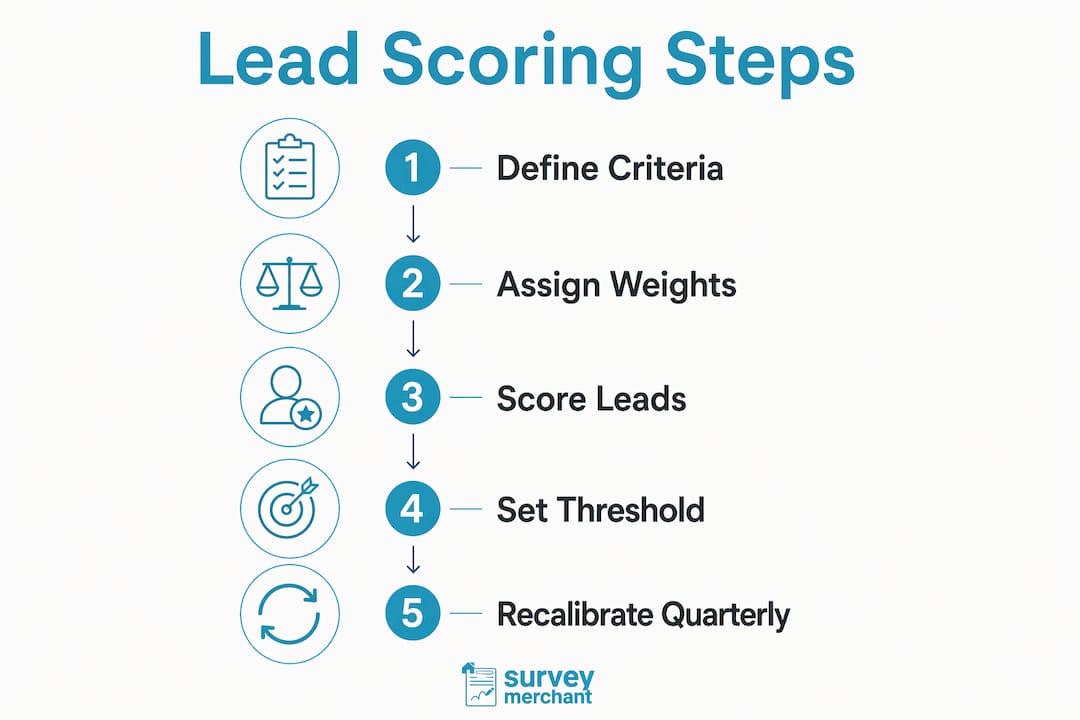
Here is how each scoring component applies to surveying:
| Scoring signal | Weighting | Surveying example |
|---|---|---|
| Behavioural signals | 35–45% | Visited pricing page, downloaded a building survey checklist, returned to site twice in one week |
| Firmographic fit | 20–30% | Property type matches your specialisation, location within service area, transaction type aligns with your services |
| Buying intent | 20–30% | Requested a quote, asked about availability, mentioned a specific survey type by name |
| Negative scoring and decay | 10–15% | No activity for 30 days, enquiry from a competitor firm, property outside service area |
Behavioural signals carry the most weight because they reflect active engagement. A lead who has visited your building survey checklist three times and downloaded a guide is demonstrably more interested than one who filled in a contact form once and went quiet.
Negative lead scoring improves model accuracy by 12–15% when combined with decay logic. Decay logic automatically reduces a lead’s score when they have shown no activity for a defined period, typically 30 to 60 days. This prevents your pipeline from filling with stale enquiries that distort your conversion forecasts.
Pro Tip: Set a threshold score that a lead must reach before it triggers a site visit booking. Align that threshold with your historical conversion data. If leads scoring above 70 convert at twice the rate of those scoring 50, your threshold should sit at 70 or above.
Lead scoring models must be recalibrated quarterly to prevent score drift, where cold or irrelevant leads accumulate points and get prioritised erroneously. Treat your scoring model as a living system, not a one-time setup. Review which signals actually predicted conversion each quarter and adjust weightings accordingly.
The right technology removes the manual burden from lead qualification and makes the process consistent across every enquiry. The table below summarises the main tool categories and their practical application for surveying professionals.

| Tool type | Examples | Key function for surveyors |
|---|---|---|
| CRM with lead scoring | HubSpot, Salesforce, Pipedrive | Score and route leads automatically based on intake data and behaviour |
| AI chatbots | Tidio, Intercom, Drift | Conduct structured 24/7 intake, collect property photos, filter unqualified leads before human contact |
| Intent data platforms | Bombora, G2 | Identify prospects actively researching surveying services online |
| Scheduling automation | Calendly, HubSpot Meetings | Trigger booking links only when a lead crosses your qualification threshold |
| Form builders | Typeform, JotForm | Build multi-step intake forms that collect address, budget, timeline, and authority data upfront |
HubSpot and Salesforce both offer built-in lead scoring that integrates with your intake forms. A lead who completes a full intake form, confirms their budget, and books a callback automatically scores higher than one who submits only an email address. Pipedrive suits smaller surveying practices that need a straightforward pipeline without the complexity of enterprise CRM systems.
AI chatbots add particular value outside business hours. A prospect enquiring at 9pm on a Sunday can complete a full intake process, upload property photos, and receive an automated acknowledgement. By monday morning, your team has a scored, pre-qualified lead waiting rather than a cold contact form submission.
Third-party intent data from platforms like Bombora identifies companies or individuals actively researching topics related to property surveys, structural assessments, or building defects. Integrating this data with your CRM means you can reach out to prospects before they have even submitted an enquiry, giving you a significant timing advantage. For further guidance on qualifying construction clients, the process shares many of the same principles.
The most damaging mistake surveyors make is treating the first client contact as a sales pitch. Viewing first contact as an intake interview produces better qualification outcomes and fewer wasted site visits. The goal of the first conversation is to gather information, not to close a deal.
What to do:
What to avoid:
BANT remains a relevant baseline for qualifying transactional surveying leads when the property owner is the sole decision-maker. BANT stands for Budget, Authority, Need, and Timing. Use it as a checklist to confirm the four fundamentals are in place before investing further time in a lead.
Pro Tip: Never schedule a site visit without confirming both property access and decision-making authority. These two fields alone prevent the majority of wasted visits. Build them as mandatory fields in your CRM so no lead can progress without them.
For residential clients, the questions to ask before hiring a surveyor mirror the intake questions you should be asking on the other side of the transaction. Understanding what clients expect helps you design intake processes that feel natural rather than bureaucratic.
Qualifying leads for surveyors requires a structured intake process, a scored prioritisation model, and the right digital tools working together to eliminate wasted site visits and improve conversion rates.
| Point | Details |
|---|---|
| Ask the right intake questions | Confirm address, budget, timeline, authority, and access before booking any site visit. |
| Use a composite scoring model | Weight behavioural signals at 35–45% and firmographic fit at 20–30% for the most accurate prioritisation. |
| Apply negative scoring and decay | Removing inactive or out-of-area leads improves model accuracy by 12–15%. |
| Recalibrate your model quarterly | Score drift causes cold leads to be prioritised; review and adjust weightings every three months. |
| Filter by service area first | Local search intent is the primary disqualifier; never invest time in leads outside your operational area. |
I spent years watching surveying firms treat every enquiry as a potential instruction. The logic seemed sound: more visits, more conversions. The reality was the opposite. Surveyors were spending two hours travelling to properties that were outside their specialism, owned by tenants with no authority to commission work, or simply not viable at any fee level. The conversion rate looked acceptable on paper because nobody was tracking the cost of the failed visits.
The shift to structured intake changed everything. When you treat the first contact as an information-gathering exercise rather than a pitch, the dynamic changes immediately. Clients who are serious welcome the questions. Clients who are not serious drop off, which is exactly what you want. The intake process itself signals professionalism and filters out the time-wasters before they consume any real resource.
What surprised me most was how much the scoring model improved over time. The first version was rough. The weightings were guesswork. But after two quarters of recalibration against actual conversion data, the model started predicting outcomes with real accuracy. Leads scoring above the threshold converted at a rate that justified the investment in the process. Leads below the threshold rarely did.
The tools matter less than the discipline. HubSpot and Pipedrive are both capable platforms, but a well-maintained spreadsheet with clear stage-gate rules outperforms a poorly configured CRM every time. Start with the questions, build the scoring logic, then automate once the process is proven.
— Surveymerchant
Surveymerchant connects property professionals with qualified surveyors across the UK, covering everything from commercial property surveys to full Level 3 building surveys for complex residential projects. The platform is built around the same principle this article covers: matching the right surveyor to the right instruction, without wasted effort on either side.

For real estate professionals managing a pipeline of property transactions, Surveymerchant removes the friction of finding and vetting surveyors for each instruction. The panel covers structural assessments, defect inspections, party wall matters, and RICS valuations. Whether you are managing a single acquisition or a portfolio of commercial assets, Surveymerchant’s network gives you access to qualified professionals matched to your specific project requirements.
The five most critical questions are full property address, budget range, start date, decision-making authority, and payment method. These five alone eliminate the majority of unqualified site visits.
Lead scoring assigns numerical values to enquiries based on behaviour, property fit, and buying intent, then ranks them so surveyors contact the most promising leads first. A composite model weighting behavioural signals at 35–45% produces the most accurate results.
Lead scoring models should be recalibrated quarterly to prevent score drift, where inactive or irrelevant leads accumulate points and distort prioritisation. Quarterly reviews align the model with actual conversion data.
Local search intent and service area are the primary disqualifiers because a lead outside your operational area cannot convert regardless of budget or urgency. Filtering by geography first prevents all downstream wasted effort.
BANT stands for Budget, Authority, Need, and Timing. It works as a baseline checklist for transactional surveying leads where the property owner is the sole decision-maker, confirming the four fundamentals before any further investment of time.
Survey Merchant provides vetted RICS surveyors across 100+ UK locations at fixed fees:
→ Level 2 Home Survey (HomeBuyer Report)
→ Level 3 Building Survey (full structural survey)
→ RICS Red Book property valuations
→ Party wall surveyors — notices, awards & schedules of condition
→ Expert witness surveyors — CPR Part 35 reports for property disputes