Building Surveying
Sep 4, 2026
Commercial survey services list for UK property developers
Explore this comprehensive commercial survey services list for UK property developers. Ensure sound investments and avoid costly disputes.

Every commercial property transaction, lease event, or major refurbishment calls for a specific type of survey. The core commercial survey services list covers: Technical Due Diligence (TDD) or commercial building survey (pre-acquisition), schedule of condition (lease start), schedule of dilapidations (lease end), measured building survey (refurbishment or space planning), RICS Red Book valuation (finance or disposal), party wall survey (works affecting shared structures), asbestos survey (any pre-1999 building), fire risk assessment (statutory compliance), MEP/plant survey (mechanical and electrical due diligence), defect diagnosis and drainage survey (reactive or pre-purchase), and drone roof survey (large or inaccessible roofs).
The short version: commission a TDD on every acquisition and a schedule of condition at every lease start. Those two alone prevent the most expensive disputes.
Key commissioning triggers at a glance:
The term “structural survey” still appears in briefs, but RICS advises against it for commercial property. The correct terms are TDD or commercial building survey, and the distinction matters when you are appointing a team: a vague brief attracts vague proposals. Below is the full catalogue of types of survey services used across the UK commercial sector, with the professional responsible, typical deliverables, and the lifecycle stage that triggers each.
| Survey type | Who carries it out | Typical deliverables | When to commission |
|---|---|---|---|
| TDD / commercial building survey | RICS chartered building surveyor | Condition report, defect schedule, costed remedial estimates, limitations statement, photos | Pre-acquisition, pre-let |
| Schedule of condition | RICS chartered building surveyor | Photographic record, written condition schedule, agreed baseline | Lease start, pre-works |
| Schedule of dilapidations | RICS chartered building surveyor | Breach schedule, Scott Schedule, costed claim or counter-schedule | Lease end, mid-term |
| Measured building survey | RICS surveyor or specialist measurement firm | CAD floor plans, elevations, sections, GIA/NIA/GEA calculations | Refurbishment, space planning, letting |
| Topographical survey | Land surveyor or geomatics specialist | Ordnance Survey-referenced site plan, contours, features | Development, planning, drainage design |
| RICS Red Book valuation | RICS Registered Valuer | Formal valuation report, comparable evidence, assumptions | Finance, acquisition, disposal, dispute |
| Party wall survey | Party wall surveyor (often RICS) | Party wall award, schedule of condition of adjoining property | Pre-works affecting shared structures |
| Asbestos survey | Licensed asbestos surveyor (P402 qualified) | Management or refurbishment/demolition survey report, register | Any pre-1999 building; mandatory pre-demolition |
| Fire risk assessment | Competent fire risk assessor | Risk assessment report, action plan, compliance status | Statutory: all non-domestic premises; review post-alteration |
| MEP / plant survey | MEP consultant or building services engineer | Condition and capacity report, maintenance liability schedule | Pre-acquisition, refurbishment, lease event |
| Defect diagnosis / drainage survey | RICS building surveyor, structural engineer, drainage specialist | Defect report, CCTV drainage footage, structural calculations | Reactive, pre-acquisition, lease end |
| Drone roof survey | Drone operator (CAA-authorised) with surveyor oversight | Annotated aerial photography, condition report, thermal imaging | Large or inaccessible roofs, portfolio inspections |
| EPC (Energy Performance Certificate) | Accredited energy assessor | EPC certificate, asset rating, recommendations | Letting, sale, compliance |
| PPM survey | RICS chartered building surveyor | 5–10 year maintenance cost plan, priority schedule | Asset management, budgeting |
RICS defines TDD as the industry-standard approach for commercial property surveys and is explicit that the scope must be tailored to the asset lifecycle stage and the client’s brief. A pre-acquisition TDD for a 1970s industrial unit looks very different from one for a newly constructed office: the former needs asbestos management survey integration, a drainage CCTV run, and a costed remedial schedule; the latter focuses on defects liability and building envelope performance. The report typically contains a condition summary, a defect schedule with photographs, costed remedial estimates (where instructed), a statement of limitations, and recommendations for further specialist investigation.
This is the document that protects both landlord and tenant at lease start. It records the exact condition of the premises on the day the lease is signed, with photographs and a written schedule. Without it, a tenant faces a dilapidations claim at lease end based on a standard that may never have existed. Commissioned by either party, though tenants benefit most from insisting on one.
Party wall matters, dilapidations schedules and fire risk assessments are among the most frequent legal and contractual triggers for specialist surveys in commercial leases. A schedule of dilapidations sets out alleged breaches of the tenant’s repairing and decorating obligations. The landlord’s surveyor prepares it; the tenant’s surveyor responds with a counter-schedule. Survey findings here function as evidence in negotiations and, if unresolved, in litigation. They are not a substitute for legal advice on the lease covenants themselves: coordinate with a solicitor.
Accurate floor plans are the foundation of any refurbishment design, letting particulars, or rent review. Measured surveys are commonly priced from around £1,400 upwards for accurate floor plans and are frequently commissioned for design, refurbishment, and space management. The output is typically CAD drawings showing GIA (Gross Internal Area), NIA (Net Internal Area), or GEA (Gross External Area) depending on the purpose, along with elevations and sections where needed.
A formal valuation under the RICS Valuation Global Standards (Red Book) is required by lenders, for accounts, on disposal, and in disputes. Only a RICS Registered Valuer may sign a Red Book report. The report includes comparable transaction evidence, assumptions and special assumptions, and a certified opinion of value. It is not the same as a desktop appraisal or an indicative figure from an agent.
The Party Wall etc. Act 1996 requires notice to adjoining owners before certain works. If agreement is not reached, both parties appoint surveyors who jointly produce a party wall award. The award governs how works proceed, includes a schedule of condition of the adjoining property, and protects both sides from unsubstantiated damage claims. Failure to serve notice can halt a project entirely.
Any commercial building constructed or refurbished before 2000 may contain asbestos-containing materials (ACMs). The Control of Asbestos Regulations 2012 requires duty holders to manage ACMs. There are two main types: a management survey (for routine occupation and maintenance) and a refurbishment/demolition survey (required before any intrusive works). Both must be carried out by a surveyor holding the relevant BOHS P402 qualification or equivalent.
The Regulatory Reform (Fire Safety) Order 2005 requires a suitable and sufficient fire risk assessment for all non-domestic premises. It must be reviewed regularly and after any material alteration. The assessor must be competent; there is no statutory licensing regime, so check qualifications and professional body membership carefully.
Mechanical, electrical, and public health (MEP) systems are often the largest maintenance liability in a commercial building. An MEP survey assesses the condition, remaining life, and compliance of plant and services. It is particularly important in pre-acquisition TDDs for office buildings and industrial sites where plant replacement costs can run to hundreds of thousands of pounds.

Where a specific defect is identified or suspected, a targeted defect diagnosis report is more cost-effective than a full TDD. CCTV drainage surveys are almost always worth commissioning pre-acquisition on older stock: blocked or collapsed drainage is common and expensive to remediate. A structural engineer should be involved where the defect affects load-bearing elements.
For large flat roofs, multi-storey buildings, or portfolio inspections, a drone survey with a CAA-authorised operator reduces access costs significantly compared with scaffold or MEWP. Thermal imaging attachments can identify wet insulation or heat loss. The output should always be reviewed by a qualified building surveyor, not just the drone operator.
An Energy Performance Certificate is legally required on the letting or sale of most commercial premises. From April 2023, commercial landlords in England and Wales must hold a valid EPC; minimum energy efficiency standards are tightening. An accredited energy assessor produces the certificate and an asset rating from A to G.
Additional specialist inputs often commissioned alongside core surveys:
Pro Tip: When briefing a TDD, explicitly list excluded intrusive works in the instruction letter. State whether costed remedial estimates are required and at what level of detail. A brief that omits these points almost always generates scope-creep queries mid-instruction, which delays reporting and inflates fees.
Cost varies more by access, specialist testing, and the need for intrusive works than by the survey label itself. Budget for likely specialist inputs alongside the headline surveyor fee: that is where the real variation sits.
According to published UK cost guidance, typical ranges are:
| Survey type | Indicative UK cost range | Key price drivers |
|---|---|---|
| Schedule of condition | — | Size, number of photos, complexity |
| TDD / commercial building survey (SME) | — | Building size, age, access |
| TDD / commercial building survey (large/complex) | — | Specialist inputs, multiple buildings |
| Measured building survey | From £1,400 | Floor area, number of levels, CAD complexity |
| RICS Red Book valuation | — | Asset type, complexity, purpose |
| Asbestos management survey | — | Size, number of samples, lab fees |
| Fire risk assessment | — | Premises size, occupancy type |
| Party wall survey | — | Number of adjoining owners, complexity of works |
| Drone roof survey | — | Roof area, thermal imaging, report depth |
| MEP survey | — | Plant complexity, number of systems |
Factors that move the price:
Typical lead times:
For a small retail unit, a schedule of condition and a management asbestos survey together typically cost under £3,000 and complete within two weeks. A mid-size office acquisition with TDD, MEP survey, asbestos survey, and RICS valuation can run to £15,000–£20,000+ in total specialist fees, with a four-to-six-week programme. An industrial warehouse with contaminated land concerns, intrusive investigation, and a structural assessment sits at the upper end of the range. For more context on construction-related survey costs, see examples of construction surveys.
The most common procurement mistake is appointing on price alone. A low fee from a surveyor without sector experience in the asset type, or without adequate PI insurance, is a false economy.
Appointment checklist:
Questions to ask at tender stage:
Red flags:
Procurement options:
A single-practice TDD with subconsultants works well for most standard acquisitions: one point of contact, coordinated reporting, and clear liability. A coordinated multi-discipline team (separate structural engineer, MEP consultant, and building surveyor reporting independently) suits complex or high-value assets where specialist depth matters more than coordination simplicity. For types of surveyor qualifications and what to look for in credentials, the RICS provides detailed guidance.
Pro Tip: Ask whether the surveyor has carried out a survey on a comparable asset in the last 12 months. Recent, relevant experience is more useful than general years of practice. A surveyor who last inspected an industrial building five years ago may not be current on modern cladding systems or updated fire safety guidance.
RICS defines TDD as the industry-standard framework for commercial property surveys, and its guidance is explicit: the scope of services must be adapted to the asset lifecycle stage, not applied as a generic checklist. That distinction has real consequences for how you brief and budget.
The term “structural survey” is imprecise and RICS advises against its use in commercial briefs. Using “TDD” or “commercial building survey” in your instruction letter signals to the market that you expect a suitably qualified team and a report structured to professional standards. It also helps you compare proposals on a like-for-like basis.
RICS on TDD scope: The RICS technical due diligence standard states that the schedule of services should be tailored to the asset and the transaction stage, and that RICS members must only accept instructions for work they are competent to perform. A TDD brief that does not specify the lifecycle stage, required specialist inputs, and whether costed remedial estimates are needed will generate inconsistent proposals and variable-quality reports.
How TDD findings affect a commercial acquisition:
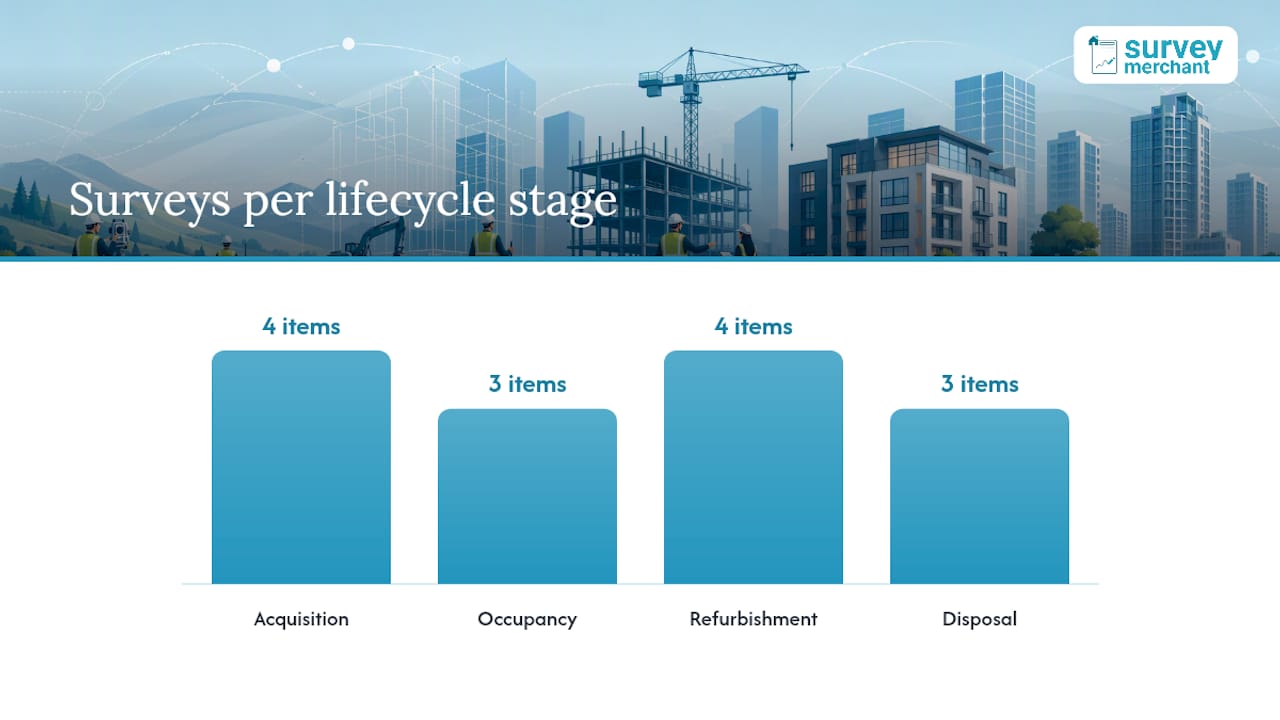
Lifecycle alignment:
RICS members are bound by the competence requirement: they must not accept instructions for work outside their expertise. When you appoint a chartered building surveyor for a TDD, confirm that MEP and structural elements are either within their competence or will be covered by named subconsultants. The RICS property surveyor guide sets out the full range of roles and responsibilities across the profession.
A guide to commercial property building surveys from RPS confirms that common survey types span building surveys, schedules of condition, dilapidations, party wall advice, measured surveys, valuations, defect diagnosis, PPM surveys, and specialist inputs including asbestos, fire risk, and MEP. The commercial building survey guide on Surveymerchant covers the full process and standards in depth for those who want a detailed walkthrough.
Commissioning the right survey at the right lifecycle stage is the single most effective way to control risk and cost in commercial property transactions and lease management.
| Point | Details |
|---|---|
| Prioritise TDD on acquisitions | Commission a TDD or commercial building survey before every acquisition; it is the primary tool for identifying defects and negotiating price. |
| Schedule of condition at lease start | Always agree and sign a schedule of condition at lease commencement to limit dilapidations liability at lease end. |
| Verify RICS credentials and PI insurance | Confirm RICS membership, chartered status, and current PI cover before appointing any surveyor; request a sample report. |
| Budget for specialist inputs | Asbestos surveys, MEP assessments, and structural engineers carry separate fees; include them in your total due diligence budget. |
| Use Surveymerchant to compare vetted surveyors | Surveymerchant connects you to RICS-accredited surveyors across the UK for commercial property surveys, valuations, and party wall services. |
The gap between a well-scoped survey instruction and a poorly scoped one is not a matter of budget. It is a matter of knowing what to ask for. Developers who brief a “structural survey” and receive a report that does not include costed remedial estimates, MEP commentary, or a limitations statement have not received bad service from a bad surveyor. They have received exactly what they asked for, which was not enough.
The commercial survey services list in this article is not exhaustive of every specialist input a complex asset might need, but it covers the core services that protect buyers, tenants, landlords, and lenders at every stage of the property lifecycle. The pattern I see repeatedly is that clients underinvest in the schedule of condition at lease start and then face a dilapidations dispute at lease end that costs multiples of what the survey would have cost. The same logic applies to asbestos: a management survey on acquisition costs a fraction of the liability exposure from undisclosed ACMs discovered during refurbishment.
Surveymerchant’s role is to remove the friction from finding the right surveyor for the right instruction. The platform connects clients to RICS-accredited surveyors across the UK, with impartial matching, access to sample reports, and quality assurance built into the process. That means you are not appointing blind on a Google search; you are comparing credentials, sample reports, and sector experience before you commit.
Knowing which surveys to commission is only half the job. Finding a suitably qualified surveyor, comparing their credentials and sample reports, and getting a clear fee proposal is where most developers lose time.

Surveymerchant is a UK marketplace that connects property developers, owners, and asset managers directly with RICS-accredited surveyors for the full range of commercial building surveying services. Describe your brief, compare sample reports and credentials from vetted surveyors on the panel, then book and pay the surveyor directly. No retainers, no agency mark-ups. For RICS valuations, visit the valuation services page; for party wall appointments, the party wall service covers awards and advice across the UK. Start your instruction at surveymerchant.com/service/commercial-property-surveys.
The sources below are the primary references for procurement standards, cost guidance, and regulatory requirements covered in this article.
| Source | Why it matters |
|---|---|
| RICS TDD standard (PDF) | The definitive RICS framework for commercial property surveys; sets out scope, competence, and lifecycle alignment requirements. |
| RICS TDD guidance page | Explains correct terminology, the competence expectation for RICS members, and why “structural survey” is not the right term for commercial instructions. |
| RICS property surveyor guide | Outlines the full range of roles and responsibilities for RICS surveyors across valuation, inspection, and technical consultancy. |
| Commercial building survey cost guide 2025 | UK-focused ballpark cost ranges for common survey types with examples by building size and complexity. |
| RPS guide to commercial building surveys | Practical overview of survey types, deliverables, and specialist inputs for commercial property. |
| Surveymerchant commercial property surveys | Surveymerchant’s service landing page for booking RICS-accredited surveyors for commercial instructions across the UK. |
Survey Merchant provides vetted RICS surveyors across 100+ UK locations at fixed fees:
→ Level 2 Home Survey (HomeBuyer Report)
→ Level 3 Building Survey (full structural survey)
→ RICS Red Book property valuations
→ Party wall surveyors — notices, awards & schedules of condition
→ Expert witness surveyors — CPR Part 35 reports for property disputes