Leasehold
Jul 16, 2026
10 Questions to Ask Your Property Surveyor Before Hiring
Essential questions to ask a property surveyor before hiring: survey types, qualifications, fees, report timing, repair cost

Hiring the right property surveyor is essential when buying a home. To avoid costly mistakes, ask these key questions before making a decision:
Understanding these points can save you money, time, and stress. Always verify credentials, confirm the scope of services, and compare options before making your choice.
RICS Property Survey Levels Comparison Guide
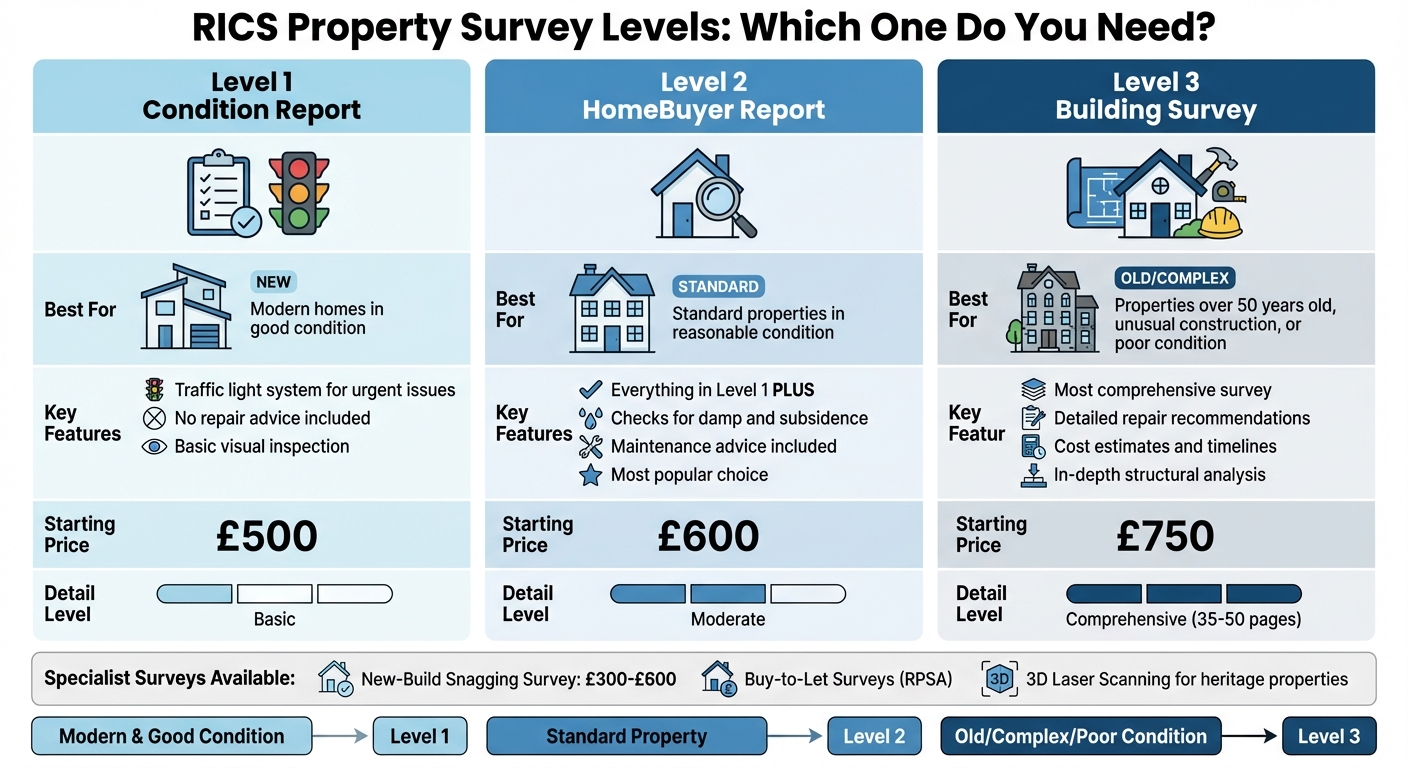
Surveyors provide a range of services, so it's important to choose one that matches your property's condition and age. The three main RICS survey levels vary in detail and cost:
In addition to the standard RICS surveys, some surveyors offer specialist services. For example, a new-build snagging survey focuses on identifying cosmetic flaws and minor construction issues that builders should address before you move in. These surveys typically cost between £300 and £600[7]. If you’re purchasing a listed or heritage property, ask if the surveyor uses 3D laser scanning to capture intricate architectural details accurately[10]. For landlords, the Residential Property Surveyors Association (RPSA) offers buy-to-let surveys designed for rental properties[5].
"A mortgage valuation is nowhere near comprehensive enough to take the place of a proper house survey. In fact, it sometimes won't even involve anyone visiting the property in person." – Which?[5]
When arranging a survey, check whether the fee includes a market valuation, as this can be crucial for negotiating the price[1][2]. If your property has distinctive features like a thatched roof, timber frame, or prefab construction, ensure the surveyor has experience with non-traditional builds. These features can influence mortgage eligibility[1]. Additionally, it’s a good idea to list specific concerns - such as visible cracks or damp - before the inspection so the surveyor can focus on potential problem areas[2][8].
When hiring a surveyor, make sure they hold a recognised chartered qualification, such as MRICS or FRICS. These credentials indicate membership in the Royal Institution of Chartered Surveyors (RICS), a body that enforces strict professional standards and requires members to carry professional indemnity insurance. Unlike the term "surveyor", which isn’t legally protected in the UK, "Chartered Surveyor" is reserved exclusively for qualified professionals within RICS [2]. This distinction ensures you're working with someone suitably trained and insured [2].
While qualifications are important, practical experience is equally critical. A surveyor’s hands-on knowledge can make all the difference, especially for properties with unique features or challenges. For example, if you're dealing with a period or non-traditional property, check whether the surveyor has specific expertise with materials like lime, thatch, or timber framing. This can help avoid complications with mortgages or repairs [1][3]. Don’t hesitate to ask how many similar properties they’ve assessed and request a sample report to gauge their thoroughness.
Local expertise is another factor to consider. A surveyor familiar with your area will be better equipped to identify potential risks, such as subsidence, flooding, or local planning restrictions [2][3]. Opt for someone who works independently rather than being tied to volume targets, as this often leads to a more detailed and personalised service [2].
Finally, consider whether the surveyor is regulated by the Residential Property Surveyors Association (RPSA). This organisation focuses on independent residential surveyors, particularly those specialising in homebuyer surveys [3]. Whether accredited by RICS or RPSA, choosing a qualified professional ensures high standards of service and provides a safety net if any issues arise.
Once you've confirmed a surveyor's qualifications and experience, the next step is to assess the quality of their work. One of the best ways to do this is by asking for a sample report. A well-prepared sample will reveal whether the surveyor provides detailed, property-specific insights or relies on generic, copy-and-paste statements that could apply to any building [13]. Ideally, you want a surveyor who delivers tailored feedback rather than standardised text designed solely to minimise their liability.
Pay close attention to how the sample report is organised, as it can reflect the surveyor's thoroughness. Many reports use a "traffic light" system - red for urgent issues, amber for moderate concerns, and green for acceptable conditions - which makes it easier for non-specialists to prioritise issues [4]. The report should also be written in plain English, avoiding unnecessary jargon to ensure it’s easy to understand [2]. Paul James, Founder of Property Road, highlights the importance of clarity and detail:
"What you are looking for here is a surveyor who is detailed in their report, not just copying and pasting standard statements and one which is clear in their feedback without simply trying to cover their own back all the time." [13]
The level of detail in the sample should match the type of survey you require. For example, a Level 2 Homebuyer Report typically follows a standardised format, while a Level 3 Building Survey is far more detailed and bespoke. A Level 3 report for a three-bedroom house might run to about 35 pages, with larger properties requiring up to 50 pages [12]. To get a realistic sense of the surveyor’s approach, ask for a sample report from a property that’s similar in age and type to yours.
Beyond presentation, the sample should go further than just listing defects. It should explain the causes of any issues, suggest remedial actions, and provide estimated repair costs [13][14]. Also, take note of the "limitations of inspection" section, which outlines areas that weren’t assessed [12]. This will give you a clearer understanding of what to expect from the survey.
Once you've reviewed sample reports, it's essential to discuss the specific issues your surveyor will prioritise during the inspection. Their focus will vary depending on whether you're looking at a modern flat, a Victorian terrace, or even a listed building. Before hiring a surveyor, ask them to detail the areas they'll examine based on your property's age, construction type, and location. This ensures their checks are relevant to your situation.
Surveyors typically investigate structural movement, looking for signs of subsidence, heave, structural cracks, or damage caused by removed chimney breasts. They also assess damp and timber defects, using moisture meters to detect problems like dampness, timber rot, or woodworm infestations [6][15][11][1]. Jonathan Rolande from the National Association of Property Buyers highlights the importance of a thorough survey:
"A good surveyor will reassure you, or highlight things you may not have seen, such as dampness, water corrosion, roof issues, woodworm or asbestos" [6].
The inspection also includes the roof and exterior, covering roof voids, chimney stacks, and the damp-proof course. Surveyors will check for hazardous materials, such as asbestos, and invasive plants like Japanese knotweed or bamboo, which can threaten a property's foundations [11][15][6][4]. Additionally, they perform a general review of services and utilities, including electricity, gas, plumbing, and drainage systems [11][1].
It's crucial that your surveyor has local expertise to address region-specific risks. For instance, properties in London might face clay-related subsidence, while other areas could be prone to flooding or historical mining issues [6][4]. Be upfront about any concerns you already have, like visible cracks or damp smells, so the surveyor can pay extra attention to these areas [6][15]. If your property is over 30 years old, has been altered, or is of an unusual construction type, a Level 3 Building Survey is the most comprehensive option [11][15].
Knowing the timeline for your property survey is crucial when planning your purchase. The time needed for the on-site inspection and the delivery of the report depends on the type of survey and the complexity of the property.
On-site inspections can take anywhere from an hour to a full day. For instance, a mortgage valuation typically lasts 30 minutes to an hour, whereas a Level 3 Building Survey for a standard three-bedroom house usually takes around six hours[12][3]. Larger or more intricate properties might require up to eight hours[3].
Once the inspection is complete, the next step is receiving the written report. Most surveyors aim to deliver this within 3–7 working days[3]. Angela Kerr, Director at HomeOwners Alliance, offers this advice:
"Most surveyors will be able to tell you what their availability is, and how long it takes them to write up the report before you book them"[17].
Before hiring a surveyor, it’s a good idea to ask if they can provide a verbal summary on the day of the inspection. Additionally, confirm whether the report will be sent as a PDF via email, as this ensures faster access compared to postal delivery[4].
With both the inspection and reporting stages outlined, bear in mind that the entire process - from booking to receiving the final report - usually takes 10 to 12 days[3]. To avoid delays, book your surveyor as soon as your offer is accepted, giving yourself enough time to address any issues before the exchange.
Once you've assessed a surveyor's expertise, the next step is to understand the fee structure clearly. Knowing exactly what you're paying for is crucial before making any commitments.
Survey fees in the UK typically range from £290 to £1,390, depending on factors like the property's size, age, and location [1][4]. However, this range often excludes additional charges, so it's important to dig into the details.
A standard survey fee usually covers three main components: pre-inspection research, the on-site physical inspection, and the final report preparation [12]. That said, property valuations are typically not included and must be requested as an extra service, which comes with an additional cost [1][12]. According to RightSurvey, prices generally remain fixed unless the property description provided is inaccurate. However, adding a valuation service will increase the overall fee [2]. Similarly, technical testing for services like gas, electricity, or drainage - conducted by specialists such as NICEIC or Gas Safe engineers - is usually not part of the base price [12].
To avoid any confusion, ask for a written "Scope of Services" or engagement terms before hiring a surveyor. This document will outline exactly what is included in the fee [12][7]. Check whether VAT is already factored in and if follow-up support, such as discussing the report findings, is included. Many professional surveyors offer a post-report consultation as standard, but it's always worth confirming [1][9].
Keep in mind that properties with specific issues, such as subsidence or roof defects, might require additional diagnostics - like fibre optic probes or drones - which can incur extra costs [12]. Travel expenses may also be higher if the property is in London, South West England, or remote areas [18].
To avoid unexpected price adjustments, provide detailed information about the property upfront. Mention features like extensions, loft conversions, or any unusual characteristics [2]. Having a transparent conversation about costs from the start ensures there are no surprises later and helps you get the thorough service you need.
Knowing the scope of repairs and their estimated costs upfront can make a big difference when it comes to budgeting and negotiations.
Both RICS Level 2 and Level 3 surveys include advice on necessary repairs, but Level 3 reports go further, offering detailed cost projections and timelines that are incredibly helpful for planning your budget [5]. Sam Wilson, a Personal Finance Expert at Which?, explains:
"You can also ask the surveyor to include projected costs and timings for any repair work recommended in the report" [5].
Surveyors often use a "traffic light" system to categorise repairs by urgency. Red flags indicate critical issues needing immediate attention, while amber and green highlight less urgent concerns. However, it’s important to understand that these cost estimates are guides, not formal quotes [4][1]. As Surveyor Local puts it:
"The survey will highlight the list of faults and issues in an easy-to-read traffic system, with red being the most important to fix. The surveyor will also give their opinion of the immediacy of the fix required" [4].
For major problems - like structural movement or outdated wiring - you’ll need a specialist contractor to provide a formal quote [16]. Even so, the surveyor's estimates can be a useful tool during negotiations. For instance, if the survey identifies £10,000 worth of repairs, you could use this to negotiate a price reduction or ask the seller to address the issues before the exchange [5].
It’s a good idea to request a sample report to see how repair details and priorities are presented. Also, check whether the surveyor offers follow-up support to help you understand the findings [13][4]. Clarify these points before moving forward to ensure you’re clear on both the repair recommendations and any assistance available afterward.
When a surveyor uncovers a serious issue - like structural subsidence, unsafe electrical systems, or Japanese knotweed - it’s essential they notify you right away and explain the next steps. Top-notch surveyors often provide a verbal update immediately after the site visit if they spot anything that could impact your decision to buy or your chances of securing a mortgage [1][9].
After the detailed inspection process, urgent findings need to be addressed promptly. Reliable surveyors categorise issues by severity, using an established system, and provide clear timelines for necessary repairs to ensure safety and maintain structural soundness [4]. As Bevans Chartered Surveyors highlights:
"The report will be debriefed in detail so you know exactly what your next step is" [9].
Make sure the surveyor is available for a follow-up call to discuss the findings in straightforward terms. This can be particularly helpful if the report reveals issues like asbestos - commonly found in UK homes built before 2000 - or outdated wiring, which could lead to a mortgage refusal. Also, check if the survey includes estimated repair costs. Knowing these figures can be a game-changer when renegotiating with the seller or deciding whether to move forward with the purchase [1][16].
For significant problems such as subsidence or foundation damage, ask for an immediate referral to a specialist, like a structural engineer or an accredited asbestos assessor. Just as with repair recommendations, it’s important to understand the immediate response protocols. Confirming these communication channels and support options can help protect your investment and guide you through critical property decisions.
When hiring a surveyor, their independence is key to getting an honest and impartial evaluation of the property. Before committing, it’s worth asking if the surveyor has any connections to the seller, estate agent, or other parties involved in the transaction. Surveyors registered with RICS are required to disclose potential conflicts of interest as part of their formal "terms of engagement" [19]. This level of transparency is particularly important when the surveyor is recommended by an estate agent.
Estate agents often suggest surveyors they’re affiliated with, which could raise questions about impartiality. Angela Kerr, Director of the HomeOwners Alliance, offers this advice:
"Don't just go with the estate agent's recommendation... remember to shop around to avoid paying more for a worse service" [17].
It’s best to avoid relying solely on an estate agent’s recommendation. While the agent’s focus is on closing the sale, your surveyor’s role is to uncover potential problems with the property - two goals that may not always align [17][3].
Another factor to consider is how some large corporate firms operate. These companies often work closely with mortgage lenders and banks, and their surveyors may be under pressure to meet high-volume targets, sometimes conducting as many as six inspections per day [2]. On the other hand, independent surveyors typically prioritise thoroughness and are more likely to act in your best interest. For new-build homes, specialist snagging inspectors often refuse to work with developers or builders, ensuring their evaluations remain completely unbiased [17].
To ensure you’re working with a surveyor who adheres to professional standards, confirm their membership with RICS or RPSA. These organisations enforce strict codes of conduct that require impartiality and transparency [17][6]. Additionally, ask whether the surveyor receives referral fees or has commercial ties to any party in the transaction. This independent approach aligns with the detailed assessments previously discussed, giving you the confidence that your surveyor is working solely for you.
You don’t have to attend the property survey, as surveyors usually arrange access directly with the estate agent and seller. However, if you’d like to be there, you’re welcome to join. Surveys can take anywhere from one to eight hours, depending on the property’s size and the type of survey being done [3]. Being present could give you a clearer understanding of the process and any potential issues.
Once the on-site inspection is complete, most surveyors offer extensive follow-up support. They often provide a verbal summary right after the inspection, followed by a detailed report within 3 to 10 working days. This report is typically discussed with you over the phone or in person. During this debrief, surveyors explain any major concerns, suggest repair or renegotiation strategies, and break down technical terms into plain, easy-to-understand language. As Bevans Chartered Surveyors put it:
"The report will be debriefed in detail so you know exactly what your next step is" [9].
Surveyors can also guide you on whether further testing by a specialist - such as a NICEIC or Gas Safe registered professional - is necessary. Surveyors.co.uk highlights this aspect of their service:
"Our fee reflects the time reasonably spent inspecting and reporting, with some subsequent telephone 'support' time answering the inevitable follow up queries" [12].
Before you hire a surveyor, confirm that follow-up support is included in the fixed fee, which typically ranges between £290 and £1,390. Also, ensure you’ll have direct contact information to address any lingering questions after reviewing the report.

Survey Merchant links property buyers with RICS-accredited surveyors across the UK, offering a range of services tailored to different needs. Their core offerings include Level 2 HomeBuyer Reports, Level 3 Building Surveys, Red Book valuations, and specialist services like party wall agreements, dilapidations, lease extensions, and expert witness reports. Here's a closer look at the main services:
A Level 2 HomeBuyer Report is ideal for properties built within the last 50 years that are in decent condition. This survey focuses on a visual inspection of accessible areas to identify potential issues, such as damp or subsidence. It's a non-intrusive process, typically taking a few hours to complete, with an average cost of around £400 [14].
For a more thorough inspection, the Level 3 Building Survey is the go-to choice. Designed for older homes, complex layouts, or properties requiring significant repairs, this survey involves advanced techniques like drones, pole cameras, and ladders to access hard-to-reach areas, including roofs and chimneys. Surveyors also examine attics, cellars, and sub-floor spaces, providing detailed repair advice and cost estimates. Reports are generally delivered within 3–4 working days, and the service costs approximately £600 or more [9][14].
Red Book valuations follow the rigorous global standards set by RICS, delivering a formal assessment of a property's market value. These valuations consider factors like location, age, and condition, making them essential for mortgage applications, legal cases, and price negotiations. They also include a professional insurance reinstatement figure. All valuations are carried out by MRICS/FRICS-qualified surveyors with in-depth local knowledge [2].
In addition to standard surveys, Survey Merchant offers specialist reports for unique property concerns. Whether you're dealing with a listed building constructed with traditional materials or a property facing significant structural challenges, they connect you with surveyors who have the necessary expertise. For more specific issues, such as cracking or timber decay, you can opt for single-issue reports that focus solely on the problem rather than a full property overview.
By asking these 10 questions, you can ensure the surveyor you choose aligns with your needs, helping you sidestep unexpected expenses while staying on track with your conveyancing timeline. On average, survey reports are delivered within 3–7 working days, making it crucial to confirm details like credentials, fee inclusions, and turnaround times upfront [3].
Take into account the surveyor's local expertise and their specialisation. A surveyor familiar with the area can identify region-specific risks, while one experienced with your property type - whether it’s a period home, thatched roof, or new build - will provide more tailored insights [2][1].
These questions also help you differentiate between independent surveyors and larger corporate firms. For example, corporate surveyors may handle as many as six inspections daily, leaving limited time for thorough analysis. Independent surveyors, on the other hand, often dedicate more time to detailed evaluations, which can be invaluable when assessing complex properties [2].
Survey Merchant offers a solution by connecting property buyers and owners with a nationwide network of RICS-accredited surveyors. The platform ensures surveyors hold professional indemnity insurance and have experience with various property types, whether you need a Level 2 HomeBuyer Report, a Level 3 Building Survey, or a specialist service. By using an independent platform, you avoid potential conflicts of interest often associated with estate agent recommendations, ensuring the surveyor’s focus remains solely on your best interests [17].
Always verify your surveyor’s MRICS or FRICS status. Selecting a qualified surveyor as soon as your offer is accepted not only protects your investment but also allows time for renegotiations or additional checks before contracts are exchanged [3]. Taking these steps ensures a smoother and more secure property transaction.
When reviewing a sample survey report, it should offer a thorough and clear evaluation of the property. Pay attention to specific details on defects, such as cracks in walls, damp issues, roof damage, outdated or unsafe services, the presence of asbestos, or invasive plants. It should also explain the likely causes of these problems and assess their seriousness.
Additionally, the report should provide practical recommendations for repairs or remedial actions, along with estimated costs. It should flag any major concerns that might affect the property's safety, market value, or legal standing. A detailed and well-structured report reflects the surveyor’s expertise and precision, giving you the information you need to make a confident decision.
To ensure your surveyor is both independent and impartial, start by examining their professional qualifications. Opt for a Chartered Surveyor regulated by RICS (MRICS or FRICS). Members of the Royal Institution of Chartered Surveyors adhere to strict ethical standards, ensuring they prioritise your interests. You can verify their RICS membership by requesting their membership number and checking it on the official RICS website.
It’s also important to make sure the surveyor isn’t connected to an estate agent, mortgage lender, or any other party with a financial stake in the transaction. Independent surveyors will make it clear that they work solely for you. Feel free to ask direct questions such as, “Do you receive commissions from lenders or agents?” and request a written statement confirming their independence.
Finally, go for a surveyor who provides a clear and upfront fee structure, along with a written agreement outlining the scope of their work. Ensure they have professional indemnity insurance to protect you in case of any errors or disputes. Having these details documented not only provides peace of mind but also ensures accountability throughout the process.
If the survey uncovers pressing issues, it’s essential to discuss them with your surveyor as soon as possible to get a clear understanding of the findings. Ask for a comprehensive written report that details the problems and outlines possible solutions. In some cases, you might also need to consult experts for additional advice or gather quotes for any necessary repairs.
This information can guide your next steps. You might choose to negotiate with the seller for repairs or a price adjustment, or even reconsider the purchase entirely. Taking swift and informed action can help you tackle potential risks head-on.
Survey Merchant provides vetted RICS surveyors across 100+ UK locations at fixed fees:
→ Level 2 Home Survey (HomeBuyer Report)
→ Level 3 Building Survey (full structural survey)
→ RICS Red Book property valuations
→ Party wall surveyors — notices, awards & schedules of condition
→ Expert witness surveyors — CPR Part 35 reports for property disputes