Leasehold
Sep 29, 2026
How Much Does It Cost to Renew Lease? UK Guide 2026
Find out how much does it cost to renew lease in the UK. Our 2026 guide details all fees for tenancy renewals & statutory lease extensions. Get clarity!

Your end date is getting close, the paperwork mentions a “renewal”, and the first question is obvious: how much does it cost to renew lease in the UK?
The problem is that people use the same phrase for two very different situations. One is a tenancy renewal, where a renter signs on for another fixed term. The other is a lease extension, where a leaseholder formally adds years to a long residential lease. Those are not remotely the same transaction, and they don't carry remotely the same cost profile.
I've seen plenty of homeowners and flat owners lose time by asking the wrong question first. If you rent your home under an assured shorthold tenancy, you're usually dealing with an admin-style renewal. If you own a leasehold flat or house and your remaining term is falling, you're looking at a valuation and legal process that can have serious financial consequences. If you're unsure which camp you're in, start there. That one distinction determines whether your likely cost is measured in a modest fee or a much larger premium with professional costs on top.
When a lease or tenancy is nearing its end, people often assume there must be a standard renewal fee. There usually isn't. What you pay depends first on the legal nature of the agreement, and only after that does it make sense to talk about cost.
If you're a tenant, the issue is usually whether you're signing a fresh fixed term or continuing under updated terms. That tends to be an administrative exercise. If you're a leaseholder, the issue is different. You're not just extending occupancy. You're changing the value and marketability of the asset itself.
That's why the right first question isn't “what's the fee?”. It's “am I renewing a tenancy or extending a leasehold interest?”
Use this quick check:
Practical rule: If the transaction changes the number of years left on your title, it isn't a simple renewal.
The confusion matters because the wrong route leads to the wrong expectations. A tenant might worry unnecessarily about valuation costs. A leaseholder might assume the process is just a form and a fee, then discover they need a surveyor, a solicitor, and a negotiation with the freeholder.
If your concern is a leasehold flat or house, it also helps to read some plain-English property advice on lease extensions before speaking to the freeholder. Going in too casually often costs more than taking advice first.
A homeowner says, “I just need to renew the lease,” and the next question decides the cost. Are they renting under an assured shorthold tenancy, or do they own a leasehold flat and need more years added to the title? Those are two different transactions with different bills, different professionals, and different risks.
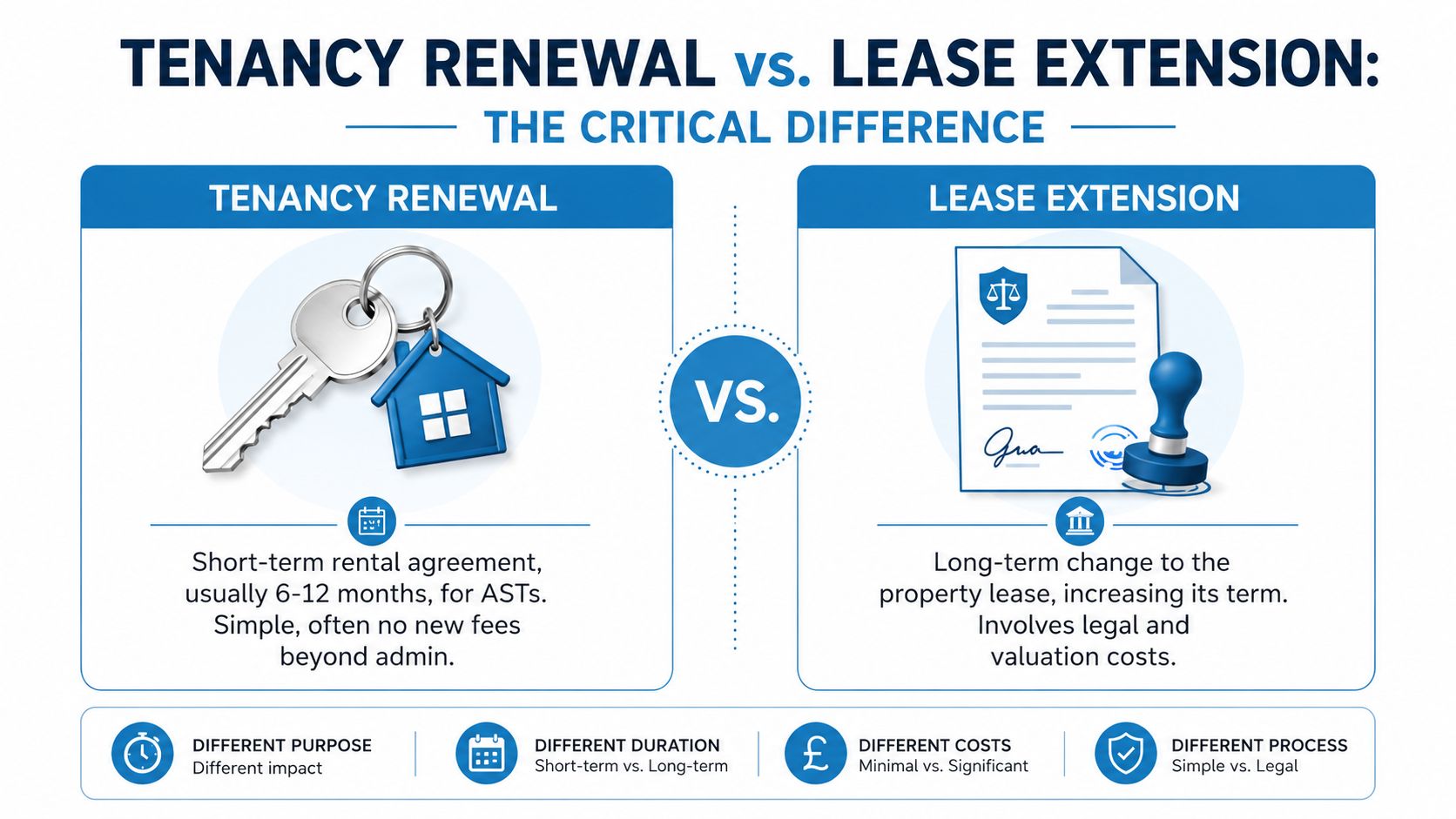
A tenancy renewal keeps an occupation agreement in place for another period. A lease extension changes the length of a leasehold interest registered against the property. That difference matters because one is usually paperwork and an admin charge, while the other can affect value, mortgage options, saleability, and the price payable to the freeholder.
For a tenant, renewal usually means agreeing a new fixed term, or replacing the old agreement with an updated one. The main financial points are practical:
That is why tenancy renewal costs are often modest compared with lease extension costs.
For a leaseholder, the position is more serious. Adding years to the lease can improve the flat's market position, but it also brings valuation work, legal procedure, and negotiation over the premium and terms.
In plain terms, you are not renewing your stay in the property. You are paying to improve the legal asset.
That usually means dealing with:
Use the test that matters financially:
| Situation | What you are paying for | Typical type of cost |
|---|---|---|
| Renting from a landlord | Another tenancy period | Admin fee, agent fee, rent increase |
| Owning a leasehold flat or house | More years on the legal title | Premium, valuation fees, legal fees |
I often find people use the same phrase for both. That is where the confusion starts. If the number of years left on your title is changing, you are in lease extension territory. If you are only agreeing another rental term, you are dealing with a tenancy renewal.
A tenancy renewal keeps the agreement going. A lease extension changes the asset.
Getting that distinction right at the start saves time and avoids the wrong budget assumptions. A tenant usually needs to ask what the agent or landlord will charge. A leaseholder needs to ask what the premium might be, what professional fees will arise, and whether delay will make the position more expensive.
For a standard rental tenancy, the main cost is usually administrative rather than legal in the heavy sense. There isn't a single statutory renewal fee that applies across the board.

Industry guidance cited by MRI Software says the main quantifiable cost driver is often the landlord's or agent's administration charge, which can range from about £250 to £500 per renewal, or in some cases be calculated as a percentage of monthly rent, according to MRI Software's discussion of lease renewal fees.
In practice, that sort of fee usually relates to routine work such as:
The important point is that the work itself may be similar from one property to another, but the billing method can vary. A flat fee is easy to understand. A rent-linked fee can make the renewal feel more expensive at higher monthly rents, even if the paperwork is broadly the same.
Tenants often focus on the renewal fee and ignore the bigger practical point, which is the full cost of staying. A modest admin charge may matter less than an unfavourable rent revision or new clauses that reduce flexibility.
Watch for these pressure points:
Before agreeing a tenancy renewal, compare the one-off fee with the annual effect of any rent increase. The recurring cost usually matters more.
If you're a tenant, this is usually where the answer to “how much does it cost to renew lease” ends. If you're a leaseholder owner, this is not your process at all. Your cost sits in a different category entirely.
A statutory lease extension is where cost becomes layered. There isn't one price tag. There are separate cost components, and they need to be budgeted together.
The central figure is the premium payable to the freeholder. On top of that sit professional fees, both yours and certain costs on the landlord's side. Homeowners who budget only for the premium are often caught out because the transaction also needs legal and valuation work.
The Leasehold Advisory Service says its calculator gives only a general estimate of the premium for extending a flat lease because it relies on national data and doesn't include local variations, as explained on the Leasehold Advisory Service calculator page. That's an important warning. There is no national menu price for a lease extension.
Why does the premium vary so much? Because valuation turns on the specific lease and property. In practical terms, the premium is shaped by matters such as:
Two apparently similar flats can therefore produce very different figures. Same block doesn't always mean same premium. Same town doesn't always mean same premium either.
The premium is only one part of the bill. A leaseholder also needs to think about the cost of getting the deal analysed, negotiated and completed.
That usually means three broad baskets:
The premium
This is the amount paid for the new extended lease term. It is the financial heart of the transaction.
The landlord's reasonable costs
In many cases, the leaseholder is expected to meet the landlord's reasonable legal and valuation costs connected with the extension process.
Your own professional fees
You will normally need your own solicitor and a valuation surveyor. The surveyor's role is especially important because the opening stance on premium can shape the whole negotiation.
If you treat a lease extension as a legal formality, you'll usually overpay or expose yourself to poor terms. It is a valuation exercise first and a paperwork exercise second.
A homeowner doesn't need to memorise valuation law to budget sensibly. What matters is understanding the headings under which money leaves your account.
| Cost Component | What It Covers | Estimated Cost Range |
|---|---|---|
| Premium | Payment to the freeholder for the lease extension | Varies. No single fixed fee |
| Landlord's costs | Freeholder's reasonable legal and valuation costs | Varies |
| Your own professional fees | Your solicitor and valuation surveyor | Varies |
That table looks simple, but the discipline matters. It stops people asking the wrong person the wrong question. A solicitor can explain process and legal drafting. A valuer addresses what a reasonable premium may look like. The freeholder's opening position is not the same thing as the fair market position.
The best outcomes usually come from preparation. In practice, that means getting the lease checked early, understanding the term left, and instructing professionals who handle leasehold reform work regularly.
What tends to go wrong is equally predictable:
For most leaseholders, the true financial question isn't “what is the fee?” It's “what is the full transaction cost, and what happens if I delay?”
A flat owner with 83 years left on the lease often feels they still have time. Two years later, the same owner is trying to sell or remortgage with 79 years left, and the extension bill is no longer in the same territory. That is why surveyors, solicitors, and lenders pay close attention to the 80-year point.
Once a lease drops to 80 years or below, the premium can rise sharply because marriage value comes into the calculation under the usual statutory framework. You do not need to master valuation theory to see the practical effect. Delay can turn a manageable cost into a much larger one.
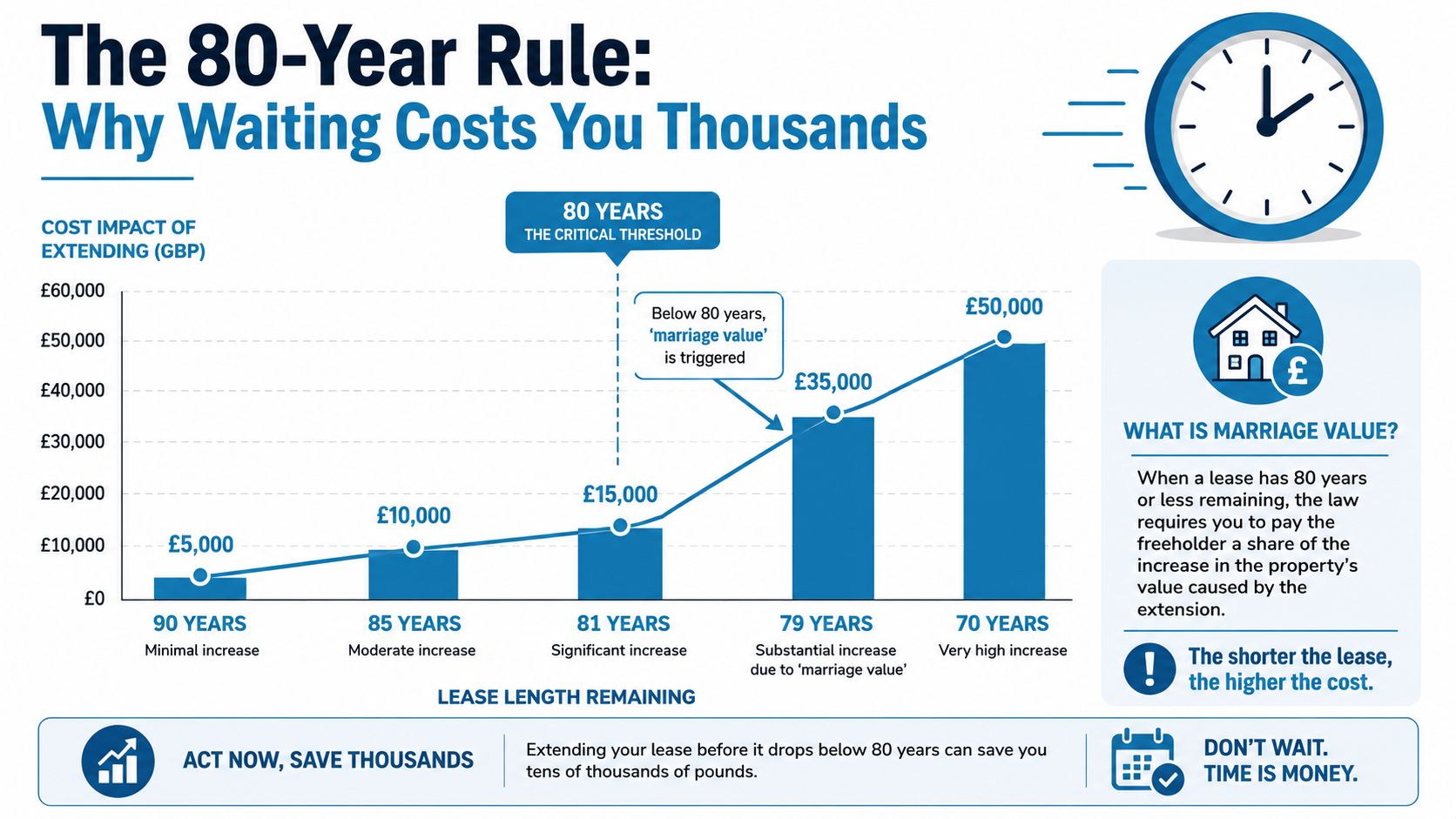
Marriage value is the extra value created when a short lease is turned into a longer one. Once the lease is at or below 80 years, that uplift is no longer treated as belonging entirely to the leaseholder. Part of it is shared with the freeholder, which pushes the premium up.
Owners often find this frustrating because nothing physical has changed in the property. The kitchen is the same. The bathroom is the same. The only thing that has changed is the lease length, but that alone can alter the price materially.
This is also where confusion with a tenancy renewal causes trouble. A rental tenancy renewal is usually a modest admin exercise. A leasehold extension is a valuation problem with legal consequences, and the 80-year threshold is one of the main reasons.
In practice, delay usually shows up in three places:
I regularly see owners put this off because the lease still sounds long on paper. Then the issue arrives all at once during a sale, remortgage, or probate matter, when timing is poor and bargaining power is weaker.
A lease does not need to feel short to become expensive.
If you want a clearer explanation of how marriage value affects the premium, the Survey Merchant blog on lease value explains it in plain English.
The practical message is simple. If your lease is getting close to 80 years, time is part of the cost. Waiting is rarely neutral.
Once a leaseholder realises this isn't a simple renewal, the next challenge is procedure. A good process doesn't remove cost, but it does reduce avoidable mistakes and weak negotiation.
Near the start of the journey, it helps to see the two routes visually.
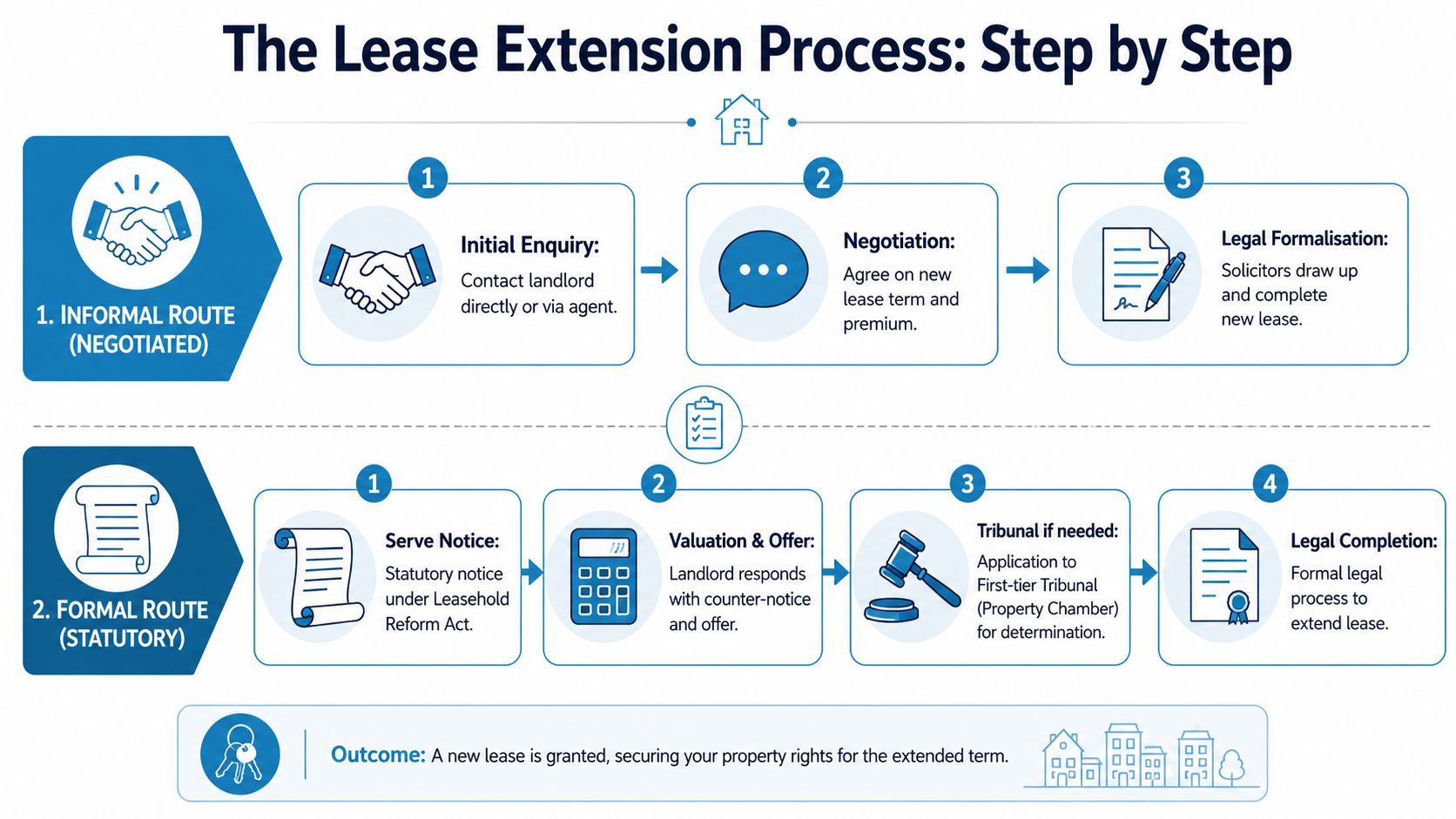
An informal deal means approaching the freeholder outside the statutory framework and trying to agree terms directly.
That can work when both sides are realistic and the lease terms offered are sensible. It can also go wrong if the freeholder offers an apparently attractive premium but keeps or reshapes unfavourable terms elsewhere in the lease. I often tell owners not to look only at the front-page figure. The structure of the new lease matters just as much.
Common reasons people choose the informal route include:
The formal route gives structure and protection. It is usually the safer route when the sums are material or the parties are far apart.
A typical sequence looks like this:
Appoint a valuation surveyor and solicitor
The surveyor advises on likely premium and negotiation stance. The solicitor checks eligibility, title and procedure.
Value the lease extension claim
This is the foundation. Without it, the opening offer is guesswork.
Serve the statutory notice
The formal claim starts here. Accuracy matters because errors can create delay and extra cost.
Receive the freeholder's counter-notice
The landlord responds, often disputing price or terms.
Negotiate
During this stage, a lot of value is won or lost. Surveyor-to-surveyor discussion is often central.
Complete the legal documentation
Once figures and terms are agreed or determined, the lawyers complete the new lease paperwork.
A short explainer can help if you want to see the process discussed in video form.
The legal route is structured, but that doesn't mean it is effortless. Most problems come from one of three places:
For commercial lease renewals, timing also affects one's negotiating position. Market practice commentary notes that businesses are often advised to begin renewal analysis 12–24 months before expiry, with rent, legal review and negotiated concessions all shaping the true economics of the deal, as discussed by MWI Animal Health on renewing a lease and planning ahead. Although commercial renewals are a different discipline from residential statutory extensions, the timing lesson is the same. Late action usually leaves less room to negotiate well.
A lot of owners start by speaking to the wrong adviser.
If your fixed-term tenancy is ending, the discussion is usually with the landlord or letting agent, and the paperwork is relatively straightforward. If you own a leasehold flat and the lease term is running down, you are in a different process with different costs, deadlines and risks. That distinction matters before you spend money on advice.
A formal lease extension usually calls for two professionals. A solicitor handles notices, legal procedure and completion. A valuation surveyor advises on the premium and the negotiation strategy. The solicitor keeps the process valid. The surveyor protects your financial position.
The valuation side is often the point owners underestimate. The figure put forward at the start affects the tone of the negotiation, and poor advice can leave you paying more than necessary or taking an unrealistic position that wastes time. If you want a clearer picture of the cost components and who does what, this guide on understanding lease extension fees is a useful place to start.
If your situation is a tenancy renewal rather than leasehold reform, landlord process guides such as VerticalRent lease renewal can help you see how that route is handled in practice. It is a separate world from statutory lease extension, but it clarifies which process you're in.
When choosing a surveyor, look for a RICS-chartered surveyor who deals regularly with leasehold reform work. General residential valuation experience on its own is not enough. Lease extension work involves statute, negotiation, relativity, deferment and the judgment calls that affect real money.
Survey Merchant is one factual option for finding a surveyor for leasehold and valuation instructions across the UK. However you choose, the aim is the same. Get someone who understands this niche area, can explain the trade-offs plainly, and can spot early whether you are dealing with a simple tenancy renewal or a proper lease extension.
Survey Merchant provides vetted RICS surveyors across 100+ UK locations at fixed fees:
→ Level 2 Home Survey (HomeBuyer Report)
→ Level 3 Building Survey (full structural survey)
→ RICS Red Book property valuations
→ Party wall surveyors — notices, awards & schedules of condition
→ Expert witness surveyors — CPR Part 35 reports for property disputes