We use cookies to improve your experience on our site, analyze site traffic, and assist in our marketing efforts. By clicking "Accept all," you agree to the storing of cookies on your device. You can choose to "Reject all" non-essential cookies. For more information, please read our Cookie Policy.
Fence Height Regulations UK 2026: Limits & Permission
Everything homeowners need to know about fence height regulations in the UK in 2026: the 2 m and 1 m rules, trellis and sloping ground, listed buildings, Article 4 directions, enforcement and planning fees.
Fence height regulations in the UK are simpler than most people expect, but the details trip up thousands of homeowners every year. In England, Wales and Scotland you can normally put up a fence, wall or gate of up to 2 metres without planning permission, dropping to 1 metre where it sits next to a road. Get the measurement, the location or the exceptions wrong and you risk an enforcement notice, a prosecution and a fence that has to come down. This guide sets out the 2026 rules in full, how height is measured (including trellis and sloping ground), the exceptions for listed buildings and conservation areas, what it costs to apply, and what to do when a neighbour’s fence is too high.
Key takeaways
2 metres is the maximum fence, wall or gate height without planning permission in most locations; 1 metre applies where the boundary is adjacent to a highway used by vehicles.
Height is measured from the natural ground level at the base of the fence to its highest point – trellis toppers, gravel boards and post caps are all part of the structure.
The limits do not apply within the curtilage of a listed building, and permitted development rights can be removed by an Article 4 direction or a planning condition.
Since 25 April 2024 councils in England have 10 years (not four) to take enforcement action against an unauthorised fence.
A householder planning application in England costs £528 plus annual inflation uplifts, with a further rise of around 8% proposed for 8 December 2026.
Hedges are treated differently: councils can act on evergreen hedges over 2 metres under the Anti-social Behaviour Act 2003, but cannot order them below 2 metres.
What are the fence height regulations in the UK?
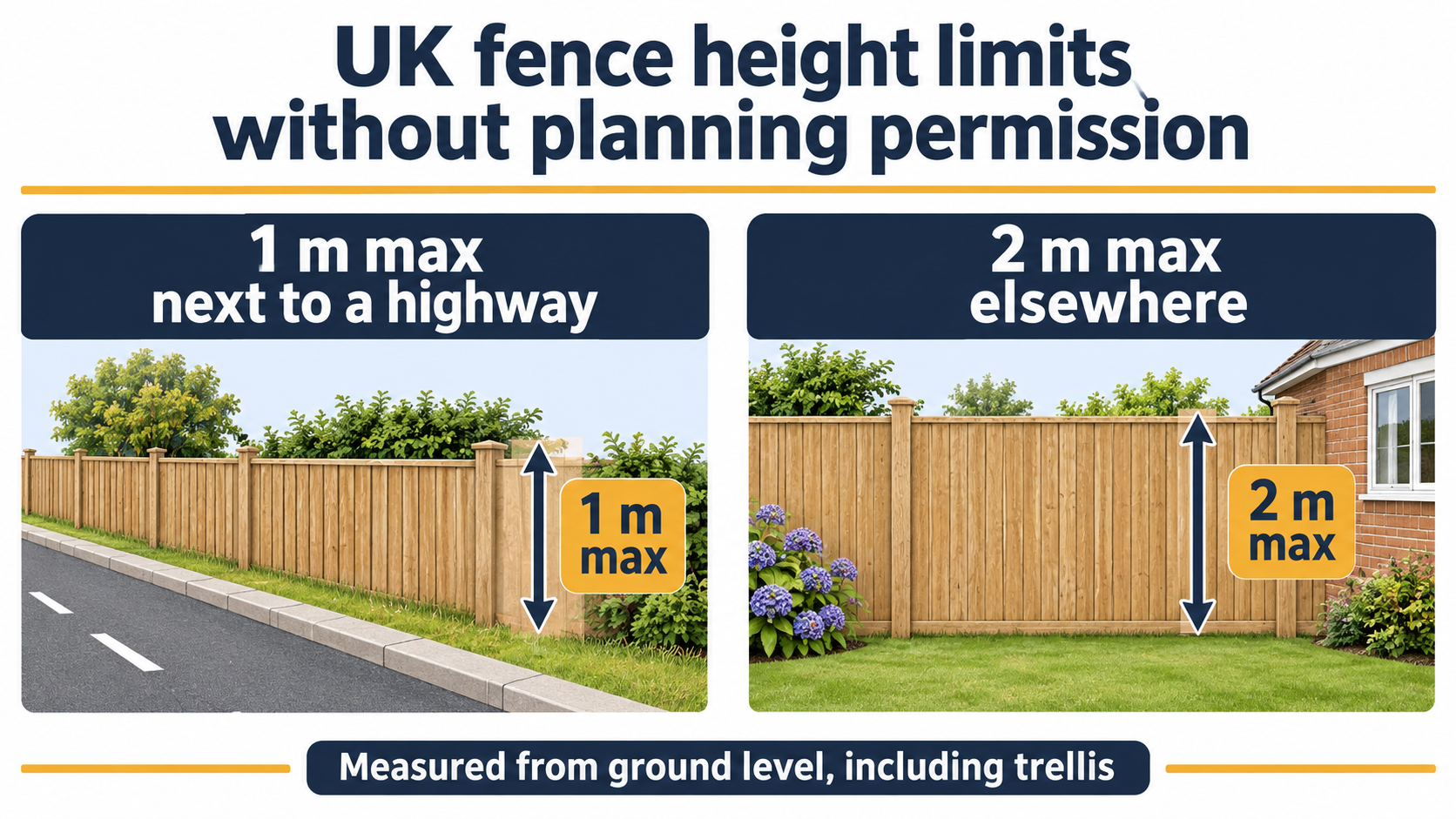
Under permitted development rights, a fence, wall or gate in the UK can be up to 2 metres high from ground level without planning permission, or 1 metre where it adjoins a highway used by vehicular traffic. Anything taller needs a planning application, and the limits do not apply to listed buildings or where rights have been removed.
In England the rules come from Schedule 2, Part 2, Class A of the Town and Country Planning (General Permitted Development) (England) Order 2015. Class A permits “the erection, construction, maintenance, improvement or alteration of a gate, fence, wall or other means of enclosure”, but withdraws that permission if, after the work, the structure would exceed 1 metre above ground level adjacent to a highway used by vehicular traffic, or 2 metres above ground level in any other case. A special rule allows school boundaries next to a road to reach 2 metres, provided the part above 1 metre does not obstruct drivers’ views.
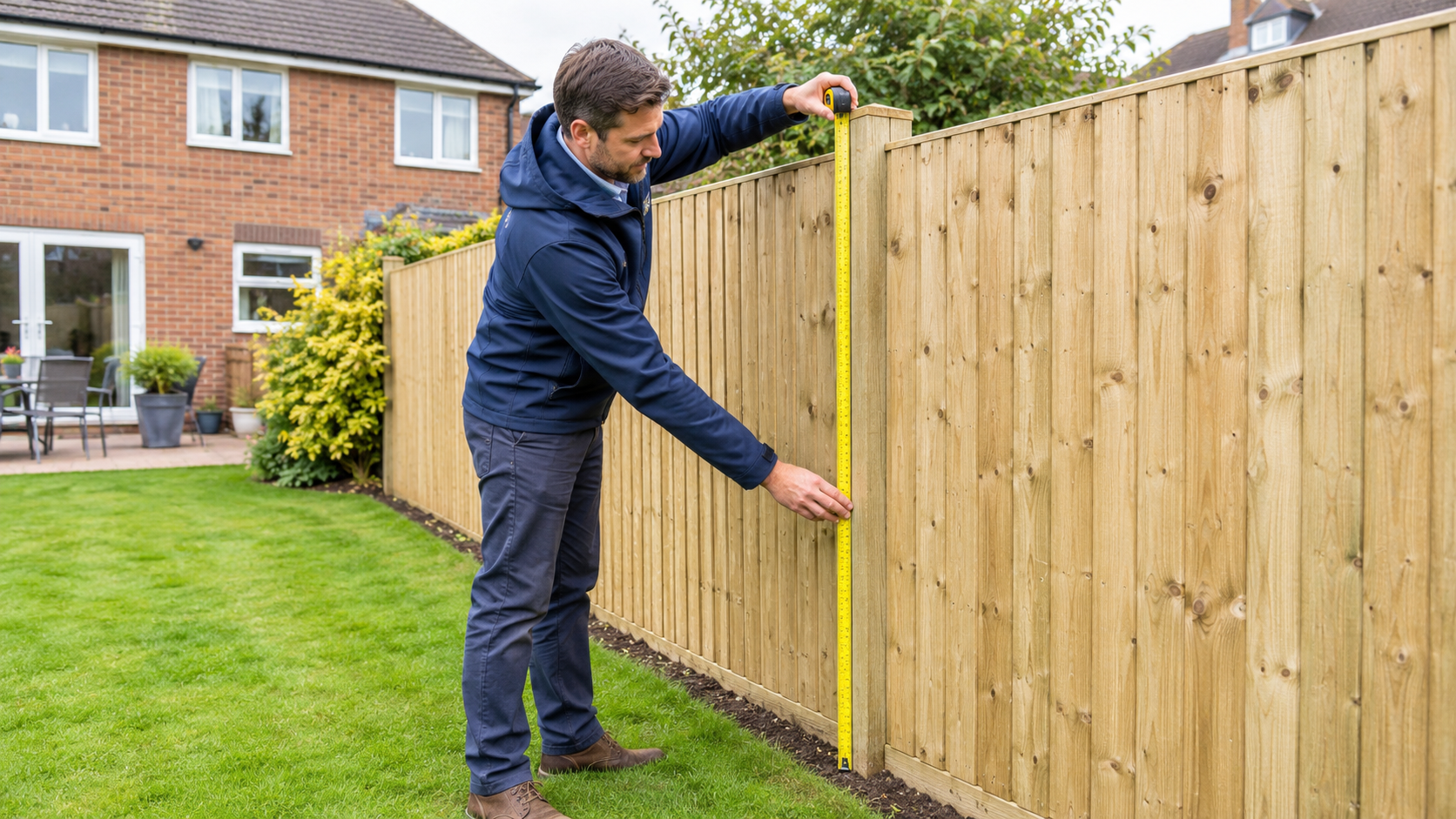
Fence height is measured from natural ground level at the base of the fence to the top of the highest element.
The Planning Portal adds the practical conditions that sit alongside those limits: no part of the site may be a listed building or within its curtilage, the fence must not form a boundary with a neighbouring listed building, and the right must not have been removed by an Article 4 direction or a planning condition. If any one of those tests fails, you need a full planning application before you start.
Fence height limits at a glance (England, Wales and Scotland)
Situation
England
Wales
Scotland
Rear or side garden, not next to a road
2 m max
2 m max
2 m max
Adjacent to a highway used by vehicles (including its footpath)
1 m max
1 m max
1 m max where it faces a road
Forward of the front or side wall of the house
1 m if next to a highway, otherwise 2 m
As England
1 m max
Replacing an existing fence that is already over the limit
Allowed, but no higher than its former height
As England
Allowed, but no higher than the old one
Listed building or its curtilage
No permitted development – apply
No permitted development – apply
No permitted development – apply
Conservation area
Erecting is permitted; taking down may need consent
As England
No permitted development – apply
Scotland’s rules are set out on mygov.scot (updated 20 November 2025): the 1 metre limit applies not only where a fence faces a road but wherever it extends beyond the front or side of the house, and permitted development does not apply at all in conservation areas. Wales mirrors England’s 1 metre and 2 metre thresholds, though its three National Parks frequently use Article 4 directions to restrict boundary works.
How is fence height measured?
The legislation refers to height “above ground level”, which planning authorities interpret as the natural ground level immediately beside the fence. The measurement runs to the top of the whole means of enclosure, so the following all count towards your 2 metres or 1 metre:
Fence panels and the posts that carry them, including post caps and finials.
Gravel boards fixed below the panels.
Trellis or lattice toppers fixed to the fence, however open the weave.
A fence built on top of a wall – the wall and the fence are measured together.
A common mistake is to fit a standard 1.8 metre panel on a 150 mm gravel board and add a 300 mm trellis, giving a total of 2.25 metres. Some councils take a relaxed view of lightweight trellis intended for climbing plants, but that is discretion rather than law, and an enforcement officer measuring to the top of the trellis is on firm ground.
Sloping ground and raised gardens
Where the ground slopes, the height is normally assessed at each point along the fence from the ground on which it stands. A 2 metre fence that is stepped down a slope is compliant; a level-topped fence that reaches 2.4 metres at the low end is not. Disputes often arise where the two gardens are at different levels or where a raised bed or decking sits behind the fence. A Scottish appeal reported by STV News illustrates the point: Glasgow City Council measured a Ruchill fence at nearly 9 feet by taking the lowest adjacent ground, but the Scottish Government reporter measured it at 1.8 metres from the level ground on which it stood and allowed it to stay.
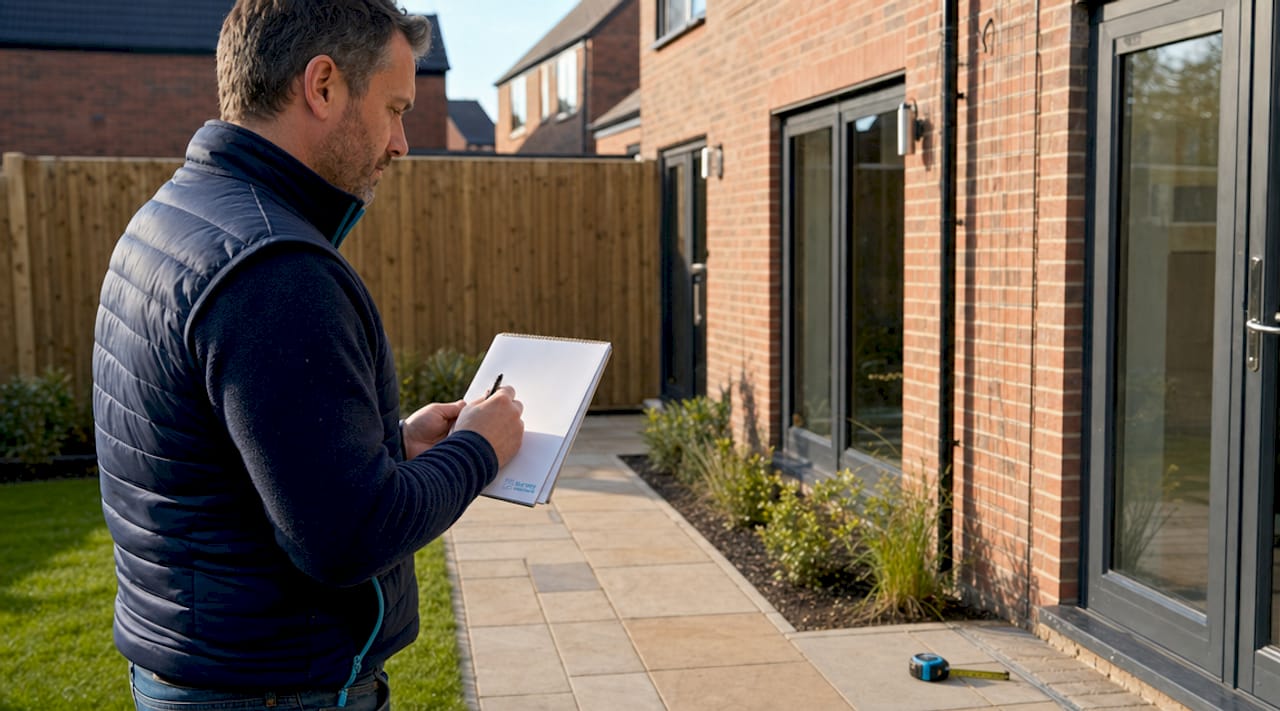
If you are unsure which ground level applies, a measured survey of the boundary by a suitably qualified, accredited surveyor – from a panel regulated by bodies such as RICS, CIOB or RPSA – gives you an impartial record you can rely on with the council or a neighbour.
Front garden fences and the 1 metre highway rule
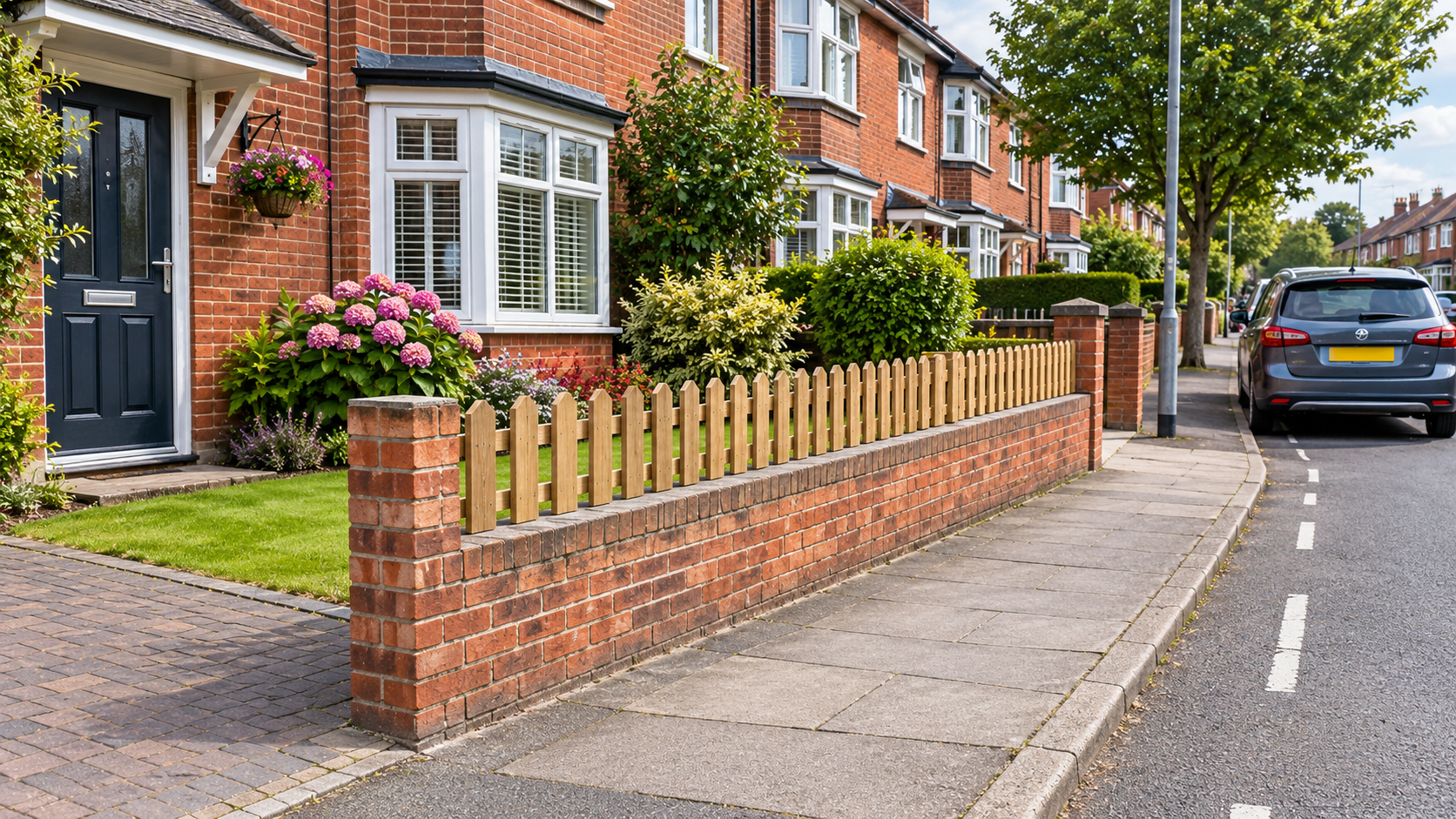
The 1 metre limit exists to protect sight lines for drivers and pedestrians. It applies where the fence is “adjacent to” a highway used by vehicular traffic, and the Planning Portal confirms that the footpath alongside such a road is included. A fence beside a footpath that carries no vehicles, a private drive or a bridleway is not caught, so the 2 metre limit applies there.
Next to a road used by vehicles, a front boundary wall or fence is limited to 1 metre without planning permission.
“Adjacent” is not defined in the Order. Most authorities treat a fence as adjacent if it runs along the back edge of the pavement or is set back only marginally from it; a fence several metres inside the plot, with a front garden between it and the road, is usually judged on the 2 metre rule. Because the interpretation varies, check with your local planning authority before building a 2 metre fence anywhere near the front of the property.
Exceptions: listed buildings, conservation areas and Article 4 directions
Listed buildings: Class A does not apply to any gate, fence or wall within the curtilage of a listed building, and the Planning Portal adds that your fence must not form a boundary with a neighbouring listed building. Listed building consent may also be needed. See our guide to listed building consent.
Conservation areas: you can still erect a fence up to the normal limits in England, but taking down a fence, wall or gate in a conservation area may need permission. Our conservation area rules guide explains the wider restrictions.
Article 4 directions and planning conditions: many estates built since the 1970s carry a condition preventing front boundary enclosures, and councils use Article 4 directions to withdraw rights in sensitive areas. Your title deeds, the original planning permission and the council’s Article 4 map will tell you. Our overview of permitted development rights covers how to check.
Flats and maisonettes: Class A is not limited to houses, but a leaseholder will usually need the freeholder’s consent under the lease as well as any planning permission.
Restrictive covenants: a covenant in the deeds can cap fence height below 2 metres even where planning law allows it. This is a private-law matter enforced by the beneficiary of the covenant, not the council.
What happens if a fence is too high? Enforcement in 2026
Building a fence over the limit without permission is a breach of planning control. It is not a criminal offence in itself, but ignoring an enforcement notice is. The process usually runs as follows: a neighbour complains, the council investigates and may invite a retrospective application, then serves an enforcement notice requiring the fence to be lowered or removed. You can appeal to the Planning Inspectorate, but if the notice is upheld and ignored the council can prosecute. In a case published by Barking and Dagenham Council, a homeowner who kept a rear fence above 2 metres after his appeal failed pleaded guilty at Barkingside Magistrates’ Court and was ordered to pay £522 in fines, costs and surcharge – and still had to lower the fence.
The timescale for enforcement changed significantly in 2024. Under the Levelling-up and Regeneration Act 2023, confirmed in GOV.UK guidance, the old four-year immunity for operational development was abolished in England for works substantially completed on or after 25 April 2024. A single 10-year limit now applies to all breaches, so an over-height fence put up in 2025 can be enforced against until 2035. Councils can also issue enforcement warning notices inviting a regularisation application. If your fence has stood unchallenged for the relevant period, a lawful development certificate is the way to prove it is immune.
The two numbers to remember: 1 metre next to a highway, 2 metres everywhere else, measured from ground level.
Applying for planning permission for a taller fence: costs and timescales
If you want a 2.4 metre fence for privacy or security, or a 1.8 metre front boundary beside a road, you need a householder planning application. Councils weigh the effect on neighbours’ light and outlook, the street scene and highway safety; well-justified applications for rear boundaries often succeed, while tall front fences on residential streets are frequently refused.
Item (England)
Cost or timescale
Source
Householder planning application fee
£528 from 1 April 2025, uprated by 3.8% from 1 April 2026
Planning Portal
Proposed further fee increase
Around 8% for applications made on or after 8 December 2026 (draft regulations, subject to Parliament)
Planning Geek / draft SI 2026
Statutory decision period
8 weeks for a householder application
Planning Portal
Enforcement time limit for breaches after 25 April 2024
10 years
GOV.UK
Fine for breaching a high hedge remedial notice
Up to £1,000
GOV.UK
Prosecution for ignoring a fence enforcement notice (example)
£522 total in fines, costs and surcharge
Barking and Dagenham Council
The Planning Portal confirmed the 3.8% inflation uplift that took effect on 1 April 2026, following the jump from £258 to £528 in April 2025. A draft statutory instrument published on 16 July 2026 proposes a further rise of about 8% for applications submitted from 8 December 2026, so if you are planning to apply, doing so before that date will save money.
Hedges are different: the high hedges rules
Planning permission is never needed for a hedge, so the 2 metre fence rule does not cap hedge height. Instead, Part 8 of the Anti-social Behaviour Act 2003 lets you complain to the council about a neighbour’s hedge if, according to GOV.UK, it is a line of two or more mostly evergreen or semi-evergreen trees or shrubs, over 2 metres tall, acting as a barrier to light or access and harming your reasonable enjoyment of your home. You must try to resolve it with your neighbour first and will usually pay a council fee. The council can issue a remedial notice requiring the hedge to be cut and maintained at a set height, with a fine of up to £1,000 for non-compliance, but it cannot order a hedge below 2 metres or require its removal.
Fence height and boundary disputes with neighbours
Height is the most common flashpoint in neighbour disputes. Research published by law firm Higgs LLP in October 2024, based on a survey of 500 people and a Freedom of Information request to HM Land Registry, found that fences were the subject of 47% of boundary disputes, that 258,177 boundary agreements were completed through the Land Registry between 2019 and 2024, and that the typical dispute lasted six to twelve months with one in ten people spending more than £2,000. Our own analysis of boundary dispute costs and outcomes reaches similar conclusions.
Three practical points reduce the risk of a dispute:
Establish who owns the fence before you touch it. The “good side faces the neighbour” rule is a myth; read our guide on which side of the fence is yours.
Know whether it is a party fence wall. A masonry wall astride the boundary is governed by the Party Wall etc. Act 1996, which brings notice and award procedures into play. See the difference between a party fence wall and a boundary wall.
Build on your own land. Setting the posts even 50 mm over the line is a trespass regardless of height. Our article on how close a neighbour can build to your fence explains the rules.
Where positions have hardened, a boundary determination by an independent surveyor, backed by Land Registry plans, pre-registration deeds and a measured site survey, usually settles the matter far more cheaply than litigation. If the dispute does reach court, a boundary dispute expert witness surveyor will be needed to give CPR Part 35 compliant evidence.
Fence height checklist before you build
Measure the proposed total height from natural ground level, including gravel boards, trellis and caps.
Check whether any part of the fence is adjacent to a road used by vehicles, including its pavement.
Confirm the property is not listed, not within a listed building’s curtilage and not subject to an Article 4 direction or a restrictive planning condition.
Read your title deeds for restrictive covenants and, if you own a flat, check the lease for the freeholder’s consent requirements.
Confirm the exact boundary line and ownership of any existing fence before removing it.
Talk to your neighbour early – most enforcement investigations start with a complaint.
If in doubt, ask the council for pre-application advice or apply for a lawful development certificate.
Why choose Survey Merchant for your fence height or boundary question?
Fence height regulations sit at the junction of planning law, boundary law and the Party Wall Act, and the facts on the ground – where the boundary runs, what the ground level is, whether the wall is a party fence wall – decide most disputes. Survey Merchant connects you with suitably qualified, accredited surveyors regulated by bodies such as RICS, CIOB and RPSA, matched to the specific job rather than a one-size-fits-all offer. Our panel covers the whole of the UK, so you get local knowledge of how your planning authority interprets “adjacent to a highway” alongside national expertise. Fees are fixed and quoted up front, turnaround is fast, and because the surveyor is independent of both parties the advice is impartial – which is exactly what a council officer, a neighbour or a court will want to see. From an initial boundary check through to a measured survey, a party wall award or expert witness evidence, we support you end to end.
This article is general guidance on fence height regulations in the UK as at November 2026 and is not legal advice. Planning rules differ between England, Wales, Scotland and Northern Ireland, and local policies apply; always confirm with your local planning authority before starting work.
Related guides
No items found.
Book a RICS surveyor
Survey Merchant provides vetted RICS surveyors across 100+ UK locations at fixed fees:
Can I put up a 6ft fence without planning permission?
Yes, in most cases. A 6ft (1.83 metre) fence is within the 2 metre permitted development limit for a rear or side boundary, provided the property is not listed and the right has not been removed by an Article 4 direction or planning condition. Next to a road used by vehicles the limit falls to 1 metre, so a 6ft front fence beside the pavement would need planning permission.
Does trellis count towards the 2 metre fence height limit?
Yes. The height limit applies to the whole means of enclosure measured from ground level, so trellis fixed to the top of a fence, gravel boards beneath it and post caps are all included. A 1.8 metre panel with a 300 mm trellis topper is 2.1 metres and over the limit. Some councils tolerate lightweight trellis for plants, but that is discretion rather than a legal exemption.
Can I have a 7ft or 8ft fence in the UK?
Only with planning permission. A 7ft fence is about 2.13 metres and an 8ft fence about 2.44 metres, both above the 2 metre permitted development limit. You would need to submit a householder planning application (£528 in England from April 2025, uprated for inflation in April 2026) and the council will consider the effect on neighbours, the street scene and highway safety.
How is fence height measured on sloping ground?
Height is measured from the natural ground level on which the fence stands to its highest point, assessed along the length of the fence. A fence stepped down a slope so that no section exceeds 2 metres is compliant; a level-topped fence that reaches 2.4 metres at the lower end is not. Where neighbouring gardens sit at different levels, a measured survey by an accredited surveyor provides an impartial record.
What happens if my neighbour's fence is too high?
Speak to your neighbour first, then report it to the council's planning enforcement team if it exceeds 2 metres (or 1 metre beside a road) and no permission exists. The council can invite a retrospective application or serve an enforcement notice; since 25 April 2024 councils in England have 10 years to act. If the fence breaches a restrictive covenant in the deeds, that is a private matter you would enforce yourself.
Do I need planning permission to replace an existing fence?
No, provided the replacement is no higher than the fence it replaces and no taller than the permitted limit, whichever is greater. You can repair, repaint or like-for-like replace an existing over-height fence without permission, but you cannot increase its height. In a conservation area, taking a fence or wall down may itself need consent, and listed buildings always need a formal application.