We use cookies to improve your experience on our site, analyze site traffic, and assist in our marketing efforts. By clicking "Accept all," you agree to the storing of cookies on your device. You can choose to "Reject all" non-essential cookies. For more information, please read our Cookie Policy.
Which Side of the Fence Is Mine? UK Rules Explained (2026)
A 2026 guide to which side of the fence is mine in England and Wales: reading your HM Land Registry title plan, T and H marks, repair responsibilities, planning rules and resolving disputes.
“Which side of the fence is mine?” is one of the most common questions UK homeowners ask – usually the moment a panel blows down, a neighbour wants to paint their side, or a sale is about to complete. The honest answer is that there is no left-hand or right-hand rule. Fence ownership in England and Wales is decided by your title deeds, by any boundary agreement that exists, and in some cases by long-standing use and presumption. This 2026 guide explains how to find out for certain, what T marks and H marks really mean, what the 2026 HM Land Registry guidance says, who has to pay for repairs, and when to bring in a suitably qualified, accredited surveyor.
Key takeaways
There is no legal rule that you own the fence on the left (or right) of your garden – ownership is set by your deeds, not by convention.
A “T” mark on your title plan pointing into your land normally means you are responsible for that boundary; an “H” (two back-to-back T marks) means it is shared.
If the deeds are silent, HM Land Registry’s June 2026 guidance says the feature is generally treated as a party (shared) boundary, so changes need both owners’ agreement.
The “good side faces the neighbour” and “posts are on the owner’s side” conventions are useful clues but carry no legal weight.
Unless a deed covenant says otherwise, you generally cannot force a neighbour to repair or even have a fence at all.
Fences up to 2 metres (1 metre next to a highway) usually need no planning permission in England, but never on the boundary of a listed building without consent.
Which side of the fence is mine? The short answer
In the UK, which side of the fence is yours is determined by your property’s title deeds and title plan, not by whether it sits on the left or right. A “T” mark on the boundary line pointing into your land means you own or must maintain it; an “H” mark means the fence is shared. If nothing is marked, the boundary is normally treated as jointly owned.
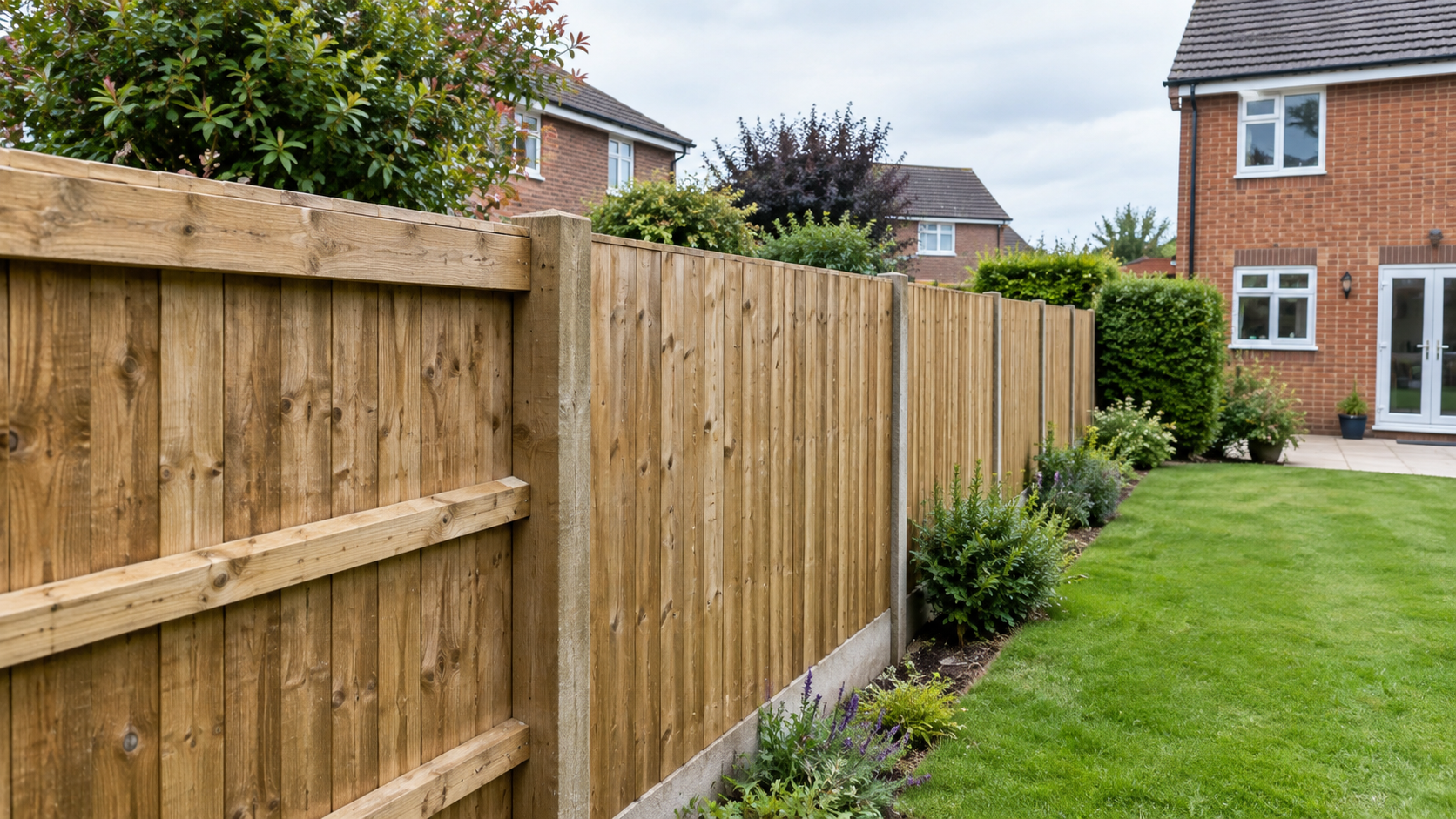
A closeboard fence on a typical UK garden boundary. Who owns it is a question for the deeds, not the position of the posts.
The left-hand side myth (and why it persists)
Almost every street has a resident who will tell you with total confidence that “everyone owns the fence on the left as you look out of the back door”. It is a myth. There is no statute, regulation or common-law rule in England and Wales that allocates boundary fences by left or right. The belief probably grew up because many developers of post-war estates did allocate boundaries in a consistent pattern (often the left-hand and rear boundaries to each plot) and wrote that into the original conveyances. On those estates the pattern may well be true – but it is true because the deeds say so, not because of a general rule. Walk two streets over to an older or infill development and the allocation could be the opposite, or entirely shared.
The same applies to Scotland and Northern Ireland, which have their own land registration systems; this guide focuses on England and Wales, where HM Land Registry operates.
How to find out which fence is yours: a step-by-step check
Step 1 – Read your title register and title plan
Nearly all homes in England and Wales are now registered. You can download an official copy of the title register and title plan from the GOV.UK property information service. Since 9 December 2024, HM Land Registry charges £7 per document online (£11 by post), up from £3 – the first change to information-service fees in a decade. Check the register first: if the original transfer contained a covenant about fences, the register may repeat it word for word, for example “the Transferee covenants to erect and forever maintain a fence along the boundary marked with an inward T on the plan”.
Step 2 – Look for T marks and H marks
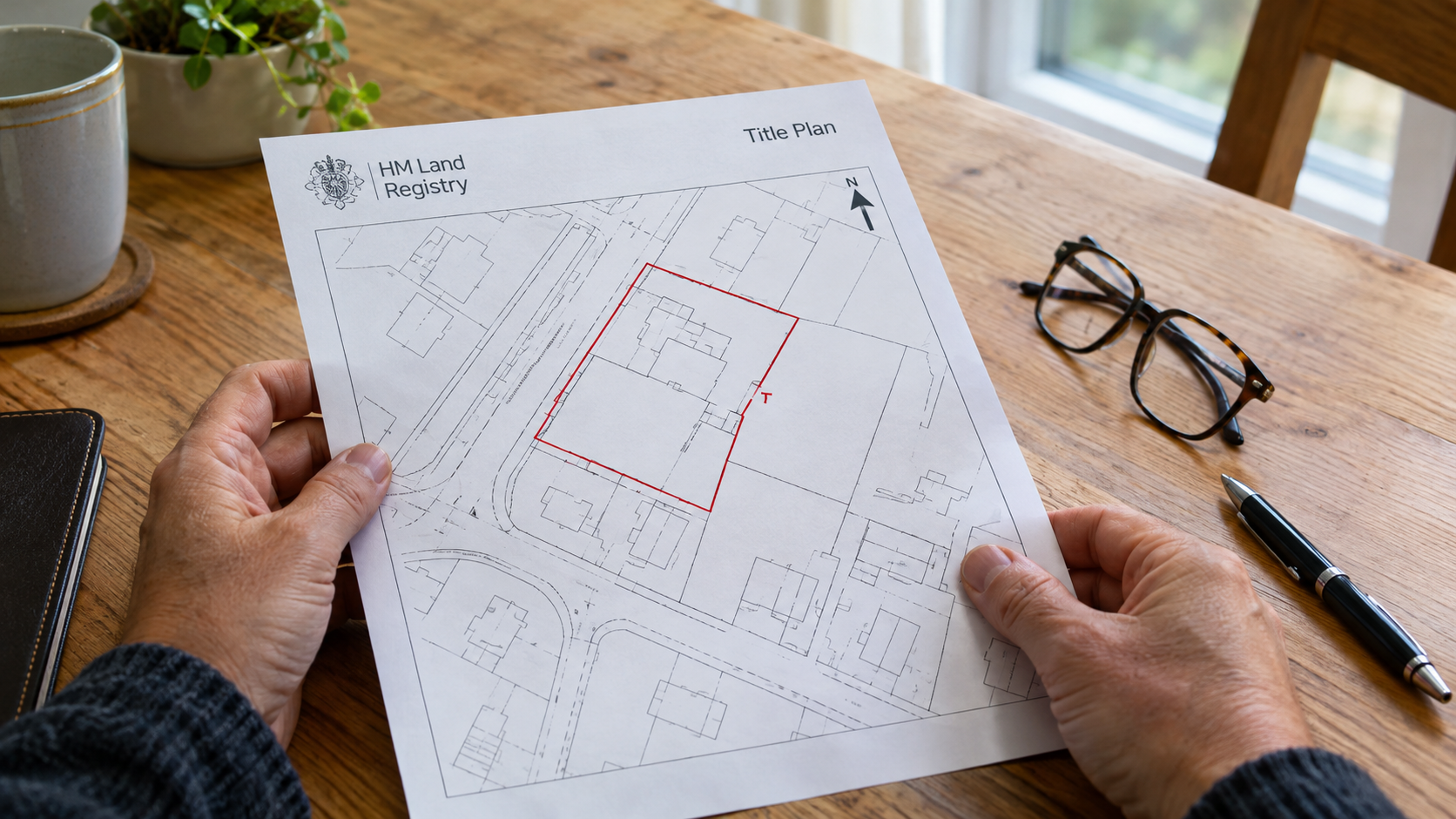
According to HM Land Registry Practice Guide 40, Supplement 3 (updated 1 June 2026), a T mark is “normally a statement concerning the ownership of a boundary structure or the liability to maintain and repair it”. The stem of the T points into the land of the owner who carries that responsibility. Two T marks back-to-back form an H, which signals a party (shared) boundary. Crucially, the guidance also says T marks only have effect where the deed text refers to them; stray T marks that the wording does not mention are “normally ignored”. So read the words, not just the drawing.
Illustrative example of a title plan being checked for boundary markings. Always read the register wording alongside any T or H marks.
Step 3 – Check the pre-registration deeds and any boundary agreement
If the register says nothing, the original conveyance or transfer (the “pre-registration deeds”) may. Your conveyancer, the seller, or HM Land Registry (if copies were filed) can help. Also look for a recorded boundary agreement: where neighbours have agreed who maintains what, it can be noted on both registers for a small fee.
Step 4 – Use physical clues, carefully
Only when the paperwork is silent should you fall back on convention, and even then treat it as a clue rather than proof. The usual conventions are that the posts and arris rails sit on the owner’s side with the “good” smooth face given to the neighbour, and that a fence is normally erected on the owner’s own land, just inside the line. HM Land Registry is explicit that “construction features, such as fence posts being on one owner’s side, don’t establish ownership”. Many modern fences use slotted concrete posts that sit centrally in any case.
Step 5 – Ask a surveyor if it still matters
If money, an extension or a dispute turns on the answer, instruct a suitably qualified, accredited surveyor. A boundary surveyor compares the deeds, historic Ordnance Survey mapping, aerial photography and measured evidence on site to give a reasoned opinion. Our guides to boundary dispute surveyor costs and how an expert witness surveyor establishes the line explain what that involves.
What do the markings on a title plan actually mean?
Marking or wording
What it usually means
Legal weight
T mark pointing into your land
You own, or must maintain, that boundary feature
Binding where the register or deed wording refers to it
T mark pointing into the neighbour’s land
Your neighbour owns or maintains it
As above
H mark (two T marks back-to-back)
Party boundary – shared ownership and upkeep
As above
Fencing covenant in the register
Named party must erect/maintain a fence of a stated type or height
Enforceable obligation (though a covenant alone does not prove ownership)
No marks, no wording
Treated as a party boundary unless other evidence exists
Presumption only – rebuttable by evidence
Red edging on the title plan
The general extent of the registered land
A “general boundary” only – it does not fix the exact line
Why the red line on your title plan is not the exact boundary
Under section 60 of the Land Registration Act 2002, the boundary shown on a title plan is a “general boundary” which “does not determine the exact line of the boundary”. Title plans are drawn on Ordnance Survey mapping, typically at 1:1250 in urban areas, so the width of the red line itself can represent the best part of a metre on the ground. This is why two neighbours can both be “right” when reading their plans and still disagree about 30 centimetres of soil. If you need the exact line fixed, you can apply for a determined boundary using form DB with a plan prepared by a chartered land surveyor (accurate to ±10 mm, scale no smaller than 1:200). The HM Land Registry fee is £90, plus the surveyor’s and solicitor’s fees.
Who is responsible for repairing a boundary fence?
This is where most neighbourly friction starts. The position in England and Wales is:
If the deeds place the fence with you, you may maintain it, but unless there is a positive covenant to keep it in repair, you are not obliged to. Many estates do carry such a covenant, so check.
If the deeds place it with your neighbour, you cannot force them to repair or replace it unless a covenant exists – and even then enforcement is a civil matter between owners. Councils and the police will not intervene in a private fence repair.
If it is shared, both of you are jointly responsible; neither can remove or alter it without the other’s consent.
There is generally no legal duty to have a fence at all, except where a covenant requires one or safety legislation applies (for example around a swimming pool, railway or livestock).
The practical fix when a neighbour will not act is simple: erect your own fence a few centimetres inside your boundary, at your own cost. You then own it outright and control its appearance.
Can my neighbour paint, lean on or attach things to my fence?
If the fence is yours, your neighbour needs your permission to paint, stain, screw trellis to, or hang planters on it. Doing so without consent can amount to trespass or damage to your property. Equally, if it is their fence, you cannot fix anything to it either. If it is shared, agree changes in writing. A fence that is yours but sits exactly on the line is still yours; what matters is ownership, not which face you can see.
Fence height and planning permission in 2026
Under Class A of Part 2, Schedule 2 of the Town and Country Planning (General Permitted Development) (England) Order 2015 (in force as amended at October 2026), you can erect or replace a fence, gate or wall without planning permission provided it is no more than 2 metres high, or 1 metre where it adjoins a highway used by vehicles. Replacement fences may go up to the existing height if that is greater. Permitted development does not apply within the curtilage of a listed building, and local Article 4 directions or conservation-area conditions can remove the right. The Planning Portal confirms anything taller needs an application.
Fences remain the single most common trigger for neighbour disputes. Research reported by Ideal Home on 19 June 2026, drawing on Checkatrade survey data, found that six in ten Britons have experienced a garden dispute with a neighbour, with fences, overhanging branches and high hedges the leading causes. Earlier research by Direct Line Group (2022) estimated that around 11 million UK adults had been involved in a boundary dispute at some point. Litigation is expensive and rarely proportionate: a contested county court claim over a few feet of garden can run to tens of thousands of pounds in costs, as our analysis of boundary dispute costs and outcomes shows.
Two developments matter for 2026. First, HM Land Registry refreshed its boundaries practice guidance (PG40 Supplements 3 and 4) on 1 June 2026, restating that physical features do not establish ownership and encouraging recorded boundary agreements. Second, the courts continue to expect parties to try alternative dispute resolution before issuing a claim; the RICS Boundaries: procedures for boundary identification, demarcation and dispute resolution (4th edition professional standard) sets out the evidence-led approach surveyors follow and recommends mediation, which resolves most cases for a fraction of court costs.
A boundary surveyor measures the fence line against deed plans and historic mapping before giving an opinion on ownership.
What to do if you and your neighbour disagree
Talk first. Most fence questions are solved over the garden gate once both sides have looked at their title plans together.
Compare documents. Download both registers and plans (£7 each). Markings on one title often mirror the other.
Record an agreement. Put any agreement about ownership or upkeep in writing, sign it, and ask HM Land Registry to note it on both titles (alteration of the register costs £20 online or £40 by post).
Commission a boundary report. An independent, accredited surveyor’s report is persuasive to neighbours, solicitors and mediators alike.
Mediate before you litigate. Court should be the last resort; a judge can also order costs against a party who refused to mediate.
Buying or selling a house? Check the fences before exchange
Sellers must answer the fence-ownership questions in the TA6 Property Information Form, and buyers should compare those answers with the title plan before exchange. A building survey will note the condition of boundary fences and flag anything that looks inconsistent with the plan, such as a fence line that does not match the red edging. Survey Merchant’s building surveying service can combine a condition survey with a boundary check where you need both.
Why choose Survey Merchant for your boundary and fence questions?
Survey Merchant connects you with a panel of suitably qualified, accredited surveyors regulated by bodies including RICS, CIOB and RPSA, matched to the job in hand – whether that is a quick deed-plan review, a measured boundary survey, a determined-boundary plan for HM Land Registry, or an expert report for mediation or court. Here is why homeowners choose us:
The right accreditation for the task: boundary work is matched to surveyors with the relevant land and building expertise, not a one-size-fits-all panel.
Nationwide UK coverage with local surveyors who know the mapping, estate layouts and council practice in your area.
Transparent, competitive fixed fees agreed before any work starts, so a fence question does not become a surprise bill.
Fast turnaround – deed-plan reviews and site measurements can be arranged quickly when a sale or a dispute is pressing.
Impartial advice: our surveyors report on the evidence, which is exactly what neighbours, solicitors and mediators need.
End-to-end support from the first phone call through to boundary agreements, party wall matters and, if needed, expert witness evidence.
<p>Neither by default. There is no rule in England and Wales that gives you the left- or right-hand fence. Ownership is set by your title deeds and title plan, so check for T or H marks and any fencing covenant in the register.</p>
What does a T mark on a title plan mean?
<p>A T mark with its stem pointing into your land normally shows that you own, or are responsible for maintaining, that boundary feature. HM Land Registry guidance says the mark only carries weight where the deed wording refers to it.</p>
Can I force my neighbour to repair their fence?
<p>Generally no. Unless the deeds contain a positive covenant to maintain the fence, there is no legal duty to repair it or even to have one. The practical option is to erect your own fence just inside your boundary at your own cost.</p>
Can my neighbour paint or attach things to my fence?
<p>Not without your permission. If the fence belongs to you, painting, staining or fixing trellis to it from the other side can amount to trespass or damage. If the fence is shared, agree any changes in writing first.</p>
How high can a garden fence be without planning permission?
<p>In England, up to 2 metres, or 1 metre where the fence adjoins a highway used by vehicles, under Class A of the General Permitted Development Order 2015. Listed buildings and some conservation areas or Article 4 areas are excluded, so check with your council.</p>
How much does it cost to check or fix a boundary officially?
<p>An official copy of your title register or plan costs £7 online from HM Land Registry. Recording a boundary agreement costs £20 online (£40 by post) and a determined boundary application costs £90, plus surveyor and solicitor fees.</p>