KEY TAKEAWAYS
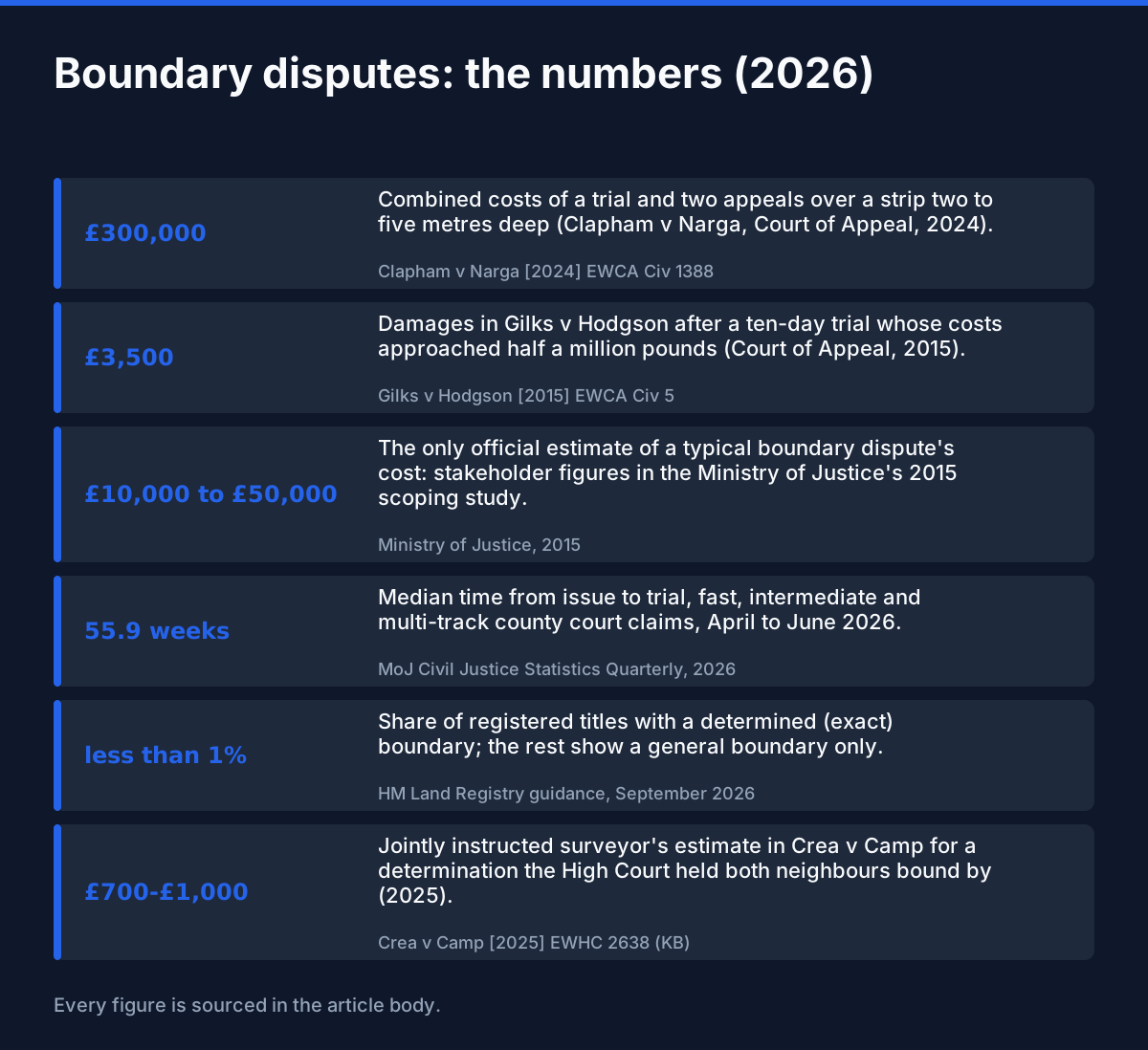
- → half a million pounds Costs in Gilks v Hodgson approached half a million pounds against damages of £3,500, after a ten-day trial and three days in the Court of Appeal (2015). (Gilks v Hodgson [2015] EWCA Civ 5, 2015)
- → £10,000 to £50,000 The only official estimate of a typical boundary dispute's cost: stakeholder figures gathered for the Ministry of Justice's 2015 scoping study, which also recorded that costs "typically far exceed the value of the piece of land at stake". (MoJ Boundary Disputes Scoping Study, 2015)
- → 55.9 weeks Median time from issue to trial for fast, intermediate and multi-track county court claims in England and Wales, April to June 2026, the track a defended boundary claim normally sits on. (MoJ Civil Justice Statistics Quarterly, 2026)
- → less than 1% Share of registered titles with a determined (exact) boundary; the rest show only a general boundary, which is why the title plan rarely settles a dispute. (HM Land Registry boundaries guidance, 2026)
- → £700-£1,000 The jointly instructed surveyor's estimate in Crea v Camp for a boundary determination that, eight years and two courts later, the High Court held both neighbours had agreed to be bound by (2025). (Crea v Camp [2025] EWHC 2638 (KB), 2025)
- → over 1100 Disputed Land Registry applications referred to the First-tier Tribunal's Land Registration Division each year, where there is no fee and free mediation is offered. (Courts and Tribunals Judiciary, 2023)
- → £90 HM Land Registry fee to apply for a determined boundary, against a £387 county court issue fee for a non-money claim and a £1,334 multi-track hearing fee. (GOV.UK determined boundary guidance, 2026)
Ask a solicitor what a boundary dispute costs and the answer is almost always £10,000 to £50,000. That range has a single origin: the Ministry of Justice's scoping study of January 2015, which gathered estimates from 10 respondents and recorded that costs "typically far exceed the value of the piece of land at stake"(MoJ Boundary Disputes Scoping Study, 2015). Nothing official has measured the subject since. What has accumulated instead is a run of judgments in which the Court of Appeal states the bill: over £300,000 for a strip between 2 metres and 5 metres deep in Clapham v Narga (2024) (Clapham v Narga [2024] EWCA Civ 1388, 2024), and costs approaching half a million pounds against damages of £3,500 in Gilks v Hodgson (2015) (Gilks v Hodgson [2015] EWCA Civ 5, 2015).
This guide gathers the figures that exist for England and Wales in one place: the reported costs, the official estimates, the measured timescales in the county court and the First-tier Tribunal, the fees each route charges, and the rules that decide whether a surveyor's determination ends the argument. It is written for the owner, the litigant in person and the solicitor deciding whether to instruct a boundary dispute expert witness surveyor and what to do with the report once it arrives. Every number carries its source and its year, and the 2015 figures are labelled as such, because nobody has updated them.
1 What Have Boundary Disputes Cost in Reported Cases? From £910 to Half a Million Pounds
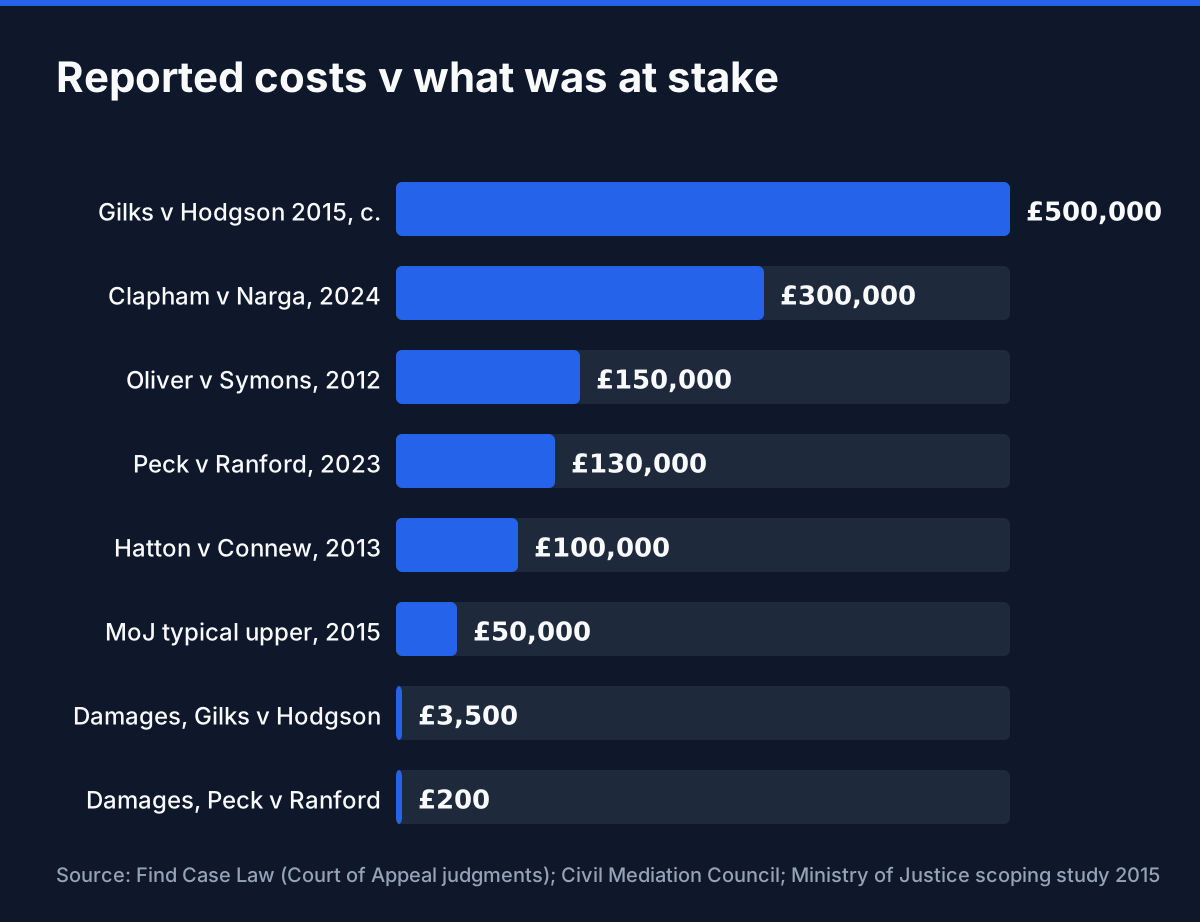
In the cases that reach the Court of Appeal, costs run from £100,000 to half a million pounds, against land worth almost nothing and damages that rarely clear four figures: Clapham v Narga cost over £300,000 for a strip between 2 metres and 5 metres deep (Clapham v Narga [2024] EWCA Civ 1388, 2024), and Gilks v Hodgson approached half a million pounds after a 10 days trial that awarded £3,500(Gilks v Hodgson [2015] EWCA Civ 5, 2015).
| CASE AND YEAR | FIGURE | SOURCE |
|---|---|---|
| Clapham v Narga (2024): combined costs of trial and two appeals | £300,000 | Clapham v Narga [2024] EWCA Civ 1388 |
| Clapham v Narga (2024): depth of the disputed strip | between 2 metres and 5 metres | Clapham v Narga [2024] EWCA Civ 1388 |
| Gilks v Hodgson (2015): costs 'so far' | half a million pounds | Gilks v Hodgson [2015] EWCA Civ 5 |
| Gilks v Hodgson (2015): damages awarded after a 10 days trial | £3,500 | Gilks v Hodgson [2015] EWCA Civ 5 |
| Oliver v Symons (2012): appellants' costs in a neighbour access dispute | £150,000 | Oliver v Symons [2012] EWCA Civ 267 |
| Hatton v Connew (2013): claimants' total costs | £100,000 | Hatton v Connew [2013] EWCA Civ 1681 |
| East Dulwich trespass case (reported 2023): lawyers' bills left with the claimants | £130,000 | Civil Mediation Council case note |
| East Dulwich trespass case (reported 2023): damages | £200 | Civil Mediation Council case note |
| Bradford v James (2008): payment on account of costs, loser paying 75% of the bill | £20,500 | Bradford v James [2008] EWCA Civ 837 |
| Richardson v MacNab (2008): payment on account of the other side's costs | £12,500 | Richardson v MacNab [2008] EWCA Civ 860 |
| Richardson v MacNab (2008): sum actually awarded for the fence | £910.63 | Richardson v MacNab [2008] EWCA Civ 860 |
The pattern across sixteen years of judgments is consistent. In Bradford v James (2008) Mummery LJ saw "too many calamitous neighbour disputes in the courts" over "a little strip of farmyard worth much less than the legal costs of fighting over it"; the loser paid 75% of the winner's costs with £20,500 on account (Bradford v James [2008] EWCA Civ 837, 2008). In Oliver v Symons (2012), over a track little more than a hundred metres long, the appellants' costs were in the region of £150,000 and Ward LJ said the case was "crying out for mediation"(Oliver v Symons [2012] EWCA Civ 267, 2012). In Gilks v Hodgson (2015) the trial took 10 days, the Court of Appeal three more, and Sir Stanley Burnton called it litigation pursued "to an extent grossly disproportionate to what was at stake"(Gilks v Hodgson [2015] EWCA Civ 5, 2015).
Two features of these figures matter for anyone deciding whether to fight. First, the sums are costs, not damages: in Richardson v MacNab the claim had been for something over twenty thousand pounds, the court awarded £910.63 for a fence, and the losing side still had to find £12,500 on account of the other party's costs (Richardson v MacNab [2008] EWCA Civ 860, 2008). Second, the money is spent on lawyers and experts, not on the land. The East Dulwich case, an unreported county court judgment known through the Civil Mediation Council's note of an Evening Standard report, ended with £200 in damages and lawyers' bills of around £130,000, the judge describing a "sledgehammer to crack a nut"(Civil Mediation Council case note, 2023). The rules on who pays expert witness fees decided the rest, and in every case above the answer was mostly the loser.
2 What Does a 'Typical' Boundary Dispute Cost? The Only Official Estimate Is a Decade Old
The Ministry of Justice's 2015 scoping study is the sole official attempt to size the problem. Its respondents put typical costs at £10,000 to £50,000 per case, mediation at £1000–£1500 per party and resolution at anywhere from three months to several years(MoJ Boundary Disputes Scoping Study, 2015); it drew on 10 responses, and the government declined to legislate.
| METRIC (MOJ SCOPING STUDY, 2015) | VALUE | SOURCE |
|---|---|---|
| Typical cost per case, stakeholder estimate | £10,000 to £50,000 | MoJ Boundary Disputes Scoping Study |
| Cost of mediation per party | £1000–£1500 | MoJ Boundary Disputes Scoping Study |
| Time to resolve, range given | three months to several years | MoJ Boundary Disputes Scoping Study |
| Referrals to the Land Registration Division per year | 1200 | MoJ Boundary Disputes Scoping Study |
| Cases formally adjudicated by the Division per year | 500 | MoJ Boundary Disputes Scoping Study |
| Boundary disputes before the Division per year, informal estimate | 160–170 | MoJ Boundary Disputes Scoping Study |
| Division cases resolved within its seventy-week target | 80% | MoJ Boundary Disputes Scoping Study |
| Disputes involving litigation, one respondent | 80% | MoJ Boundary Disputes Scoping Study |
| Disputes that did not go to court, other respondents | 50% | MoJ Boundary Disputes Scoping Study |
| Cases in which mediation is used | 20% | MoJ Boundary Disputes Scoping Study |
| Mediation success rate, one respondent | 95% | MoJ Boundary Disputes Scoping Study |
| Disputes surveyors and mediators said they see per year | upwards of 1000 | MoJ Boundary Disputes Scoping Study |
| Boundary disputes per year at each of two Land Registry offices | 40–50 | MoJ Boundary Disputes Scoping Study |
| Responses received to the questionnaire | 10 | MoJ Boundary Disputes Scoping Study |
The study is worth reading for what it could not find as much as for what it found. Its volume figures came from the Land Registration Division: approximately 1200 referrals a year, around 500 formally adjudicated, with boundary disputes suggested informally to be about a third of the total, or 160–170 a year (MoJ Boundary Disputes Scoping Study, 2015). Surveyors and mediators said they became aware of upwards of 1000 disputes a year, and two Land Registry offices each saw 40–50, so the study treated the tribunal's caseload as the visible tip of a larger pile. On how disputes end, the responses disagreed: one put litigation at 80% of cases, others said up to 50% never reached court, mediation was used in about 20%, and a single respondent claimed it succeeded in 95% of the cases where it was tried (MoJ Boundary Disputes Scoping Study, 2015). That last figure is one person's estimate and is reported here as such.
Two findings bear directly on the surveyor's role. The study recorded that independent expert surveyors and the Land Registry's own procedure were "little used", and it rejected a compulsory expert determination scheme modelled on the Party Wall etc. Act, preferring "piecemeal improvement of the current system without impinging on its flexibility"(MoJ Boundary Disputes Scoping Study, 2015). The state looked at the problem, decided not to make the surveyor's decision binding, and left the question to the parties. How that works in practice, and what a boundary dispute surveyor costs relative to the figures above, is the subject of the last two sections; the boundary dispute resolution checker gives a quick first read of which route fits.
3 How Long Does a Boundary Dispute Take? A Year to a County Court Trial, Two to Three Years Through the Tribunal
A defended claim on the fast, intermediate or multi-track took a median 55.9 weeks from issue to trial in April to June 2026, and a small claim 41.0 weeks(MoJ Civil Justice Statistics Quarterly, 2026). Tribunal references run longer because the clock starts at the Land Registry: Cunningham v Holehouse went from application on 17 November 2023 to decision on 1 May 2026(Cunningham v Holehouse [2026] UKFTT 771 (PC), 2026).
| STAGE OR CASE | DATE OR DURATION | SOURCE |
|---|---|---|
| Median time from issue to trial, small claims, April to June 2026 | 41.0 weeks | MoJ Civil Justice Statistics Quarterly |
| Median time from issue to trial, fast, intermediate and multi-track, April to June 2026 | 55.9 weeks | MoJ Civil Justice Statistics Quarterly |
| County court claims issued in the quarter | 571,000 | MoJ Civil Justice Statistics Quarterly |
| Claims that reached trial in the quarter | 12,000 | MoJ Civil Justice Statistics Quarterly |
| Land Registration Division: hearing dates offered within this period of a case being ready | 10 weeks | HMCTS Land Registration Division guide T412 |
| Cunningham v Holehouse: determined boundary application lodged | 17 November 2023 | Cunningham v Holehouse [2026] UKFTT 771 (PC) |
| Cunningham v Holehouse: referred to the tribunal | 18 May 2025 | Cunningham v Holehouse [2026] UKFTT 771 (PC) |
| Cunningham v Holehouse: decision (application dismissed, applicants to pay costs) | 1 May 2026 | Cunningham v Holehouse [2026] UKFTT 771 (PC) |
| Denno v White: determined boundary application filed | 23 April 2024 | Denno v White [2026] UKFTT 453 (PC) |
| Denno v White: referred to the tribunal | 23 March 2025 | Denno v White [2026] UKFTT 453 (PC) |
| Denno v White: decision (neither side's line accepted) | 19 March 2026 | Denno v White [2026] UKFTT 453 (PC) |
| Sharma v James: adverse possession application filed | 15 March 2023 | Sharma v James [2026] UKFTT 1354 (PC) |
| Sharma v James: decision | 9 September 2026 | Sharma v James [2026] UKFTT 1354 (PC) |
| Todd v Marsh: trial, on a dispute that began in August 2019 | 19-22 May 2025 | Todd v Marsh [2026] EWHC 1701 (Ch) |
| Crea v Camp: joint surveyor's report, litigated until October 2025 | 6 February 2017 | Crea v Camp [2025] EWHC 2638 (KB) |
The court statistics are the only measured timescales, and they cover all claim types: 571,000 claims were issued in the quarter and 12,000 reached trial, so a defended boundary claim joins a queue in which trial is the exception (MoJ Civil Justice Statistics Quarterly, 2026). Cunningham v Holehouse was lodged with HM Land Registry on 17 November 2023, referred on 18 May 2025 and decided on 1 May 2026: roughly two and a half years, eighteen months of it before the tribunal had the file (Cunningham v Holehouse [2026] UKFTT 771 (PC), 2026). Denno v White ran from 23 April 2024 to 19 March 2026, with the referral at 23 March 2025(Denno v White [2026] UKFTT 453 (PC), 2026), and Sharma v James, an adverse possession claim over a strip about half a metre wide, from 15 March 2023 to 9 September 2026(Sharma v James [2026] UKFTT 1354 (PC), 2026). Once a case is ready the Division aims to offer hearing dates within 10 weeks(HMCTS Land Registration Division guide T412, 2023).
The longest timelines belong to disputes that went to court and then on appeal. Todd v Marsh began with a damaged deer fence in August 2019, was tried over 19-22 May 2025 and lost its appeal in July 2026; the court remarked that almost no purchaser of such a house would employ a boundary surveyor before buying, which is how most of these cases start (Todd v Marsh [2026] EWHC 1701 (Ch), 2026). Crea v Camp turned on a surveyor's report dated 6 February 2017 and was still being argued in the High Court in October 2025 (Crea v Camp [2025] EWHC 2638 (KB), 2025). The 2015 study's range of three months to several years remains accurate as a range; the dates above show which end of it each route occupies. The clock also depends on whether the court permits expert evidence at all, which is governed by the rules on CPR Part 35 expert reports and on whether the parties share a single joint expert.
4 What Does Each Route Cost in Fees? £90 at the Land Registry, £387 to Issue in Court, Nothing at the Tribunal
The fixed fees are small next to the bills above: £90 for a determined boundary application (GOV.UK determined boundary guidance, 2026), £387 to issue a non-money county court claim and £1,334 for a multi-track hearing (HMCTS court fees EX50, 2026), and nothing at all at the Land Registration Division, which also offers free mediation (Courts and Tribunals Judiciary, 2023). The real expense is professional time.
| FEE OR RATE | VALUE | SOURCE |
|---|---|---|
| HM Land Registry: determined boundary application (form DB) | £90 | GOV.UK determined boundary guidance |
| County court: issue fee, non-money claim | £387 | HMCTS court fees EX50 |
| High Court: issue fee, non-money claim | £663 | HMCTS court fees EX50 |
| County court: hearing fee, intermediate or multi-track | £1,334 | HMCTS court fees EX50 |
| County court: hearing fee, fast track | £619 | HMCTS court fees EX50 |
| County court: application on notice | £321 | HMCTS court fees EX50 |
| County court: fee to appeal (other than small claims) | £175 | HMCTS court fees EX50 |
| Land Registration Division: referrals each year, no fee, free mediation | over 1100 | Courts and Tribunals Judiciary |
| Small claims track: maximum expert's fee recoverable, per expert | £750 | CPR Practice Direction 27A |
| Average expert hourly rate, civil court work (all disciplines, 2025) | £253.73 | Bond Solon Expert Witness Survey 2025 |
| Average expert hourly rate, report writing (2025) | £238.81 | Bond Solon Expert Witness Survey 2025 |
| Crea v Camp: joint surveyor's estimate for a boundary determination (2016 letter) | £700-£1,000 | Crea v Camp [2025] EWHC 2638 (KB) |
| Cunningham v Holehouse: rate allowed for a litigant in person's own time | £19 per hour | Cunningham v Holehouse [2026] UKFTT 771 (PC) |
| Mediation: aggregate settlement rate, all civil and commercial cases (year to September 2022) | 92% | CEDR Tenth Mediation Audit |
| Mediation: civil and commercial mediations per year (year to September 2022) | 17,000 | CEDR Tenth Mediation Audit |
| Surveyor's fees, surveying firm's own estimate (Anstey Horne) | £750 – £5,000+ | Anstey Horne (firm's own estimates) |
| Mediation or ADR, surveying firm's own estimate (Anstey Horne) | £1,500 – £5,000 | Anstey Horne (firm's own estimates) |
| Full county court trial with expert evidence, surveying firm's own estimate (Anstey Horne) | £25,000 – £50,000+ | Anstey Horne (firm's own estimates) |
Put the fees beside the judgments and the shape of the problem is obvious. The entire fixed cost of taking a non-money claim through the county court to a multi-track trial, issue fee plus hearing fee, is £387 and £1,334(HMCTS court fees EX50, 2026); Clapham v Narga cost roughly a hundred and seventy times that. The tribunal route is cheaper still: the Land Registration Division, which received over 1100 referrals a year on the judiciary's own figures, charges nothing, offers judicial mediation and sits 34 fee-paid judges alongside its salaried bench (Courts and Tribunals Judiciary, 2023). What the parties pay for is professional time. Bond Solon's 2025 survey of 525 experts put the average hourly rate for civil court work at £253.73 and for report writing at £238.81, across all disciplines (Bond Solon Expert Witness Survey 2025, 2025); the wider picture of expert witness costs in the UK follows from those rates multiplied by the days a case consumes.
The cheapest figure in the table is also the most instructive. In Crea v Camp the proposal was that one surveyor be jointly instructed for £700-£1,000, over two or three days, and that both neighbours accept the result (Crea v Camp [2025] EWHC 2638 (KB), 2025); had both sides kept to that, the dispute would have cost less than a single hearing fee. The surveying firm Anstey Horne publishes its own unsourced ranges, £750 – £5,000+ for the surveyor, £1,500 – £5,000 for mediation and £25,000 – £50,000+ for a full county court trial with expert evidence (Anstey Horne (firm's own estimates), 2025); they are a practitioner's impression rather than data. Costs-shifting runs both ways: in Cunningham v Holehouse the losing applicants paid the respondents' costs, with their own time valued at £19 per hour(Cunningham v Holehouse [2026] UKFTT 771 (PC), 2026). Instructing the expert properly, as set out in the guide on how to instruct an expert witness surveyor, is the one cost decision that shapes all the others.
5 Will the Surveyor's Report Decide the Case? Only If Both Sides Agreed to Be Bound
A surveyor's report is evidence, not a decision. HM Land Registry "cannot decide, mediate or resolve boundary disputes", less than 1% of registers carry a determined boundary, and under section 60(2) of the Land Registration Act a general boundary does not fix the exact line (HM Land Registry boundaries guidance, 2026). The report binds when both sides agree it will, as Crea v Camp held in 2025 (Crea v Camp [2025] EWHC 2638 (KB), 2025).
| RULE OR FIGURE | VALUE | SOURCE |
|---|---|---|
| Registered titles with a determined boundary | less than 1% | HM Land Registry boundaries guidance |
| Land and property titles on the register | 27 million | HM Land Registry Annual Report 2024-25 |
| Share of the land area of England and Wales registered | 89% | HM Land Registry Annual Report 2024-25 |
| Total determined boundaries, RICS estimate (2021) | a few thousand | RICS Boundaries guidance, 4th edition |
| Precision a determined boundary plan must record | +/-10mm | HM Land Registry Practice Guide 40s4 |
| Smallest permitted scale for a determined boundary plan | 1:200 | HM Land Registry Practice Guide 40s4 |
| Land Registration Act: a general boundary 'does not determine the exact line' | section 60(2) | Land Registration Act 2002, section 60 |
| Adverse possession period to apply for registered land | ten years | Land Registration Act 2002, Schedule 6 |
| Limitation period to recover unregistered land | twelve years | Limitation Act 1980, section 15 |
| Protocol: exchange Land Registry copies within | 2 weeks | PLA Boundary Disputes Protocol |
| Protocol: discuss negotiation or mediation by week | 8 weeks | PLA Boundary Disputes Protocol |
| Protocol: appoint experts (adverse possession cases) by week | 16 weeks | PLA Boundary Disputes Protocol |
| Churchill v Merthyr Tydfil: courts may order non-court dispute resolution | 29 November 2023 | Churchill v Merthyr Tydfil [2023] EWCA Civ 1416 |
| Crea v Camp: joint surveyor's fee estimate, held binding by agreement | £700-£1,000 | Crea v Camp [2025] EWHC 2638 (KB) |
The reason the title plan rarely ends a dispute is statutory. Under section 60(2) a general boundary does not determine the exact line, and HM Land Registry's September 2026 guidance says only less than 1% of registers have a determined boundary out of more than 27 million titles covering 89% of the land area (HM Land Registry Annual Report 2024-25, 2025); RICS put the total at a few thousand in 2021 (RICS Boundaries guidance, 4th edition, 2021). Determining one needs a plan at a scale no smaller than 1:200 with measurements accurate to +/-10mm, and even then the registry "does not determine a boundary in the sense of resolving a disagreement as to where the exact line of the boundary is located"; a non-groundless objection goes to the tribunal, which weighs the report as set out in the guide to what to expect from a property expert witness report(HM Land Registry Practice Guide 40s4, 2026). Time also moves boundaries: a neighbour in adverse possession of registered land for ten years may apply to be registered if they reasonably believed the land was theirs for at least that long and no boundary had been determined (Land Registration Act 2002, Schedule 6, 2002); for unregistered land the limitation period is twelve years(Limitation Act 1980, section 15, 1980).
The binding question has a clear answer in the cases. In Crea v Camp the defendants proposed that both sides jointly instruct one firm for £700-£1,000 and accept its conclusion; the claimants later sued anyway, and the High Court held that "the parties entered into an agreement that they would jointly instruct Lewis Brown on terms that they would be bound by the firm's conclusion as to the boundary", so the report of 6 February 2017 decided the case eight years on (Crea v Camp [2025] EWHC 2638 (KB), 2025). Without such an agreement a report binds nobody, which is why the Property Litigation Association's Boundary Disputes Protocol says that in most garden disputes "it will not be proportionate for the parties to have an expert each", with negotiation or mediation discussed by week 8 weeks and experts in adverse possession cases appointed by week 16 weeks(PLA Boundary Disputes Protocol, 2017). Since Churchill v Merthyr Tydfil on 29 November 2023 a court can order the parties into non-court dispute resolution, provided the order is proportionate (Churchill v Merthyr Tydfil [2023] EWCA Civ 1416, 2023), so expert evidence in mediated property disputes now matters as much as evidence at trial.
Explore every figure in this article
Methodology
This page was researched on the first of October 2026 from primary sources: judgments and tribunal decisions on The National Archives' Find Case Law service, the Ministry of Justice's 2015 boundary disputes scoping study and its Civil Justice Statistics Quarterly for April to June 2026, HM Land Registry's practice guide, fees page, annual report and its boundary disputes guidance of September 2026, HM Courts and Tribunals Service's civil fee table and Land Registration Division user guide, the Civil Procedure Rules, the Land Registration Act 2002 and Limitation Act 1980 on legislation.gov.uk, the Courts and Tribunals Judiciary, the Property Litigation Association's Boundary Disputes Protocol, RICS's boundaries guidance, CEDR's mediation audit and the Bond Solon expert witness survey. Four figures rest on secondary or estimated sources and are named as such in the text: the East Dulwich costs and damages, which come from the Civil Mediation Council's note of an Evening Standard report of an unreported county court judgment; the surveying firm Anstey Horne's own fee ranges; and the single-respondent mediation success rate in the 2015 study. Pre-2025 figures are dated in the text and in the tables. The recency sweep that preceded the research ran at full strength across Reddit, YouTube, TikTok and the open web with no degraded leg, and surfaced the 2026 tribunal decisions used in the duration section. Every source URL was fetched and checked by the automated verification script on the second of October 2026: all hosts were reachable and each figure was located in the page text, except that figures held inside PDF documents, which the script cannot read, were confirmed by extracting the PDF text and locating the exact value; a small number of hosts that block automated requests were confirmed by opening the page directly. That check is recorded against every fact in the fact sheet. The hero image was rendered by an image model from a text-free composition brief; the statistics card and the comparison chart were drawn locally from the fact sheet so that every number on them is the fact sheet's own. No court, tribunal or registry publishes boundary-dispute costs or outcomes as a data series, so the reported judgments over-represent the expensive cases that reached the Court of Appeal, the tribunal timelines are individual decisions rather than averages, and the county court time-to-trial figures cover all claim types rather than boundary claims alone.
- Sources consulted: 41
- Sources cited: 31
- Data freshness: 2026: 32, 2025: 12, 2024 and older: 47
- Data range: 1980-11-13 to 2026-09-24
- Research date: 2026-10-01
- Update schedule: Quarterly, next with the Civil Justice Statistics for July to September 2026
- Limitations: No court, tribunal or registry publishes boundary-dispute costs or outcomes as a data series. The 'typical' cost range is a 2015 set of stakeholder estimates from ten responses; the reported judgments are the expensive tail and over-represent cases that reached the Court of Appeal; the tribunal timelines are individual 2026 decisions, not averages; the county court time-to-trial figures cover all claim types, not boundary claims alone; and three surveying-firm fee ranges are the firm's own unsourced estimates, named as such.
Sources & References
- Clapham v Narga [2024] EWCA Civ 1388. "Clapham v Narga [2024] EWCA Civ 1388." caselaw.nationalarchives.gov.uk/ewca/civ/2024/1388. Accessed 2026-10-01.
- Gilks v Hodgson [2015] EWCA Civ 5. "Gilks v Hodgson [2015] EWCA Civ 5." caselaw.nationalarchives.gov.uk/ewca/civ/2015/5. Accessed 2026-10-01.
- MoJ Boundary Disputes Scoping Study. "Ministry of Justice, Boundary Disputes: A Scoping Study (January 2015)." assets.publishing.service.gov.uk/media/5a7eb0c2e5274a2e87db1498/boundary-dispute. Accessed 2026-10-01.
- MoJ Civil Justice Statistics Quarterly. "MoJ Civil Justice Statistics Quarterly, April to June 2026." gov.uk/government/statistics/civil-justice-statistics-quarterly-april-to-june-20. Accessed 2026-10-01.
- HM Land Registry boundaries guidance. "HM Land Registry, boundaries and boundary disputes guidance (September 2026)." gov.uk/guidance/hm-land-registry-boundaries-and-boundary-disputes. Accessed 2026-10-01.
- Crea v Camp [2025] EWHC 2638 (KB). "Crea v Camp [2025] EWHC 2638 (KB)." caselaw.nationalarchives.gov.uk/ewhc/kb/2025/2638. Accessed 2026-10-01.
- Courts and Tribunals Judiciary. "Courts and Tribunals Judiciary, the work of the Land Registration Division." judiciary.uk/courts-and-tribunals/tribunals/first-tier-tribunal/property-chamber. Accessed 2026-10-01.
- GOV.UK determined boundary guidance. "GOV.UK, apply to have the exact boundary determined." gov.uk/your-property-boundaries/apply-exact-boundary-determined. Accessed 2026-10-01.
- Hatton v Connew [2013] EWCA Civ 1681. "Hatton v Connew [2013] EWCA Civ 1681." caselaw.nationalarchives.gov.uk/ewca/civ/2013/1681. Accessed 2026-10-01.
- Oliver v Symons [2012] EWCA Civ 267. "Oliver v Symons [2012] EWCA Civ 267." caselaw.nationalarchives.gov.uk/ewca/civ/2012/267. Accessed 2026-10-01.
- Richardson v MacNab [2008] EWCA Civ 860. "Richardson v MacNab [2008] EWCA Civ 860." caselaw.nationalarchives.gov.uk/ewca/civ/2008/860. Accessed 2026-10-01.
- Bradford v James [2008] EWCA Civ 837. "Bradford v James [2008] EWCA Civ 837." caselaw.nationalarchives.gov.uk/ewca/civ/2008/837. Accessed 2026-10-01.
- Civil Mediation Council case note. "Civil Mediation Council case note, citing the Evening Standard." civilmediation.org/130k-legal-costs-over-boundary-issue/. Accessed 2026-10-01.
- Cunningham v Holehouse [2026] UKFTT 771 (PC). "Cunningham v Holehouse [2026] UKFTT 771 (PC)." caselaw.nationalarchives.gov.uk/ukftt/pc/2026/771. Accessed 2026-10-01.
- Denno v White [2026] UKFTT 453 (PC). "Denno v White [2026] UKFTT 453 (PC)." caselaw.nationalarchives.gov.uk/ukftt/pc/2026/453. Accessed 2026-10-01.
- Sharma v James [2026] UKFTT 1354 (PC). "Sharma v James [2026] UKFTT 1354 (PC)." caselaw.nationalarchives.gov.uk/ukftt/pc/2026/1354. Accessed 2026-10-01.
- Todd v Marsh [2026] EWHC 1701 (Ch). "Todd v Marsh [2026] EWHC 1701 (Ch)." caselaw.nationalarchives.gov.uk/ewhc/ch/2026/1701. Accessed 2026-10-01.
- HMCTS Land Registration Division guide T412. "HMCTS, Property Chamber Land Registration Division: a short guide for users (T412, February 2023)." assets.publishing.service.gov.uk/media/6470cbc5c38c55000c342c5c/T412_February_20. Accessed 2026-10-01.
- HMCTS court fees EX50. "HMCTS civil court fees, EX50 (July 2026)." gov.uk/government/publications/fees-in-the-civil-and-family-courts-main-fees-ex5. Accessed 2026-10-01.
- CPR Practice Direction 27A. "CPR Practice Direction 27A." justice.gov.uk/courts/procedure-rules/civil/rules/part27/pd_part27. Accessed 2026-10-01.
- Bond Solon Expert Witness Survey 2025. "Bond Solon Expert Witness Survey 2025." bondsolon.com/media/knsjspbj/expert-witness-survey-2025.pdf. Accessed 2026-10-01.
- CEDR Tenth Mediation Audit. "CEDR Tenth Mediation Audit (February 2023)." learn.cedr.com/hubfs/CEDR/Mediation%20Audit/Tenth-CEDR-Mediation-Audit-2023.pdf. Accessed 2026-10-01.
- Anstey Horne (firm's own estimates). "Anstey Horne, boundary disputes cost (surveying firm's own estimates)." ansteyhorne.co.uk/news/boundary-disputes-cost. Accessed 2026-10-01.
- HM Land Registry Annual Report 2024-25. "HM Land Registry Annual Report and Accounts 2024-25, performance report." gov.uk/government/publications/hm-land-registry-annual-report-and-accounts-2024-. Accessed 2026-10-01.
- RICS Boundaries guidance, 4th edition. "RICS, Boundaries: procedures for boundary identification, demarcation and dispute resolution (4th edition)." rics.org/content/dam/ricsglobal/documents/standards/Boundaries%20procedures%20fo. Accessed 2026-10-01.
- HM Land Registry Practice Guide 40s4. "HM Land Registry Practice Guide 40, supplement 4." gov.uk/government/publications/boundary-agreements-and-determined-boundaries-pg4. Accessed 2026-10-01.
- Land Registration Act 2002, Schedule 6. "Land Registration Act 2002, Schedule 6." legislation.gov.uk/ukpga/2002/9/schedule/6. Accessed 2026-10-01.
- Limitation Act 1980, section 15. "Limitation Act 1980, section 15." legislation.gov.uk/ukpga/1980/58/section/15. Accessed 2026-10-01.
- PLA Boundary Disputes Protocol. "Property Litigation Association, Boundary Disputes Protocol (2017)." propertyprotocols.co.uk/the-boundary-disputes-protocol. Accessed 2026-10-01.
- Churchill v Merthyr Tydfil [2023] EWCA Civ 1416. "Churchill v Merthyr Tydfil [2023] EWCA Civ 1416." caselaw.nationalarchives.gov.uk/ewca/civ/2023/1416. Accessed 2026-10-01.
- Land Registration Act 2002, section 60. "Land Registration Act 2002, section 60." legislation.gov.uk/ukpga/2002/9/section/60. Accessed 2026-10-01.
Last updated: