Building Surveying
Sep 4, 2026
Pre Purchase Inspection UK: Your Essential Guide (2026)
Our UK guide to the pre purchase inspection explains costs, types (RICS Levels), and how to use your report to negotiate and avoid costly hidden defects.

You've found a property you want. The estate agent is pressing for speed, the lender has arranged a valuation, and everyone around you is acting as if the only thing left is paperwork. That's exactly when buyers make expensive mistakes.
A proper pre purchase inspection for a property isn't a box-ticking exercise. It's a risk decision. If you buy without an insurable, professional survey, you're taking the seller's presentation of the property largely on trust. That's reckless when the sums involved are this high.
I'll be blunt. A formal survey is not an optional extra for serious buyers. It's the point where excitement gives way to evidence.
You agree a price, pay your solicitor, book removals, and start planning the first weekend in the new place. Then, six weeks after completion, a roofer tells you the covering is at the end of its life, the chimney needs work, and the damp staining in the rear bedroom is not cosmetic. That bill is now yours.
That is why a pre purchase inspection earns its keep before you even own the property.
The point is simple. You are not just buying square footage and a postcode. You are taking on the building's defects, maintenance backlog, and repair risk. If you do not establish the condition properly before exchange, you are pricing blind.
A formal survey gives you independent evidence from someone with no stake in the sale. That impartiality matters. The estate agent wants the deal through. The lender wants adequate security. The seller wants the highest price. Your surveyor's job is different. They assess condition and flag the issues that could cost you real money.
A good survey helps in three practical ways:
Practical rule: If a defect would change what you are willing to pay, you need it identified before exchange.
Buyers often balk at paying for advice on a property they do not yet own. That is short-term thinking. The fee is small compared with the cost of inheriting someone else's neglect, patch repairs, or failed DIY work.
I advise clients to treat the survey fee as part of risk control, not an optional extra. It is one of the few points in the purchase where you can still make a calm, evidence-based decision with a clear exit available. Once you complete, that advantage is lost and the invoices start arriving.
The UK market confuses this issue constantly. People use “inspection”, “survey”, “builder's look”, and “valuation” as if they mean the same thing. They don't.
A formal property inspection in the buying process means a proper survey carried out by a qualified professional who owes you a duty of care. That's the point. Professional accountability.
A mortgage valuation is for the lender. It tells the lender whether the property is adequate security for the loan. It is not a detailed condition assessment for you.
A walkthrough with a builder, relative or contractor may be useful as informal opinion. It is not a substitute for a formal survey. If they miss a defect, your recourse is effectively nil.
According to guidance on pre-purchase building surveys, the UK market heavily conflates informal pre-purchase inspections with formal RICS building surveys, leaving buyers unaware that a DIY or contractor inspection carries zero professional liability. The same guidance states that where the inspection is not a formal survey, it produces no legal document, so buyers cannot use it to renegotiate price or exit contracts based on structural failures discovered later.
An informal opinion may reassure you. It won't protect you.
A proper survey gives you something concrete:
That legal and professional framework is the difference that matters. Buyers who skip it often discover too late that they paid for “someone to have a look” rather than for defensible advice.
Estate agents want a sale. Sellers want certainty. Mortgage lenders want security. None of those interests are the same as yours.
Your surveyor should be the one person in the process with no incentive to flatter the asset or smooth over concerns. That is why I push buyers towards formal, insured reporting rather than casual reassurance. If a property has cracking, damp, movement, roof spread, poor detailing or suspect alterations, you need someone prepared to write it down plainly.
Buy the survey that matches the risk in the building. Get this wrong and you either pay for detail you do not need, or far worse, you save a few hundred pounds and inherit a five-figure problem.
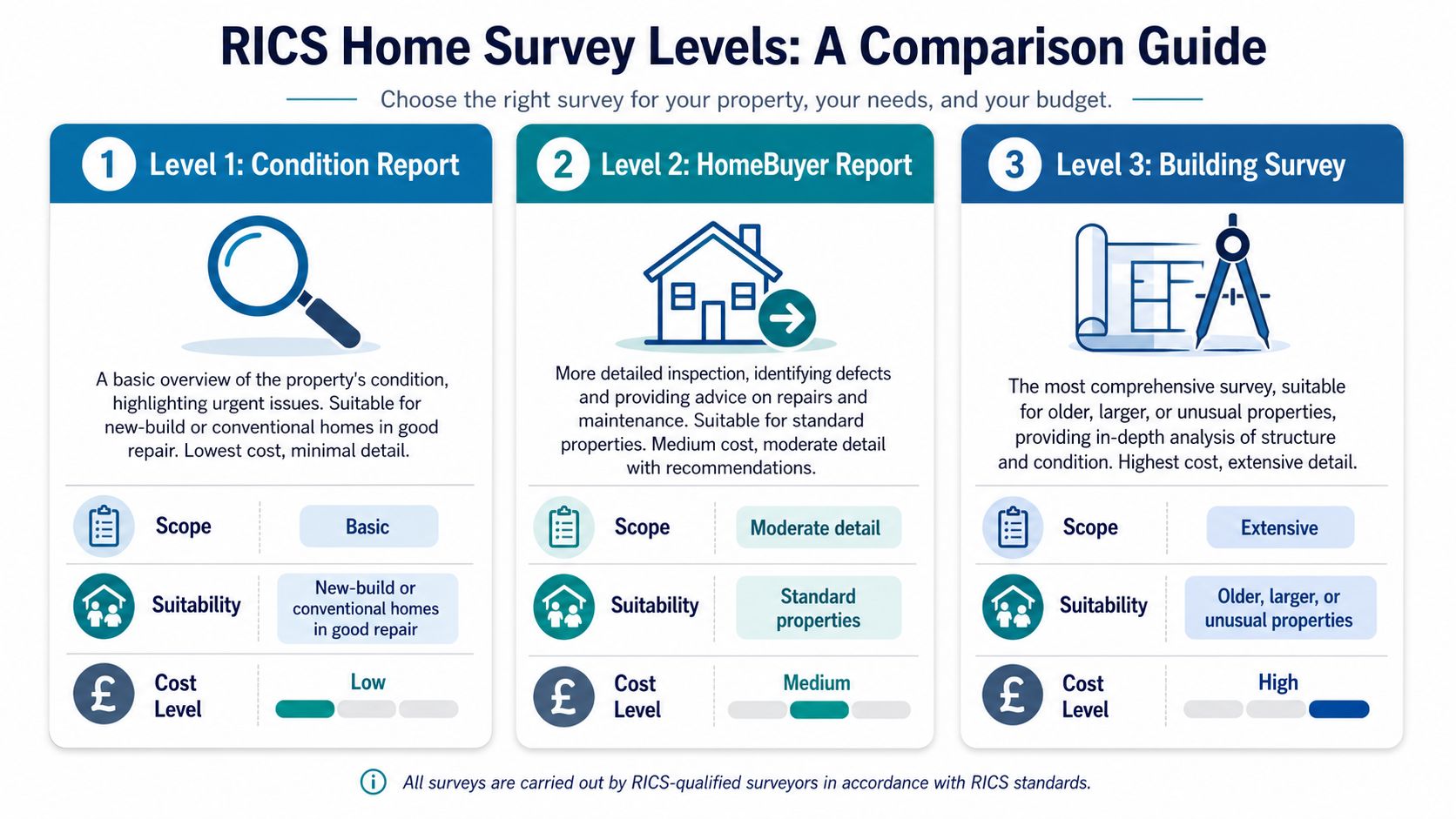
A formal RICS survey is not just a longer version of an informal inspection. It is a defined reporting service with a set scope, a written outcome, and professional accountability behind it. That distinction matters when you are deciding how much scrutiny the property deserves.
A RICS Level 1 report suits a modern, conventional property with no obvious signs of defect, no meaningful alterations, and no unusual construction. It gives you a clear snapshot of condition using the standard traffic-light format, but it does not go far into diagnosis, repair strategy, or concealed risk.
For many buyers, Level 1 is too light. If the property is older, extended, poorly maintained, or raises questions on viewing, do not try to save money here.
A RICS Level 2 survey is the right choice for many standard houses and flats built with conventional materials and appearing in reasonable condition. It gives more useful detail on defects, maintenance issues, and areas that need attention soon. For a buyer trying to judge whether the asking price reflects the true condition of the property, that extra detail is often where the fee earns its keep.
If you are weighing up whether the property crosses the line into higher risk, use this guide to compare Level 2 and Level 3 surveys.
Level 2 is still not a catch-all. It is not the right instruction for a tired Victorian house, a heavily altered bungalow, a listed building, or a property where movement, damp, timber decay or poor-quality extensions are already on your radar.
A RICS Level 3 survey is for buildings where the cost of being wrong is high. Older homes, unusual construction, substantial alterations, neglected properties, and anything with visible warning signs belong in this category.
Choose Level 3 if you have seen cracking, sloping floors, roof distortion, staining, bulging walls, patch repairs, outdated services, or signs that previous work was done cheaply. A lighter report can confirm that defects exist. Level 3 is far better at explaining what they may mean, where the serious risks sit, and what further investigation is sensible before exchange.
This is also the sensible route where electrical safety is a concern, particularly in older stock or rented property histories. A good starting point is this UK landlord electrical safety guide, but the survey decision still comes back to the age, condition and complexity of the building itself.
| Feature | RICS Level 1 (Condition Report) | RICS Level 2 (HomeBuyer Report) | RICS Level 3 (Building Survey) |
|---|---|---|---|
| Best for | Newer, conventional homes in apparent good order | Standard properties with no obvious major complexity | Older, altered, larger or unusual properties |
| Depth | Basic overview | Moderate detail with advice on defects and maintenance | Most detailed analysis of structure and condition |
| Repair guidance | Limited | Practical guidance | Broad, detailed commentary |
| Risk coverage | Low | Medium | High |
| Typical buyer | Buyer purchasing straightforward stock with low apparent risk | Buyer wanting balanced cost and useful condition advice | Buyer managing significant structural and financial exposure |
If the property is old, altered, neglected or suspicious, instruct the deeper survey. Buyers rarely regret knowing too much before exchange. They regularly regret knowing too little.
The value of a pre purchase inspection appears when the report turns vague worry into specific risk. “It feels a bit uneven” becomes measured floor deviation. “That patch looks old” becomes active damp evidence. “Those cracks are probably nothing” becomes a structural question with major cost attached.
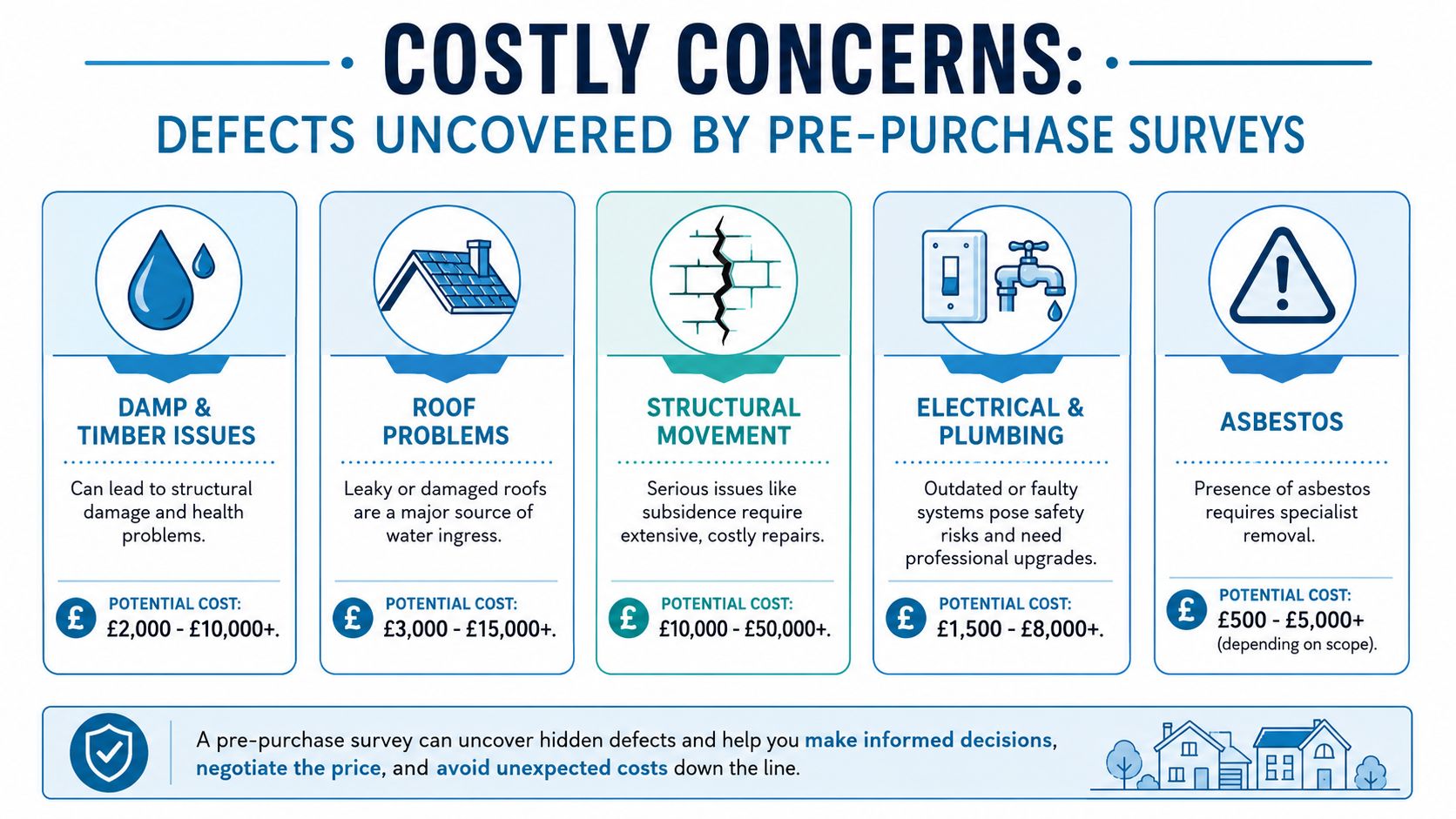
Subsidence is the defect buyers fear, and rightly so. A RICS Level 3 survey can diagnose structural concerns such as subsidence by identifying diagonal cracking over 5mm and uneven floors, as set out in RPSA survey inspection and reporting standards.
The same standards note that remedial cost estimates for foundation reinforcement average £25,000–£45,000, and failing to identify such defects early can reduce a buyer's negotiating power by 30–40%. That is exactly why a formal survey pays for itself when movement is present.
A buyer who spots this before exchange can renegotiate, seek specialist reports, or walk away. A buyer who spots it after completion owns the problem.
Not all damp is equal. Some staining is historic. Some damp is active and destructive. A proper inspection distinguishes between them.
The RPSA standards linked above also refer to moisture content in plaster above 15% as indicating active rising damp, and to thermal imaging that locates heat loss zones more than 3°C below ambient. Where insulation failure is identified in older homes, the same source associates retrofit costs in pre-1990 homes with £8,000–£12,000.
That's not cosmetic inconvenience. That's expenditure, disruption and advantage lost if you buy blindly.
For a practical companion on electrical risk in residential property, landlords and buyers alike may find this UK landlord electrical safety guide useful when reviewing older installations and compliance responsibilities.
A short explainer on what surveyors look for can help here:
Electrical defects are often underappreciated because they're not always visible at a viewing. Outdated consumer units, poor alterations, overloaded circuits and amateur additions can sit behind neat finishes.
A surveyor will flag visible risk indicators and recommend specialist testing where appropriate. That recommendation matters. Buyers shouldn't dismiss it because “the lights came on during the viewing”. Functional is not the same as safe.
You agree a price, pay for searches, line up your mortgage, and start picturing the move. Then the survey lands and exposes roof failure, damp spread, unsafe electrics, or movement you were never told about. That is the point of the process. A formal RICS survey is there to stop you buying blind and inheriting someone else's costs.

Start with three checks. Qualifications, scope, and insurance.
You need a surveyor who is properly accredited for the report level you are buying and who carries Professional Indemnity insurance. That is the dividing line between a formal, insurable opinion and an informal once-over. If the advice is not tied to a recognised standard and backed by insurance, your protection is weaker and your recourse is limited if serious defects are missed.
Match the surveyor to the property as well. A Victorian terrace, a timber-frame flat, and a rural cottage with altered extensions carry different risks and need different judgement. Survey Merchant is one route buyers use to find a suitable surveyor from a nationwide panel for residential and commercial instructions. However you appoint them, confirm the exact report type and check what is and isn't included.
For a broader overview of the buyer journey, this step-by-step UK property survey guide is worth keeping to hand.
The surveyor attends the property, inspects accessible areas, and records visible defects, risks, and limitations. They do not move heavy furniture, open up sealed construction, or carry out destructive testing unless that has been separately agreed.
A proper survey is disciplined. It covers the building in a way that can support lending, decision-making, negotiation, and risk management. An informal inspection may give you impressions. A formal survey gives you a documented opinion with clear observations, limits, and recommendations.
Typical areas reviewed include:
If drainage concerns arise, get specialist follow-up rather than guessing. In that context, even though it's from a different market, this explanation of a Los Angeles sewer line inspection is a useful example of how specialist drainage investigations complement a building survey rather than replace one.
Ask before booking whether the surveyor offers a post-report call. That conversation often saves buyers from misreading a serious issue as routine wear, or dismissing an expensive problem because it sounds technical.
Do not skim the traffic lights or summary page and call it done. Read the report in stages.
First, pick out anything affecting safety, structural stability, or urgent repair liability. Second, mark defects likely to affect value or require spending soon after completion. Third, separate routine upkeep from items that need specialist investigation before you commit further money to the purchase.
Good reports do more than list defects. They help you decide whether to proceed, renegotiate, commission further reports, or walk away before exchange. That impartiality is where the money is saved.
A survey report is only valuable if you use it properly. Too many buyers read unpleasant findings, feel discouraged, then proceed on the original price anyway. That defeats the point.
The report is an advantage. Use it.

Negotiate when the report identifies defects that are significant, foreseeable and cost-bearing. Structural concerns, active damp, defective roofs, unsafe electrics, poor alterations and major maintenance backlogs all fall into that category.
Your approach should be disciplined:
If you need a framework for that conversation, these tips for adjusting property offers will help you structure it properly.
Some reports justify withdrawal. That's not failure. It's sound risk management.
Walk away when one or more of these apply:
The cheapest property to leave is the one you haven't completed on.
Buyers often become emotionally attached and start rationalising defects. Don't. Once the facts change, the decision should change with them. A survey gives you permission to be commercial.
Yes. New doesn't mean defect-free. For new-build UK properties, pre-completion inspections are important because inspectors check compliance with standards including BS 7671 for electrical safety, and guidance on pre-completion inspections states that failure rates in 15% of new builds correlate to average rectification costs of £1,200–£2,800. I would not accept “it's covered by warranty” as a reason to skip independent scrutiny.
In some cases, yes. A pre-sale survey can expose defects early, stop renegotiation shocks later, and help a seller decide whether to repair, disclose or price realistically from the outset. It's especially sensible for older, altered or visibly tired properties.
The principles are the same, but the risk profile differs. With flats, the surveyor pays close attention to leasehold implications, common parts where visible, signs of movement or water ingress affecting the block, and anything suggesting wider building issues that may result in service charge exposure. With houses, the focus tends to widen across roofs, grounds, drainage clues and the full external envelope.
That limitation matters. If lofts are inaccessible, floors are covered, cupboards are blocked, or parts of the structure can't be seen, the report should say so clearly. You then decide whether to accept that uncertainty, request access for reinspection, or commission targeted specialist checks. Buyers get into trouble when they treat “not inspected” as “all fine”.
If you're buying, selling or managing property and need a formal survey rather than an informal opinion, Survey Merchant can help you find a suitably qualified surveyor for the instruction. Use the report for what it's meant to do. Reduce risk, protect your position and make the decision with evidence rather than hope.
Survey Merchant provides vetted RICS surveyors across 100+ UK locations at fixed fees:
→ Level 2 Home Survey (HomeBuyer Report)
→ Level 3 Building Survey (full structural survey)
→ RICS Red Book property valuations
→ Party wall surveyors — notices, awards & schedules of condition
→ Expert witness surveyors — CPR Part 35 reports for property disputes