We use cookies to improve your experience on our site, analyze site traffic, and assist in our marketing efforts. By clicking "Accept all," you agree to the storing of cookies on your device. You can choose to "Reject all" non-essential cookies. For more information, please read our Cookie Policy.
Chancel Repair Liability 2026: UK Buyer's Guide & Costs
Chancel repair liability can make a homeowner pay for church repairs. This 2026 guide covers how it arises, the 13 October 2013 rule, searches, indemnity insurance costs and Law Commission reform.
Chancel repair liability is one of the strangest things that can turn up when you buy a home in England or Wales. It is a centuries-old obligation that can make the owner of an ordinary house, farm or plot of land legally responsible for paying to repair part of the local parish church. Most buyers never hear of it until their conveyancer asks whether they want a “chancel search” or a “chancel indemnity policy”. This 2026 guide explains what chancel repair liability is, how it arises, how to find out whether a property is affected, what the searches and insurance cost, and what the Law Commission’s current reform project means for buyers, sellers and landowners.
Key takeaways
Chancel repair liability is an ancient obligation on certain landowners (“lay rectors”) to pay for repairs to the chancel, the eastern part of a parish church containing the altar. It is enforced under the Chancel Repairs Act 1932.
Since 13 October 2013 it has no longer been an “overriding interest”: a buyer of registered land who pays for the property is generally only bound if a notice of the liability appears on the Land Registry title.
Uncertainty remains, because HM Land Registry still accepts applications to register notices and unregistered land is treated differently, so most conveyancers still run a chancel search and/or buy a one-off indemnity policy, typically costing around £20 to £50.
The landmark Aston Cantlow v Wallbank case left one couple facing nearly £187,000 of repairs plus around £250,000 in legal costs.
The Law Commission consulted on reform between July and November 2025 and is expected to publish its final recommendations during 2026, which would confirm that only liabilities noted on the title bind buyers.
A chancel search is a legal check, not a building inspection. Pair it with a Level 2 or Level 3 survey from a suitably qualified, accredited surveyor to understand the property itself.
What is chancel repair liability?
Chancel repair liability is a legal obligation on the owners of certain land in England and Wales to pay for repairs to the chancel of the local Church of England parish church. It dates from medieval times, survived the dissolution of the monasteries, and can still be enforced today against “lay rectors” under the Chancel Repairs Act 1932.
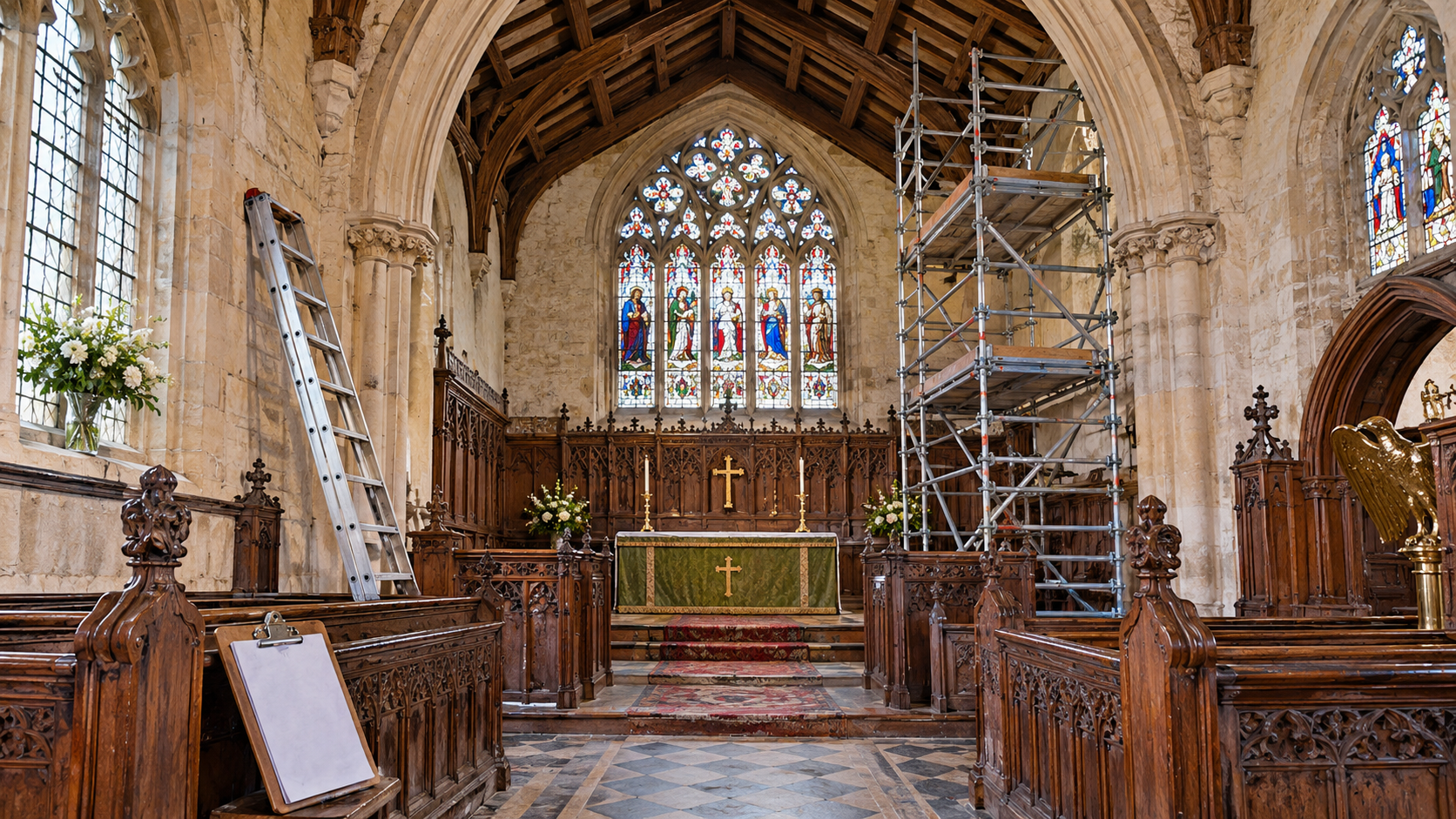
The chancel is the part of the church nearest the altar, historically the rector’s responsibility while parishioners looked after the nave. When Henry VIII dissolved the monasteries in the 1530s, church-owned rectories and their “glebe” land were sold to private owners. The duty to maintain the chancel passed with that land, and it has followed every subdivision and sale since. Owners of land that was once rectorial or glebe property are known as lay rectors or lay impropriators, and under the law they can be asked to fund chancel repairs even though they may own nothing more than a modern house on a former field.
Chancel repair liability typically attaches to land that once formed part of a rectory or glebe, often close to a historic parish church.
Where does the liability come from?
Three strands of law combine to create the position today:
Ecclesiastical law. For centuries, church courts could order a rector to repair the chancel. Where the rector was a lay owner of former church land, the obligation sat with them.
The Chancel Repairs Act 1932. This Act moved enforcement from the church courts to the county court. Section 2 lets the “responsible authority” (normally the Parochial Church Council, or PCC) serve a notice to repair on anyone who appears to be liable. If the chancel is still not in proper repair one month later, the PCC can sue for the cost of the works. You can read the Act in full on legislation.gov.uk.
The Land Registration Act 2002. Section 117 and Schedules 1 and 3 of the Land Registration Act 2002 gave chancel repair liability a ten-year run as an “overriding interest” (one that binds a buyer even though it is not on the register). That period ended at midnight on 12 October 2013.
One feature that alarms buyers is that liability has historically been treated as joint and several. Where former rectorial land has been split among many owners, a PCC has, in principle, been able to pursue any one of them for the whole cost, leaving that owner to seek contributions from the others. That is precisely why a small, cheap insurance policy became standard practice in conveyancing.
The Wallbank case: why everyone took notice
For most of the twentieth century chancel repair liability was a legal curiosity. That changed with Aston Cantlow and Wilmcote with Billesley Parochial Church Council v Wallbank. Andrew and Gail Wallbank had inherited Glebe Farm in Aston Cantlow, Warwickshire. The PCC served a notice to repair the medieval chancel of St John the Baptist church, and after a long legal battle the House of Lords ruled in the PCC’s favour in June 2003.
According to the Law Commission, the Wallbanks were pursued for nearly £187,000 in chancel repairs, on top of around £250,000 in legal costs. The couple eventually had to sell the farm. The House of Lords also held that a PCC is not a “core public authority” under the Human Rights Act 1998, so the liability could not be struck down as a breach of the owners’ human rights.
Overnight, conveyancers across the country began routinely advising buyers to search for, or insure against, chancel repair liability, and the Charity Commission guidance that PCC trustees should consider enforcing valuable rights added to the pressure.
What changed on 13 October 2013?
Parliament’s answer was the Land Registration Act 2002. For ten years after the Act came into force, chancel repair liability remained an overriding interest. PCCs were given until 12 October 2013 to protect their rights by registering a notice against affected registered titles (or a caution against first registration for unregistered land).
From 13 October 2013 the position, as intended, is this:
If a notice was registered, the liability stays on the title and binds every future owner.
If no notice was registered, the liability does not disappear, but a buyer who acquires registered land for value after that date takes the land free of it.
Anyone who receives land as a gift or inheritance, rather than buying it, remains bound even if nothing is registered.
In practice, relatively few PCCs registered before the deadline. The Church of England had encouraged parishes to investigate, but many councils decided that pursuing their neighbours for church repairs was unpalatable, or simply could not prove which plots carried the liability.
Why conveyancers still worry
If the 2013 change had worked perfectly, chancel searches and insurance would have faded away. They have not, for three reasons set out in HM Land Registry’s own Practice Guide 66:
HM Land Registry will still accept applications to register a notice of chancel repair liability after 13 October 2013, and it does not check whether the property has changed hands for value in the meantime.
The courts have not yet decided whether the register can later be altered to add a notice where an owner has already taken free of the liability, or whether any indemnity would be payable if that happened.
The 2013 rule only applies to registered land. If you are buying unregistered land (a significant minority of land in England and Wales is still unregistered) the liability can bind you whether or not you could have discovered it.
The result is a legal grey area. Most conveyancers, and many mortgage lenders, therefore take the cautious route: a quick screening search, a one-off indemnity policy, or both.
How do I check if a property has chancel repair liability?
There are three layers of checking, usually handled by your conveyancer as part of the wider property search process:
1. Read the Land Registry title
Your conveyancer will inspect the Charges Register of the official copy of the title. If a PCC registered its interest, you will see an entry referring to liability for the repair of the chancel of a named church. A registered notice does not prove the liability exists, only that someone has claimed it, but it means the liability will bind you if it is valid.
2. Order a chancel screening search
A chancel repair search (often branded ChancelCheck or similar) compares the property’s location against historic parish and tithe records to say whether it lies within a parish where a potential liability exists. It is quick (often same-day) and inexpensive, usually £20 to £40. A “clear” result lets you proceed without insurance; a “potential liability” result tells you the property sits within an affected parish, not that your particular plot is liable.
3. Commission a full liability report
For high-value rural property, or where a screening search flags a risk, a specialist can trace the records held at The National Archives and the diocesan registry to establish whether your specific land was ever rectorial. This is slower and costs more, and the result can be inconclusive.
The Charges Register of the title, a screening search and, where needed, a full records search are the three ways to check for chancel repair liability.
An important tactical point: most “no search” indemnity policies are void if the buyer already knew about a liability. Many conveyancers therefore advise buying the policy instead of ordering a search, rather than searching first and then finding the property is uninsurable. Discuss the order of steps with your solicitor before anyone orders anything.
Chancel repair search and insurance costs in 2026
The figures below reflect the ranges quoted by conveyancing search providers and insurers in 2025 and 2026, and the Law Commission’s own estimate that buyers typically pay an extra £30 to £40 per transaction for chancel checks and cover. Exact premiums depend on the property value, the cover limit and whether a liability is already known.
Item
Typical cost (2026)
What it does
Official copy of title register
£7 per document
Shows whether a chancel notice is registered against the property
Chancel screening search
£20 – £40
Confirms whether the property lies in a parish with a potential liability; results often within hours
“No search” chancel indemnity policy
£15 – £50 one-off premium
Covers the owner (and usually successors and lenders) against a future claim; void if liability was already known
“Known liability” indemnity policy
£40 upwards, often several hundred pounds
Cover where a search or notice has revealed a liability; priced on risk
Full historical liability report
£100s, depending on scope
Traces tithe and glebe records to confirm whether a specific plot is liable
Potential repair bill if liable
£5,000 to £500,000+
Depends on the condition of the chancel; the Wallbank repairs alone were nearly £187,000
Most policies are single-premium and last for the life of the ownership, with cover limits commonly between £500,000 and £1 million, and they usually pass to future owners and mortgage lenders automatically. Check the schedule: some older policies cover only the named buyer.
Who is most at risk?
Although around 15,000 ecclesiastical parishes exist in England and Wales, the liability can only arise in parishes with a pre-Reformation church, and only on land that was once part of the rectory or glebe. Risk indicators include:
Rural or village locations close to a medieval or listed parish church.
Property names such as Glebe Farm, Glebe House, The Old Rectory, Church Farm or Tithe Barn.
Land shown on nineteenth-century tithe maps as rectorial or belonging to the lay impropriator.
Older properties on unregistered land, where the 2013 protection does not apply.
Flats on modern estates and houses in towns that were built up long after the land ceased to be glebe are unlikely to be affected, although screening searches still flag some urban parishes. In Wales, the Welsh Church Act 1914 and subsequent disestablishment appear to have extinguished most liabilities, a point the Law Commission is examining as part of its current project.
What happens if the PCC makes a claim?
If a PCC believes you are a lay rector it will serve a notice to repair under section 2 of the Chancel Repairs Act 1932, setting out the grounds of liability and the extent of the disrepair. If the chancel is not put in proper repair within one month, proceedings can be issued in the county court for the cost of the works. Court rules allow the PCC to be ordered to give security for costs, and any money awarded for works not yet carried out can be paid into court and used only on the chancel.
Repairs to the chancel of a medieval church, including roof timbers, stonework and glazing, can easily run to six figures.
In reality reported claims are rare, and many PCCs chose not to pursue registration at all. But the liability is not capped, there is no requirement for the repairs to be proportionate to the value of your land, and it is joint and several between lay rectors, so the downside for the unlucky few is severe. That asymmetry, a tiny premium against a potentially ruinous bill, is why insurance remains the default.
Chancel repair liability in 2026: the Law Commission reforms
The most important recent development is the Law Commission’s project Chancel repair liability and registration. On 15 July 2025 it published a consultation paper describing the liability as “ancient, unusual, obscure and onerous” and noting that the individual costs of searches and insurance “cumulatively add millions of pounds to property transactions” across England and Wales each year. The consultation closed on 15 November 2025 and, as of October 2026, the Commission says it is analysing responses, with a final report and recommendations expected during 2026.
The provisional proposals would:
Amend the Land Registration Act 2002 to confirm expressly that chancel repair liability can be protected by a notice on the register.
Confirm that a buyer of registered land is bound only if such a notice appears on the title at the time of purchase.
Allow PCCs to lodge a caution against first registration for unregistered land, so that any liability not recorded when the land is first registered ceases to bind the new registered estate.
Apply the changes retrospectively to sales and first registrations since 13 October 2013.
Examine the position in Wales, where the Welsh Church Act 1914 appears to have greatly reduced the scope of the liability.
Sir Peter Fraser, Chair of the Law Commission, said the proposals “aim to deliver the certainty that was intended when the land registration rules changed in 2013”. Note that the Commission is not proposing abolition: the liability would continue for registered notices and for owners who did not buy for value. Reform will also require Parliament to legislate, so buyers should expect searches and insurance to remain standard practice through 2026 and probably beyond. If you are buying now, the safe assumption is that the current rules apply.
Practical advice for buyers, sellers and landowners
If you are buying
Ask your conveyancer early whether they recommend a search, a policy or both, and in what order. Follow their advice on sequencing so you do not inadvertently invalidate cover.
Check the seller’s replies on the TA6 Property Information Form: sellers must disclose any notices or claims they know about.
If a notice is registered, ask the seller to provide an existing policy or to pay for known-liability cover, and reflect the risk in your offer.
Do not confuse a chancel search with a survey. It tells you nothing about the roof, damp or structure of the house you are buying. Read our guide to house survey costs in 2026 to choose the right level of inspection.
If you are selling
Disclose any registered notice or past correspondence from the PCC honestly on the TA6.
If you already hold an indemnity policy, dig it out: a transferable policy is a selling point and can keep the sale on track.
Expect the buyer’s solicitor to raise the point even if your own purchase was trouble-free; it is routine, not a sign of a problem.
If you own affected land
A notice registered against your title can be challenged. A unilateral notice can be cancelled unless the PCC proves the liability; take legal advice before accepting it.
Keep an eye on the Law Commission’s final report, which may change the position for anyone who bought for value after October 2013.
Chancel liability often sits alongside other historic burdens such as restrictive covenants and rights of way. A specialist title review, combined with title indemnity insurance where appropriate, can deal with all of them together.
How chancel liability fits into your wider due diligence
Chancel repair liability is a legal risk rather than a physical defect, so it belongs with your conveyancer’s searches rather than your surveyor’s inspection. The two strands work together. A suitably qualified, accredited surveyor, whether regulated by RICS, CIOB, RPSA or another recognised UK body, will tell you about the condition of the building, the likely cost of repairs and anything that affects value. Your conveyancer will tell you about the title, the searches and any historic obligations. Older rural properties near a medieval church are exactly the kind of homes where both deserve particular care: a period house may carry a chancel risk on paper and lime mortar, timber and roof issues in practice.
If you are at the start of the process, our 2026 home buying timeline shows where searches, surveys and insurance fit between offer and completion.
Why choose Survey Merchant for your pre-purchase survey?
A chancel search protects you from a church’s repair bill; a proper survey protects you from the property’s. Survey Merchant helps buyers across England and Wales get the right inspection at the right price:
Accredited panel matched to the job. Our panel includes suitably qualified surveyors accredited or regulated by RICS, CIOB and RPSA among others, so a period farmhouse, a listed cottage or a modern flat each goes to a surveyor with the right experience.
Nationwide UK coverage with local knowledge. We work with surveyors who know the construction types, soils and planning context of their own area, including the rural parishes where chancel risk is most common.
Transparent, competitive fixed fees. You get a clear quote for a Level 2 or Level 3 survey before you commit, with no surprises.
Fast turnaround. Quick booking and prompt reporting so your purchase does not stall while searches and insurance are being arranged.
Impartial, end-to-end support. We have no stake in the sale. If the report raises questions, we help you understand them and, where appropriate, use them to renegotiate.
This article is general information, not legal advice. Chancel repair liability is a matter of title and ecclesiastical law; always take advice from a qualified conveyancing solicitor on the specific property you are buying or selling.
Related guides
No items found.
Book a RICS surveyor
Survey Merchant provides vetted RICS surveyors across 100+ UK locations at fixed fees:
Chancel repair liability is an ancient legal obligation on the owners of certain land in England and Wales, known as lay rectors, to pay for repairs to the chancel of the local parish church. It attaches to land that once belonged to a rectory or glebe and is enforced under the Chancel Repairs Act 1932.
Is chancel repair liability still an issue in 2026?
Yes, although it is less of a risk than before 2013. Since 13 October 2013 a buyer of registered land who pays for the property is generally only bound if a notice is on the title. Because HM Land Registry still accepts notices and unregistered land is treated differently, conveyancers still routinely recommend a search or indemnity insurance. The Law Commission consulted on reform in 2025 and is expected to publish recommendations during 2026.
How do I know if my house is liable for chancel repair?
Check the Charges Register of the Land Registry title for a notice referring to chancel repair, order a chancel screening search that checks whether the property lies in an affected parish, and, if needed, commission a full historical liability report. Your conveyancer normally handles all three.
How much does chancel repair insurance cost?
A standard no-search chancel indemnity policy usually costs a one-off premium of around £15 to £50, with cover limits commonly between £500,000 and £1 million. Where a liability is already known, a known-liability policy starts at around £40 and can run to several hundred pounds depending on the risk.
Do I need a chancel search if I buy indemnity insurance?
Usually not, and in many cases it is better not to. Most no-search policies are void if the buyer already knew about a liability, so ordering a search first can leave you unable to insure. Ask your conveyancer which route is right for your property before anything is ordered.
Is chancel repair insurance a one-off payment and does it transfer to new owners?
Most chancel indemnity policies are single-premium policies that last for as long as you own the property and typically extend to successors in title and mortgage lenders automatically. Older policies may cover only the named buyer, so check the policy schedule when buying or selling.