We use cookies to improve your experience on our site, analyze site traffic, and assist in our marketing efforts. By clicking "Accept all," you agree to the storing of cookies on your device. You can choose to "Reject all" non-essential cookies. For more information, please read our Cookie Policy.
Right to Light UK: 2026 Guide to the 20-Year Rule & Claims
The right to light is a private easement, not a planning matter. Learn how it is acquired after 20 years, how accredited surveyors test infringement, what the courts award, and when to commission a right to light assessment.
The right to light is one of the most misunderstood property rights in England and Wales. Homeowners assume it means a neighbour can never block their sunshine; developers assume it is a planning matter that disappears once permission is granted. Both are wrong. A right to light is a private legal easement, usually earned after 20 years of uninterrupted daylight through a defined window, and it can stop or reshape a building project long after the council has said yes. This 2026 guide explains how the right to light works, how a suitably qualified, accredited surveyor measures whether it has been infringed, what the courts awarded in the landmark 2025 Bankside judgment, and what to do if a neighbour’s extension is about to darken your home.
Key takeaways
A right to light is a legal easement protecting the daylight that reaches a specific window or aperture, not a general right to sunshine, a view or light over a garden.
Under section 3 of the Prescription Act 1832, light enjoyed by a building for 20 years without interruption becomes “absolute and indefeasible” unless it was enjoyed by written consent.
Planning permission does not override a right to light. Councils assess daylight using BRE guidance; the courts assess infringement using the Waldram method and the 50/50 rule.
In Cooper v Ludgate House (8 July 2025) the High Court refused to order alterations to a completed Bankside office block but awarded the two flat owners £850,000 in damages, and a March 2026 costs ruling then penalised unrealistic settlement positions on both sides.
A light obstruction notice under the Rights of Light Act 1959 lets a developer interrupt a neighbour’s 20-year clock without building anything; the Upper Tribunal certificate fee is £795 (GOV.UK, 2026).
If you suspect an infringement, act before construction starts: a right to light assessment typically costs a few hundred to around £1,500 for a domestic case, far less than a dispute after the walls go up.
What is a right to light?
A right to light is a legal easement that entitles the owner of a building to receive natural daylight through defined windows or other apertures across a neighbour’s land. It is acquired most often by 20 years of uninterrupted enjoyment under the Prescription Act 1832, and it can be enforced through the civil courts by an injunction or damages, regardless of planning permission.
Three points flow from that definition. First, the right attaches to apertures in buildings: windows, rooflights and glazed doors. Open land, gardens, solar panels and greenhouses that have no window to a defined room do not benefit. Second, the right is to sufficient light for the ordinary use of the room, not to all the light the room has historically enjoyed. The House of Lords settled that test in Colls v Home & Colonial Stores (1904), and it remains the starting point today. Third, the right is a private property right that runs with the land, so it binds future owners of the burdened plot and benefits future owners of the lit building. If you are buying a home, our guide to easements in property surveys explains how these rights show up (or fail to show up) in the conveyancing process.
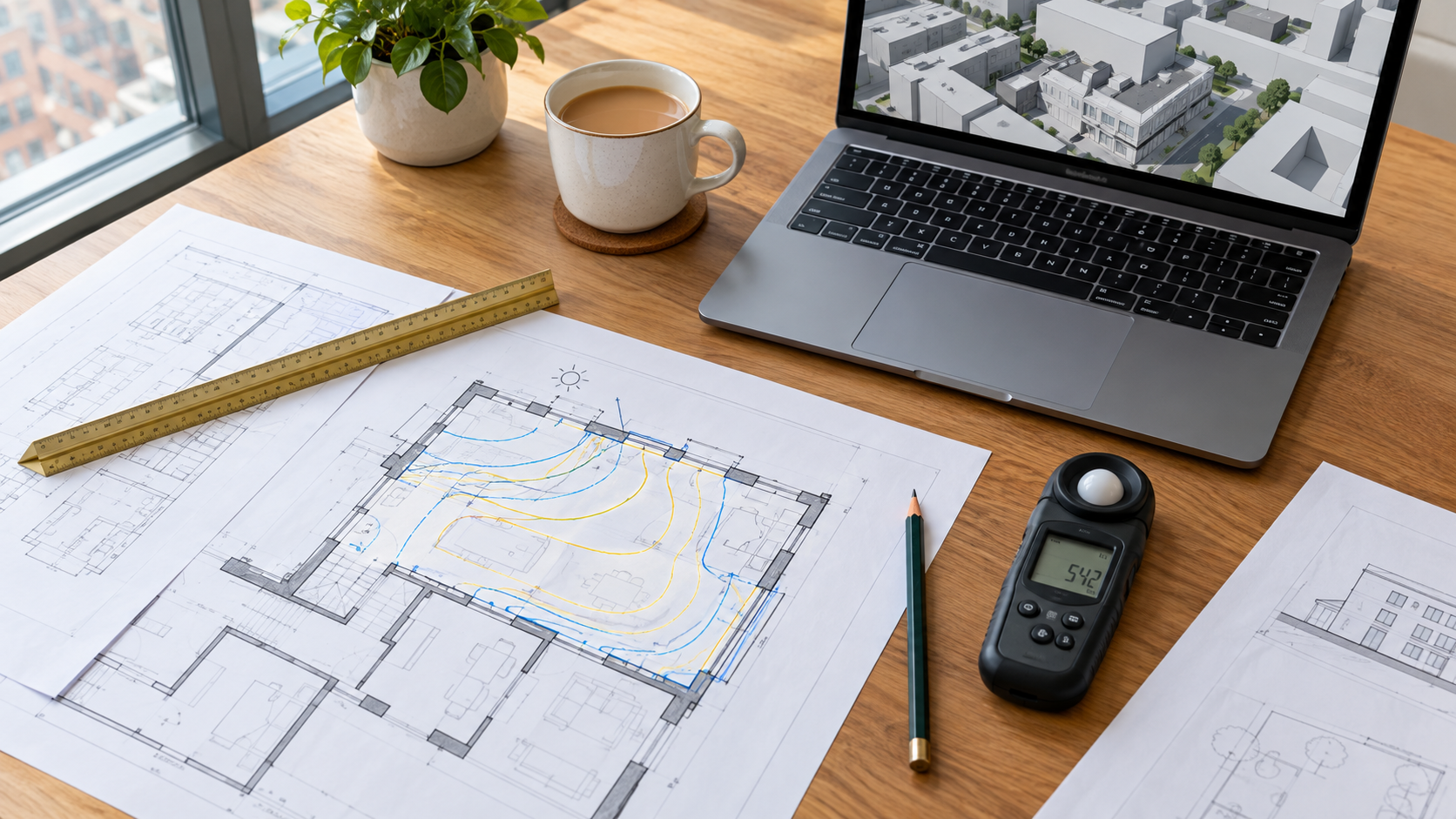
A right to light protects the daylight reaching a specific window, measured at a working plane roughly 850mm above the floor.
How is a right to light acquired? The 20-year rule explained
There are three routes to a right to light, but one dominates in practice.
Prescription Act 1832, section 3
The statute provides that where light has been “actually enjoyed” by a dwelling house, workshop or other building for 20 years without interruption, the right becomes absolute and indefeasible, unless the light was enjoyed under a written deed or agreement. Unlike other easements, there is no need to show that the use was “as of right”; the mere passage of 20 years is enough. An “interruption” only counts if it has been submitted to or acquiesced in for a full year, which is why a temporary scaffold or a hoarding does not reset the clock. The full wording is on legislation.gov.uk.
Lost modern grant and express grant
Where the 1832 Act cannot be relied on (for example, because the 20 years ended more than a year before the claim), the common-law doctrine of lost modern grant can still establish the right from any 20-year period of enjoyment. Rights can also be granted expressly in a deed, and, equally importantly, they can be excluded by a clause in a transfer or lease stating that no right to light is conferred. Many modern estate transfers contain exactly that clause, which is why a surveyor will ask to see your title documents before advising.
The special rule for leaseholders and the Crown
Rights acquired by prescription benefit the freehold, so a long leaseholder in a flat relies on the landlord’s right (the Bankside claimants were flat owners in exactly this position). Historically, prescriptive rights could not be acquired against Crown land at all; section 4 of the Rights of Light Act 1959 extended the 1832 Act to Crown land, subject to its own conditions. For a wider look at what your neighbour can and cannot do on adjoining land, see can a neighbour build on land I own?
Right to light vs planning permission: why the council’s approval is not the end
This is the point that catches out most homeowners and many small builders. When a local planning authority assesses a proposed extension, it considers daylight and sunlight as a matter of amenity, usually by reference to the Building Research Establishment’s guide Site Layout Planning for Daylight and Sunlight (BRE 209) and informal tools such as the 45-degree rule. Typical BRE planning yardsticks include a vertical sky component (VSC) of at least 27% at the centre of a window, or no more than a 20% reduction from the existing figure.
None of that is law. The RICS Property Journal puts it bluntly: BRE planning guidance is irrelevant to a legal claim, and artificial lighting cannot be counted. Planning permission is permission from the state to build; it does not extinguish a private right owned by your neighbour. The only exception is where a local authority or statutory body deliberately engages section 203 of the Housing and Planning Act 2016 to override easements on land it has appropriated for planning purposes, converting the neighbour’s remedy to compensation only. That power was pivotal at Bankside, as we explain below. If you are at the pre-application stage of your own project, our comparison of pre-application advice and full planning permission shows where daylight questions first arise.
Issue
Planning daylight (BRE 209)
Legal right to light
Who decides
Local planning authority
Civil courts (or negotiated settlement)
Legal basis
Policy and guidance; not binding
Prescription Act 1832, common law, Rights of Light Act 1959
Who is protected
Neighbours generally, as a matter of amenity
Only buildings whose windows have enjoyed light for 20+ years (or hold an express grant)
Measurement
VSC, no-sky line, APSH, average daylight factor
Waldram method: 0.2% sky factor and the 50/50 rule
Outcome
Permission granted, conditioned or refused
Injunction, damages in lieu, or release deed
Timing
Before approval
Any time, including after completion
How surveyors measure a right to light infringement
A right to light assessment is a specialist piece of building surveying work. In outline, a suitably qualified, accredited surveyor will:
Establish the apertures that qualify. Using title documents, historic mapping, aerial photography and site inspection, the surveyor identifies which windows have enjoyed light for 20 years and whether any deed excludes the right.
Model the existing and proposed obstructions. A 3D model of the surrounding buildings is built from measured survey data and the developer’s drawings, so the position of the sky visible from each room can be calculated before and after.
Apply the Waldram method. Developed by Percy Waldram in the 1920s and still the only method with full judicial approval, this plots the area of each room that receives at least 0.2% of the light from an unobstructed sky (roughly one lumen per square foot) at a working plane 850mm above floor level.
Apply the 50/50 rule. If at least half of the room remains adequately lit after the development, there is generally no actionable injury. Where the well-lit area falls below 50%, or where a room already below 50% loses a material further slice, the loss is likely to be actionable.
Quantify the loss. The surveyor reports the square footage of lit area lost in each room and often expresses it in “equivalent first zone” (EFZ) units, which valuers use to turn light loss into a compensation figure.
The courts treat the 50/50 rule as a rule of thumb rather than a rule of law. In Ough v King (1967) a fall from about 64% to 51% well-lit was still held actionable, and higher standards may apply to living rooms and kitchens than to a store cupboard. In Cooper v Ludgate House the developer argued for modern radiance-based and climate-based daylight modelling; the judge accepted that these are useful supporting evidence but confirmed Waldram as the primary test. For an overview of who is qualified to carry out this work, read how to verify a surveyor’s credentials in the UK.
A Waldram contour divides each room into the area that still receives 0.2% sky factor and the area that does not; the 50/50 rule is applied to the result.
Does my neighbour have a right to light over my extension?
Possibly, and the answer does not depend on how large or modest your extension is. Ask four questions:
Has the neighbouring window been there for 20 years? If their house (or a replacement window in the same position) has stood for two decades, assume a prescriptive right exists unless a deed says otherwise.
Does the window light a room, and will your building reduce the sky it sees? A single-storey rear extension beside a neighbour’s kitchen window on a terraced street is the classic risk scenario; a loft conversion that only adds bulk above the existing roofline is much lower risk.
How much well-lit area will the room keep? Only a Waldram assessment can answer this reliably, but as a rule of thumb, if your extension projects more than three metres alongside a neighbour’s ground-floor window, get it checked.
Is the right excluded by the title? New-build estates frequently exclude rights to light in the original transfers, which can defeat a claim entirely.
Remember that the right to light is separate from the Party Wall etc. Act 1996, which governs works to shared walls and excavations near a neighbour’s foundations. A party wall award gives you no protection against a right to light claim, and vice versa. If you are planning work on the boundary, our complete UK guide to party wall agreements and our explainer on how close a neighbour can build to your fence cover the other half of the picture.
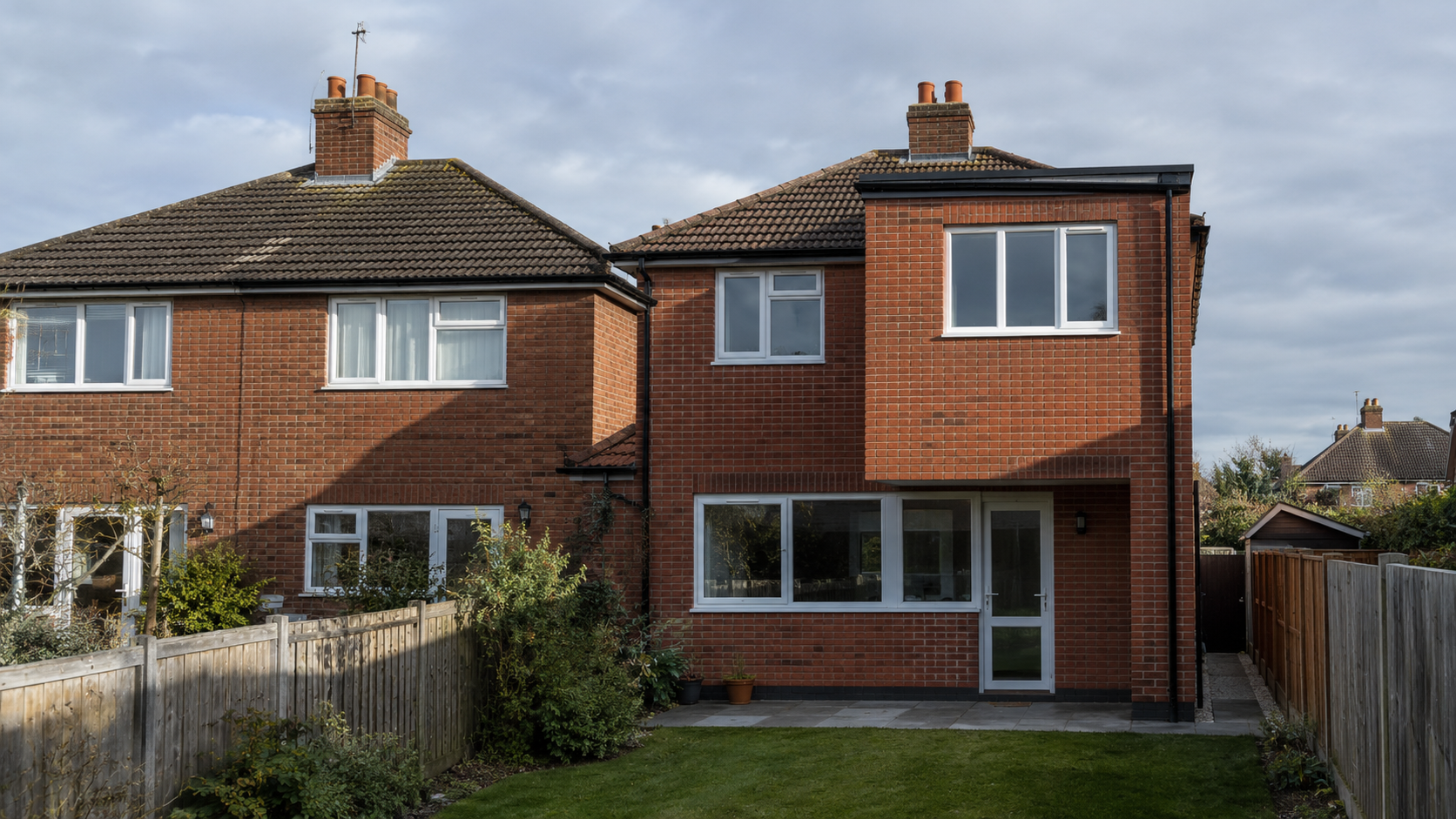
A two-storey rear extension beside a neighbour’s ground-floor window is the most common trigger for a domestic right to light dispute.
Light obstruction notices: the Rights of Light Act 1959
Before 1959, a landowner who wanted to stop a neighbour acquiring a right to light had to erect a physical screen for a year. The Rights of Light Act 1959 replaced that with a paper procedure: the light obstruction notice (LON). The landowner applies to the Upper Tribunal (Lands Chamber) for a certificate confirming that adequate publicity has been given to affected neighbours, then registers the notice as a local land charge with the council. Once registered, the notice is treated as if a wall of the stated dimensions had been built on the boundary, and it remains effective for a year. If no neighbour challenges it in that year, their 20-year clock is interrupted and must start again.
According to GOV.UK guidance updated in July 2026, the Tribunal fee for a standard definitive certificate is £795, a temporary certificate (available only where a neighbour is about to complete the 20 years) is valid for four months, and the Tribunal aims to issue the definitive certificate within five days of receiving evidence of service. Any neighbour who believes they already hold a right must object in the county court or High Court, not the Tribunal. For a developer, a LON is a cheap insurance policy; for a homeowner who receives one, it is a signal that the 20-year rule is about to work against you, and it is the moment to take advice.
Injunction or damages? What the courts decide
A right to light infringement is an actionable nuisance. The claimant’s primary remedy is an injunction, which can be prohibitory (stop building) or mandatory (cut back what has been built). Historically the Court of Appeal in Shelfer v City of London Electric Lighting (1895) set a narrow test for substituting damages, and in HKRUK II (CHC) Ltd v Heaney (2010) the High Court ordered a developer to remove two completed floors in Leeds. The Supreme Court loosened the approach in Coventry v Lawrence (2014), confirming that judges have a genuine discretion to award damages in lieu where an injunction would be disproportionate.
The 2025 Bankside judgment: Cooper v Ludgate House Ltd
The most significant right to light decision in a decade arrived on 8 July 2025 in Cooper v Ludgate House Ltd and Powell v Ludgate House Ltd [2025] EWHC 1724 (Ch). The owners of two flats overlooking the Bankside Yards scheme in Southwark established that a completed office tower (the only block in the scheme not protected by the council’s section 203 power) infringed their rights to light, and sought a mandatory injunction. The High Court refused it, citing the environmental waste of demolition, the likelihood that the block would be rebuilt with section 203 protection, the public benefits of the scheme and the developer’s genuine attempts to negotiate. Instead it awarded £350,000 to Mr Cooper and £500,000 to Mr and Mrs Powell, £850,000 in total, against claims of more than £6 million. The judge used a “negotiating damages” approach based on a 12.5% share of the developer’s profit attributable to the infringing light, rejected a pure diminution-in-value method as inadequate, capped the awards by reference to the flats’ values, and endorsed Waldram over the developer’s preferred radiance modelling.
In March 2026 the court handed down its costs decision. The claimants were treated as the successful party on liability, but because Mr Cooper had made a £7 million counter-offer and continued litigating after a £500,000 Part 36 offer in November 2024, he recovered only one-third of his costs; the Powells, who beat their offer, recovered two-thirds. The developer’s pre-action offers of £23,000 and £36,000 were described as far below the eventual awards. The lessons for 2026 are clear: injunctions against completed commercial buildings are now hard to obtain, but damages can be very substantial, and both sides are punished for unrealistic negotiating positions.
Case
Year
Remedy
Why it matters
Colls v Home & Colonial Stores
1904
No injunction
Right is to sufficient light for ordinary use, not all light previously enjoyed
Regan v Paul Properties
2006
Injunction
Court of Appeal confirmed injunction as the normal remedy for a home
HKRUK II (CHC) Ltd v Heaney
2010
Mandatory injunction
Completed floors in Leeds ordered to be cut back
Coventry v Lawrence
2014
Guidance on damages
Supreme Court gave judges wider discretion to award damages instead
How much does a right to light survey cost in 2026?
Fees depend on the number of windows and rooms affected, the complexity of the surrounding buildings and whether the surveyor must produce court-ready evidence. Published guidance for 2026 puts a typical domestic assessment by a chartered surveyor at roughly £500 to £1,500. In our experience the work falls into three tiers:
Desktop screening (from a few hundred pounds): a review of plans, title and mapping to say whether a right is likely to exist and whether the proposal looks risky. Ideal before you submit a planning application or object to a neighbour’s.
Full Waldram assessment (typically £750 to £1,500 for a house): a measured survey, 3D model and room-by-room report with EFZ figures, suitable for negotiation or a release deed.
Expert witness report (several thousand pounds): a CPR Part 35-compliant report for litigation, including radiance or climate-based modelling where appropriate.
Compare that with the cost of a dispute. Our analysis of boundary dispute surveyor costs shows how quickly neighbour litigation runs into five figures, and Bankside shows what is at stake for larger schemes. Developers can also buy right to light indemnity insurance, which pays out if a neighbour makes a claim, but insurers usually require that neighbours have not yet been approached.
Trees, hedges, gardens and Scotland: common misconceptions
There is no right to light against a tree or hedge, because a right to light protects you only against buildings and other structures erected on neighbouring land. If an evergreen hedge over two metres high is blocking your light, the remedy is a high hedges complaint to the council under Part 8 of the Anti-social Behaviour Act 2003, not a right to light claim. For tree problems more generally, including removal costs, see our UK tree removal cost guide.
Gardens, patios and open land have no right to light, and nor do solar panels unless they sit behind a defined aperture to a room. Scotland has no equivalent to the Prescription Act 1832 regime, so the law described in this article applies to England and Wales only. Finally, a right to light is a right to daylight, not direct sunshine or a view; losing afternoon sun or an outlook over fields may be a planning amenity point, but it is not an easement.
Step-by-step: what to do if a neighbour’s plans threaten your light
Check the planning portal early. Most councils publish applications online; the consultation window is usually 21 days. Object on daylight grounds using BRE criteria, but remember an objection is not a legal claim.
Confirm your right. Gather title deeds, old photographs and sale particulars that prove the window has existed for 20 years. Check for any clause excluding rights to light.
Commission a right to light assessment. A Waldram report tells you whether the loss is actionable and roughly what it is worth, which transforms your negotiating position.
Write to the neighbour or developer before work starts. Courts expect claimants to raise the issue promptly; delay is one of the strongest reasons for refusing an injunction and awarding damages instead.
Negotiate a release deed or redesign. Many disputes end with a payment for a formal release of the right, or with a stepped-back or lower design that keeps the room above 50% well-lit.
Take legal advice if talks fail. A solicitor can seek an interim injunction; the surveyor’s report becomes the expert evidence.
The Law Commission’s December 2014 report Rights to Light (Law Com No 356) recommended a statutory notice procedure forcing neighbours to say within a fixed period whether they will seek an injunction, a statutory test for damages in lieu, and a power for the Lands Chamber to discharge obsolete rights. As of 2026 the Commission is still awaiting a government response, so the common-law position set out above continues to apply, and the Bankside decision is the best current guide to how judges will exercise their discretion.
Why choose Survey Merchant for your right to light assessment?
Right to light work sits at the intersection of measured survey, daylight modelling, valuation and neighbour negotiation, and it rewards a firm that can bring all four together. Survey Merchant is a UK-wide property and building surveying practice whose panel includes suitably qualified, accredited surveyors regulated or accredited by bodies such as RICS, CIOB and RPSA, matched to the specific job rather than assigned at random. Here is why homeowners, buyers and developers choose us for daylight and neighbourly matters:
The right specialist for the job. We match your instruction to a surveyor with genuine rights of light experience and the software to run Waldram contours and, where needed, radiance modelling.
Nationwide coverage with local knowledge. From London terraces to Manchester mills and Bristol semis, our surveyors understand how local housing stock and planning policy interact with the 20-year rule.
Transparent, competitive fixed fees. You receive a clear quote for a desktop screening, a full assessment or an expert witness report before any work begins, with no hourly surprises.
Fast turnaround. Planning consultation windows are short; we prioritise urgent daylight objections and pre-construction checks so you can act before the concrete is poured.
Impartial advice. Whether you are the developer or the neighbour, you get an honest view of whether a claim is likely to succeed and what it is realistically worth, informed by the latest case law, including Bankside.
End-to-end support. We work alongside your solicitor, prepare release-deed schedules and, if a dispute cannot be avoided, provide court-compliant expert evidence. Our party wall surveyors and building surveying teams can handle the adjoining-owner and condition issues that so often arise alongside daylight disputes.
If a neighbour’s extension is about to shadow your kitchen, or you want to de-risk your own project before you submit plans, speak to a suitably qualified, accredited surveyor first. Explore our building surveying services or contact Survey Merchant today for a fixed-fee right to light quote.
A right to light is a legal easement entitling a building owner to receive enough natural daylight through defined windows for the ordinary use of the rooms behind them. It is usually acquired after 20 years of uninterrupted enjoyment under the Prescription Act 1832 and is enforced in the civil courts, independently of planning permission.
Does my neighbour have a right to light over my extension?
If your neighbour's window has existed for 20 years or more and your extension will reduce the sky it sees, there is a real risk unless the right has been excluded in the title deeds. A Waldram assessment by a suitably qualified, accredited surveyor will show whether the room would keep at least half its area adequately lit, which is the usual threshold for an actionable loss.
Does planning permission override a right to light?
No. Planning permission is the council's consent to build and is assessed against BRE daylight guidance. A right to light is a private property right that survives planning approval, so a neighbour can still seek an injunction or damages after permission is granted, unless a local authority has used section 203 of the Housing and Planning Act 2016 to override easements on the site.
How much does a right to light survey cost in the UK?
Published 2026 guidance puts a typical domestic right to light assessment by a chartered surveyor at around £500 to £1,500. Desktop screening starts from a few hundred pounds, a full Waldram report for a house is typically £750 to £1,500, and court-compliant expert witness reports for larger schemes cost several thousand pounds.
Can I claim a right to light against a tree or hedge?
No. A right to light protects you only against buildings and structures erected on neighbouring land, not against trees or hedges. If an evergreen hedge over two metres high is blocking your light, the remedy is a high hedges complaint to your council under Part 8 of the Anti-social Behaviour Act 2003.
What did the 2025 Bankside right to light case decide?
In Cooper v Ludgate House Ltd [2025] EWHC 1724 (Ch), decided on 8 July 2025, the High Court refused a mandatory injunction against a completed Bankside office block but awarded the two affected flat owners £850,000 in damages, based on a 12.5% share of the developer's profit. The judgment endorsed the Waldram method and confirmed that damages, not demolition, are increasingly likely for completed commercial schemes.